
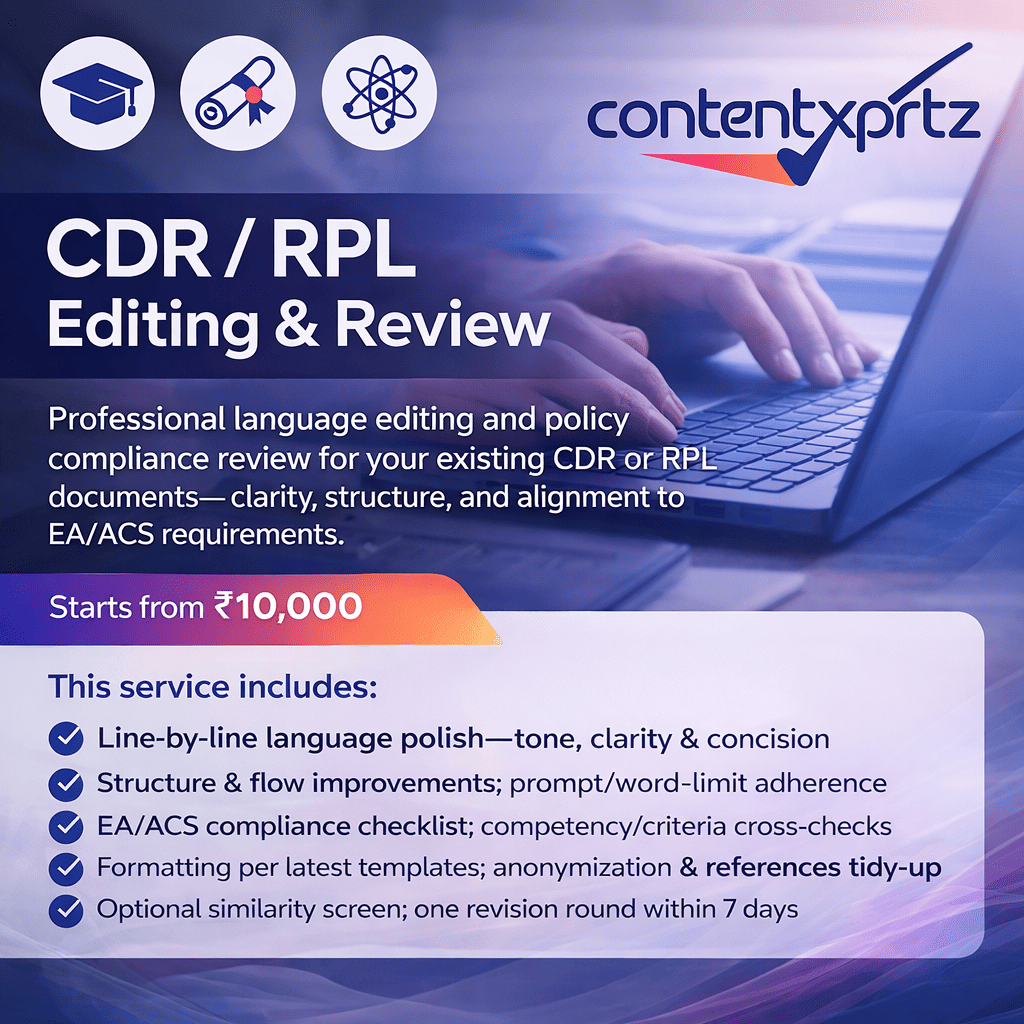
CDR / RPL Editing & Review — Get It Assessed Right the First Time 📄🎓
Already prepared your CDR or RPL but unsure about language quality, structure, or EA/ACS compliance?
ContentXprtz provides professional editing and review to ensure your documents are clear, well-structured, and aligned with official assessment requirements.
What this service offers:
• Line-by-line language refinement for clarity, tone, and concision
• Structural and flow improvements with strict word-limit adherence
• EA / ACS compliance checks with competency and criteria cross-verification
• Formatting as per latest templates, anonymization, and reference clean-up
• Optional similarity screening with one revision round within 7 days
We work ethically—your experience, your ownership.
No fabrication. No plagiarism. Just expert academic refinement you can trust.
Starts from ₹10,000
📘 Message us on WhatsApp to get started today
WhatsApp: https://wa.me/917065013200
Website: https://contentxprtz.com
#ContentXprtz #CDRPreparation #RPLAssessment #EngineersAustralia #ACSAssessment #AcademicEditing #ProfessionalEditing #PhDSupport #ResearchScholars #HigherEducation #AcademicWriting #EthicalWriting #PlagiarismFree #ResearchSupport #PublicationReady #StudyAbroadSupport #EngineeringMigration #ICTProfessionals #PhDLife #ResearchCareers #AcademicServices #GraduateEngineers #ScholarlyWriting
Beyond Compliance to Credibility: Why CDR/RPL Editing & Review Determines Your Academic and Professional Future
Introduction
For many students, PhD scholars, and internationally mobile professionals, academic excellence alone is no longer sufficient to secure global recognition. In an era defined by cross-border education, professional migration, and stringent assessment frameworks, documents such as Competency Demonstration Reports (CDR) and Recognition of Prior Learning (RPL) dossiers have become decisive gatekeepers. It is within this demanding context that CDR/RPL Editing & Review emerges not as a cosmetic service, but as a critical academic and professional safeguard.
Across disciplines, researchers and professionals face a common challenge: translating years of tacit knowledge, research rigor, and professional expertise into assessment-ready documentation that meets institutional and regulatory expectations. PhD scholars already operating under intense pressure to publish, teach, secure funding, and meet completion timelines often underestimate how cognitively demanding this translation process can be. At the same time, global data indicates that more than 40 percent of international academic and professional submissions are returned for revision due to structural non-compliance, language ambiguity, or misalignment with assessment criteria rather than a lack of competence itself. This gap between capability and communication is where high-quality CDR/RPL Editing & Review becomes indispensable.
The challenge is amplified by rising academic and professional costs. According to data from major academic publishers such as Elsevier and Springer, rejection or revision cycles increase not only psychological stress but also financial burden, delaying career progression and international mobility. Moreover, acceptance rates for formal assessments and peer-reviewed outputs remain increasingly competitive, often below 25 percent in high-demand evaluation frameworks. As a result, scholars and professionals are no longer asking whether they need expert academic support, but how to choose services that are ethical, credible, and aligned with international standards.
At ContentXprtz, established in 2010 and serving researchers across more than 110 countries, we understand that CDR/RPL Editing & Review is not about rewriting someone’s work. It is about safeguarding intellectual ownership while ensuring clarity, coherence, and compliance. Our global teams in India, Australia, Tokyo, Seoul, Beijing, Shanghai, London, and New Jersey work closely with scholars and professionals to bridge the gap between lived expertise and formal evaluation requirements.
This article provides a comprehensive, evidence-based exploration of CDR/RPL Editing & Review. It explains why these services are essential, how they differ from generic academic editing, and what best practices scholars and professionals should follow to protect both their credibility and outcomes. Throughout, the discussion reflects ContentXprtz’s commitment to ethical academic support, editorial integrity, and publication-ready excellence.
Understanding CDR and RPL in Academic and Professional Contexts
What Is a CDR and Why Does It Matter?
A Competency Demonstration Report is a structured technical and professional narrative used primarily for skills assessment by international accreditation bodies. While its format varies across disciplines, the underlying expectation remains consistent: applicants must demonstrate applied knowledge, ethical judgment, and professional competency using evidence-based narratives.
Unlike traditional academic writing, a CDR requires reflective articulation. It demands clarity, logical sequencing, and strict adherence to assessment rubrics. Even highly qualified PhD scholars often struggle with this shift from analytical exposition to competency-based storytelling.
What Is RPL and How Is It Assessed?
Recognition of Prior Learning enables individuals to convert experiential knowledge into formal academic or professional recognition. RPL submissions often combine reflective narratives, mapped competencies, and documentary evidence. However, assessment panels prioritize structure, coherence, and alignment with learning outcomes over volume or complexity.
Here, CDR/RPL Editing & Review ensures that experiential depth is not lost in poorly framed narratives or inconsistent language. Effective editing strengthens logic while preserving the author’s authentic professional voice.
Why Generic Editing Is Not Enough for CDR/RPL Submissions
Many scholars mistakenly assume that standard academic editing services suffice for CDR or RPL documentation. This assumption frequently leads to avoidable resubmissions.
Distinctive Requirements of CDR/RPL Editing & Review
-
Alignment with competency frameworks rather than theoretical argumentation
-
Narrative clarity without exaggeration or misrepresentation
-
Ethical compliance with assessment guidelines
-
Evidence mapping and consistency across sections
Generic proofreading focuses on surface-level grammar. In contrast, CDR/RPL Editing & Review requires conceptual scrutiny, domain awareness, and assessor-focused refinement.
At ContentXprtz, our academic editing services are specifically adapted to these nuanced requirements, ensuring that submissions meet both linguistic and evaluative benchmarks.
The Role of Editing Ethics in CDR/RPL Success
Ethical considerations are central to CDR/RPL Editing & Review. Leading academic publishers such as Taylor and Francis and Emerald Insight emphasize transparency and author ownership as non-negotiable principles in scholarly communication.
Unethical editing practices such as fabrication, ghostwriting, or competency inflation can permanently damage academic and professional credibility. Therefore, expert review focuses on clarity and compliance rather than content invention.
ContentXprtz adheres strictly to global academic ethics, ensuring that all revisions enhance expression while preserving intellectual authenticity. This ethical positioning not only protects clients but also aligns with international quality assurance expectations.
How ContentXprtz Approaches CDR/RPL Editing & Review
A Structured, Scholar-Centric Workflow
Our CDR/RPL Editing & Review process follows a rigorous yet transparent framework:
-
Initial diagnostic review against assessment criteria
-
Structural alignment and narrative flow enhancement
-
Language refinement for clarity and professional tone
-
Consistency checks across sections and evidence mapping
-
Final compliance review prior to submission
This process is supported by subject specialists with deep familiarity in academic and professional evaluation systems.
Clients seeking integrated support often combine this service with our broader PhD thesis help and research paper writing support, creating a seamless academic journey.
Explore our full scope of offerings under Writing and Publishing Services:
https://contentxprtz.com/writing-publishing-services
Practical Benefits of Professional CDR/RPL Editing & Review
Improved Acceptance Probability
Studies published by Springer indicate that clarity and structural coherence significantly influence evaluator judgments, even when technical competence is high.
Reduced Revision Cycles
Expert review minimizes resubmission requests, saving time, cost, and emotional strain.
Enhanced Professional Confidence
Well-edited documentation empowers scholars and professionals to present their expertise with confidence and precision.
Integrating CDR/RPL Support with Broader Academic Goals
Many PhD scholars pursue international recognition alongside research publication. Strategic alignment between CDR/RPL documentation and academic outputs strengthens professional narratives.
ContentXprtz supports this integration through comprehensive PhD and Academic Services:
https://contentxprtz.com/phd-academic-services
For early-stage scholars, tailored Student Writing Services offer foundational support:
https://contentxprtz.com/student-career-academic-writing-services
Frequently Asked Questions on CDR/RPL Editing & Review
How is CDR/RPL Editing & Review different from proofreading?
CDR/RPL Editing & Review extends beyond grammar correction. It involves structural alignment, competency mapping, and narrative refinement based on assessment criteria. Proofreading addresses surface-level errors, whereas professional review ensures conceptual clarity and compliance.
Can editing affect the originality of my work?
Ethical editing preserves originality. Reputable services refine expression without altering meaning or adding content. ContentXprtz strictly adheres to international academic ethics, safeguarding author ownership.
Is CDR/RPL Editing suitable for PhD scholars?
Yes. PhD scholars often possess deep expertise but struggle to translate it into competency-based formats. Targeted editing bridges this gap effectively.
How long does the review process take?
Timelines depend on document complexity. However, structured workflows typically reduce overall submission delays by preventing revision cycles.
Are subject specialists involved in the review?
Yes. Subject-matter experts ensure technical accuracy and contextual relevance, particularly for interdisciplinary submissions.
Does editing guarantee acceptance?
No ethical service can guarantee outcomes. However, professional review significantly improves clarity, compliance, and evaluator perception.
How do I prepare my draft for review?
Providing complete drafts, assessment guidelines, and supporting evidence ensures efficient and accurate review.
Is confidentiality maintained?
Strict confidentiality protocols protect all client data and intellectual property.
Can editing help with assessor feedback revisions?
Yes. Many clients seek review after initial feedback to address specific concerns and improve resubmission quality.
How does CDR/RPL support align with publication goals?
Clear professional narratives complement research visibility, strengthening overall academic and career trajectories.
Academic Best Practices and Authoritative References
Best practices outlined by Elsevier emphasize clarity, ethical authorship, and audience awareness in all scholarly communication. Similarly, APA guidelines reinforce the importance of transparency and structure in evaluative writing.
Relevant resources include:
-
Elsevier Researcher Academy
-
Springer Author Services
-
Emerald Insight publishing guidelines
These frameworks inform ContentXprtz’s editorial standards and reinforce our evidence-based approach.
Conclusion: Investing in Precision, Protecting Your Future
In competitive academic and professional landscapes, success is often determined not by what you know, but by how effectively you communicate it. CDR/RPL Editing & Review represents a strategic investment in clarity, compliance, and credibility.
ContentXprtz brings over a decade of global academic expertise to this process, supporting scholars and professionals with ethical, tailored, and publication-ready solutions. Whether you are navigating international assessments, advancing academic careers, or aligning professional recognition with research excellence, expert editorial support ensures that your work speaks with authority and integrity.
Explore our comprehensive academic editing services and professional support offerings to strengthen your next submission.
At ContentXprtz, we don’t just edit — we help your ideas reach their fullest potential.
