
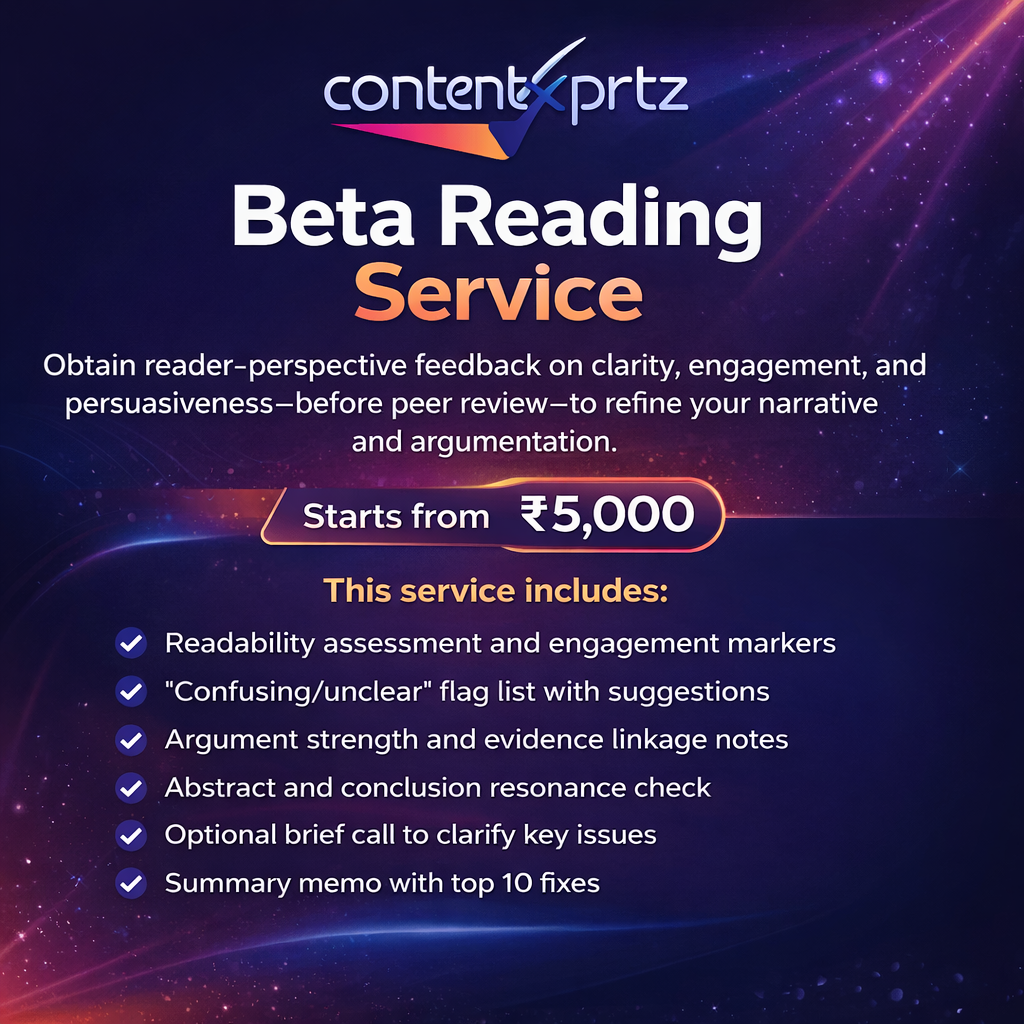
📘 Strengthen Your Manuscript Before Peer Review
Because clarity and persuasion matter as much as methodology.
Your research deserves to be understood exactly as you intend. ContentXprtz’s Beta Reading Service offers reader-perspective feedback to refine clarity, engagement, and argumentative flow—before formal peer review.
What this service delivers:
📄 Readability and engagement assessment
🧠 Clear flags on confusing or unclear sections with improvement suggestions
📘 Argument strength and evidence-linkage feedback
🎓 Abstract and conclusion resonance check
📑 Concise summary memo highlighting the top 10 priority fixes
✔ Ethical, transparent, and originality-focused
✔ Your ideas remain fully yours—author ownership always respected
✔ Designed to improve narrative coherence and submission readiness
Starts from ₹5,000
👉 Message us on WhatsApp to get started today
WhatsApp: https://wa.me/917065013200
Website: https://contentxprtz.com
#AcademicWriting #PhDSupport #ResearchManuscript #BetaReading #JournalSubmission #PublishResearch #PhDLife #DoctoralStudies #PostdocLife #ResearchSupport #ScholarlyWriting #AcademicEditing #ResearchStudents #HigherEducation #EthicalEditing #ManuscriptPreparation #ResearchPublication #ThesisSupport #DissertationHelp #JournalReady #STEMResearch #SocialSciencesResearch #HumanitiesResearch #EarlyCareerResearchers
Beyond Editing: How a Professional Beta Reading Service Strengthens PhD Research and Academic Publishing
Introduction: Why Beta Reading Matters More Than Ever in Doctoral Research
For many PhD scholars and academic researchers, the journey from an initial research idea to a polished, publication-ready manuscript is intellectually rewarding yet emotionally and professionally demanding. Long research cycles, supervisory expectations, journal rejection pressures, and increasing competition in global academia have transformed doctoral writing into a high-stakes endeavor. Within this demanding landscape, a Beta Reading Service has emerged as a critical yet often misunderstood form of academic support.
A Beta Reading Service goes beyond grammar correction or stylistic editing. Instead, it focuses on the reader experience of a scholarly work. It evaluates how effectively a thesis, dissertation, or research manuscript communicates its argument, logic, originality, and contribution to the field. In the first stages of academic writing, researchers are deeply immersed in their subject matter. This immersion, while necessary, often creates blind spots. Arguments may feel clear to the author but remain opaque to external readers. Conceptual gaps, structural inconsistencies, or weak transitions may go unnoticed until peer reviewers or journal editors highlight them.
Globally, these challenges are becoming more pronounced. According to data published by Elsevier, journal acceptance rates in many high-impact journals range between 10 percent and 25 percent, with rejection frequently linked to issues of clarity, coherence, and positioning rather than the quality of the research idea itself. Springer Nature has also reported that early-career researchers struggle most with framing their contribution and aligning their manuscripts with journal expectations. These findings underline a crucial reality: strong research alone does not guarantee successful publication.
At the doctoral level, time pressure compounds these issues. PhD candidates often juggle teaching responsibilities, funding constraints, institutional milestones, and personal commitments. The rising cost of extended enrollments and publication delays further intensifies stress. As a result, many scholars submit work that is intellectually sound but underdeveloped in presentation. This is precisely where a structured Beta Reading Service provides value.
Unlike traditional academic editing, beta reading addresses the macro-level concerns of scholarly communication. It examines whether the research question is compelling, whether arguments unfold logically, whether the literature review establishes authority, and whether conclusions genuinely reflect the findings. Importantly, it does so without rewriting the author’s work, thereby preserving academic ownership and ethical integrity.
At ContentXprtz, a global academic support provider established in 2010, beta reading has become an integral part of ethical research assistance. Serving scholars across more than 110 countries, ContentXprtz understands that academic writing is not merely about correctness. It is about persuasion, credibility, and impact. Through a carefully designed Beta Reading Service, the organization supports PhD scholars, postdoctoral researchers, and faculty members in refining their work before it reaches supervisors, examiners, or journal reviewers.
This article offers a comprehensive, evidence-based exploration of the Beta Reading Service. It explains what beta reading involves, how it differs from editing, and why it is increasingly essential for doctoral success and academic publishing. More importantly, it demonstrates how professional beta reading aligns with best practices recommended by major academic publishers and addresses the real challenges faced by today’s researchers.
Understanding the Concept of a Beta Reading Service in Academia
A Beta Reading Service originates from creative and literary writing, where beta readers provide feedback on manuscripts before formal publication. In academic contexts, however, beta reading has evolved into a sophisticated scholarly review process. Its primary purpose is to simulate the perspective of an informed but critical reader, similar to a thesis examiner or journal peer reviewer.
In academic beta reading, the focus shifts from surface-level language to deeper structural and conceptual elements. The beta reader assesses whether the research narrative flows logically, whether arguments are well-supported, and whether the manuscript aligns with disciplinary norms. This process is particularly valuable for PhD theses, systematic reviews, conceptual papers, and interdisciplinary research, where clarity and positioning play a decisive role.
Unlike proofreading or copyediting, beta reading does not correct punctuation or formatting errors. Instead, it provides analytical commentary, marginal notes, and summary feedback that highlight strengths, weaknesses, and areas for improvement. The feedback is diagnostic rather than corrective. This distinction ensures that the author remains fully responsible for revisions, preserving ethical standards outlined by organizations such as the Committee on Publication Ethics and the American Psychological Association.
From an academic integrity perspective, beta reading is widely accepted. Publishers such as Taylor and Francis and Emerald Insight explicitly encourage authors to seek pre-submission feedback to improve manuscript quality. Beta reading, when conducted transparently, aligns perfectly with this recommendation.
Why PhD Scholars and Researchers Need Beta Reading Support
Doctoral research demands originality, rigor, and independence. However, these expectations often conflict with the realities of academic writing. Scholars are trained extensively in research methods but receive limited formal training in scholarly storytelling. As a result, many PhD theses suffer from issues such as overly descriptive literature reviews, fragmented argumentation, or conclusions that fail to demonstrate contribution.
A Beta Reading Service addresses these challenges at an early stage. It allows scholars to identify weaknesses before formal evaluation. For instance, a beta reader may point out that a research gap is insufficiently articulated or that the theoretical framework lacks integration with the methodology. Such insights can prevent major revisions later.
Furthermore, beta reading offers emotional reassurance. Doctoral writing can be isolating, and feedback from supervisors may be infrequent or limited in scope. A professional beta reader provides constructive, unbiased feedback that empowers scholars to revise with confidence. This support is particularly valuable for international researchers writing in English as an additional language, who may struggle with tone and disciplinary conventions despite strong research ideas.
At ContentXprtz, beta reading is positioned as a collaborative academic dialogue rather than a transactional service. Scholars receive feedback that respects their voice while challenging them to improve clarity and impact. This approach reflects the organization’s long-standing commitment to ethical and developmental academic support.
Beta Reading Versus Academic Editing: A Critical Distinction
Understanding the difference between a Beta Reading Service and academic editing is essential for informed decision-making. While both services aim to improve manuscript quality, they operate at different levels of intervention.
Academic editing focuses on language accuracy, grammar, syntax, and style. Editors may also ensure consistency with citation formats such as APA, MLA, or Chicago. This service is typically performed once the content and structure are finalized.
Beta reading, by contrast, occurs earlier in the writing process. It evaluates whether the manuscript works as a coherent academic argument. Beta readers ask questions such as whether the introduction clearly establishes relevance, whether chapters connect logically, and whether the conclusion advances theoretical or practical implications.
Importantly, beta reading does not replace editing. Instead, it complements it. Many successful scholars adopt a layered approach, beginning with beta reading, followed by substantive editing and final proofreading. This workflow aligns with best practices recommended by major academic publishers.
How a Professional Beta Reading Service Improves Publication Outcomes
Empirical evidence suggests that manuscripts benefiting from pre-submission feedback have higher acceptance rates. Elsevier’s author resources emphasize the importance of clarity, structure, and audience awareness in successful submissions. Beta reading directly addresses these criteria.
Through detailed feedback, beta readers help authors refine their research narrative. They may suggest reorganizing sections, strengthening transitions, or clarifying key concepts. These improvements enhance readability and reviewer engagement.
Moreover, beta reading supports journal targeting. Experienced beta readers understand disciplinary expectations and can advise whether a manuscript aligns with the scope and audience of specific journals. This guidance reduces desk rejection risk, which remains one of the most common outcomes in academic publishing.
For PhD scholars preparing their theses, beta reading can also improve examination outcomes. Examiners often comment on coherence, originality, and contribution. By addressing these aspects proactively, candidates can approach their viva with greater confidence.
ContentXprtz and Its Approach to Ethical Beta Reading
Since 2010, ContentXprtz has built a reputation as a trusted academic support provider. Its Beta Reading Service reflects this legacy. The service is delivered by subject specialists with doctoral or postdoctoral experience, ensuring disciplinary relevance and methodological understanding.
ContentXprtz adheres strictly to ethical guidelines. Beta readers do not rewrite content or alter data. Instead, they provide structured feedback reports, annotated comments, and strategic recommendations. This approach ensures compliance with institutional policies and publication ethics.
Scholars seeking broader academic assistance can explore related services such as PhD thesis help and academic editing services through ContentXprtz’s Writing and Publishing Services and PhD and Academic Services. These integrated offerings allow researchers to select support that aligns with their stage of writing and specific needs.
Frequently Asked Questions About Beta Reading Service
What exactly does a Beta Reading Service include for PhD scholars?
A Beta Reading Service provides comprehensive, reader-focused feedback on a scholarly manuscript. For PhD scholars, this typically includes an evaluation of the research narrative, argument clarity, logical flow, and scholarly positioning. The beta reader assesses whether the introduction effectively frames the research problem, whether the literature review demonstrates critical engagement, and whether the methodology aligns with the research questions.
Importantly, beta reading also examines coherence across chapters. PhD theses often evolve over several years, leading to stylistic inconsistencies or conceptual drift. A beta reader identifies these issues and recommends alignment strategies. Feedback is usually delivered through annotated comments and a detailed summary report outlining strengths, weaknesses, and actionable suggestions.
Unlike editing, beta reading does not correct grammar or formatting. Instead, it empowers scholars to revise independently. This distinction ensures academic ownership and aligns with ethical guidelines set by publishers such as Springer Nature and the APA.
When is the best time to use a Beta Reading Service during a PhD?
The optimal time to engage a Beta Reading Service is after completing a full draft but before final submission. At this stage, the core content exists, allowing the beta reader to evaluate structure and argumentation holistically. However, beta reading can also be valuable at earlier stages, such as after drafting individual chapters.
For journal articles derived from a thesis, beta reading is particularly effective before selecting a target journal. Feedback can help refine the manuscript to meet specific audience expectations. Many scholars also use beta reading before supervisor review, ensuring that feedback sessions are more productive and focused.
At ContentXprtz, beta reading timelines are flexible, accommodating the varied schedules and milestones of doctoral programs worldwide.
How does Beta Reading differ from peer review in journals?
While beta reading and peer review share similarities, they serve different purposes. Peer review is evaluative and gatekeeping in nature. Reviewers assess whether a manuscript meets publication standards and often recommend acceptance, revision, or rejection.
Beta reading, by contrast, is developmental. It aims to improve the manuscript before formal evaluation. Beta readers do not judge publishability. Instead, they identify areas for improvement and offer constructive suggestions. This proactive approach reduces the likelihood of negative peer review outcomes.
Furthermore, beta reading feedback is typically more detailed and supportive. Peer reviewers may highlight problems without offering solutions. Beta readers, especially those with mentoring experience, provide guidance on how to address identified issues.
Is using a Beta Reading Service considered ethical in academia?
Yes, using a Beta Reading Service is widely considered ethical when conducted transparently. Major academic publishers encourage authors to seek feedback before submission. Ethical beta reading does not involve rewriting content, fabricating data, or misrepresenting authorship.
Organizations such as Elsevier and Taylor and Francis emphasize that authors remain responsible for their work. Beta reading aligns with this principle by offering advice rather than direct intervention. At ContentXprtz, ethical compliance is central to service delivery, ensuring scholars can confidently disclose external support if required.
Can Beta Reading help with journal selection and targeting?
A professional Beta Reading Service often includes guidance on journal suitability. Experienced beta readers understand disciplinary norms and publication landscapes. They can advise whether a manuscript aligns with the scope, audience, and methodological preferences of specific journals.
This guidance is particularly valuable given high desk rejection rates. According to Emerald Insight, mismatched submissions account for a significant proportion of rejections. By refining positioning and targeting, beta reading enhances submission strategy and efficiency.
How does Beta Reading support non-native English researchers?
For researchers writing in English as an additional language, beta reading provides critical support beyond language correction. Beta readers focus on clarity, tone, and academic voice. They identify areas where phrasing may obscure meaning or where cultural differences affect argument presentation.
Rather than correcting sentences, beta readers explain how to improve communication. This approach fosters long-term skill development and confidence. Many international scholars report that beta reading improves their understanding of Anglo-American academic conventions, contributing to future writing success.
What disciplines benefit most from a Beta Reading Service?
All academic disciplines can benefit from beta reading, though its impact is particularly significant in the social sciences, humanities, and interdisciplinary fields. These areas often involve complex theoretical frameworks and argumentative structures that require careful articulation.
However, STEM researchers also benefit, especially when preparing review articles, grant proposals, or interdisciplinary manuscripts. Beta reading ensures that technical content remains accessible and logically organized, enhancing reviewer comprehension.
How long does a Beta Reading Service typically take?
The duration of a Beta Reading Service depends on manuscript length and complexity. For a full PhD thesis, the process may take several weeks. For journal articles, turnaround times are often shorter.
At ContentXprtz, timelines are clearly communicated, and expedited options may be available. Scholars are encouraged to plan beta reading well ahead of submission deadlines to allow sufficient time for revision.
Can Beta Reading replace supervisor feedback?
Beta reading does not replace supervisory guidance. Instead, it complements it. Supervisors focus on disciplinary rigor and research direction, while beta readers emphasize clarity and reader engagement. Using both sources of feedback creates a robust revision process.
Many scholars find that beta reading enhances supervisor feedback by addressing presentation issues early. This synergy leads to more focused academic discussions and efficient progress.
How does ContentXprtz ensure quality in its Beta Reading Service?
ContentXprtz maintains quality through rigorous reviewer selection and training. Beta readers possess advanced academic qualifications and subject expertise. Each project is matched with a specialist familiar with the relevant discipline and publication standards.
Quality assurance processes include internal reviews and standardized feedback frameworks. This consistency ensures that scholars receive actionable, high-value insights aligned with global academic expectations.
Conclusion: Strengthening Scholarly Impact Through Beta Reading
In an increasingly competitive academic environment, clarity and coherence are as vital as originality and rigor. A professional Beta Reading Service bridges the gap between research excellence and effective scholarly communication. By offering reader-focused feedback, beta reading empowers PhD scholars and researchers to refine their work, enhance confidence, and improve publication outcomes.
ContentXprtz’s approach to beta reading reflects over a decade of experience supporting global scholars. By combining ethical practices, subject expertise, and developmental feedback, the organization helps researchers navigate the complexities of doctoral writing and academic publishing.
Scholars seeking comprehensive support can explore ContentXprtz’s integrated offerings, including PhD and Academic Services, Student Writing Services, Book Author Writing Services, and Corporate Writing Services.
If you are preparing a thesis, dissertation, or research manuscript and want informed, ethical feedback before submission, consider professional beta reading as a strategic investment in your academic success.
At ContentXprtz, we do not just edit. We help your ideas reach their fullest potential.
