
📘 Strengthen Your Manuscript—Before Reviewers Point It Out
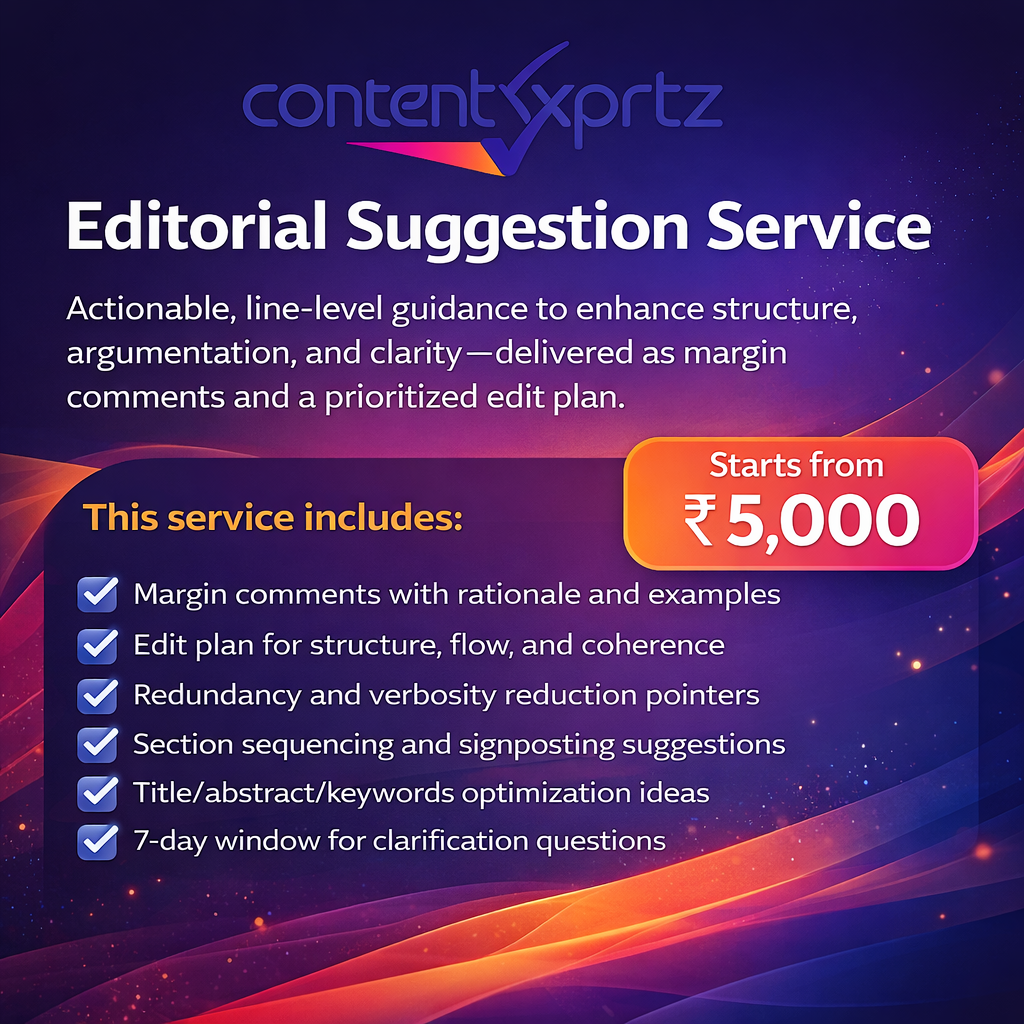
Clear arguments, logical flow, and strong structure are essential for successful academic publishing. ContentXprtz’s Editorial Suggestion Service provides actionable, line-level guidance to help you refine your manuscript with confidence and clarity.
🧠 What you gain from this service:
• Margin comments with clear rationale and practical examples
• A prioritized edit plan to improve structure, flow, and coherence
• Guidance to reduce redundancy and improve academic precision
• Section sequencing and signposting suggestions
• Title, abstract, and keyword optimization ideas
🎓 Ethical, transparent, and author-first
All feedback is advisory only. Your research remains fully yours—no rewriting, no content ownership transfer, and complete academic integrity at every step.
📄 Starts from ₹5,000
📲 Message us on WhatsApp to get started today
WhatsApp: https://wa.me/917065013200
Website: https://contentxprtz.com
#ContentXprtz #AcademicEditing #PhDSupport #ResearchWriting #JournalSubmission #ManuscriptEditing #AcademicIntegrity #PublishResearch #PhDLife #DoctoralResearch #PostdocLife #ScholarlyWriting #ResearchScholars #HigherEducation #ThesisSupport #DissertationHelp #JournalReady #ResearchSupport #STEMResearch #SocialSciences #AcademicPublishing #EarlyCareerResearchers #UniversityLife #ResearchExcellence
Editorial Suggestion Service: Strategic Academic Guidance for Publication-Ready Research
Introduction
For PhD scholars, postgraduate students, and academic researchers, writing a manuscript is only one part of a far more demanding journey. The real challenge begins after the first draft is complete. Transforming a research document into a submission-ready manuscript that aligns with journal expectations requires critical judgment, disciplinary awareness, and editorial expertise. This is where a professional Editorial Suggestion Service becomes indispensable.
Across disciplines, researchers face mounting pressure to publish in indexed journals while balancing teaching loads, funding constraints, and administrative responsibilities. According to Elsevier’s global research insights, manuscript rejection rates across high-impact journals often exceed 60 percent, not due to weak research ideas, but because of structural flaws, unclear argumentation, weak positioning, or non-compliance with editorial standards. These challenges are further intensified for early-career researchers and international scholars working in a second language.
In recent years, the global research ecosystem has become more competitive. Springer Nature reports a steady increase in annual submissions, while acceptance rates continue to narrow. At the same time, publication costs have risen, making repeated resubmissions financially and emotionally exhausting. For PhD candidates nearing submission deadlines, each revision cycle adds stress, delays graduation timelines, and impacts career progression.
An Editorial Suggestion Service addresses this gap by offering expert-driven, ethical, and strategic feedback that strengthens manuscripts without altering author ownership. Unlike basic proofreading or surface-level editing, editorial suggestions focus on the intellectual architecture of a document. They guide authors on clarity, coherence, scholarly positioning, methodological transparency, and alignment with journal scopes.
At ContentXprtz, established in 2010 and trusted by researchers across more than 110 countries, editorial guidance is treated as an academic partnership rather than a transactional service. Our editors work closely with authors to refine arguments, strengthen research narratives, and enhance scholarly impact while preserving the original voice and intent.
This article explores the full scope of Editorial Suggestion Services, their academic value, ethical foundations, and practical benefits. It is written for students, PhD scholars, and researchers seeking credible academic editing, PhD support, and research paper assistance that genuinely improves publication outcomes.
Understanding Editorial Suggestion Service in Academic Publishing
An Editorial Suggestion Service provides structured, expert feedback aimed at improving the quality, clarity, and publishability of academic documents. The service does not rewrite content or fabricate arguments. Instead, it offers detailed recommendations that empower authors to revise their work independently and confidently.
Editorial suggestions typically focus on macro-level and micro-level elements. At the macro level, editors assess logical flow, chapter organization, argument progression, and contribution clarity. At the micro level, they evaluate sentence construction, academic tone, referencing accuracy, and discipline-specific conventions.
For PhD theses, editorial suggestions often address research questions, literature synthesis depth, methodological alignment, and examiner expectations. For journal manuscripts, feedback aligns content with specific journal aims, reviewer expectations, and editorial guidelines set by publishers such as Elsevier, Springer, Emerald Insight, and Taylor and Francis.
Why Editorial Suggestion Services Matter for PhD Scholars
Doctoral research is evaluated not only on originality but also on articulation. Examiners and reviewers expect clarity, methodological rigor, and scholarly positioning. Even strong research can be undermined by unclear structure or weak argument transitions.
An Editorial Suggestion Service supports PhD scholars by identifying gaps between research intent and reader interpretation. Editors act as informed academic readers, highlighting areas that require clarification or stronger justification. This process improves thesis defensibility and reduces the risk of major revisions.
For international scholars, editorial suggestions also bridge linguistic and cultural gaps. Academic writing conventions vary across regions, and misalignment can lead to misinterpretation. Editorial guidance ensures that manuscripts meet global academic standards while respecting disciplinary nuances.
Editorial Suggestions vs Academic Editing
While academic editing and editorial suggestions are often discussed together, they serve distinct purposes. Academic editing focuses on language accuracy, grammar, style consistency, and formatting. Editorial suggestions go deeper, addressing conceptual clarity, argument strength, and research positioning.
At ContentXprtz, editorial suggestions are frequently integrated with academic editing services to provide holistic manuscript support. Authors receive actionable insights that extend beyond language corrections, enabling meaningful revision rather than cosmetic changes.
Core Components of a High-Quality Editorial Suggestion Service
A robust Editorial Suggestion Service includes several critical components:
-
Structural evaluation of chapters, sections, and argument flow
-
Clarity assessment of research objectives and contributions
-
Journal alignment analysis to match scope, tone, and expectations
-
Methodological coherence checks for transparency and rigor
-
Reference and citation consistency following APA or journal-specific styles
-
Ethical compliance review, including plagiarism risk awareness
These components ensure that feedback is comprehensive, academically sound, and ethically grounded.
How ContentXprtz Delivers Editorial Suggestion Excellence
At ContentXprtz, editorial guidance is delivered by subject-matter specialists with deep disciplinary expertise. Editors are selected based on academic background, publication experience, and familiarity with journal review processes.
Our approach is consultative. Each manuscript is reviewed within its academic context, publication goals, and target audience. Suggestions are provided with clear explanations, enabling authors to understand the rationale behind each recommendation.
Researchers seeking research paper writing support or PhD thesis help benefit from this transparent, educational approach. The goal is not dependency, but scholarly empowerment.
Explore our full range of Writing and Publishing Services at
https://contentxprtz.com/writing-publishing-services
Editorial Suggestion Service Across Academic Documents
Editorial suggestions apply to a wide range of academic outputs:
-
PhD and Master’s theses
-
Journal manuscripts
-
Conference papers
-
Grant proposals
-
Research monographs and edited volumes
Each document type requires tailored feedback. For example, grant proposals emphasize clarity, impact, and feasibility, while journal manuscripts prioritize originality and contribution positioning.
Our PhD and Academic Services page provides detailed insights into discipline-specific support:
https://contentxprtz.com/phd-academic-services
Ethics and Author Ownership in Editorial Suggestions
Ethical integrity is central to editorial work. Reputable editorial services do not fabricate data, alter interpretations, or misrepresent authorship. Instead, they guide authors to refine their own work.
ContentXprtz follows international publication ethics aligned with APA guidelines and publisher standards. All editorial suggestions preserve author voice and intellectual ownership, ensuring compliance with university and journal policies.
Frequently Asked Questions
1. What exactly does an Editorial Suggestion Service include?
An Editorial Suggestion Service provides expert, structured feedback on the academic, structural, and conceptual quality of a manuscript. Unlike proofreading, which focuses on grammar and spelling, editorial suggestions address how ideas are presented, connected, and justified. Editors review argument flow, clarity of research objectives, methodological coherence, and alignment with academic conventions.
For PhD scholars, this service often includes chapter-level feedback, examiner-focused insights, and suggestions to strengthen theoretical framing. For journal submissions, editors assess journal fit, reviewer expectations, and clarity of contribution. The service empowers authors to revise independently while improving scholarly rigor and publication readiness.
2. Is using an Editorial Suggestion Service ethically acceptable?
Yes, when used correctly. Editorial suggestions are widely accepted in academic publishing because they do not involve ghostwriting or content fabrication. Instead, they support clarity, coherence, and compliance with academic standards.
Publishers such as Elsevier and Springer acknowledge the role of professional editing and editorial guidance, particularly for non-native English speakers. Ethical editorial services, including ContentXprtz, preserve author ownership and intellectual integrity.
3. How does editorial guidance improve journal acceptance chances?
Many rejections occur due to unclear arguments, poor structure, or misalignment with journal scope. Editorial suggestions address these issues before submission.
By refining argument flow, clarifying contributions, and aligning manuscripts with journal guidelines, authors reduce reviewer confusion and increase perceived quality. While no service can guarantee acceptance, editorial guidance significantly improves manuscript competitiveness.
4. Can Editorial Suggestion Services help with reviewer comments?
Yes. Editorial suggestions are particularly valuable during revision stages. Editors help authors interpret reviewer feedback, prioritize revisions, and respond strategically.
This support reduces resubmission cycles and ensures responses are academically appropriate. Many researchers combine editorial suggestions with academic editing services during revisions for optimal outcomes.
5. Do Editorial Suggestion Services rewrite my work?
No. Reputable services do not rewrite content. They provide recommendations, margin comments, and explanatory notes. Authors remain fully responsible for implementing changes.
This approach ensures compliance with academic integrity policies while improving manuscript quality.
6. Is this service suitable for Master’s students and early researchers?
Absolutely. Early-career researchers benefit significantly from editorial guidance because it accelerates learning and builds academic writing confidence.
Students using student writing services at ContentXprtz receive educational feedback that improves long-term writing skills.
https://contentxprtz.com/student-career-academic-writing-services
7. How long does the editorial suggestion process take?
Turnaround time depends on document length and complexity. Typically, journal manuscripts take 5 to 7 working days, while PhD chapters may require longer.
ContentXprtz provides realistic timelines and transparent communication to support academic deadlines.
8. Are editorial suggestions discipline-specific?
Yes. Academic conventions vary widely across disciplines. Editors are matched based on subject expertise to ensure relevance and accuracy.
This discipline-specific approach distinguishes professional editorial services from generic editing tools.
9. Can editorial suggestions support book authors and corporate researchers?
Yes. Editorial guidance extends beyond academia to book authors and corporate research teams. ContentXprtz supports academic monographs, professional reports, and white papers through specialized services.
Explore our Book Authors Writing Services and Corporate Writing Services for tailored support:
https://contentxprtz.com/book-authors-writing-services
https://contentxprtz.com/corporate-writing-services
10. How do I know if I need editorial suggestions or full editing?
If your research content is strong but feedback suggests clarity or structure issues, editorial suggestions are ideal. If language accuracy and formatting are primary concerns, academic editing may suffice.
Many researchers benefit from a combined approach, starting with editorial guidance and followed by final editing.
Conclusion and Call to Action
In today’s competitive academic landscape, strong research alone is not enough. Clear communication, strategic positioning, and adherence to publication standards determine success. A professional Editorial Suggestion Service bridges the gap between research quality and publication readiness.
ContentXprtz brings over a decade of global academic expertise, ethical editorial practices, and discipline-specific insight to every manuscript. Our editorial guidance empowers scholars to refine their work confidently and submit with clarity.
If you are seeking expert PhD assistance, academic editing services, or research paper writing support, explore our comprehensive academic solutions today.
Visit https://contentxprtz.com/phd-academic-services to begin your journey.
At ContentXprtz, we don’t just edit — we help your ideas reach their fullest potential.
