
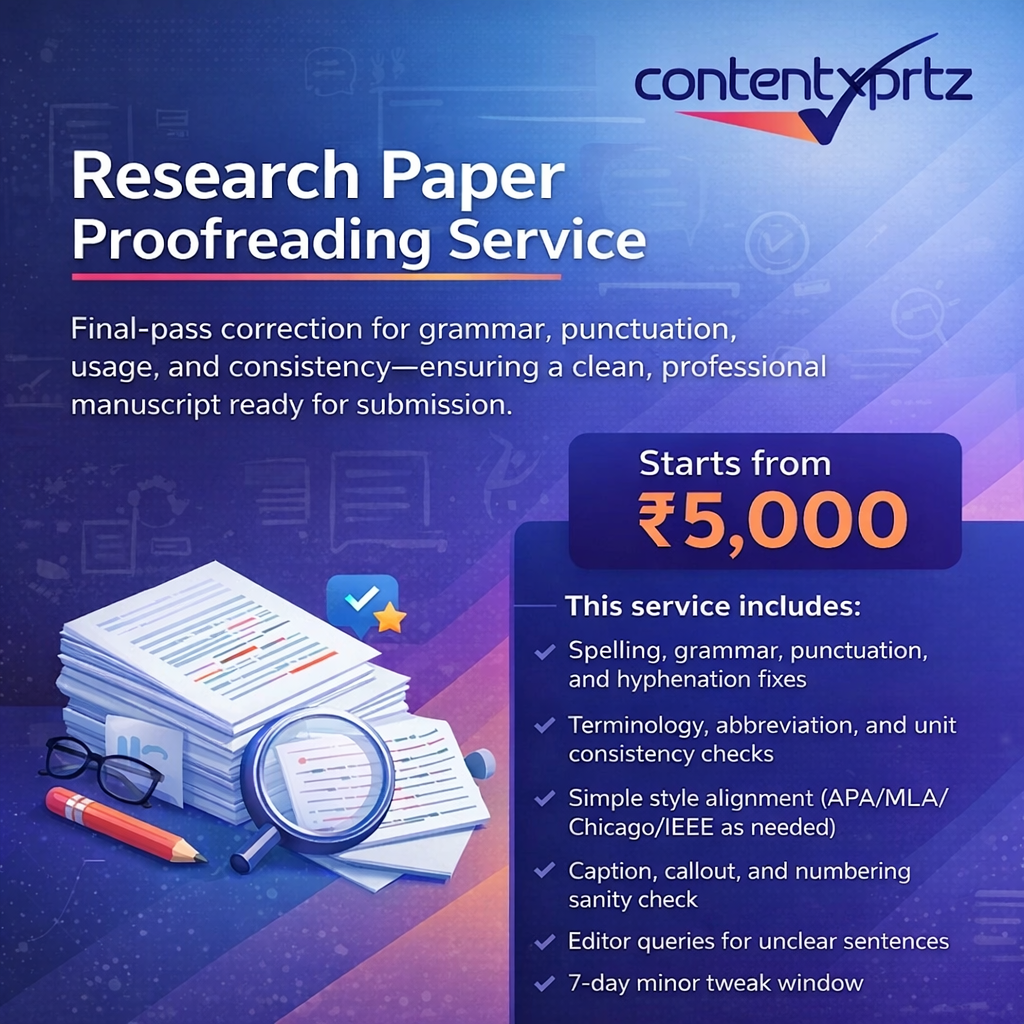
📄 Final-Check Your Research Before Submission
Because small errors should never hold back strong research.
Our Research Paper Proofreading Service gives your manuscript a meticulous final pass—ensuring linguistic precision, consistency, and a polished academic tone before journal submission.
We help you submit with confidence by refining clarity without altering your ideas, arguments, or authorship.
🔍 What this service includes:
• Grammar, spelling, punctuation & hyphenation correction
• Terminology, abbreviation & unit consistency checks
• Basic style alignment (APA / MLA / Chicago / IEEE)
• Caption, callout & numbering sanity review
• Editor queries for unclear or ambiguous sentences
• 7-day minor tweak window after delivery
✅ Ethical. Transparent. Author-owned.
Your research remains entirely yours—we only enhance accuracy, readability, and professionalism in line with academic standards.
📘 Starts from ₹5,000
📲 Message us on WhatsApp to get started today
WhatsApp: https://wa.me/917065013200
Website: https://contentxprtz.com
📄🎓🧠
#ContentXprtz #ResearchPaperProofreading #AcademicProofreading #PhDSupport #PhDScholars #AcademicWriting #ResearchSupport #JournalSubmission #ManuscriptPreparation #HigherEducation #ResearchIntegrity #EthicalEditing #PublicationReady #PostgraduateStudies #DoctoralResearch #ResearchScholars #AcademicServices #ScholarlyWriting #STEMResearch #HumanitiesResearch #SocialScienceResearch #JournalPublishing #UniversityLife #ResearchStudents
Beyond Error Correction: How a Professional Research Paper Proofreading Service Shapes Academic Success
Introduction: Why Proofreading Has Become a Survival Skill in Modern Academia
For today’s PhD scholars, postgraduate students, and academic researchers, publishing is no longer a milestone. It is a continuous expectation. Doctoral candidates are expected to publish during their PhD. Early-career researchers are assessed through citation metrics. Even postgraduate students face growing pressure to submit journal-ready manuscripts rather than classroom-level assignments.
In this demanding ecosystem, a Research Paper Proofreading Service is no longer a luxury. It has become an essential academic support mechanism.
Across disciplines, researchers face the same structural challenges. Time constraints continue to intensify as teaching, administrative responsibilities, grant applications, and conference commitments compete for attention. According to Elsevier’s global research insights, the volume of scientific publications has more than doubled over the last two decades, while peer-review standards have grown increasingly stringent. Journals today reject over 70 percent of submissions before peer review, often due to language quality, structural weaknesses, or failure to meet editorial expectations.
For non-native English-speaking researchers, the burden is even heavier. Studies published by Springer and Taylor and Francis consistently highlight linguistic bias as an unspoken but influential factor in editorial screening. Even strong empirical contributions may face rejection if the manuscript lacks clarity, coherence, or academic tone.
Proofreading addresses this gap at a critical stage. Unlike rewriting or ghostwriting, professional proofreading focuses on refining what the researcher has already achieved. It preserves the author’s voice while enhancing precision, readability, and compliance with journal standards. When executed ethically and expertly, it becomes an academic safeguard rather than a shortcut.
At ContentXprtz, we have worked with researchers across more than 110 countries since 2010. We have observed a clear pattern. Manuscripts that undergo structured, discipline-aware proofreading demonstrate higher acceptance rates, smoother peer-review cycles, and fewer rounds of revision. More importantly, authors report reduced anxiety, stronger confidence, and better engagement with reviewer feedback.
This article provides a comprehensive, evidence-based exploration of professional proofreading in academic publishing. It explains what a Research Paper Proofreading Service truly entails, why it matters across disciplines, how to choose an ethical provider, and how ContentXprtz supports scholars at every stage of their academic journey.
Understanding the True Scope of a Research Paper Proofreading Service
A Research Paper Proofreading Service extends far beyond correcting spelling or punctuation. At its core, it is a quality assurance process that aligns a manuscript with international academic communication standards.
Professional proofreading focuses on four primary dimensions.
First, linguistic accuracy. This includes grammar, syntax, punctuation, and sentence construction. Errors in these areas may seem minor, yet they disrupt readability and can trigger desk rejection during editorial screening.
Second, stylistic consistency. Academic writing demands precision, formal tone, and logical flow. Proofreading ensures consistent terminology, appropriate tense usage, and adherence to disciplinary conventions. For example, conventions in qualitative social sciences differ from those in biomedical research.
Third, structural clarity. While proofreading does not involve rewriting arguments, it identifies inconsistencies in headings, transitions, referencing, and figure captions. This layer improves coherence without altering intellectual content.
Fourth, journal compliance. High-quality proofreading aligns manuscripts with journal-specific guidelines, including referencing style, formatting norms, word limits, and abstract structure.
Unlike editing or rewriting, proofreading preserves the originality of the author’s ideas. This distinction is critical from an ethical standpoint. Reputable academic publishers such as Elsevier and Emerald explicitly permit language editing and proofreading, provided the intellectual contribution remains unchanged.
When performed by subject-aware professionals, proofreading becomes an invisible but powerful contributor to scholarly credibility.
Why Journal Rejections Often Trace Back to Language and Presentation
Editorial rejections are rarely blunt. However, phrases such as “lack of clarity,” “poor language quality,” or “insufficient academic rigor” frequently appear in decision letters. These comments often mask avoidable presentation issues rather than fundamental research flaws.
Data from Springer Nature indicates that manuscripts with language-related concerns experience significantly longer review cycles and higher rejection probabilities. Reviewers, constrained by time, may disengage from papers that demand excessive cognitive effort due to unclear phrasing or inconsistent terminology.
This reality creates an uneven playing field. Researchers from institutions with limited academic writing support face systemic disadvantages, regardless of the quality of their research design or findings.
A professional Research Paper Proofreading Service mitigates this imbalance. By refining clarity and flow, proofreading allows reviewers to focus on the research contribution rather than linguistic obstacles. This shift often results in more constructive feedback and a fairer evaluation process.
The Strategic Role of Proofreading Across the Research Lifecycle
Proofreading delivers value at multiple stages of academic work.
During manuscript submission, it enhances first impressions and reduces desk rejection risk. At the revision stage, proofreading ensures reviewer comments are addressed clearly and professionally. For conference papers and grant proposals, it strengthens persuasiveness and credibility. Even after acceptance, proofreading plays a role in final proofs, where minor errors can still undermine professionalism.
Researchers who integrate proofreading into their workflow treat it as a strategic investment rather than a last-minute correction.
Ethical Boundaries: What Proofreading Is and Is Not
Academic integrity remains paramount. Ethical proofreading adheres to strict boundaries.
Proofreading does not introduce new data, arguments, or interpretations. It does not alter methodological decisions or theoretical frameworks. It does not mask plagiarism or fabricate citations.
Professional providers operate transparently and align with guidelines from bodies such as the Committee on Publication Ethics. They enhance language without compromising authorship or originality.
At ContentXprtz, our proofreading protocols are designed around these principles. Each manuscript undergoes quality checks to ensure compliance with institutional and publisher ethics standards.
Choosing the Right Research Paper Proofreading Service
Not all services are equal. Researchers should evaluate providers using clear criteria.
Subject expertise matters. A proofreader familiar with engineering research understands technical precision differently from one working in humanities. Generic proofreading often fails to detect discipline-specific inconsistencies.
Experience and credibility are equally important. Established providers demonstrate familiarity with journal ecosystems, reviewer expectations, and citation norms.
Transparency distinguishes ethical services from predatory ones. Clear service descriptions, defined scope, and absence of unrealistic guarantees signal professionalism.
Data security also plays a critical role. Academic manuscripts contain unpublished ideas. Confidential handling and secure workflows are non-negotiable.
Researchers seeking integrated support often explore broader academic editing services or research paper writing support through platforms like ContentXprtz. Our PhD thesis help ecosystem ensures continuity from drafting to submission.
Learn more about our comprehensive offerings through:
-
Writing and Publishing Services: https://contentxprtz.com/writing-publishing-services
-
PhD and Academic Services: https://contentxprtz.com/phd-academic-services
-
Student Writing Services: https://contentxprtz.com/student-career-academic-writing-services
Evidence-Based Benefits of Professional Proofreading
Peer-reviewed studies consistently highlight the benefits of language refinement in scholarly publishing. Research discussed in Elsevier’s author resources emphasizes that clarity and structure significantly influence reviewer perception. Emerald Insight notes that manuscripts written in clear academic English receive more focused methodological feedback.
Professional proofreading offers measurable advantages:
-
Reduced revision cycles
-
Higher reviewer engagement
-
Improved acceptance probability
-
Enhanced author confidence
-
Stronger citation potential through clarity
These outcomes are not guarantees, but they reflect consistent patterns observed across disciplines.
How ContentXprtz Approaches Research Paper Proofreading
Since 2010, ContentXprtz has supported thousands of scholars worldwide. Our proofreading methodology is rooted in academic ethics, subject expertise, and editorial precision.
Each manuscript is matched with a proofreader familiar with the relevant discipline. Our process includes multiple review layers to ensure consistency, accuracy, and journal compliance.
We integrate proofreading within a broader ecosystem of academic editing services and research paper assistance, enabling seamless transitions between drafting, revision, and submission.
Our global virtual presence allows localized understanding with international standards. Researchers working across time zones benefit from responsive support and flexible workflows.
Frequently Asked Questions About Research Paper Proofreading Service
FAQ 1: How is proofreading different from academic editing in research papers?
Proofreading focuses on surface-level accuracy and clarity without altering meaning. Academic editing may involve restructuring sentences, improving argument flow, and enhancing style. Proofreading corrects errors and inconsistencies after the manuscript content is finalized. Researchers typically choose proofreading when their argument is complete but requires refinement to meet publication standards. Ethical proofreading preserves authorship while improving readability.
FAQ 2: Can proofreading increase my chances of journal acceptance?
Proofreading does not guarantee acceptance, but it removes common barriers that lead to desk rejection. Clear language allows editors and reviewers to focus on research quality rather than presentation flaws. Evidence from publishers like Springer shows that well-presented manuscripts progress more smoothly through peer review. Proofreading improves fairness in evaluation rather than manipulating outcomes.
FAQ 3: Is using a Research Paper Proofreading Service ethically acceptable?
Yes, when conducted transparently and responsibly. Major publishers including Elsevier and Taylor and Francis permit language editing and proofreading. Ethical services do not add content or alter intellectual ownership. They refine language to support clear communication. Universities and journals widely recognize proofreading as legitimate academic support.
FAQ 4: When should I use proofreading during my PhD journey?
Proofreading is most effective at the final drafting stage of manuscripts, thesis chapters, conference papers, and grant proposals. Many PhD scholars integrate proofreading before submission and after major revisions. It also supports thesis formatting and final submission checks. Early integration reduces cumulative errors and stress.
FAQ 5: How long does professional proofreading usually take?
Turnaround time depends on manuscript length, discipline, and complexity. Short research papers may require two to four days, while longer theses require staged review. Reputable providers prioritize accuracy over speed. At ContentXprtz, timelines are discussed transparently to align with submission deadlines.
FAQ 6: Will proofreading change my academic voice?
No. Ethical proofreading preserves the author’s voice. It improves clarity and consistency without rewriting ideas. Proofreaders respect disciplinary tone and stylistic preferences. The goal is enhancement, not transformation. Authors remain fully responsible for content and interpretation.
FAQ 7: Is proofreading suitable for non-native English researchers?
Proofreading is particularly valuable for non-native English scholars. It addresses linguistic nuances that automated tools often miss. Professional proofreaders understand academic conventions and cultural differences in writing. This support helps researchers compete equitably in international journals.
FAQ 8: Can proofreading help with reviewer comments and revisions?
Yes. After revision, proofreading ensures responses are clear, polite, and professionally phrased. It reduces misinterpretation and strengthens revision letters. Many researchers use proofreading strategically at this stage to enhance communication with editors.
FAQ 9: How do I ensure confidentiality when using proofreading services?
Choose providers with explicit confidentiality policies and secure workflows. Avoid services that lack transparency. ContentXprtz maintains strict data protection protocols and does not reuse or share manuscripts. Confidentiality is central to academic trust.
FAQ 10: Why choose ContentXprtz for research paper proofreading?
ContentXprtz combines subject expertise, ethical standards, and global experience. Established in 2010, we support scholars across disciplines and regions. Our proofreading integrates seamlessly with PhD thesis help, academic editing services, and broader research paper writing support. We prioritize clarity, integrity, and researcher confidence.
Conclusion: Proofreading as an Academic Investment, Not a Shortcut
In contemporary academia, communication quality shapes scholarly impact. A Research Paper Proofreading Service strengthens that communication without compromising integrity. It allows ideas to emerge clearly, arguments to resonate, and research to receive fair evaluation.
For PhD scholars and researchers navigating competitive publication environments, proofreading represents an informed investment. It safeguards years of intellectual effort and enhances professional credibility.
ContentXprtz stands as a trusted partner in this journey. Our services extend beyond correction to empowerment. We support scholars with empathy, expertise, and ethical commitment.
Explore our PhD Assistance Services to strengthen your academic work and publication outcomes.
At ContentXprtz, we don’t just edit — we help your ideas reach their fullest potential.
