
📄 Turn Reviewer Feedback into Approval—With Confidence
🎓 Structured. Ethical. University-Aligned.
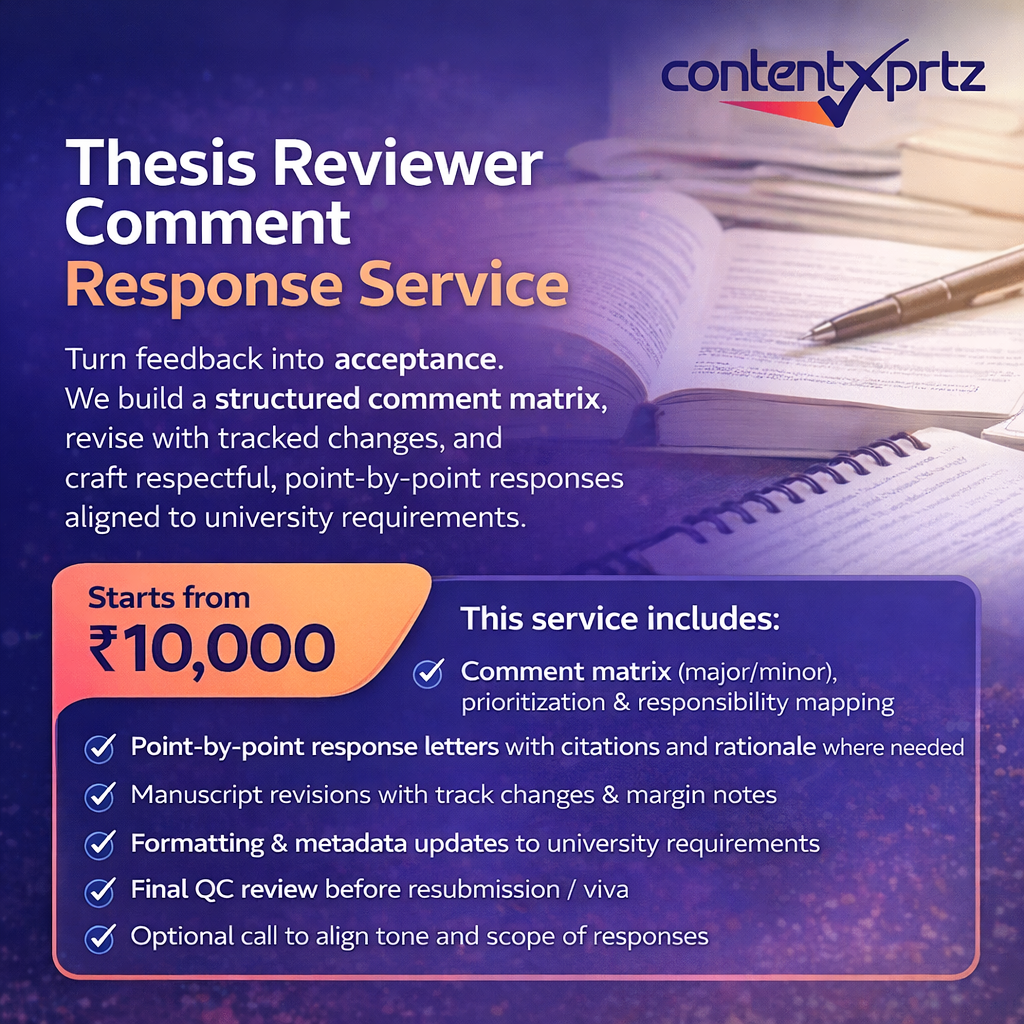
Reviewer comments don’t have to delay your thesis or resubmission. ContentXprtz’s Thesis Reviewer Comment Response Service helps you convert complex feedback into clear, respectful, and well-structured responses—aligned with academic standards and university requirements.
🧠 How we support you:
• Structured comment matrix (major/minor) with clear prioritization
• Point-by-point response letters with academic rationale and citations
• Manuscript revisions using tracked changes and margin notes
• Formatting and metadata alignment to university guidelines
• Final quality check before resubmission or viva
• Optional consultation to align tone, scope, and academic positioning
📘 Ethical & Author-First Approach
Your research remains 100% yours. We work transparently, follow academic ethics, and support clarity—never shortcuts.
💬 Ready to respond with confidence?
Message us on WhatsApp to get started today.
📲 WhatsApp: https://wa.me/917065013200
🌐 Website: https://contentxprtz.com
#PhDLife #ThesisSupport #ReviewerComments #AcademicWriting #ResearchSupport #PhDScholars #DoctoralResearch #AcademicEditing #ResearchStudents #HigherEducation #UniversitySubmission #ScholarlyWriting #ManuscriptRevision #VivaPreparation #PublicationSupport #EthicalResearch #ResearchJourney #GradSchoolLife #Academia #ResearchHelp #PhDIndia #JournalSubmission #AcademicServices #ContentXprtz
Decoding Examiner Feedback: An Academic Guide to the Thesis Reviewer Comment Response Service
Introduction: Why Responding to Thesis Reviewer Comments Is One of the Most Critical PhD Skills
For many PhD scholars, submitting a thesis feels like reaching the summit of a long academic climb. Years of conceptualization, data collection, analysis, and writing culminate in a document that represents intellectual identity and scholarly maturity. Yet, for most candidates worldwide, submission is not the end. It is the beginning of one of the most psychologically demanding and academically complex phases of doctoral study: responding to reviewer or examiner comments.
Within this context, the Thesis Reviewer Comment Response Service has emerged as an essential form of academic support rather than a luxury. Reviewer feedback is rarely superficial. It often challenges theoretical positioning, methodological rigor, analytical depth, and even the originality of the research contribution. Many comments are phrased diplomatically, but their implications can be profound. Others are direct, technical, and time-intensive to address. For international scholars and early-stage researchers, this stage can feel overwhelming.
Globally, doctoral attrition and delay rates remain high. According to the Council of Graduate Schools, nearly 40–50% of PhD candidates do not complete their doctorate within the expected timeframe, with post-submission revisions cited as a major bottleneck. In parallel, rising tuition fees, shrinking funding windows, and increased publication pressure intensify the stakes. Candidates are expected to revise with precision, defend their academic choices, and communicate changes in a way that satisfies examiners while preserving scholarly voice.
The challenge is not simply what to revise, but how to respond. Examiner comments require strategic interpretation, academic diplomacy, and structured rebuttal. A weak or defensive response letter can undermine even strong revisions. Conversely, a well-crafted response document can significantly improve examiner perception and expedite approval.
This is where a professionally guided Thesis Reviewer Comment Response Service plays a critical role. Such services do not rewrite research or compromise ethics. Instead, they provide structured academic guidance, editorial clarity, and response strategy aligned with doctoral assessment standards. For scholars working across disciplines, languages, and academic cultures, this support can mean the difference between prolonged revision cycles and successful thesis approval.
At ContentXprtz, a global academic support provider established in 2010, we have worked with doctoral researchers across more than 110 countries. Our experience shows that examiner feedback is rarely about failure. It is about alignment, clarity, and scholarly maturity. This article offers an educational, evidence-based exploration of how thesis reviewer comments should be approached, structured, and responded to, and how professional support can ethically and effectively assist scholars during this decisive stage.
Understanding the Nature of Thesis Reviewer Comments
Why Examiner Feedback Is Often More Complex Than Journal Reviews
Unlike journal peer reviews, thesis examiner comments operate within a broader evaluative framework. Examiners assess not only the written document but also the candidate’s readiness to be recognized as an independent researcher. Feedback may therefore span multiple dimensions simultaneously, including:
-
Theoretical positioning and originality
-
Methodological justification and rigor
-
Data interpretation and analytical coherence
-
Structure, logic, and academic writing quality
-
Contribution to knowledge within the discipline
According to guidance published by Springer on doctoral examination standards, examiners often focus on whether the thesis demonstrates “critical engagement with existing literature and independent scholarly judgment.” This means that comments may appear subjective, interpretive, or even contradictory between reviewers.
Such complexity makes response preparation a specialized academic skill.
Common Categories of Thesis Reviewer Comments
Understanding the intent behind examiner feedback is the first step in responding effectively. Most comments fall into identifiable categories.
Conceptual and Theoretical Comments
These comments question the framing of the research problem, the adequacy of the literature review, or the clarity of the theoretical contribution. For example, an examiner may request stronger justification for the chosen framework or ask how the study advances existing theory.
Methodological Clarifications
Method-related feedback often requires detailed revisions. Examiners may ask for clearer sampling rationale, improved validity discussion, or additional explanation of analytical techniques. According to Elsevier’s Researcher Academy, unclear methodology is among the most frequent reasons for major revisions.
Structural and Coherence Issues
These comments address chapter flow, argument progression, and internal consistency. While they may appear editorial, they often signal deeper concerns about logical development.
Language and Academic Style
Particularly for non-native English speakers, examiners may highlight issues related to clarity, tone, or academic register. Such comments should never be underestimated, as clarity directly affects perceived rigor.
Contribution and Implications
Examiners frequently ask candidates to better articulate the original contribution of the thesis or to expand on theoretical and practical implications.
Each category requires a different response strategy. A generic or superficial reply risks signaling academic immaturity.
What Is a Thesis Reviewer Comment Response Service
An Educational and Ethical Support Model
A Thesis Reviewer Comment Response Service is a specialized form of academic assistance focused exclusively on post-review revision and response. Its purpose is not to alter research ownership, but to help scholars engage with examiner feedback in a structured, academically sound manner.
At ContentXprtz, this service typically includes:
-
Detailed analysis of reviewer or examiner reports
-
Categorization and prioritization of comments
-
Guidance on revision strategy and sequencing
-
Academic editing aligned with examiner expectations
-
Drafting or refining point-by-point response documents
-
Ensuring tone, clarity, and scholarly diplomacy
Importantly, ethical services operate within established academic integrity guidelines, including those outlined by the American Psychological Association (APA) and major publishers such as Taylor and Francis.
Why Many PhD Scholars Struggle With Reviewer Responses
Time Pressure and Cognitive Fatigue
After years of research, candidates often face revision deadlines while managing employment, funding constraints, or visa timelines. Cognitive fatigue reduces the ability to objectively interpret criticism.
Emotional Impact of Feedback
Research published in Emerald Insight highlights that doctoral feedback can trigger anxiety, self-doubt, and defensive reactions. These emotions directly affect response quality.
Lack of Formal Training
Few doctoral programs formally train students in writing response-to-reviewer documents. As a result, many candidates rely on trial and error.
Language and Cultural Barriers
For international scholars, nuances of academic English and examiner expectations vary across regions. What is considered assertive in one academic culture may be perceived as defensive in another.
A structured Thesis Reviewer Comment Response Service addresses these gaps by combining editorial expertise with academic mentoring.
Best Practices for Responding to Thesis Examiner Comments
Adopt a Point-by-Point Structure
Examiners expect responses that clearly map comments to revisions. Each comment should be acknowledged, addressed, and cross-referenced to revised sections.
Maintain an Academic and Respectful Tone
Even when disagreeing, responses should remain neutral, evidence-based, and respectful. Phrases such as “We appreciate the examiner’s insight” or “Following this suggestion, the section has been revised” are standard practice.
Justify, Do Not Defend
Disagreement is permissible, but it must be supported with literature, data, or methodological reasoning. Unsupported rebuttals weaken examiner confidence.
Ensure Consistency Across the Thesis
Revisions in one chapter often require adjustments elsewhere. Inconsistency is a common examiner complaint during re-evaluation.
Professional academic editing services help ensure that revisions align seamlessly across the document.
The Role of Academic Editing in Reviewer Response Success
Academic editing during the response stage goes beyond grammar correction. It includes:
-
Aligning revisions with examiner intent
-
Strengthening argumentative clarity
-
Enhancing coherence between chapters
-
Improving precision of academic language
According to Taylor and Francis Author Services, clarity and coherence significantly influence examiner perception during re-submission.
At ContentXprtz, editing is integrated with reviewer response strategy, ensuring that changes are not only implemented but also effectively communicated.
How ContentXprtz Approaches Thesis Reviewer Comment Responses
A Structured, Scholar-Centric Process
With more than a decade of global experience, ContentXprtz follows a transparent and ethical process:
-
Initial Assessment
Examiner reports are reviewed by subject specialists and senior editors. -
Comment Mapping
Comments are categorized by type, urgency, and impact. -
Revision Strategy Design
A clear roadmap is created, prioritizing major revisions. -
Academic Editing and Guidance
Revisions are implemented or guided, depending on scholar preference. -
Response Document Preparation
A point-by-point response letter is drafted or refined. -
Final Consistency Review
The revised thesis and response document are cross-checked.
This approach aligns with international doctoral standards and preserves scholarly ownership.
For broader academic support, scholars often explore our PhD thesis help offerings under PhD & Academic Services.
Ethical Considerations in Thesis Revision Support
Ethical academic support does not involve:
-
Fabricating data
-
Altering research findings
-
Misrepresenting authorship
Instead, it focuses on clarity, structure, and scholarly communication. Major publishers, including Elsevier, explicitly acknowledge the legitimacy of professional editing and revision assistance when transparently used.
ContentXprtz adheres strictly to these principles, ensuring compliance with university and journal ethics policies.
Integrated FAQs: Addressing Common Scholar Questions
FAQ 1: Is using a Thesis Reviewer Comment Response Service academically ethical
Yes, when used correctly, a Thesis Reviewer Comment Response Service is academically ethical and widely accepted. Universities and publishers distinguish between unethical authorship manipulation and legitimate academic support. Ethical services focus on interpretation of feedback, language clarity, structure, and scholarly communication, not on altering research ownership or results. Organizations such as the APA and publishers like Springer recognize professional editing and revision guidance as acceptable, provided the intellectual content remains the author’s own.
For many international scholars, such services level the playing field by addressing language and structural barriers rather than intellectual capacity. Transparency with supervisors and adherence to institutional guidelines further ensures ethical compliance.
FAQ 2: How detailed should a thesis reviewer response document be
A high-quality response document should be comprehensive and precise. Each examiner comment should be quoted or summarized, followed by a clear explanation of how it was addressed. Page numbers, section references, and brief descriptions of revisions improve clarity.
Examiners appreciate responses that are neither overly verbose nor dismissive. According to Elsevier Researcher Academy, concise yet complete responses signal academic maturity and respect for examiner time.
FAQ 3: What if I disagree with an examiner comment
Disagreement is permissible in doctoral revision, but it must be handled diplomatically. Responses should acknowledge the examiner’s perspective, explain the rationale for maintaining the original approach, and support the decision with literature or methodological justification.
A professional Thesis Reviewer Comment Response Service helps scholars phrase such responses appropriately, reducing the risk of perceived defensiveness.
FAQ 4: Can poor responses delay thesis approval even after revisions
Yes. Examiners assess not only the revised thesis but also the response quality. Vague or poorly structured responses may lead to further clarification requests or additional revision rounds.
This is why structured response preparation is as critical as the revisions themselves.
FAQ 5: How long does the reviewer response process usually take
Timelines vary by institution and revision scope. Minor revisions may take a few weeks, while major revisions can extend over several months. Professional guidance helps streamline the process by prioritizing high-impact comments and avoiding unnecessary revisions.
FAQ 6: Should supervisors be involved in the reviewer response process
Yes, supervisors play an important role in advising on examiner intent and institutional expectations. However, supervisors may have limited availability. Professional academic support complements, rather than replaces, supervisory guidance.
FAQ 7: Do examiner expectations differ across countries
Significantly. Doctoral assessment standards vary across regions such as the UK, Australia, Europe, and North America. International scholars often struggle with these differences. Global academic service providers like ContentXprtz bring cross-cultural insight that helps align responses with regional expectations.
FAQ 8: Can academic editing improve examiner perception
Yes. Clear language, logical flow, and consistent terminology directly affect how examiners interpret scholarly rigor. Studies cited by Emerald Insight confirm that clarity enhances perceived quality, even when content remains unchanged.
FAQ 9: Is a Thesis Reviewer Comment Response Service only for weak theses
No. Many high-quality theses receive extensive feedback. Examiner comments are part of quality assurance, not an indicator of failure. Strong scholars use professional support strategically to refine and communicate their work more effectively.
FAQ 10: How do I choose a trustworthy academic support provider
Look for providers with transparent processes, established history, subject expertise, and ethical positioning. Global experience, verifiable credentials, and clear service boundaries are essential indicators of trustworthiness.
ContentXprtz, established in 2010, operates across regions with discipline-specific experts, making it a reliable partner for doctoral scholars worldwide.
Conclusion: Turning Examiner Feedback Into Academic Advancement
Reviewer comments are not obstacles. They are invitations to strengthen scholarly contribution, clarify intellectual positioning, and demonstrate academic maturity. However, navigating this stage requires more than subject knowledge. It demands strategic communication, emotional resilience, and editorial precision.
A well-structured Thesis Reviewer Comment Response Service provides scholars with the tools to engage confidently and ethically with examiner feedback. By combining academic editing, response strategy, and global examination insight, such services reduce revision cycles and improve outcomes.
For scholars seeking integrated support across writing, revision, and publication, ContentXprtz offers comprehensive solutions through its Writing and Publishing Services and dedicated research paper writing support tailored to doctoral standards.
If you are navigating examiner feedback and want structured, ethical, and globally informed guidance, explore our PhD thesis help services today.
At ContentXprtz, we don’t just edit — we help your ideas reach their fullest potential.
