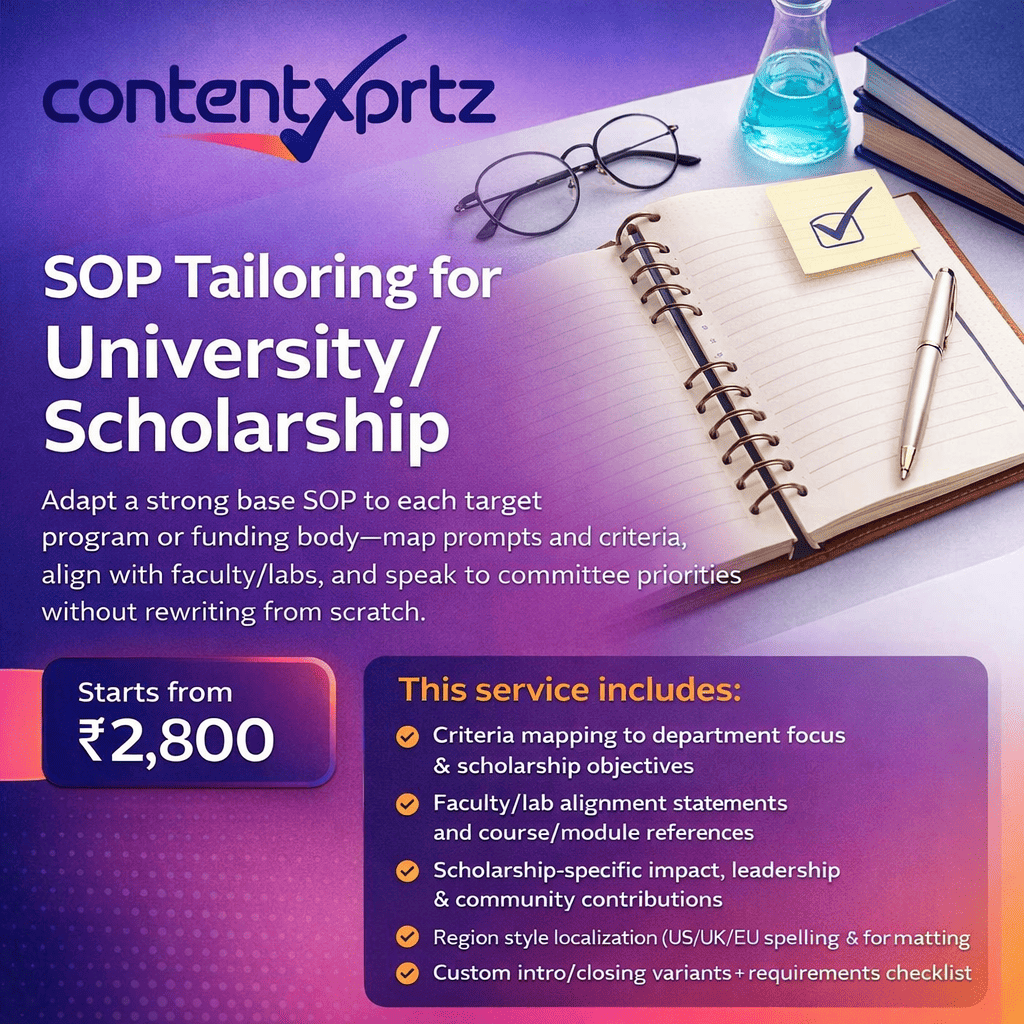
SOP Tailoring for University / Scholarship: A Strategic, Ethical, and Evidence-Based Guide for Global Applicants
Introduction: Why SOP Tailoring Is No Longer Optional in Global Academia
For many students and PhD scholars, the Statement of Purpose (SOP) is the most emotionally demanding and strategically misunderstood academic document they will ever write. It is not a mere formality. It is not a personal essay in disguise. And it is certainly not a generic summary of academic achievements. In today’s competitive academic ecosystem, SOP Tailoring for University / Scholarship has become a decisive factor that often separates successful applicants from equally qualified candidates who receive rejection letters.
Across global higher education systems, admissions committees are under unprecedented pressure. According to data published by UNESCO, international student mobility crossed 6.3 million students globally, with continued growth projected despite economic uncertainty. Simultaneously, elite universities and funding bodies have not proportionally increased seat availability or scholarship budgets. This imbalance has created an admissions environment where selection committees must rely heavily on qualitative documents to differentiate candidates.
For PhD scholars and research-focused applicants, the pressure is even greater. Doctoral programs demand not only academic excellence but also research clarity, institutional alignment, and long-term scholarly intent. A well-tailored SOP must communicate intellectual maturity, methodological awareness, and contribution potential, all within a strict word limit. This challenge intensifies for non-native English speakers, first-generation researchers, and applicants balancing teaching loads, publications, grant deadlines, and rising education costs.
Studies from publishers such as Elsevier and Springer Nature consistently highlight that doctoral attrition and funding inefficiencies often stem from misaligned expectations between candidates and institutions. Admissions committees, therefore, scrutinize SOPs for alignment, not storytelling. They want to know whether the applicant understands the department’s research culture, faculty strengths, funding philosophy, and academic values.
This is where SOP Tailoring for University / Scholarship becomes essential rather than optional. A single SOP cannot effectively address the expectations of multiple universities or funding bodies. Each institution operates within its own epistemological framework, strategic priorities, and evaluation criteria. A scholarship SOP, for example, emphasizes leadership, societal impact, and return on investment, while a doctoral SOP prioritizes research feasibility, supervision fit, and academic rigor.
At ContentXprtz, established in 2010, we have worked with applicants from more than 110 countries navigating these exact challenges. Our experience consistently demonstrates one truth: generic SOPs fail, while tailored SOPs succeed. This article provides an evidence-based, ethical, and strategic framework to help students, PhD scholars, and academic researchers understand what SOP tailoring truly involves, why it matters, and how it should be executed responsibly.
Understanding SOP Tailoring for University / Scholarship
What SOP Tailoring Really Means in Academic Evaluation
SOP Tailoring for University / Scholarship refers to the systematic customization of content, structure, tone, and emphasis in a Statement of Purpose to align with a specific university, department, program, or funding body. It does not involve fabricating experiences or exaggerating achievements. Instead, it requires strategic framing of authentic academic narratives.
Admissions committees evaluate SOPs using implicit and explicit rubrics. These rubrics vary significantly across institutions. For example, a research-intensive university in Germany may prioritize methodological clarity and alignment with funded research clusters, while a scholarship committee in Australia may focus on leadership trajectory, community impact, and national skill shortages.
Tailoring ensures that:
-
The applicant’s research interests resonate with departmental priorities
-
Academic background is framed in relation to program outcomes
-
Career goals align with institutional or national objectives
-
Motivation is demonstrated through informed choice, not generic ambition
Difference Between SOP Writing and SOP Tailoring
Many applicants confuse SOP writing with SOP tailoring. Writing focuses on language and grammar. Tailoring focuses on strategic relevance.
| Aspect |
SOP Writing |
SOP Tailoring |
| Focus |
Clarity and correctness |
Alignment and positioning |
| Audience |
General |
Specific institution or scholarship |
| Strategy |
Narrative |
Evaluation-driven |
| Outcome |
Readable SOP |
Competitive SOP |
Professional academic editing services go beyond proofreading. At ContentXprtz, SOP tailoring involves academic analysis, institutional research, and ethical positioning, ensuring originality while maximizing relevance.
Why Universities and Scholarship Committees Reject Generic SOPs
Institutional Expectations Are Not Universal
Each university operates within a distinct academic culture. According to Springer Nature’s Research Integrity reports, admissions decisions increasingly assess whether applicants demonstrate institutional literacy. Generic SOPs signal superficial engagement and raise concerns about commitment.
Scholarship Committees Assess Return on Investment
Funding bodies view scholarships as long-term investments. Reports from Emerald Insight emphasize that successful applicants articulate:
A recycled SOP rarely addresses these criteria convincingly.
High Rejection Rates Are Not About Merit Alone
Elsevier’s global education analytics suggest that rejection rates for competitive doctoral programs often exceed 80 percent, even among high-achieving candidates. Rejections frequently stem from:
-
Misalignment with faculty expertise
-
Vague research objectives
-
Weak articulation of motivation
SOP tailoring directly addresses these gaps.
Core Components of an Effectively Tailored SOP
Academic Background Positioned Strategically
A tailored SOP does not list qualifications. It interprets them. Coursework, research projects, and publications must be framed in relation to the target program’s expectations.
Research Interests Anchored in Institutional Context
PhD applicants must demonstrate awareness of:
This signals preparedness and reduces supervisory risk.
Motivation Grounded in Evidence
Motivation statements should reflect:
-
Engagement with institutional literature
-
Understanding of program structure
-
Long-term academic or professional intent
Career Goals Aligned with Scholarship Mandates
Scholarship SOPs must explicitly connect personal goals with:
-
National development priorities
-
Academic capacity building
-
Social or economic impact
SOP Tailoring for PhD Applicants: Advanced Considerations
Demonstrating Research Feasibility
Committees assess whether the proposed research:
-
Is methodologically sound
-
Fits within program timelines
-
Aligns with available supervision
Balancing Independence and Supervision
Effective SOPs convey intellectual autonomy while acknowledging the value of mentorship. Overstated independence can be as problematic as excessive dependence.
Ethical Research Positioning
Leading publishers such as Taylor & Francis emphasize ethical awareness as a marker of doctoral readiness. Tailored SOPs should reflect familiarity with research ethics, data integrity, and responsible scholarship.
SOP Tailoring for Scholarships: Strategic Framing
Leadership Without Hyperbole
Scholarship committees value leadership demonstrated through sustained action, not inflated claims. Tailoring ensures leadership narratives are credible and contextualized.
Impact-Oriented Storytelling
Applicants must articulate how their education will create value beyond personal advancement. This includes:
-
Academic dissemination
-
Policy influence
-
Community engagement
The Role of Professional SOP Tailoring Services
Why Self-Editing Is Often Insufficient
Even experienced researchers struggle to evaluate their SOPs objectively. Cognitive bias, disciplinary blind spots, and unfamiliarity with institutional expectations limit effectiveness.
What Ethical SOP Support Involves
At ContentXprtz, SOP Tailoring for University / Scholarship includes:
-
Institutional and program analysis
-
Academic positioning
-
Language refinement without voice distortion
-
Plagiarism-free, original drafting
This approach aligns with best practices outlined by APA and global academic integrity standards.
Integrated FAQs: Deep Academic Guidance
FAQ 1: How different should SOPs be for each university or scholarship?
A tailored SOP should differ substantially in emphasis and framing, even if core academic experiences remain consistent. Universities assess fit, while scholarships assess impact and return. A single SOP cannot address both effectively without dilution. Tailoring involves reordering priorities, adjusting terminology, and aligning narratives with evaluation criteria. This does not mean rewriting from scratch each time, but it does require intentional customization informed by institutional research and academic judgment.
FAQ 2: Can SOP tailoring affect plagiarism checks?
Ethical SOP tailoring enhances originality rather than compromising it. Plagiarism concerns arise from template reuse or copying institutional language excessively. Professional academic editing services focus on original expression, paraphrasing grounded in the applicant’s voice, and proper attribution where necessary. This aligns with integrity standards promoted by publishers such as Elsevier and APA.
FAQ 3: How long should a tailored SOP take to develop?
A high-quality tailored SOP typically requires 10 to 20 hours of research, drafting, and revision. This includes institutional analysis, content structuring, and language refinement. Rushed SOPs often lack coherence and strategic depth. PhD applicants balancing research and teaching responsibilities benefit significantly from structured academic support.
FAQ 4: Is SOP tailoring relevant for coursework-based programs?
Yes. Coursework programs assess employability alignment, skill development, and motivation. Tailored SOPs demonstrate understanding of curriculum structure, industry relevance, and career pathways. Generic SOPs often fail to articulate why a specific program, rather than the degree itself, is the right choice.
FAQ 5: Should faculty names be mentioned in SOPs?
Mentioning faculty can strengthen alignment if done thoughtfully. References should be based on genuine research interest and methodological fit, not superficial name-dropping. Committees recognize informed engagement and penalize inaccurate or forced associations.
FAQ 6: How does SOP tailoring help non-native English speakers?
Tailoring ensures clarity without erasing cultural identity. Academic editing services refine language while preserving voice, reducing the risk of misinterpretation. This improves readability, coherence, and evaluative confidence without homogenizing expression.
FAQ 7: Are scholarship SOPs evaluated differently from university SOPs?
Yes. Scholarship SOPs emphasize leadership, societal contribution, and long-term impact. University SOPs focus on academic preparedness and fit. Tailoring ensures that content priorities reflect these differences rather than applying a one-size-fits-all narrative.
FAQ 8: Can SOP tailoring compensate for lower grades?
While SOPs cannot replace academic credentials, they can contextualize performance, highlight growth, and demonstrate readiness. Committees often value resilience, research clarity, and motivation alongside quantitative metrics.
FAQ 9: How early should applicants start SOP preparation?
Ideally, SOP preparation should begin three to six months before deadlines. This allows time for reflection, feedback, and alignment with evolving application strategies. Early preparation reduces stress and improves quality.
FAQ 10: Is professional SOP support ethical?
Yes, when it adheres to academic integrity standards. Ethical support involves guidance, editing, and strategic framing, not misrepresentation. Reputable providers, including ContentXprtz, operate within globally accepted academic norms.
Internal Academic Support Resources
Applicants seeking structured assistance can explore:
Conclusion: Strategic SOPs Shape Academic Futures
In an era of intense academic competition, SOP Tailoring for University / Scholarship is not an optional enhancement. It is a strategic necessity. Universities and funding bodies seek candidates who demonstrate alignment, clarity, and purpose. A tailored SOP communicates these qualities with precision, integrity, and confidence.
For students, PhD scholars, and researchers navigating complex application landscapes, professional guidance transforms uncertainty into strategic advantage. With evidence-based methodologies, ethical standards, and global experience, ContentXprtz supports applicants in presenting their academic journeys authentically and competitively.
Explore our PhD and Academic Assistance Services to begin your SOP journey with clarity and confidence.
At ContentXprtz, we don’t just edit — we help your ideas reach their fullest potential.