
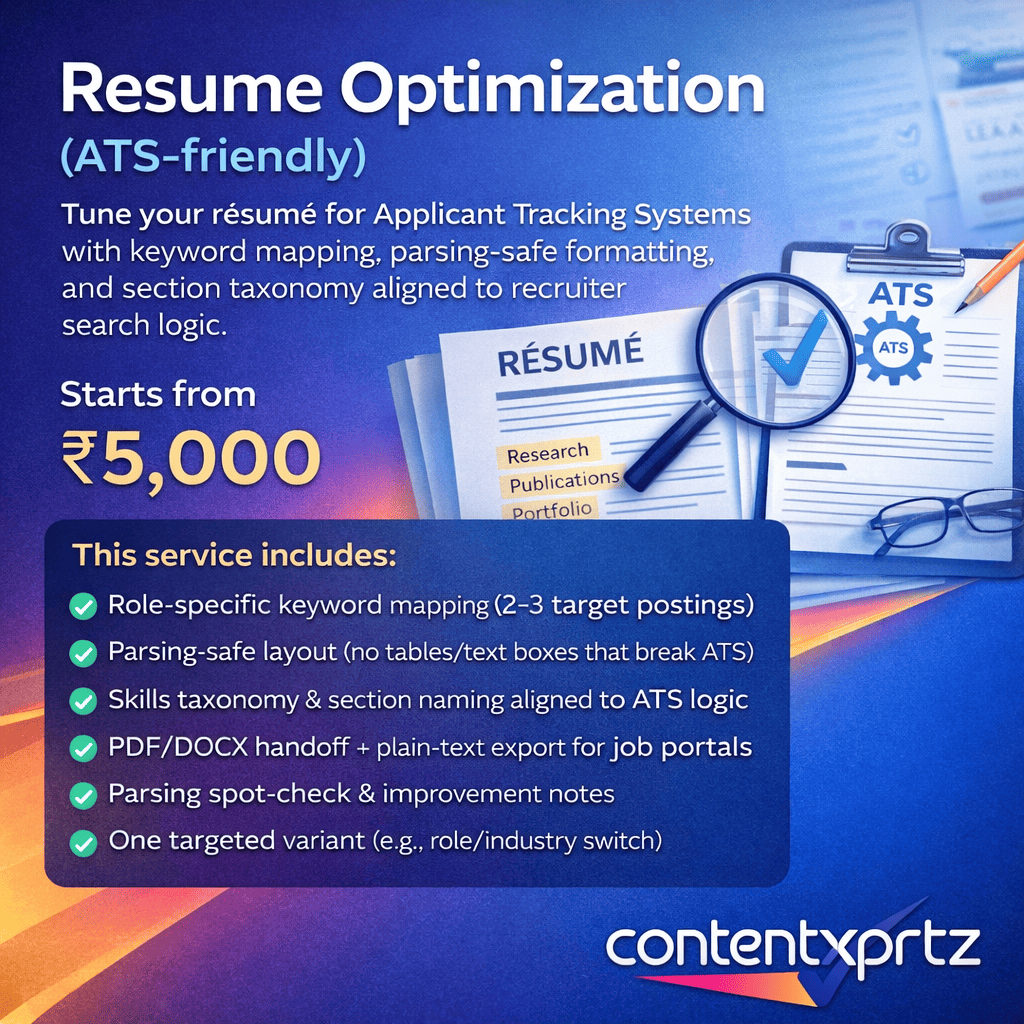
Optimize Your Résumé for Academic & Industry Success
Stand out with an ATS-friendly résumé built for how recruiters actually search 📄
Our Resume Optimization (ATS-friendly) service helps students, PhD scholars, and academic professionals present their expertise with clarity, structure, and recruiter-aligned logic—without compromising originality or ownership.
What you get:
• Role-specific keyword mapping for 2–3 target postings
• Parsing-safe formatting that works across ATS platforms
• Skills taxonomy and section naming aligned to recruiter logic
• PDF/DOCX delivery plus plain-text version for job portals
• One targeted résumé variant for role or industry transitions
Ethical & transparent support:
Your content remains yours—no fabrication, no exaggeration, and no generic templates. We refine, structure, and optimize while preserving your academic and professional integrity.
Starts from ₹5,000
Message us on WhatsApp to get started today
WhatsApp: https://wa.me/917065013200
Website: https://contentxprtz.com
#ContentXprtz #ResumeOptimization #ATSResume #AcademicCareers #PhDSupport #ResearchCareers #AcademicWritingServices #PublicationSupport #PhDScholars #PostdocLife #HigherEducationCareers #ResearchJobs #AcademicCV #CareerDevelopment #EthicalWriting #ResearchProfessionals #GraduateCareers #ScholarlySupport #AcademiaToIndustry #JobSearchStrategy #UniversityCareers #STEMCareers #HumanitiesCareers #AcademicBranding
Resume Optimization (ATS-friendly): A Strategic, Academic Guide for Students, PhD Scholars, and Researchers Seeking Global Career Mobility
Introduction: Why Resume Optimization (ATS-friendly) Matters More Than Ever in Academic and Research Careers
For PhD scholars, postdoctoral researchers, and academically trained professionals, the resume has quietly become one of the most decisive documents of a career. While years are invested in doctoral training, peer-reviewed publications, and methodological expertise, many highly qualified scholars face repeated rejections before their profiles even reach human reviewers. The reason is rarely a lack of competence. More often, it is the absence of Resume Optimization (ATS-friendly) design and structure.
Applicant Tracking Systems, commonly referred to as ATS, now dominate recruitment pipelines across universities, research institutions, multinational corporations, and policy think tanks. According to data published by Jobscan, over 98 percent of Fortune 500 companies rely on ATS software to screen resumes before any human evaluation occurs. Similar automated screening mechanisms are increasingly used in academic hiring, grant-funded project recruitment, and research consulting roles.
For PhD scholars, this creates a paradox. Academic training emphasizes depth, nuance, and intellectual rigor. ATS systems, however, prioritize clarity, structure, keyword relevance, and machine readability. As a result, even exceptional researchers experience resume rejections due to formatting issues, misaligned terminology, or excessive academic jargon.
The pressure is global. UNESCO reports that the number of doctoral graduates worldwide has more than doubled in the past two decades, while tenure-track and long-term research positions have grown at a much slower pace. At the same time, rising publication costs, funding uncertainty, and extended time-to-degree have intensified career anxiety among doctoral candidates. Many scholars now pursue parallel pathways into industry research, policy analysis, academic publishing, data analytics, and consulting. Each of these pathways requires a resume that communicates academic value in an ATS-compatible, recruiter-friendly manner.
This is where Resume Optimization (ATS-friendly) becomes not just a technical exercise, but a strategic academic intervention. A well-optimized resume translates scholarly expertise into language that both machines and hiring committees understand. It preserves intellectual credibility while enhancing discoverability, relevance, and impact.
At ContentXprtz, we have worked with researchers and professionals across more than 110 countries since 2010. Our experience consistently shows that resume optimization is one of the most overlooked yet highest-impact interventions for academically trained professionals. This comprehensive guide is designed to bridge that gap. It offers evidence-based insights, ethical best practices, and practical frameworks to help scholars align their resumes with modern ATS requirements while maintaining academic integrity.
Understanding Resume Optimization (ATS-friendly) in an Academic Context
What Is an ATS and Why Does It Screen Academic Resumes?
An Applicant Tracking System is a software platform that automates resume screening by parsing content, extracting keywords, and ranking candidates against predefined criteria. While originally designed for corporate recruitment, ATS platforms are now widely adopted by universities, research centers, funding agencies, and interdisciplinary research projects.
For academic resumes, ATS systems typically evaluate:
-
Educational qualifications and degree relevance
-
Research keywords aligned with job descriptions
-
Methodological expertise and technical skills
-
Publication and project experience
-
Institutional affiliations and funding exposure
Unlike human reviewers, ATS systems cannot interpret context, intellectual nuance, or narrative coherence. They rely on structured data and exact or semantically similar keyword matches.
Resume Optimization (ATS-friendly) Versus Traditional Academic CVs
Many PhD scholars submit lengthy academic CVs when applying for non-faculty roles. While appropriate for tenure-track evaluations, such documents often fail ATS screening. An ATS-friendly resume differs in several critical ways:
-
Concise formatting rather than exhaustive listings
-
Role-aligned keywords instead of discipline-specific jargon
-
Skills-based structuring alongside academic achievements
-
Clear section headers that ATS systems can parse accurately
Resume Optimization (ATS-friendly) does not dilute academic value. Instead, it reframes scholarly expertise in a format compatible with contemporary recruitment ecosystems.
Why PhD Scholars and Researchers Struggle With ATS Screening
Structural Mismatch Between Academia and Recruitment Technology
Doctoral training emphasizes originality, theoretical contribution, and methodological depth. ATS systems, however, prioritize standardized descriptors, measurable outcomes, and skills taxonomies. This mismatch leads to systematic underrepresentation of academic candidates in ATS shortlists.
Overuse of Untranslated Academic Language
Terms such as epistemological framework, phenomenological inquiry, or discursive analysis carry meaning in scholarly contexts. ATS systems, however, often fail to map these terms to applied competencies such as qualitative research design, stakeholder analysis, or data interpretation.
Formatting and Design Errors
Many academically trained professionals use complex layouts, tables, or graphical elements. These often break ATS parsing logic, leading to incomplete or misread resumes.
Core Principles of Resume Optimization (ATS-friendly) for Academic Profiles
Keyword Alignment Based on Role Analysis
Effective Resume Optimization (ATS-friendly) begins with rigorous analysis of job descriptions. Academic candidates should identify:
-
Required competencies
-
Preferred methodologies
-
Industry-specific terminology
-
Software and tools referenced
These keywords must then be integrated naturally into resume sections without artificial stuffing.
Section Standardization for ATS Parsing
ATS systems recognize conventional headings such as:
-
Professional Summary
-
Education
-
Research Experience
-
Skills
-
Publications
-
Projects
Non-standard headings may confuse parsing algorithms and reduce match scores.
Quantification of Academic Impact
Where possible, academic achievements should be quantified:
-
Number of publications and citations
-
Grant funding amounts
-
Dataset sizes
-
Conference presentations
Quantification improves both ATS scoring and human reviewer engagement.
Ethical Resume Optimization: Maintaining Academic Integrity
Ethical considerations are central to academic resume development. Resume Optimization (ATS-friendly) must never involve misrepresentation, fabricated metrics, or exaggerated claims. Leading publishers such as Elsevier and Springer emphasize transparency and accuracy as foundational research ethics principles.
At ContentXprtz, resume optimization follows strict ethical guidelines:
-
All claims are evidence-based
-
Terminology is translated, not distorted
-
Academic contributions remain accurately attributed
-
No false authorship or inflated metrics are introduced
This approach ensures long-term credibility and professional sustainability.
Resume Optimization (ATS-friendly) Across Career Pathways
Academic Administration and Research Management
Roles in academic administration require resumes that emphasize project coordination, compliance, and stakeholder engagement rather than theoretical depth alone.
Industry Research and Data Roles
For industry transitions, resumes must highlight transferable skills such as data analysis, modeling, and applied research design.
Publishing and Editorial Careers
Applicants targeting publishers such as Emerald Insight or Taylor & Francis should emphasize peer-review experience, editorial workflows, and publication ethics familiarity.
Integrating Professional Academic Support for Resume Optimization
Many scholars attempt resume optimization independently. However, professional academic support significantly improves outcomes. Services such as academic editing services and PhD thesis help provide structured, role-aligned guidance grounded in global recruitment standards.
Frequently Asked Questions on Resume Optimization (ATS-friendly)
FAQ 1: Is Resume Optimization (ATS-friendly) relevant for PhD scholars applying to academic roles?
Absolutely. While tenure-track applications often require CVs, many academic roles now involve ATS screening. Research associate, project scientist, and grant-funded positions frequently use automated systems. ATS-friendly optimization ensures your profile is not filtered out before committee review. It also helps align your academic narrative with institutional priorities.
FAQ 2: Can an ATS-friendly resume still include publications and research depth?
Yes. The key is structuring publication information clearly and concisely. Use standard citation formats and highlight impact indicators. Avoid excessive bibliographic detail. This preserves academic credibility while ensuring ATS readability.
FAQ 3: How do keywords affect Resume Optimization (ATS-friendly)?
Keywords act as matching signals between your resume and job descriptions. ATS systems rank resumes based on keyword frequency and relevance. Strategic keyword integration improves visibility without compromising narrative integrity.
FAQ 4: Should PhD scholars create multiple ATS-optimized resumes?
Yes. Tailoring resumes for different roles significantly improves match scores. Industry research, academic administration, and publishing roles require different keyword emphases and structural priorities.
FAQ 5: Is professional resume optimization ethical in academia?
Professional optimization is ethical when it clarifies and accurately represents your qualifications. Leading style authorities such as the American Psychological Association emphasize clarity, transparency, and accuracy in professional documentation.
FAQ 6: How long should an ATS-friendly academic resume be?
Typically, two to three pages for research-focused roles. Length depends on experience level and role requirements. Conciseness improves ATS parsing and recruiter engagement.
FAQ 7: Do ATS systems read PDFs correctly?
Most modern ATS systems parse PDFs, but formatting errors still occur. Clean layouts, standard fonts, and linear structures improve reliability. When in doubt, follow employer submission guidelines.
FAQ 8: How does resume optimization differ from academic CV editing?
Resume optimization focuses on role alignment, keyword strategy, and ATS compatibility. CV editing emphasizes completeness and academic chronology. Both serve different professional purposes.
FAQ 9: Can resume optimization help with grant and fellowship applications?
Indirectly, yes. Clear articulation of skills, outcomes, and impact strengthens personal statements and bios used in funding applications.
FAQ 10: When should a PhD scholar seek professional resume support?
Professional support is advisable when transitioning sectors, facing repeated rejections, or applying internationally. Services such as research paper writing support and corporate writing services provide targeted expertise.
Conclusion: Strategic Resume Optimization as an Academic Investment
Resume Optimization (ATS-friendly) is no longer optional for scholars navigating competitive, technology-mediated career markets. It is a strategic investment that translates years of academic labor into accessible, discoverable professional value. When executed ethically and expertly, it enhances both opportunity and integrity.
At ContentXprtz, we combine global academic expertise with modern recruitment intelligence to support scholars at every career stage. We invite you to explore our PhD & Academic Services and discover how professional optimization can accelerate your academic and professional journey.
At ContentXprtz, we don’t just edit – we help your ideas reach their fullest potential.
