
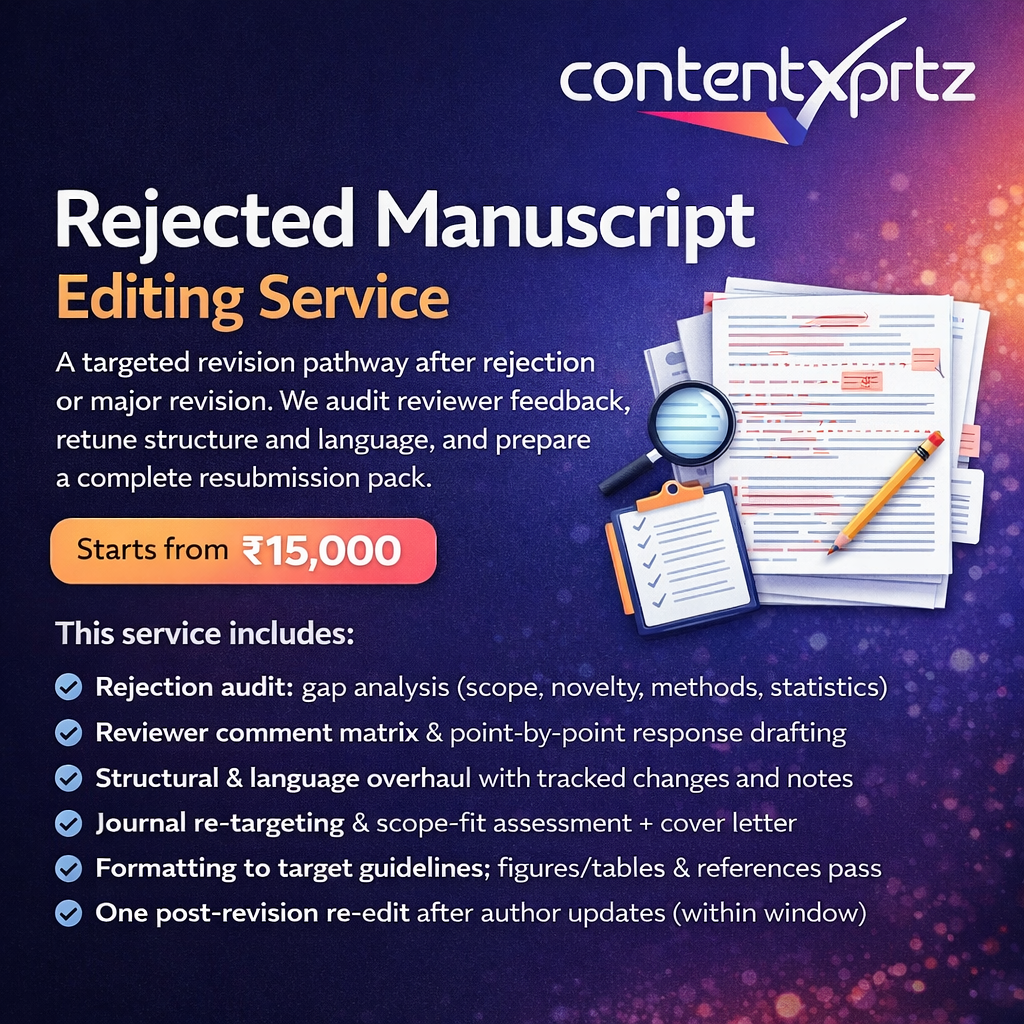
📄 Manuscript Rejected? Turn Reviewer Feedback into a Strong Resubmission.
🎓 Rejected Manuscript Editing Service by ContentXprtz
A rejection doesn’t mean the end of your research. It means your manuscript needs a clearer response, stronger structure, and better journal alignment. Our Rejected Manuscript Editing Service provides a targeted revision pathway after rejection or major revision—designed for confident resubmission.
How we support your resubmission:
📘 In-depth rejection audit and gap analysis (scope, novelty, methods, statistics)
📄 Reviewer comment matrix with clear, point-by-point response drafting
🧠 Structural and language refinement with tracked changes and expert notes
🎓 Journal re-targeting, scope-fit assessment, and tailored cover letter
📑 Formatting aligned to journal guidelines, including figures, tables, and references
✔️ Ethical, original, and transparent editing
✔️ Your research, your authorship—fully respected
✔️ One post-revision re-edit after your updates (within the defined window)
Starts from ₹15,000
📲 Message us on WhatsApp to get started today
WhatsApp: https://wa.me/917065013200
🌐 Website: https://contentxprtz.com
#ContentXprtz #RejectedManuscript #ManuscriptEditing #AcademicEditing #PhDSupport #ResearchPublication #JournalSubmission #PeerReview #ReviewerComments #PhDScholars #AcademicWriting #ResearchSupport #PublishYourResearch #ScholarlyPublishing #PostdocLife #ResearchLife #JournalResubmission #HigherEducation #EthicalEditing #ResearchIntegrity #UniversityResearch #STEMResearch #SocialScienceResearch
From Rejection to Resubmission Excellence: A Strategic Guide to Rejected Manuscript Editing Service for Academic Success
Introduction: When Rejection Becomes a Turning Point in Your Academic Journey
For PhD scholars, early-career researchers, and seasoned academics alike, a manuscript rejection can feel deeply personal. Months or even years of intellectual labor are distilled into a few pages of reviewer comments, often accompanied by a decisive “reject” or “major revision required.” In these moments, the emotional weight of rejection intersects with practical concerns: limited time, mounting publication pressure, funding deadlines, and the escalating costs of academic progression. It is precisely at this crossroads that a Rejected Manuscript Editing Service becomes not just helpful, but strategically essential.
Globally, academic publishing has become more competitive than ever. According to data reported by Elsevier, leading journals in science, technology, medicine, and social sciences now report acceptance rates ranging between 5 percent and 20 percent, depending on discipline and journal tier. Springer Nature similarly highlights that desk rejections often occur not because research lacks originality, but because manuscripts fail to meet editorial standards in structure, clarity, or alignment with journal scope. For PhD scholars balancing teaching responsibilities, data collection, grant writing, and personal obligations, revising a rejected manuscript without expert guidance can be overwhelming.
Moreover, the pressure to publish in high-impact journals is no longer limited to tenure-track academics. Doctoral candidates increasingly face “publish or progress” expectations, where peer-reviewed publications influence thesis evaluation, postdoctoral opportunities, and academic employability. At the same time, rising tuition fees, shrinking research funding, and mental health challenges have transformed the PhD experience into a high-stakes endeavor. In this context, manuscript rejection is not merely an editorial decision; it is a potential delay in an already demanding academic trajectory.
A professional Rejected Manuscript Editing Service addresses this reality with precision and empathy. Rather than treating rejection as failure, it reframes reviewer feedback as actionable intelligence. Through expert academic editing, journal-specific restructuring, and ethical language refinement, rejected manuscripts can be transformed into stronger, clearer, and more persuasive submissions. This process does not alter the author’s intellectual ownership. Instead, it amplifies scholarly voice while ensuring compliance with publisher expectations.
At ContentXprtz, established in 2010 and serving researchers across more than 110 countries, rejected manuscripts are viewed as works in progress with high potential. Our editorial philosophy recognizes that most rejections stem from remediable issues: unclear argumentation, weak methodological articulation, inconsistent referencing, or misalignment with journal aims. By addressing these systematically, scholars regain confidence and control over their publication journey.
This comprehensive guide explores how a Rejected Manuscript Editing Service functions, why it is critical for PhD scholars and researchers, and how it aligns with global academic publishing standards. Drawing on evidence from leading publishers such as Elsevier, Springer, Emerald Insight, Taylor and Francis, and APA, the article offers practical insights, ethical considerations, and expert strategies to help scholars convert rejection into resubmission success.
Understanding Manuscript Rejection in Contemporary Academic Publishing
Why High-Quality Research Gets Rejected
Contrary to common perception, manuscript rejection does not automatically indicate poor research quality. Editorial reports from Taylor and Francis emphasize that many rejected papers demonstrate strong empirical foundations but fall short in presentation, coherence, or journal fit. Common reasons include:
-
Misalignment with journal scope or audience
-
Insufficient engagement with recent literature
-
Weak articulation of contribution or novelty
-
Language clarity issues affecting reviewer comprehension
-
Methodological descriptions lacking transparency
In interdisciplinary fields, these challenges intensify. A manuscript written for a broad audience may fail to satisfy the specialized expectations of a niche journal. Conversely, highly technical writing may alienate reviewers seeking conceptual clarity.
The Psychological and Professional Cost of Rejection
Rejection also carries psychological consequences. Studies published by the American Psychological Association note increased anxiety, self-doubt, and burnout among doctoral candidates facing repeated manuscript rejection. Without structured support, scholars may either abandon promising work or resubmit without adequately addressing reviewer concerns, leading to repeated rejection cycles.
A Rejected Manuscript Editing Service mitigates these risks by introducing distance, objectivity, and expertise into the revision process. It transforms emotional feedback into structured revision pathways.
What Is a Rejected Manuscript Editing Service?
A Rejected Manuscript Editing Service is a specialized academic support solution designed to help authors revise manuscripts that have been rejected or require major revisions. Unlike basic proofreading, this service operates at multiple levels:
-
Structural editing to improve argument flow and coherence
-
Substantive editing to strengthen clarity, logic, and contribution
-
Language editing aligned with academic tone and journal style
-
Reviewer comment mapping and response strategy development
This service is particularly valuable when reviewer feedback is extensive, conflicting, or technically complex. Editors with subject-matter expertise interpret reviewer intent, prioritize revisions, and ensure that changes align with the target journal’s editorial philosophy.
At ContentXprtz, rejected manuscript editing integrates ethical editing practices, preserving authorial voice while enhancing scholarly rigor. This approach aligns with guidance from the Committee on Publication Ethics, which emphasizes transparency and author responsibility in editorial assistance.
How Rejected Manuscript Editing Supports PhD Scholars and Researchers
Strategic Alignment with Journal Expectations
Every academic journal has implicit norms regarding structure, argumentation, and methodological reporting. Editors familiar with publishers such as Elsevier, Springer, and Emerald Insight understand these nuances. A targeted Rejected Manuscript Editing Service ensures that revisions directly address both explicit reviewer comments and implicit editorial expectations.
Enhancing Scholarly Communication
High-quality research can be undermined by unclear writing. Professional academic editing improves:
-
Logical transitions between sections
-
Precision in theoretical framing
-
Consistency in terminology and referencing
-
Clarity in results interpretation
This level of refinement increases reviewer confidence and reduces cognitive load, improving acceptance probability.
Saving Time and Reducing Cognitive Burden
PhD scholars often revise manuscripts alongside ongoing research, teaching, and administrative duties. Expert editing accelerates the revision process by providing structured guidance, allowing scholars to focus on intellectual decision-making rather than technical corrections.
The ContentXprtz Approach to Rejected Manuscript Editing
ContentXprtz operates as a global academic partner, not a transactional editing vendor. Our rejected manuscript editing process includes:
-
Initial Diagnostic Review
Comprehensive analysis of reviewer comments, editor notes, and journal requirements. -
Revision Strategy Development
Prioritization of revisions based on impact and feasibility. -
Expert Academic Editing
Subject-aligned editors refine structure, argumentation, and language. -
Resubmission Readiness Check
Final quality assurance aligned with target journal guidelines.
Researchers seeking broader support can explore our academic editing services, which integrate editing with publication strategy.
Ethical Considerations in Rejected Manuscript Editing
Ethical editing is foundational to academic integrity. According to APA and COPE guidelines, editing support must not involve data fabrication, ghostwriting, or misrepresentation of authorship. A reputable Rejected Manuscript Editing Service adheres strictly to these principles.
ContentXprtz emphasizes transparency, author ownership, and scholarly authenticity. Our editors refine expression and structure, not intellectual content. This distinction ensures compliance with publisher ethics policies and protects researchers from reputational risk.
Integrated FAQs: Addressing Common Concerns About Rejected Manuscript Editing
FAQ 1: Does using a rejected manuscript editing service compromise academic integrity?
Academic integrity remains intact when editing focuses on clarity, structure, and language rather than content creation. Leading publishers such as Elsevier and Springer explicitly permit professional language editing. Ethical services follow COPE and APA guidelines, ensuring that intellectual ownership remains with the author. At ContentXprtz, editors do not add data or arguments. They refine presentation to meet scholarly standards. This approach supports integrity while enhancing communication effectiveness.
FAQ 2: How is rejected manuscript editing different from standard proofreading?
Proofreading addresses surface-level issues such as grammar and punctuation. In contrast, a Rejected Manuscript Editing Service involves substantive revision. Editors analyze reviewer feedback, restructure arguments, improve coherence, and align the manuscript with journal expectations. This depth is essential when rejection stems from conceptual or structural concerns rather than minor language errors.
FAQ 3: Can rejected manuscript editing improve acceptance chances?
While no service can guarantee acceptance, evidence suggests that professionally edited manuscripts receive more favorable reviewer evaluations. Springer Nature reports that clarity and structure significantly influence editorial decisions. By addressing reviewer concerns comprehensively, rejected manuscript editing increases the likelihood of positive outcomes upon resubmission.
FAQ 4: Is rejected manuscript editing suitable for all disciplines?
Yes. However, effectiveness depends on subject expertise. Editors with disciplinary knowledge understand methodological norms, theoretical frameworks, and citation practices. ContentXprtz assigns subject specialists across sciences, social sciences, humanities, and interdisciplinary fields, ensuring contextual accuracy.
FAQ 5: How should authors respond to reviewer comments after editing?
Editors often provide guidance on crafting response-to-reviewer documents. These responses should be respectful, concise, and evidence-based. A Rejected Manuscript Editing Service helps authors map revisions to reviewer comments, improving transparency and editorial trust.
FAQ 6: What if reviewer comments are contradictory?
Contradictory feedback is common. Expert editors help authors navigate these conflicts by identifying underlying concerns and proposing balanced revisions. When necessary, authors can justify decisions in response letters, supported by literature and methodological rationale.
FAQ 7: Does editing help with resubmission to a different journal?
Yes. Rejected manuscript editing often includes journal retargeting. Editors adjust framing, scope, and style to suit alternative journals while preserving core findings. This flexibility is particularly valuable when desk rejection indicates scope mismatch.
FAQ 8: How long does rejected manuscript editing take?
Turnaround time varies based on manuscript length and revision complexity. Typically, comprehensive editing requires one to three weeks. Structured workflows reduce delays, allowing timely resubmission aligned with academic timelines.
FAQ 9: Can doctoral candidates afford rejected manuscript editing services?
Cost considerations are valid. However, delayed publication can result in extended PhD duration and additional tuition costs. Many scholars view professional editing as an investment in timely completion and career advancement. ContentXprtz offers scalable solutions for different academic stages.
FAQ 10: How do I choose a trustworthy rejected manuscript editing service?
Key indicators include transparent processes, subject expertise, ethical policies, and verifiable experience. Established providers with global reach and academic credentials inspire confidence. ContentXprtz’s long-standing presence and international client base reflect sustained trust.
Leveraging Rejected Manuscript Editing Within a Broader Academic Support Framework
Rejected manuscript editing is most effective when integrated into comprehensive academic support. Scholars may also require:
-
PhD thesis help during manuscript development
-
Research paper writing support for new submissions
-
Book and monograph editing for advanced projects
ContentXprtz offers specialized support through its PhD and academic services, student writing services, book author writing services, and corporate writing services. This integrated approach ensures continuity across academic milestones.
Conclusion: Turning Rejection into Scholarly Resilience
Manuscript rejection, while challenging, is an inherent part of academic publishing. When approached strategically, it becomes an opportunity for refinement, growth, and eventual success. A professional Rejected Manuscript Editing Service provides the expertise, objectivity, and ethical guidance necessary to navigate this process effectively.
By aligning manuscripts with journal standards, enhancing scholarly communication, and supporting authors through evidence-based revision strategies, ContentXprtz empowers researchers to move forward with confidence. For PhD scholars and academics committed to excellence, rejection is not an endpoint. It is a transition toward stronger scholarship and wider impact.
If you are seeking trusted PhD thesis help, academic editing services, or research paper writing support, explore our comprehensive academic solutions today.
At ContentXprtz, we don’t just edit — we help your ideas reach their fullest potential.
