
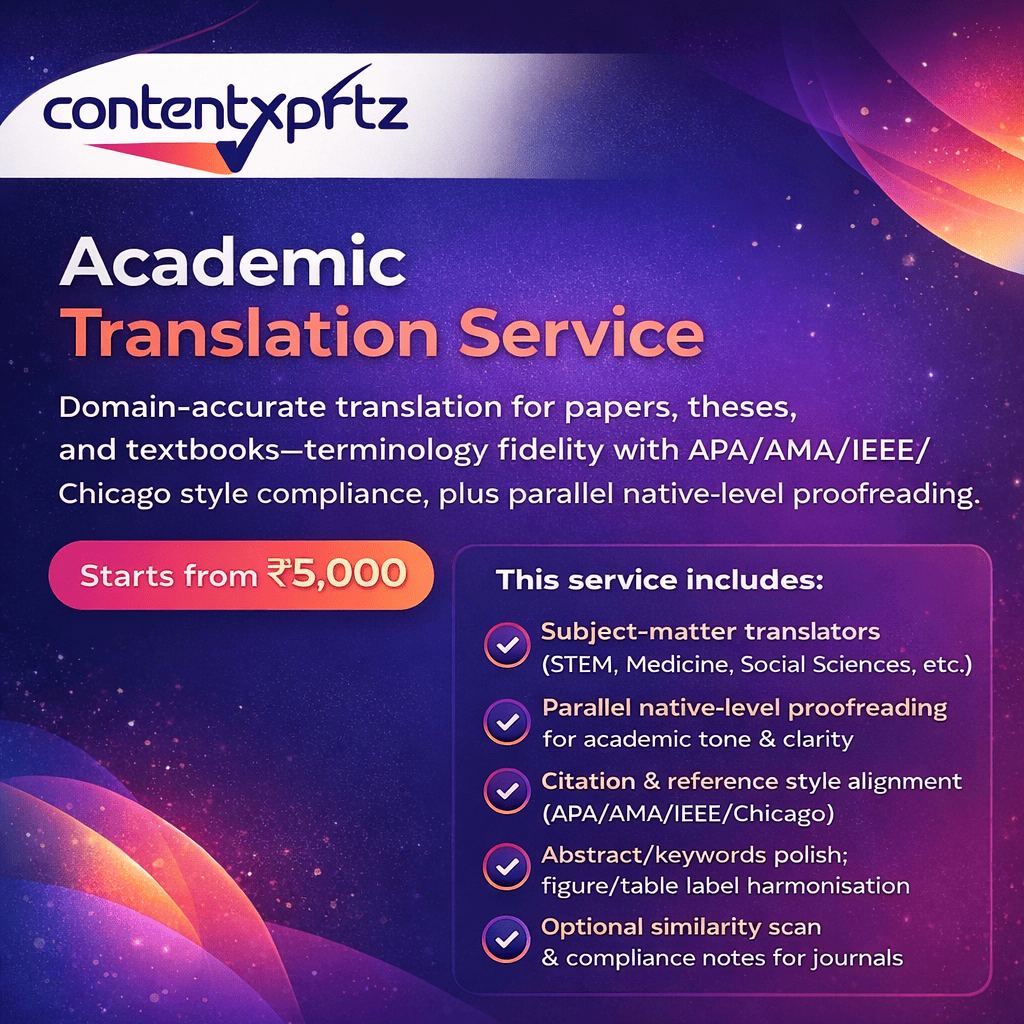
📘 Academic Translation That Preserves Your Research Voice
Clarity, accuracy, and publication-ready English—without compromising authorship.
At ContentXprtz, our Academic Translation Service is designed for researchers who need domain-accurate translation that meets international journal standards. From papers and theses to textbooks, we ensure terminology precision, academic tone, and style compliance—so your work is ready for submission with confidence.
What you get:
• Subject-matter translators across STEM, Medicine & Social Sciences
• Parallel native-level proofreading for clarity and academic tone
• APA / AMA / IEEE / Chicago citation & reference alignment
• Abstract & keyword polish; figure and table label harmonisation
• Optional similarity scan with journal compliance notes
We follow ethical, transparent processes—your ideas remain yours. No content ownership claims. No exaggerated promises. Just rigorous academic support you can trust.
💬 Message us on WhatsApp to get started today
📲 WhatsApp: https://wa.me/917065013200
🌐 Website: https://contentxprtz.com
🎓 Trusted support for serious research and responsible publishing.
#AcademicTranslation #PhDSupport #ResearchWriting #AcademicServices #JournalSubmission #PhDScholars #ResearchPublication #ThesisSupport #ScholarlyPublishing #AcademicEditing #ResearchEthics #HigherEducation #PostdocLife #STEMResearch #SocialScienceResearch #MedicalResearch #APAStyle #IEEEStyle #ChicagoStyle #AcademicIntegrity #StudentResearchers #PublishYourResearch #ResearchSupport #ContentXprtz
Academic Translation Service for Global Researchers Navigating Multilingual Scholarship
Introduction
For PhD scholars, postdoctoral researchers, and academic professionals, publishing is not merely a milestone; it is the currency of academic survival. Yet, for millions of researchers worldwide, English or another dominant academic language is not their first language. This reality creates a persistent, often underestimated barrier. An Academic Translation Service is no longer a peripheral support function. Instead, it has become a core academic enabler in a globalized research ecosystem.
Across Asia, Europe, Latin America, Africa, and the Middle East, doctoral researchers are expected to publish in high-impact international journals that operate almost exclusively in English. According to data from global indexing databases, over 75 percent of journals indexed in Scopus and Web of Science publish primarily in English, even though more than half of contributing authors are non-native English speakers. This linguistic asymmetry introduces a critical challenge. High-quality research often faces rejection, not because of weak methodology or limited contribution, but due to language clarity, conceptual drift during translation, or misalignment with disciplinary discourse conventions.
At the same time, PhD candidates face unprecedented pressures. Doctoral completion timelines are shrinking. Funding cycles are becoming more competitive. Journal acceptance rates continue to decline, with many top-tier publishers reporting acceptance rates below 10 percent. Add rising tuition fees, publication costs, and expectations for international collaboration, and the stress becomes overwhelming. In this environment, researchers must balance teaching, data collection, analysis, and writing while ensuring that their work meets global publication standards.
This is where a professionally designed Academic Translation Service plays a transformative role. Unlike generic translation tools or freelance language services, academic translation requires deep subject knowledge, disciplinary literacy, and ethical sensitivity. Translating a doctoral thesis, systematic review, or empirical article involves more than converting words from one language to another. It requires preserving epistemological intent, methodological nuance, and scholarly voice.
At ContentXprtz, established in 2010, we have worked with researchers from more than 110 countries who face this exact challenge. Many are experts in their fields, yet they struggle to communicate their findings across linguistic borders. Our role is not to rewrite their scholarship but to help it travel faithfully and effectively. Through academically grounded translation, integrated editing, and publication-aligned refinement, we help scholars participate confidently in global academic conversations.
This article offers a comprehensive, evidence-based exploration of academic translation. It explains why translation quality directly affects publication outcomes, how ethical academic translation differs from general language services, and what PhD scholars should look for when selecting professional support. Whether you are preparing a thesis, a journal manuscript, a grant proposal, or a monograph, understanding academic translation is essential for your research success.
Understanding Academic Translation in the Research Context
Academic translation operates at the intersection of language, knowledge, and disciplinary culture. Unlike commercial or literary translation, it must respect the norms of scholarly communication while preserving the author’s original intellectual contribution. An effective Academic Translation Service ensures that translated texts are not only linguistically accurate but also epistemically faithful.
Academic texts are structured around discipline-specific conventions. For example, argumentation styles in philosophy differ significantly from those in engineering or medical sciences. Even within the same language, rhetorical expectations vary across fields. A literal translation often fails because it ignores these conventions. Professional academic translators therefore work with both linguistic competence and subject-matter familiarity.
Research from publishers such as Elsevier and Springer Nature consistently highlights language clarity as a major factor influencing peer-review outcomes. Reviewers expect manuscripts to demonstrate precision, coherence, and disciplinary fluency. Poor translation disrupts argument flow, weakens claims, and raises concerns about research rigor.
Academic translation also involves ethical responsibility. Translators must not introduce new interpretations, alter findings, or modify authorial intent. Reputable academic services operate within strict ethical boundaries, ensuring that translation supports the author’s work rather than replacing it. This distinction is crucial, particularly for PhD candidates who must demonstrate independent scholarly contribution.
Why Academic Translation Quality Impacts Publication Success
The relationship between translation quality and publication success is direct and measurable. Journal reviewers assess manuscripts on clarity, coherence, and contribution. When language obscures meaning, reviewers often conflate linguistic issues with methodological weakness. Studies published through Taylor & Francis note that manuscripts from non-native English speakers are disproportionately rejected at early review stages due to language-related concerns.
High-quality academic translation addresses this issue proactively. It ensures that hypotheses are clearly stated, methods are accurately described, and findings are communicated with appropriate caution and precision. This clarity allows reviewers to focus on the substance of the research rather than its linguistic form.
Moreover, academic translation supports research visibility. Well-translated abstracts and keywords improve indexing accuracy, discoverability, and citation potential. In an era where metrics influence funding and career progression, language quality becomes a strategic asset.
Core Features of a Professional Academic Translation Service
A credible Academic Translation Service integrates multiple layers of academic expertise. It is not a one-step linguistic conversion but a structured scholarly process.
Key features include:
-
Subject-specialist translators with academic training.
-
Discipline-specific terminology management.
-
Integration with academic editing and proofreading.
-
Alignment with journal style guides and publisher requirements.
-
Ethical safeguards to protect authorial ownership.
At ContentXprtz, translation is embedded within a broader academic support ecosystem. Researchers can combine translation with academic editing services, research paper assistance, and PhD support, ensuring coherence across all stages of publication.
For scholars seeking end-to-end assistance, our Writing & Publishing Services provide integrated solutions that move beyond language correction toward publication readiness.
Academic Translation Versus General Translation
Many researchers initially rely on general translators or automated tools. While these options may suffice for informal communication, they are inadequate for academic work. General translation prioritizes literal accuracy, whereas academic translation prioritizes conceptual equivalence.
Academic translators understand methodological language, statistical reporting standards, and citation norms. They recognize when terms carry specific theoretical meanings that cannot be translated literally. This expertise prevents semantic distortion and maintains scholarly integrity.
Furthermore, academic translation often includes contextual adaptation. For instance, phrases acceptable in one academic culture may appear overly assertive or vague in another. Professional services adjust tone and structure to align with international expectations without altering content.
Academic Translation Across Disciplines
Translation requirements vary significantly by discipline. In STEM fields, precision and terminological consistency are paramount. In social sciences and humanities, argumentation, nuance, and theoretical framing require particular attention.
Medical and life sciences translations must comply with ethical reporting standards and regulatory language. Engineering and computer science texts demand accuracy in technical specifications. Humanities translations require sensitivity to philosophical and cultural contexts.
ContentXprtz assigns discipline-aligned translators and editors to each project. This approach ensures that translated manuscripts resonate with target journal audiences while maintaining scholarly depth.
Ethical Dimensions of Academic Translation
Ethics form the backbone of legitimate academic translation. Reputable services distinguish clearly between translation, editing, and authorship. Translation does not constitute plagiarism when conducted transparently and ethically.
Leading publishers, including Emerald Insight, explicitly recognize professional language support as acceptable when properly disclosed. What matters is that intellectual ownership remains with the author.
ContentXprtz operates under strict ethical guidelines. We do not fabricate data, modify arguments, or claim authorship. Our role is facilitative, not substitutive. This commitment protects researchers from ethical risks while enhancing publication success.
Integrating Academic Translation with PhD Support
For doctoral candidates, translation often intersects with broader academic needs. Theses, proposals, and articles must align conceptually across chapters and outputs. Fragmented support leads to inconsistency.
Our PhD & Academic Services integrate translation with structural editing, supervisor-aligned revisions, and journal preparation. This holistic approach reduces revision cycles and supports timely completion.
FAQs: Academic Translation Service Explained
What is an Academic Translation Service, and how is it different from regular translation?
An Academic Translation Service is a specialized scholarly support designed specifically for academic texts such as PhD theses, journal articles, conference papers, grant proposals, and academic books. Unlike regular translation, which focuses primarily on linguistic accuracy, academic translation prioritizes conceptual fidelity, disciplinary conventions, and publication standards.
Academic texts are embedded within theoretical frameworks, methodological norms, and citation practices. A professional academic translator understands these elements and ensures that the translated text communicates the same scholarly intent as the original. For example, translating a methodology section requires familiarity with research design terminology, statistical reporting norms, and ethical language. Regular translators often lack this expertise.
Moreover, academic translation is often combined with academic editing. This integration improves clarity, coherence, and readability while maintaining the author’s voice. Reputable services also adhere to strict ethical guidelines, ensuring that translation does not cross into authorship or content alteration. For PhD scholars and researchers, this distinction is critical because academic integrity and originality must be preserved at all times.
Does using an Academic Translation Service affect authorship or raise ethical concerns?
Using an Academic Translation Service does not compromise authorship or academic integrity when conducted ethically. Major academic publishers, including Elsevier and Springer Nature, explicitly acknowledge professional language support as acceptable. The key requirement is transparency and ethical practice.
Academic translation differs fundamentally from ghostwriting. Translators do not create new ideas, reinterpret data, or alter arguments. Instead, they convert existing scholarly content into another language while preserving meaning. Ethical services maintain strict boundaries and confidentiality agreements.
Many journals recommend acknowledging language assistance in the manuscript or cover letter. This practice demonstrates transparency and professionalism. At ContentXprtz, we ensure that all translation work adheres to ethical publishing standards, protecting researchers from misconduct allegations while enhancing manuscript quality.
How does academic translation improve journal acceptance rates?
Academic translation improves journal acceptance rates by eliminating language-related barriers that often lead to desk rejection. Reviewers assess manuscripts for clarity, coherence, and scholarly rigor. When language obscures meaning, reviewers may perceive the research as weak or poorly designed.
High-quality academic translation ensures that arguments are logically structured, terminology is consistent, and findings are clearly presented. This clarity allows reviewers to focus on the research contribution rather than linguistic issues. Studies cited by Taylor and Francis indicate that language quality significantly influences peer-review outcomes, particularly for non-native English speakers.
Additionally, well-translated abstracts and keywords enhance discoverability, increasing citation potential. While translation alone cannot guarantee acceptance, it removes a major obstacle and positions the manuscript competitively within international journals.
What types of documents can benefit from an Academic Translation Service?
A professional Academic Translation Service supports a wide range of scholarly documents. These include PhD and master’s theses, journal articles, conference papers, systematic reviews, grant proposals, ethics applications, and academic books.
Each document type has distinct requirements. For instance, grant proposals require persuasive clarity and compliance with funding body language expectations. Theses require consistency across chapters and alignment with institutional guidelines. Journal articles must adhere to specific style guides and reviewer expectations.
ContentXprtz also supports students and professionals through Student Writing Services and Book Authors Writing Services, integrating translation with broader academic and professional communication needs.
How do subject expertise and discipline matter in academic translation?
Subject expertise is essential in academic translation because academic language is highly specialized. Terminology often carries discipline-specific meanings that cannot be translated literally. For example, terms used in qualitative social research differ significantly from those in biomedical sciences.
A translator with subject knowledge understands theoretical frameworks, methodological language, and disciplinary discourse. This expertise prevents semantic errors and ensures that the translated text aligns with target journal expectations.
At ContentXprtz, translators are matched to projects based on disciplinary background. This approach ensures that research is translated accurately and contextually, preserving scholarly nuance and credibility.
Can academic translation be combined with editing and proofreading?
Yes, combining academic translation with editing and proofreading is considered best practice. Translation ensures linguistic conversion, while editing improves structure, clarity, and academic style. Proofreading then addresses surface-level issues such as grammar, punctuation, and formatting.
This integrated approach reduces revision cycles and improves publication readiness. Many researchers opt for bundled services to ensure coherence across all sections of a manuscript. ContentXprtz offers integrated academic editing services alongside translation to deliver polished, submission-ready documents.
How long does academic translation usually take?
The timeline for academic translation depends on document length, complexity, and subject area. A standard journal article may take several days, while a doctoral thesis may require weeks. Quality academic translation cannot be rushed without compromising accuracy.
Professional services provide realistic timelines and staged delivery. This approach allows for author review and iterative refinement. Planning translation early in the writing process helps researchers meet submission deadlines without unnecessary stress.
Is machine translation suitable for academic research?
Machine translation tools have improved significantly, but they remain unsuitable for academic research without extensive human intervention. Automated tools struggle with disciplinary terminology, complex sentence structures, and theoretical nuance.
Using machine translation without professional editing risks semantic distortion and stylistic inconsistency. Many journals explicitly warn against relying solely on automated translation. Human academic translators provide contextual understanding and ethical oversight that machines cannot replicate.
How should researchers choose a reliable Academic Translation Service?
Researchers should evaluate academic translation providers based on expertise, transparency, and ethical standards. Key indicators include subject-specialist translators, clear confidentiality policies, and integration with academic editing.
Reputable services also demonstrate familiarity with journal guidelines and publisher expectations. ContentXprtz’s global experience and academic focus since 2010 reflect long-term credibility and trustworthiness.
How does academic translation support long-term research careers?
Academic translation supports long-term research careers by enabling global dissemination of knowledge. Publishing in international journals increases visibility, citation impact, and collaboration opportunities. For early-career researchers, this visibility is crucial for funding and academic mobility.
By removing language barriers, academic translation allows scholars to focus on research quality rather than linguistic limitations. Over time, this support contributes to sustained academic productivity and professional growth.
Conclusion
In a research landscape defined by globalization, multilingual scholarship is no longer optional. An Academic Translation Service serves as a bridge between local knowledge and global academic discourse. For PhD scholars and researchers, it is a strategic investment in clarity, credibility, and career progression.
High-quality academic translation preserves intellectual integrity while enhancing publication readiness. It supports ethical scholarship, improves reviewer engagement, and expands research impact across borders. When integrated with editing and publication support, it transforms the research communication process.
At ContentXprtz, we combine academic rigor, ethical practice, and global experience to support researchers at every stage. We invite you to explore our PhD Assistance Services and discover how professional academic translation can elevate your work.
At ContentXprtz, we don’t just edit we help your ideas reach their fullest potential.
