
Beyond Spellcheck: Free Grammar Tools vs Professional Academic Editors in High-Stakes Research Writing
Introduction: Why This Comparison Matters More Than Ever (For PhD Scholars and Researchers)
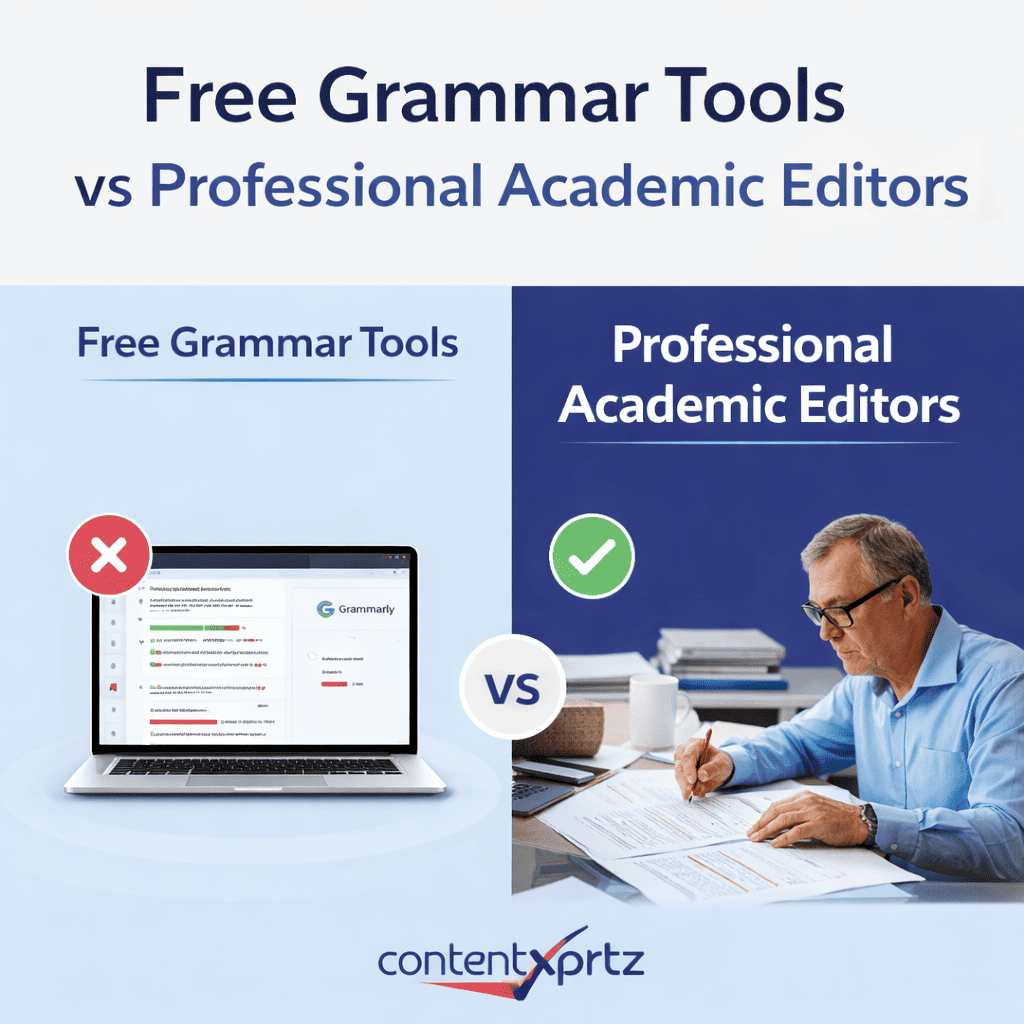
For PhD scholars, postdoctoral researchers, and academic professionals, writing is never just writing. It is intellectual labor under pressure, shaped by deadlines, journal expectations, reviewer scrutiny, funding requirements, and career-defining outcomes. In this context, the debate around Free Grammar Tools vs Professional Academic Editors is not a matter of convenience. It is a question of academic credibility, publication success, and long-term scholarly reputation.
Over the past decade, global research output has grown at an unprecedented pace. According to UNESCO, more than 8 million active researchers now publish over 3 million journal articles annually, with year-on-year growth driven by Asia, Europe, and emerging research economies. At the same time, journal acceptance rates continue to decline. Leading publishers such as Elsevier and Springer Nature report average acceptance rates between 5 percent and 20 percent, depending on the journal tier and discipline. This imbalance between output and acceptance intensifies pressure on scholars to submit work that is not only novel, but also linguistically precise, structurally rigorous, and publication-ready.
Against this backdrop, free grammar tools have become ubiquitous. They promise instant corrections, stylistic suggestions, and improved readability at no cost. For time-pressed PhD candidates juggling teaching loads, data collection, and administrative duties, these tools feel like a lifeline. However, academic writing is not general writing. A doctoral thesis, systematic review, or Q1 journal article demands far more than surface-level grammatical correctness.
This is where professional academic editors enter the conversation. Unlike automated tools, expert editors engage with argumentation, methodological clarity, discipline-specific conventions, citation integrity, and ethical publishing standards. Yet many scholars hesitate. Cost concerns, lack of awareness, or the assumption that free tools are “good enough” often delay professional intervention until rejection or major revision forces a rethink.
This article offers a comprehensive, evidence-based comparison of Free Grammar Tools vs Professional Academic Editors, written specifically for students, PhD scholars, and academic researchers. Drawing on publishing best practices, editorial ethics, and insights from global academic standards, it explains what free tools can and cannot do, where professional editors add irreplaceable value, and how to make informed decisions at different stages of the research lifecycle.
Whether you are drafting a doctoral thesis, preparing a journal submission, revising after peer review, or planning a book manuscript, understanding this distinction is essential. The goal is not to dismiss technology, but to place it correctly within a high-stakes academic ecosystem where precision, credibility, and trust determine outcomes.
Understanding Free Grammar Tools in Academic Contexts
What Free Grammar Tools Are Designed to Do
Free grammar tools are automated software applications that analyze text for surface-level language issues. Their core functions typically include spelling correction, basic grammar fixes, punctuation suggestions, and limited readability feedback. Most rely on predefined linguistic rules and machine learning models trained on large general-language datasets.
For everyday writing, emails, or informal content, these tools perform adequately. They can flag missing articles, subject-verb disagreement, or repeated words. In early drafting stages, they may help non-native English speakers gain confidence by reducing obvious errors.
However, academic writing operates under different constraints. It involves discipline-specific terminology, complex sentence structures, cautious claims, and precise methodological descriptions. Free grammar tools are not designed with these nuances in mind.
Common Free Grammar Tools Used by Students
Many PhD scholars rely on widely available tools integrated into word processors or browsers. These tools appeal because they are accessible, fast, and cost-free. Yet accessibility should not be confused with suitability. Most free tools are optimized for general English, not scholarly discourse shaped by APA, AMA, Chicago, or discipline-specific styles.
Moreover, these tools lack contextual awareness. They do not understand whether a sentence describes a hypothesis, reports a statistical result, or engages with theoretical literature. As a result, suggestions may inadvertently alter meaning or weaken academic tone.
Strengths of Free Grammar Tools
To be fair, free grammar tools do offer tangible benefits when used appropriately:
-
They help identify obvious spelling and punctuation errors.
-
They support early-stage drafting by improving basic clarity.
-
They assist writers with limited English proficiency in reducing surface mistakes.
-
They save time during preliminary self-review.
Used as a first-pass filter, they can reduce mechanical errors before deeper revision. However, their strengths end where academic judgment begins.
Limitations of Free Grammar Tools in Scholarly Writing
Lack of Disciplinary Awareness
Academic writing varies significantly across fields. A paper in applied economics follows different conventions from one in molecular biology or literary theory. Free grammar tools cannot distinguish between acceptable disciplinary phrasing and genuine errors. Technical terms may be incorrectly flagged. Passive constructions essential for scientific neutrality may be discouraged without understanding their function.
Inability to Assess Argument Quality
Grammar correctness does not equal academic quality. Reviewers evaluate coherence, logical flow, theoretical positioning, and methodological transparency. Free tools cannot assess whether your research question is clearly articulated, your literature review is balanced, or your conclusions are justified by data.
Risk of Meaning Distortion
Automated suggestions often prioritize simplicity over precision. In academic contexts, simplification can distort meaning. For example, replacing cautious hedging language with assertive phrasing may introduce claims not supported by evidence. Such changes can raise red flags during peer review.
No Support for Journal Compliance
Each journal has specific submission guidelines covering structure, referencing style, word limits, and ethical declarations. Free grammar tools do not check compliance with author guidelines, reporting standards, or ethical norms required by publishers such as Elsevier, Springer, Emerald Insight, or Taylor and Francis.
Who Are Professional Academic Editors and What Do They Actually Do?
Defining Professional Academic Editing
Professional academic editors are subject-trained language experts who specialize in scholarly writing and research communication. They are not generic proofreaders. Most have advanced degrees and extensive experience working with peer-reviewed journals, doctoral theses, grant proposals, and academic books.
Their role extends beyond correcting grammar. They enhance clarity without altering meaning, strengthen logical flow, ensure consistency, and align manuscripts with disciplinary and publisher standards.
Types of Academic Editing Services
Academic editing is not a single service. It exists on a continuum, depending on manuscript maturity:
-
Proofreading focuses on final-stage corrections such as typos, formatting, and minor language errors.
-
Language editing improves grammar, clarity, tone, and academic style.
-
Substantive or structural editing addresses organization, argument coherence, and section balance.
-
Journal readiness checks ensure compliance with target journal guidelines.
-
Response-to-reviewer editing helps authors revise manuscripts strategically after peer review.
Professional providers such as ContentXprtz offer tailored services aligned with these stages, ensuring ethical and transparent support.
Free Grammar Tools vs Professional Academic Editors: A Direct Comparison
Depth of Linguistic Analysis
Free grammar tools operate at sentence level. Professional academic editors work at sentence, paragraph, section, and manuscript levels simultaneously. They evaluate how language supports argumentation, not just correctness.
Contextual and Ethical Sensitivity
Academic editors understand research ethics. They do not introduce content, fabricate references, or alter authorial voice. Their work aligns with ethical guidelines promoted by major publishers and professional bodies.
In contrast, free tools apply generic rules without ethical judgment. They cannot flag self-plagiarism risks, inappropriate paraphrasing, or citation inconsistencies.
Impact on Publication Outcomes
Empirical evidence suggests that professionally edited manuscripts have higher chances of positive peer review outcomes. Publishers including Elsevier explicitly recommend language editing for authors writing in a second language. Well-edited manuscripts reduce reviewer fatigue and allow evaluators to focus on intellectual contribution rather than language flaws.
When Free Grammar Tools May Be Sufficient
Free grammar tools are not inherently useless. They have a place when used strategically:
-
During early brainstorming and rough drafting.
-
For informal academic communication.
-
As a supplementary self-check before submission.
However, relying on them exclusively for high-stakes documents such as PhD theses or journal submissions is risky.
When Professional Academic Editors Are Essential
PhD Theses and Dissertations
Doctoral work is examined not only for originality but also for scholarly presentation. Examiners assess clarity, coherence, and adherence to academic conventions. Professional editing ensures your years of research are not undermined by avoidable language issues. For dedicated support, explore PhD thesis help through ContentXprtz’s PhD and Academic Services.
Journal Submissions and Revisions
Top-tier journals expect polished manuscripts. Many rejections cite language and clarity as contributing factors. Professional academic editors help position your work for peer review success and assist with post-review revisions through targeted academic editing services and research paper writing support offered under Writing and Publishing Services.
Books, Monographs, and Edited Volumes
Book manuscripts require consistency across chapters, alignment with publisher guidelines, and long-form coherence. ContentXprtz supports authors through specialized Book Authors Writing Services.
The Role of EEAT in Academic Editing Decisions
Expertise, Experience, Authoritativeness, and Trustworthiness are not only SEO concepts. They mirror the values of academic publishing itself. Professional academic editors embody EEAT through subject expertise, publishing experience, transparent processes, and ethical standards.
Free grammar tools, by contrast, offer no accountability, no subject expertise, and no responsibility for outcomes.
Integrated FAQs: Answering Real Questions from PhD Scholars and Researchers
FAQ 1: Can free grammar tools replace professional academic editors for PhD theses?
Short answer: no. Free grammar tools can assist with surface-level corrections, but they cannot replace professional academic editors for doctoral work. A PhD thesis is evaluated holistically. Examiners assess clarity of argument, methodological rigor, theoretical grounding, and scholarly tone. Free tools do not understand disciplinary conventions or examination criteria.
Professional academic editors work within ethical boundaries to refine language while preserving authorial intent. They help ensure coherence across chapters, consistency in terminology, and compliance with institutional guidelines. For PhD candidates investing years into their research, professional editing is a safeguard, not a luxury.
FAQ 2: Are professional academic editing services ethical and acceptable to universities?
Yes, when used appropriately. Major publishers and universities distinguish between language editing and content authorship. Ethical academic editing focuses on clarity, grammar, and structure without contributing ideas or data. Publishers such as Elsevier and Springer Nature explicitly endorse language editing support for non-native English speakers.
Reputable providers like ContentXprtz follow strict ethical guidelines, ensuring compliance with academic integrity standards.
FAQ 3: Do journals reject papers solely because of poor language?
While language alone may not be the official reason, it often contributes significantly to rejection. Reviewers are volunteers with limited time. Manuscripts with unclear language, inconsistent terminology, or awkward phrasing increase cognitive load and reduce perceived quality. Professional editing minimizes these risks.
FAQ 4: Is professional academic editing only for non-native English speakers?
No. Many native English-speaking researchers use professional editors to refine clarity, flow, and argument structure. Academic writing demands precision beyond everyday fluency. Editing is about scholarly communication, not language proficiency alone.
FAQ 5: How does professional editing differ from proofreading?
Proofreading addresses surface errors after content is finalized. Professional academic editing often involves deeper language and structural improvements earlier in the process. Choosing the right level of support depends on manuscript stage and goals.
FAQ 6: Can free grammar tools introduce errors into academic writing?
Yes. Automated suggestions may oversimplify complex sentences or alter cautious academic language. Without contextual awareness, tools can weaken claims or introduce inaccuracies. Human editors exercise judgment and discipline-specific knowledge.
FAQ 7: When should I involve a professional academic editor in my research process?
Ideally, before journal submission or thesis finalization. Early intervention prevents extensive revisions later. Editors can also assist after peer review to address reviewer comments strategically.
FAQ 8: How do professional editors handle references and citations?
Professional academic editors check consistency, formatting, and alignment with style guides such as APA. They do not fabricate references or verify data accuracy unless explicitly agreed. Their role is to enhance presentation and compliance.
FAQ 9: Is professional academic editing worth the cost?
Consider the cost relative to the investment in your research and the consequences of rejection or delayed graduation. Professional editing improves efficiency, reduces revision cycles, and enhances credibility. For many scholars, it saves time and stress.
FAQ 10: How do I choose a trustworthy academic editing provider?
Look for transparency, subject expertise, ethical guidelines, and proven experience. Established providers with global reach, such as ContentXprtz, demonstrate credibility through long-term engagement with researchers worldwide and clearly defined service scopes.
Outbound Academic References Supporting Best Practices
For further context on academic writing and editing standards, consult:
-
Elsevier Author Services: https://www.elsevier.com/authors
-
Springer Nature Author Tutorials: https://www.springernature.com/gp/authors
-
Emerald Insight Publishing Guidelines: https://www.emeraldgrouppublishing.com/publish-with-us
-
Taylor and Francis Author Resources: https://authorservices.taylorandfrancis.com
These resources reinforce the importance of language quality and editorial support in successful publication.
Conclusion: Making the Right Choice for Your Academic Future
The debate around Free Grammar Tools vs Professional Academic Editors is ultimately about understanding limitations and responsibilities. Free tools have a place in early drafting and self-review. However, they cannot replace the nuanced judgment, disciplinary expertise, and ethical accountability of professional academic editors.
For PhD scholars and researchers navigating competitive publication environments, professional editing is a strategic investment. It protects the integrity of your work, enhances clarity, and increases the likelihood that your ideas are evaluated on merit rather than obscured by language issues.
If you are seeking trusted academic editing services, PhD thesis help, or research paper writing support, explore ContentXprtz’s dedicated offerings across Writing and Publishing Services, PhD and Academic Services, Student Writing Services, Book Author Services, and Corporate Writing Services.
At ContentXprtz, we don’t just edit. We help your ideas reach their fullest potential.
