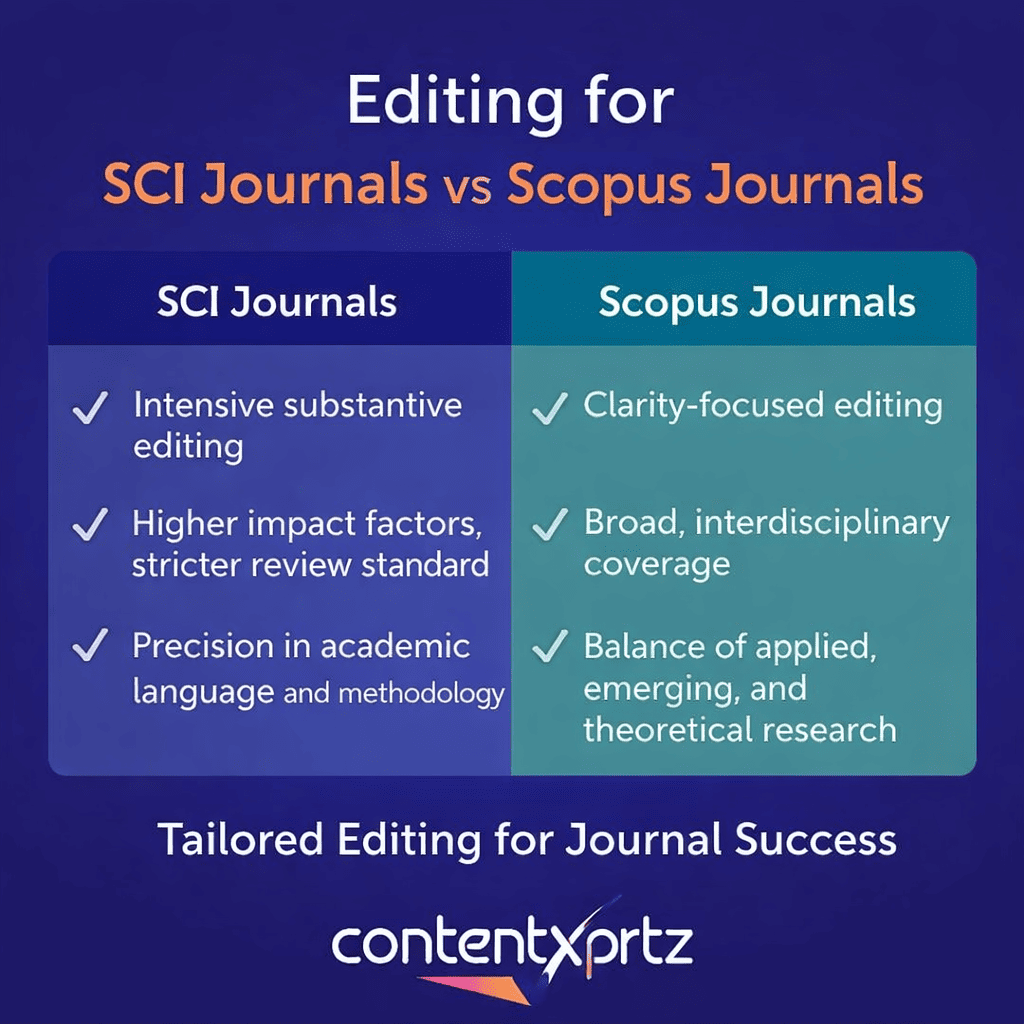

Editing for SCI Journals vs Scopus Journals: A Strategic Guide for PhD Scholars and Academic Researchers
Introduction: Why Editing Strategy Matters More Than Ever in Global Research Publishing
For PhD scholars and academic researchers, publishing in indexed journals is no longer just an academic milestone. It is a professional requirement, a funding prerequisite, and often a determinant of career progression. Yet, despite years of rigorous research, many manuscripts face rejection not because of weak ideas, but due to inadequate alignment with journal standards. This is where Editing for SCI Journals vs Scopus Journals becomes a decisive factor in publication success.
In the first paragraph itself, it is essential to acknowledge a reality many doctoral candidates quietly experience. Writing a high-quality research paper is fundamentally different from editing it for publication in indexed journals. SCI and Scopus journals, although both globally recognized, follow distinct editorial expectations, linguistic precision levels, and methodological rigor. Treating them as interchangeable often leads to avoidable desk rejections.
Globally, research output has grown exponentially. According to Elsevier’s Research Intelligence Report, over 5 million scholarly articles are published annually, with acceptance rates in high-impact SCI journals frequently falling below 10 percent. Springer Nature further reports that language quality and structural coherence account for a significant proportion of early-stage rejections, especially for non-native English researchers. These statistics reflect a critical truth. Publication stress is not just about research quality. It is about presentation, compliance, and editorial precision.
PhD students face layered challenges. Time constraints from teaching and coursework, pressure to publish before submission deadlines, limited exposure to journal-specific expectations, and rising costs associated with revisions compound the problem. Many scholars attempt self-editing, only to realize that journal reviewers evaluate manuscripts through a far more critical and standardized lens.
This is why editing for SCI journals vs Scopus journals must be approached as a strategic decision, not a cosmetic one. SCI journals prioritize methodological robustness, linguistic sophistication, and theoretical contribution. Scopus journals, while equally credible, often emphasize clarity, applied relevance, and consistency with indexing criteria. Editing approaches must reflect these differences explicitly.
At ContentXprtz, established in 2010 and trusted by researchers across more than 110 countries, we observe one recurring pattern. Manuscripts that fail often do not lack innovation. They lack alignment. This article is written to close that gap. It offers a comprehensive, evidence-based comparison of SCI and Scopus journal editing requirements, practical guidance for PhD scholars, and clarity on when professional academic editing becomes indispensable.
Whether you are preparing your first journal article or revising a manuscript after peer review, understanding these differences will save time, reduce rejection risk, and strengthen your academic voice.
Understanding Indexed Journals: SCI and Scopus in the Global Research Ecosystem
Before comparing editing requirements, it is essential to understand what SCI and Scopus journals represent in the scholarly publishing landscape.
What Are SCI Journals?
Science Citation Index journals are part of the Web of Science Core Collection, curated originally by the Institute for Scientific Information and now managed by Clarivate Analytics. SCI journals are widely regarded as benchmarks of scientific rigor and editorial excellence.
Key characteristics include:
-
Highly selective peer review processes
-
Strong emphasis on theoretical contribution
-
Rigorous methodological transparency
-
Advanced academic language standards
Publishing in SCI journals is often mandatory for PhD graduation, academic promotions, and research funding evaluations in many countries.
What Are Scopus Journals?
Scopus, managed by Elsevier, is one of the largest abstract and citation databases of peer-reviewed literature. Scopus journals span a broader range of disciplines, including applied sciences, social sciences, humanities, and interdisciplinary research.
Key characteristics include:
-
Wider journal scope and diversity
-
Emphasis on clarity and accessibility
-
Balanced focus on theory and application
-
Structured editorial and ethical compliance
Scopus journals are highly respected and often preferred for interdisciplinary and applied research outputs.
Editing for SCI Journals vs Scopus Journals: Core Differences Explained
Linguistic Expectations and Academic Tone
Editing for SCI journals demands a level of linguistic precision that closely mirrors native academic writing. Sentence structure, argument flow, and terminology must reflect disciplinary sophistication. Reviewers expect polished prose, minimal redundancy, and nuanced argumentation.
In contrast, editing for Scopus journals prioritizes clarity and readability. While language quality remains critical, editors often tolerate simpler constructions if ideas are presented coherently and logically.
Structural and Formatting Requirements
SCI journals enforce strict adherence to journal-specific formatting, often down to subsection ordering, reference styles, and data presentation formats. Editing must ensure absolute compliance.
Scopus journals are more flexible structurally but remain firm on consistency, citation integrity, and ethical transparency.
Methodological Scrutiny
Editing for SCI journals involves deeper methodological refinement. Editors often review statistical descriptions, research design clarity, and variable justification.
For Scopus journals, methodological clarity is essential, but emphasis is often placed on replicability and practical relevance rather than theoretical novelty alone.
Why One-Size-Fits-All Editing Fails for Indexed Journals
Many researchers make the costly mistake of applying generic academic editing across all submissions. This approach undermines publication success.
Professional academic editing services must be tailored to indexing requirements, disciplinary norms, and reviewer expectations. At ContentXprtz, editing workflows differ substantially for SCI and Scopus manuscripts, ensuring alignment at every editorial layer.
Generic editing typically addresses grammar. Strategic editing addresses acceptance probability.
When Professional Editing Becomes Non-Negotiable for PhD Scholars
High-Rejection Journals and Desk Review Filters
Elsevier reports that over 30 percent of manuscripts are rejected at desk review due to language and formatting issues alone. This highlights the necessity of expert editorial intervention before submission.
Non-Native English Researchers
Researchers writing in a second language face structural and rhetorical challenges. Professional editing ensures that language does not obscure intellectual contribution.
Post-Reviewer Revisions
Responding to reviewer comments requires editorial expertise. Editing at this stage must preserve author voice while aligning revisions with reviewer expectations.
For tailored support, explore PhD thesis help and academic editing services through ContentXprtz’s
https://contentxprtz.com/phd-academic-services
Ethical Editing Practices in SCI and Scopus Publishing
Ethical editing enhances clarity without altering authorial ownership. Reputable publishers such as Elsevier and Springer emphasize transparency in editorial assistance.
ContentXprtz adheres strictly to ethical guidelines, ensuring:
-
No data fabrication or manipulation
-
No ghostwriting for indexed submissions
-
Clear distinction between editing and authorship
This ethical commitment safeguards academic integrity while improving manuscript quality.
How ContentXprtz Approaches Editing for SCI and Scopus Journals
Since 2010, ContentXprtz has developed journal-aligned editorial frameworks that combine subject expertise, linguistic precision, and compliance assurance.
Our services include:
-
Journal-specific language editing
-
Structural and logical coherence review
-
Reference and citation accuracy checks
-
Reviewer comment response editing
Explore our comprehensive academic editing services at
https://contentxprtz.com/writing-publishing-services
Integrated FAQs: Addressing Real Concerns of PhD Scholars and Researchers
FAQ 1: Is editing mandatory for SCI journal submissions?
Editing is not mandatory by policy, but practically essential. SCI journals apply rigorous language and structure standards. Even strong research may face rejection if writing lacks clarity or coherence. Professional editing improves readability, aligns terminology, and ensures compliance without altering intellectual contribution.
FAQ 2: How different is editing for Scopus journals compared to SCI?
Editing for Scopus journals focuses more on clarity, flow, and applied relevance. SCI editing emphasizes theoretical precision and linguistic sophistication. Understanding this difference helps tailor manuscripts strategically.
FAQ 3: Can editing improve acceptance rates?
While editing does not guarantee acceptance, multiple publisher reports confirm that professionally edited manuscripts face fewer desk rejections and smoother peer review processes.
FAQ 4: Is journal editing ethical?
Yes, when done correctly. Ethical editing improves language and structure without adding content or influencing conclusions. Leading publishers explicitly permit professional editing.
FAQ 5: Should PhD theses be edited before journal extraction?
Absolutely. Thesis writing differs significantly from journal writing. Editing ensures concise argumentation and compliance with journal norms.
For thesis-related support, visit
https://contentxprtz.com/student-career-academic-writing-services
FAQ 6: What level of editing do reviewers expect?
Reviewers expect polished language, logical flow, and accurate citations. They evaluate content, not writing errors. Editing ensures reviewers focus on research quality.
FAQ 7: How long does professional editing take?
Turnaround varies by manuscript length and complexity. Typically, journal editing ranges from 3 to 10 working days.
FAQ 8: Can editors help with reviewer responses?
Yes. Editors can refine responses to reviewer comments, ensuring professional tone and clarity while preserving author intent.
FAQ 9: Is editing useful for interdisciplinary research?
Interdisciplinary papers benefit significantly from editing, as terminology and structure must appeal to diverse reviewers.
FAQ 10: How do I choose the right editing service?
Choose services with domain expertise, ethical policies, transparent workflows, and global experience. ContentXprtz meets all these criteria.
Additional Academic Support Beyond Journal Editing
ContentXprtz supports scholars across writing stages, including:
-
Book manuscript preparation
https://contentxprtz.com/book-authors-writing-services -
Corporate and professional research documentation
https://contentxprtz.com/corporate-writing-services
Conclusion: Making the Right Editorial Choice for Your Research Journey
Understanding Editing for SCI Journals vs Scopus Journals is not an academic luxury. It is a strategic necessity for scholars navigating a competitive publishing ecosystem. SCI and Scopus journals demand different editorial lenses, and aligning manuscripts accordingly can significantly reduce rejection risk.
Professional editing bridges the gap between strong research and successful publication. It refines language, ensures compliance, and allows reviewers to focus on intellectual contribution rather than presentation flaws.
At ContentXprtz, we combine over a decade of global experience with ethical academic practices to support scholars at every stage of their publishing journey.
If you are preparing a manuscript for indexed submission, now is the time to invest in expert editorial guidance.
Explore our PhD Assistance and Academic Editing Services today.
At ContentXprtz, we don’t just edit, we help your ideas reach their fullest potential.
