
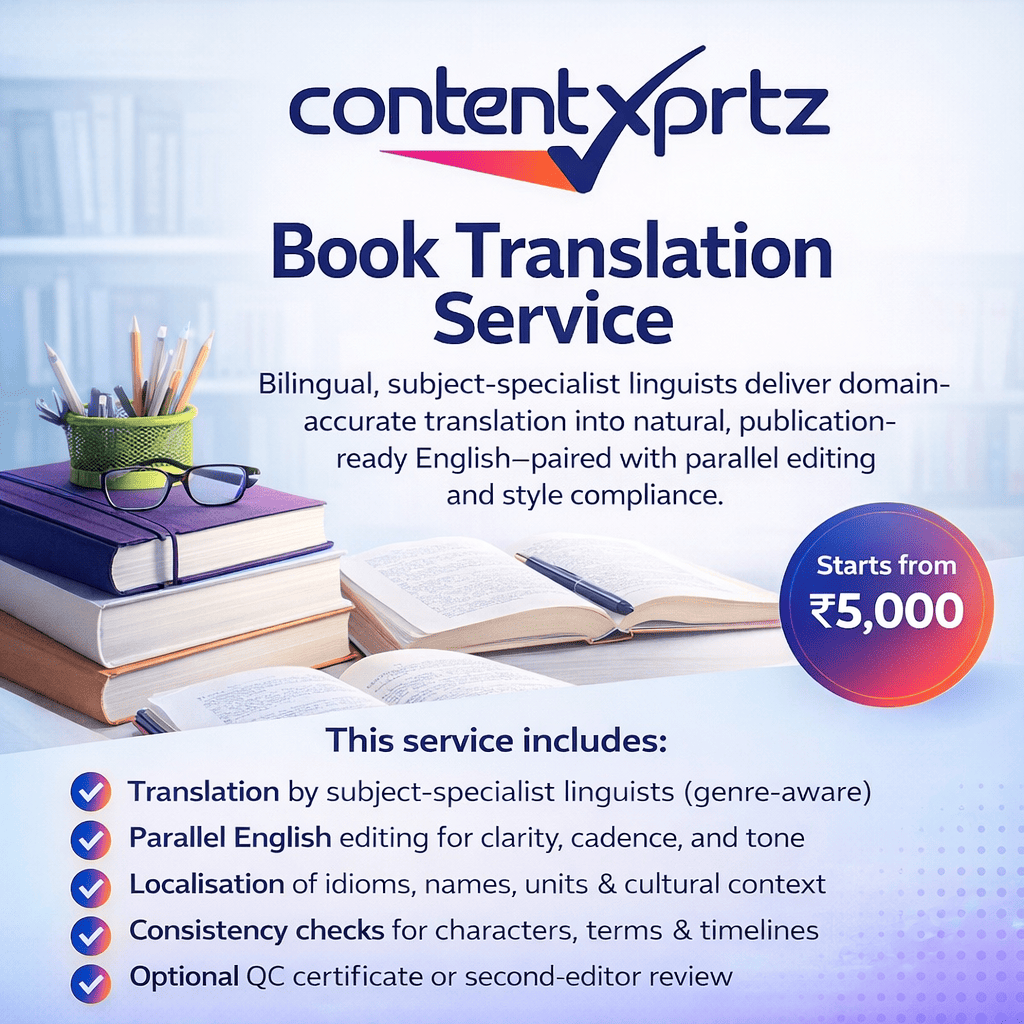
📘 Translate Your Book for Global Academic Impact
Professional, publication-ready English—without losing your original voice.
Your research deserves clarity, precision, and international reach. ContentXprtz’s Book Translation Service combines subject-specialist translation with parallel English editing to ensure your work meets academic and publishing standards.
🧠 What you get:
• Translation by subject-specialist, genre-aware linguists
• Parallel English editing for clarity, tone, and academic flow
• Cultural and contextual localisation (idioms, units, references)
• Consistency checks across terminology, characters, and timelines
• Optional second-editor review or QC certification
📄 Ethical & Author-First Approach
Your ideas remain yours. We ensure originality, confidentiality, and full author ownership—always aligned with ethical academic practices.
🎓 Ready to prepare your book for international readers?
Message us on WhatsApp to get started today.
📲 WhatsApp: https://wa.me/917065013200
🌐 Website: https://contentxprtz.com
#AcademicTranslation #BookTranslationService #PhDSupport #ResearchPublishing #AcademicEditing #ScholarlyWriting #PublicationSupport #PhDScholars #PostdoctoralResearch #ResearchCommunication #AcademicIntegrity #AuthorServices #HigherEducation #JournalSubmission #ResearchExcellence #ThesisSupport #DissertationHelp #AcademicProfessionals #GlobalResearch #EthicalPublishing #UniversityResearch #STEMResearch #HumanitiesResearch #SocialScienceResearch #ContentXprtz
From Local Scholarship to Global Impact: Why a Professional Book Translation Service Is Essential for Academic Authors
Introduction: Translating Knowledge for a Global Academic World
For PhD scholars, academic researchers, and serious authors, producing a book is never just about completing a manuscript. It is about contributing knowledge to a global scholarly conversation. Yet, for many researchers, that conversation remains limited by language. A brilliant monograph written in one language often struggles to reach its rightful audience simply because it is not accessible to readers, reviewers, and publishers across borders. This is where a professional Book Translation Service becomes not only relevant but indispensable.
In today’s interconnected research ecosystem, academic publishing has become increasingly global. According to data reported by UNESCO and major academic publishers, more than 75 percent of indexed academic publications are consumed by international audiences, with English, Chinese, Spanish, and French dominating scholarly dissemination. At the same time, acceptance rates for academic books and monographs remain extremely competitive, often below 10 percent for reputable academic presses. Language quality, conceptual clarity, and cultural precision play a decisive role in editorial decisions.
PhD scholars face immense pressure at this stage of their careers. They must balance teaching responsibilities, grant writing, journal submissions, and institutional expectations, all while navigating the financial and emotional costs of prolonged academic work. Translating a book under these conditions is not a mechanical task. It demands deep subject expertise, familiarity with disciplinary conventions, and ethical sensitivity to the author’s intellectual voice. Poor translation can distort arguments, weaken theoretical rigor, and ultimately harm academic credibility.
Moreover, global publication trends show a steady rise in translated academic works. Major publishing houses increasingly seek manuscripts that can travel across linguistic and cultural boundaries. However, they also impose strict quality benchmarks. Editors expect translations that read like original scholarly writing, not literal conversions. This is why relying on generic translation tools or non-academic translators often results in rejection, revision fatigue, or reputational risk.
A professional Book Translation Service, particularly one grounded in academic integrity and disciplinary expertise, bridges this gap. It ensures that your ideas retain their intellectual depth while becoming accessible to global audiences. At ContentXprtz, established in 2010, we work with scholars across more than 110 countries to transform books into publication-ready works that meet international academic standards.
In this comprehensive guide, we explore what academic book translation truly involves, why it matters for PhD scholars and researchers, and how choosing the right service can shape your global academic trajectory.
Understanding Academic Book Translation Beyond Language Conversion
What Makes Academic Book Translation Unique
Academic book translation differs fundamentally from commercial or literary translation. While fluency matters, accuracy, conceptual fidelity, and disciplinary nuance matter more. A research-driven book contains theories, methodologies, citations, and argumentative structures that must remain intact across languages.
A professional Book Translation Service ensures:
-
Preservation of theoretical frameworks and terminologies
-
Consistency with discipline-specific writing conventions
-
Alignment with international citation and referencing standards
-
Cultural adaptation without intellectual dilution
Unlike automated tools, academic translation requires human expertise. Translators must understand the epistemological foundations of the subject, whether it is sociology, economics, engineering, medicine, or philosophy.
The Role of Subject-Matter Experts
High-quality academic translation relies on translators who are not only linguists but also subject-matter experts. For instance, translating a book in behavioral economics requires familiarity with established terminology used by publishers such as Elsevier and Springer. Misinterpreting even a single technical concept can compromise the entire manuscript.
At ContentXprtz, translation projects are handled by teams that combine linguistic proficiency with academic specialization. This collaborative model ensures that the translated book reads as a credible scholarly contribution rather than a secondary version of the original.
Why PhD Scholars and Researchers Need Professional Book Translation
Global Visibility and Academic Impact
Publishing in one language often limits citation potential. Studies indexed in Scopus and Web of Science consistently show that translated academic works receive higher international citations and broader pedagogical adoption. A professional Book Translation Service expands the reach of your research without compromising quality.
Institutional and Career Advancement
For many PhD scholars, book publications influence tenure decisions, postdoctoral opportunities, and international collaborations. Universities increasingly value global dissemination. A well-translated book demonstrates scholarly maturity and international engagement.
Publisher Expectations and Peer Review Standards
Academic publishers maintain rigorous editorial standards. Translated manuscripts undergo peer review just like original works. Reviewers assess clarity, coherence, and theoretical precision. Professional translation reduces revision cycles and strengthens acceptance prospects.
Ethical Dimensions of Academic Book Translation
Avoiding Misrepresentation and Plagiarism Risks
Poor translation can unintentionally alter meanings, leading to accusations of misrepresentation or self-plagiarism. Ethical academic translation respects authorial intent and citation integrity, following guidelines set by bodies such as the American Psychological Association.
Transparency and Authorship Integrity
A credible Book Translation Service maintains transparency about translation processes, acknowledgments, and editorial contributions. This protects the author’s intellectual ownership while complying with international publishing ethics.
The ContentXprtz Approach to Book Translation
Since 2010, ContentXprtz has supported scholars worldwide with ethical, publication-focused academic services. Our book translation workflow integrates linguistic accuracy, academic editing, and publishing insight.
-
Dedicated subject experts for each project
-
Multi-stage quality checks and peer-style reviews
-
Alignment with publisher-specific submission guidelines
-
Optional post-translation academic editing
Our services integrate seamlessly with our broader academic support ecosystem, including academic editing services, PhD thesis help, and research paper writing support.
How Book Translation Supports International Publishing Strategies
Aligning with Global Academic Publishers
Publishers such as Emerald Insight and Taylor & Francis expect translations that conform to their house styles. This includes tone, structure, and referencing norms. Professional translation anticipates these expectations from the outset.
Enhancing Peer Review Outcomes
Reviewers often focus on argument flow and conceptual coherence. Translation that reads fluently reduces cognitive load and allows reviewers to focus on scholarly merit rather than language issues.
Frequently Asked Questions About Book Translation Service
How is academic book translation different from standard translation services?
Academic book translation demands a level of rigor that standard translation services cannot provide. Unlike general translation, academic work involves specialized terminology, theoretical arguments, and methodological explanations that must remain precise across languages. A professional Book Translation Service integrates subject expertise, academic writing conventions, and publishing standards.
General translators may be fluent linguistically but unfamiliar with disciplinary discourse. This often results in awkward phrasing, conceptual drift, or misinterpretation of core arguments. Academic translators, by contrast, are trained to preserve intellectual structure, citation accuracy, and scholarly tone. They also understand how reviewers and editors evaluate translated manuscripts.
Additionally, academic translation often includes alignment with publisher guidelines, reference style consistency, and optional academic editing. These layers ensure that the translated book is not merely readable but publishable. For PhD scholars, this distinction can determine whether a manuscript advances their career or stalls at the review stage.
Can a translated academic book be accepted by international publishers?
Yes, translated academic books are regularly accepted by international publishers, provided they meet quality standards. Many global presses actively seek translated works to diversify perspectives and expand readership. However, acceptance depends heavily on translation quality.
A professional Book Translation Service ensures that the manuscript reads like an original scholarly work in the target language. Editors and reviewers evaluate clarity, coherence, and theoretical integrity, not the author’s native language. Poor translation often leads to rejection, while high-quality translation enhances credibility.
ContentXprtz supports authors throughout this process, aligning translations with publisher expectations and offering post-translation academic editing when needed. This integrated approach significantly improves acceptance prospects.
How long does professional book translation usually take?
The timeline for academic book translation depends on several factors, including word count, subject complexity, target language, and review requirements. On average, a scholarly monograph may take several weeks to a few months to translate properly.
Unlike rushed or automated solutions, a credible Book Translation Service prioritizes accuracy and academic integrity. The process typically includes initial translation, subject-matter review, linguistic editing, and final quality checks. While this takes time, it prevents costly revisions later.
At ContentXprtz, timelines are discussed transparently, balancing efficiency with quality. This allows scholars to plan submissions without compromising standards.
Is machine translation suitable for academic books?
Machine translation tools have improved significantly, but they remain unsuitable for academic books. These tools lack the ability to interpret context, theoretical nuance, and disciplinary conventions. As a result, they often produce literal translations that distort meaning.
Using machine translation for academic work can lead to conceptual errors, stylistic inconsistencies, and ethical concerns. Publishers and reviewers can easily detect such issues, which may damage credibility.
A professional Book Translation Service relies on human expertise, supported by academic editing and quality assurance. This approach ensures that the translated book meets scholarly expectations and ethical norms.
How do you ensure terminological consistency in book translation?
Terminological consistency is critical in academic writing. Inconsistent use of key terms can confuse readers and weaken arguments. Professional translation addresses this through glossary development, style guides, and iterative reviews.
At ContentXprtz, translators create discipline-specific glossaries at the beginning of each project. These glossaries are reviewed by subject experts and applied consistently throughout the manuscript. This method ensures conceptual clarity and scholarly coherence.
Such practices distinguish professional academic translation from generic services and significantly enhance publication readiness.
Does book translation include academic editing?
High-quality Book Translation Service often includes or recommends academic editing. Translation focuses on linguistic accuracy, while academic editing refines structure, argument flow, and compliance with publishing standards.
ContentXprtz offers integrated solutions, combining translation with academic editing services and book author support. This holistic approach ensures that the final manuscript meets both linguistic and scholarly expectations.
How do translations handle citations and references?
Academic translations must preserve citation integrity. This includes accurate translation of in-text references, consistency with reference lists, and adherence to styles such as APA or publisher-specific formats.
Professional translators are trained to maintain citation accuracy and flag any inconsistencies. This protects authors from ethical risks and ensures compliance with international standards.
Can book translation help with interdisciplinary research?
Interdisciplinary books often face additional challenges due to overlapping terminologies and methodological frameworks. Professional translation is especially valuable in such cases.
A specialized Book Translation Service assigns translators with interdisciplinary experience, ensuring that concepts are accurately conveyed across fields. This enhances accessibility and scholarly impact.
What languages are most in demand for academic book translation?
English remains the dominant language of global academic publishing. However, translations into Chinese, Spanish, French, and German are increasingly востребованы. Demand depends on discipline, region, and target audience.
ContentXprtz supports multilingual academic translation, aligning language strategy with publication goals and audience reach.
How do I choose the right book translation service?
Choosing the right Book Translation Service requires evaluating academic expertise, ethical standards, and publishing experience. Look for providers with a proven track record, transparent processes, and subject-matter specialization.
ContentXprtz combines all these elements, offering tailored, ethical, and publication-focused support for scholars worldwide.
Conclusion: Turning Scholarship into Global Knowledge
In an era where academic influence transcends borders, professional book translation is no longer optional. It is a strategic investment in visibility, credibility, and scholarly impact. A high-quality Book Translation Service preserves your intellectual voice while making your work accessible to global audiences, publishers, and reviewers.
ContentXprtz brings over a decade of experience in academic support, combining translation expertise with deep knowledge of publishing standards. Our integrated services, including PhD thesis help and corporate writing services, ensure that your work moves confidently from local scholarship to global recognition.
If you are ready to extend the reach of your research and publish with confidence, explore our PhD Assistance and Writing Services today.
At ContentXprtz, we don’t just edit — we help your ideas reach their fullest potential.
