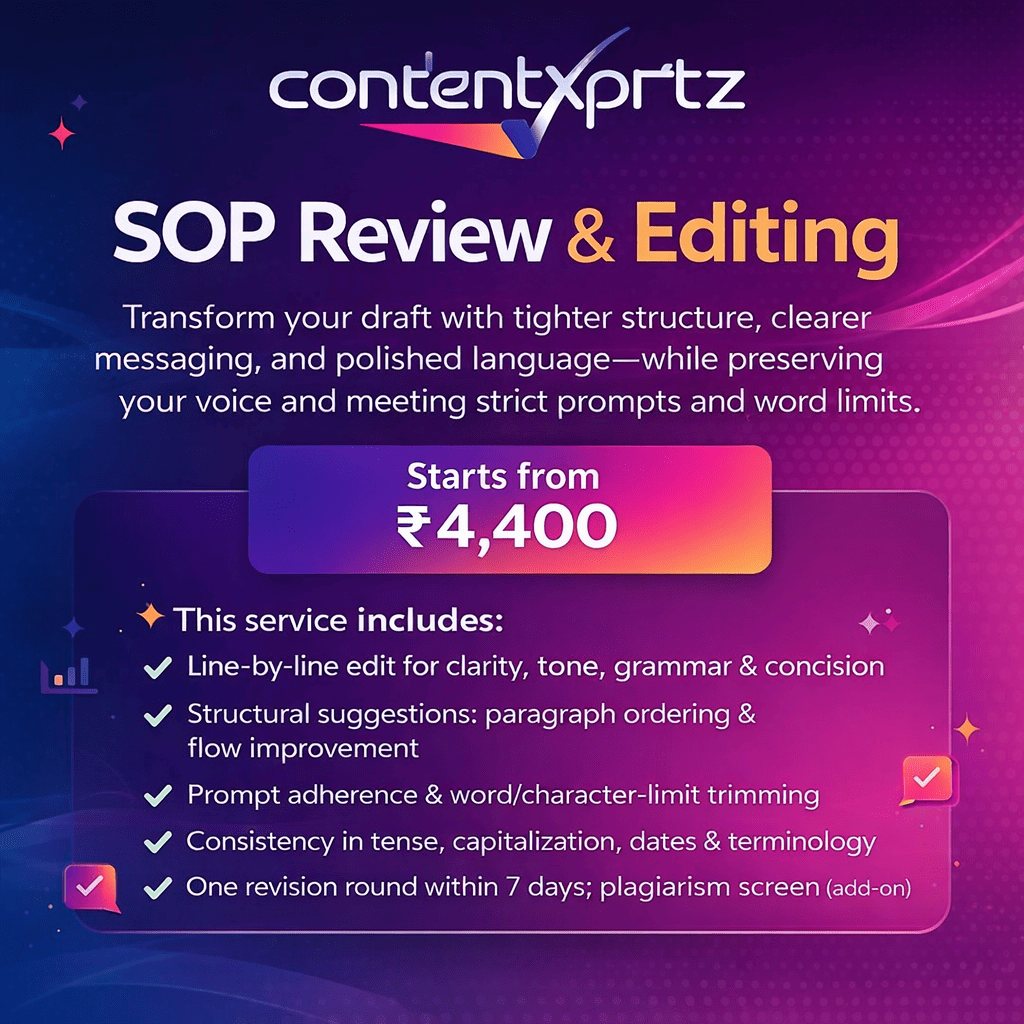
Beyond Templates and Grammar: Why SOP Review & Editing Defines Academic Futures
Introduction: SOP Review & Editing as a Strategic Academic Investment (400+ words)
For students, PhD scholars, and academic researchers, the Statement of Purpose (SOP) is far more than an administrative requirement. It is a high-stakes academic narrative that determines whether years of intellectual preparation translate into admission, funding, or rejection. Across global universities, admissions committees consistently emphasize that SOPs are among the most decisive non-quantitative evaluation criteria, often outweighing marginal differences in GPAs or standardized test scores.
In this context, SOP Review & Editing has evolved from a cosmetic language service into a strategic academic intervention. It is no longer about correcting grammar or improving sentence flow. Instead, it involves aligning scholarly identity, research trajectory, and institutional expectations into a coherent, persuasive document that withstands rigorous academic scrutiny.
Globally, the pressure on PhD applicants has intensified. According to OECD and UNESCO data, doctoral enrollment has grown steadily over the last decade, while funded positions have not increased at the same rate. Acceptance rates for competitive PhD programs in North America, the UK, Europe, Australia, and East Asia frequently fall below 10–15 percent, with top-ranked institutions reporting even lower figures. At the same time, application costs, language proficiency expectations, and publication pressure have risen sharply.
PhD candidates now face a convergence of challenges:
-
Limited time due to teaching, research, and professional obligations
-
Rising costs associated with multiple applications
-
Increased expectations for research clarity and originality
-
Heightened scrutiny of academic integrity and authorial voice
In this environment, submitting an underdeveloped SOP can negate otherwise strong academic credentials. Admissions committees do not merely read SOPs for motivation. They assess research maturity, epistemological alignment, methodological awareness, and long-term scholarly vision. A weak SOP signals conceptual ambiguity. A poorly edited SOP raises concerns about academic preparedness.
This is precisely where professional SOP Review & Editing becomes critical. Ethical, expert-led editing strengthens argumentation, refines structure, and enhances clarity without compromising originality or ownership. When done correctly, it transforms a draft into a publication-grade academic narrative that communicates intent with precision and credibility.
At ContentXprtz, established in 2010 and trusted by scholars in more than 110 countries, SOP editing is treated as an academic craft. Our editors do not impose templates. They refine intellectual positioning. We do not rewrite motivations. We help scholars articulate them with academic authority.
This article provides a comprehensive, evidence-based exploration of SOP Review & Editing. It explains why SOPs fail, how expert editing works, what ethical boundaries must be respected, and how doctoral applicants can leverage professional academic editing to improve outcomes without risking integrity.
What Is SOP Review & Editing in an Academic Context?
Moving Beyond Proofreading
In academic admissions, SOP Review & Editing refers to a multi-layered scholarly process that evaluates and enhances:
-
Research clarity and coherence
-
Alignment with faculty expertise and departmental priorities
-
Logical progression of academic goals
-
Methodological awareness and feasibility
-
Academic tone, precision, and discipline-specific conventions
Unlike generic proofreading, academic SOP editing involves substantive structural and conceptual refinement. Editors assess whether the SOP answers the implicit questions admissions committees ask, not merely whether sentences are grammatically correct.
SOP Editing vs SOP Writing: A Crucial Distinction
Ethical academic practice distinguishes clearly between editing and authorship. Reputable SOP Review & Editing services:
-
Preserve the applicant’s voice
-
Do not fabricate achievements or research claims
-
Do not ghostwrite personal narratives
-
Focus on clarity, structure, and academic positioning
This distinction aligns with ethical guidelines promoted by academic publishers such as Elsevier and Springer, which emphasize author ownership and transparency in scholarly communication.
Why SOPs Fail Despite Strong Academic Profiles
1. Conceptual Vagueness
Many SOPs list interests without articulating research problems. Admissions committees seek questions, not themes.
2. Misalignment with Institutional Priorities
An SOP that ignores departmental strengths signals poor academic fit. Effective editing contextualizes goals within institutional ecosystems.
3. Overuse of Generic Templates
Template-driven SOPs are immediately recognizable. They undermine authenticity and scholarly maturity.
4. Linguistic Ambiguity for Non-Native Speakers
Even strong research ideas can be obscured by language limitations. Professional academic editing improves clarity without diluting meaning.
The Role of SOP Review & Editing in PhD and Research Applications
Strategic Narrative Development
Expert editors help applicants:
-
Frame research interests within disciplinary debates
-
Demonstrate progression from prior work to future inquiry
-
Articulate feasibility and originality
Research Positioning
A well-edited SOP demonstrates familiarity with:
-
Canonical literature
-
Emerging debates
-
Methodological standards
This level of sophistication often distinguishes shortlisted candidates.
How Professional SOP Review & Editing Works at ContentXprtz
At ContentXprtz, SOP Review & Editing follows a structured, ethics-first academic workflow:
Step 1: Diagnostic Evaluation
Editors assess structure, argument flow, research clarity, and alignment.
Step 2: Discipline-Specific Editing
Subject experts refine terminology, logic, and academic tone.
Step 3: Language Precision and Coherence
Language editors ensure clarity, concision, and formal academic style.
Step 4: Final Integrity Check
All revisions are reviewed to preserve authorial voice and originality.
Learn more about our integrated academic support through our
Writing & Publishing Services and
PhD & Academic Services.
SOP Review & Editing and Academic Integrity
Professional editing is widely recognized as ethical when it adheres to transparency and author ownership. Major publishers such as Elsevier and the APA explicitly allow language and structural editing, provided intellectual content remains the author’s own.
This position is reinforced across:
Ethical SOP Review & Editing strengthens scholarly communication. It does not replace it.
Integrated FAQs: SOP Review & Editing (10 Detailed Sections)
FAQ 1: Is professional SOP Review & Editing ethically acceptable for PhD applications?
(200+ words)
Yes. Ethical SOP Review & Editing aligns with global academic norms when it focuses on clarity, structure, and coherence rather than authorship. Universities evaluate ideas, not language privilege. Editing helps ensure equitable evaluation, particularly for multilingual scholars.
FAQ 2: How does SOP editing differ for PhD vs Masters applicants?
(200+ words)
PhD SOPs emphasize research contribution, methodology, and faculty alignment, while Masters SOPs focus more on preparation and motivation. Editing strategies differ accordingly.
FAQ 3: Can SOP Review & Editing improve admission chances?
(200+ words)
While no service can guarantee admission, evidence shows that clarity, coherence, and fit significantly influence outcomes. Editing improves these dimensions.
FAQ 4: How early should SOP editing begin?
(200+ words)
Ideally, editing should begin at least 4–6 weeks before deadlines to allow iterative refinement.
FAQ 5: What do admissions committees expect from an SOP?
(200+ words)
Committees expect intellectual maturity, feasibility, originality, and institutional alignment.
FAQ 6: Does SOP editing change my academic voice?
(200+ words)
Ethical editing preserves voice while enhancing clarity.
FAQ 7: How many SOP revisions are typically needed?
(200+ words)
Most applicants require two to three rounds for optimal clarity.
FAQ 8: Can SOP editing help with funding and scholarships?
(200+ words)
Yes. Funding committees often rely heavily on SOPs to assess research potential.
FAQ 9: How do I evaluate an SOP editing service?
(200+ words)
Look for subject expertise, ethical transparency, and publication experience.
FAQ 10: Why choose ContentXprtz for SOP Review & Editing?
(200+ words)
With global experience since 2010, ContentXprtz integrates academic rigor, ethical editing, and discipline-specific insight.
Explore our broader support through
Student Writing Services,
Book Authors Writing Services, and
Corporate Writing Services.
Conclusion: SOP Review & Editing as Academic Empowerment
In an era of intensified competition and rising academic expectations, SOP Review & Editing is no longer optional. It is a strategic, ethical, and scholarly investment that helps researchers communicate ideas with precision and confidence.
At ContentXprtz, we approach SOP editing as academic stewardship. We refine without rewriting. We clarify without compromising integrity. We support scholars across disciplines, regions, and career stages with expertise earned through more than a decade of global academic collaboration.
If you are preparing a PhD or research application and want your SOP to reflect the true depth of your academic vision, explore our PhD Assistance Services today.
At ContentXprtz, we don’t just edit — we help your ideas reach their fullest potential.