
Beyond Advice and Red Ink: Professional Editing vs Peer Feedback for Manuscripts in the High-Stakes World of Academic Publishing
Introduction: Why This Decision Shapes Your Academic Future
For PhD scholars, early-career researchers, and seasoned academics alike, manuscript preparation is rarely just a technical task. Instead, it is an emotional, intellectual, and professional milestone. Every manuscript carries months or years of research, personal sacrifice, and career aspirations. In this context, deciding between professional editing vs peer feedback for manuscripts is far more than a stylistic choice. It is a strategic decision that directly influences publication success, research visibility, and academic credibility.
Globally, doctoral education and research productivity are under unprecedented pressure. According to UNESCO, the number of researchers worldwide has more than doubled over the past two decades, exceeding 9 million researchers globally. At the same time, journal acceptance rates are becoming increasingly selective. Leading publishers such as Elsevier and Springer report average acceptance rates between 10 percent and 25 percent for high-impact journals. In highly competitive disciplines, desk rejection rates can exceed 60 percent before peer review even begins.
For PhD students, these pressures are compounded by additional challenges. Time constraints due to teaching responsibilities, funding deadlines, mental health strain, and rising publication costs often leave little room for trial and error. Many scholars rely on peer feedback from supervisors, lab colleagues, or academic networks. While peer input remains valuable, it is often inconsistent, informal, and limited by time or expertise. Meanwhile, professional academic editing has emerged as a specialized service designed to align manuscripts with journal standards, ethical guidelines, and global publication expectations.
This article offers an in-depth, evidence-based comparison of professional editing vs peer feedback for manuscripts, grounded in academic best practices and publication ethics. Drawing on insights from major publishers such as Elsevier, Springer, Emerald Insight, Taylor and Francis, and APA, the discussion goes beyond surface-level differences. Instead, it examines structural rigor, ethical safeguards, linguistic precision, reviewer expectations, and long-term academic outcomes.
Importantly, this article is written for real scholars navigating real constraints. Whether you are preparing your first journal submission, revising after reviewer comments, or finalizing a PhD thesis, understanding the strengths and limitations of each approach will empower you to make informed decisions. Throughout the article, practical examples, discipline-specific considerations, and expert commentary are integrated to ensure clarity and relevance.
As a global academic support provider established in 2010, ContentXprtz has worked with researchers across more than 110 countries. This perspective informs a balanced and ethical analysis that respects academic autonomy while emphasizing publication readiness. The central question is not whether peer feedback or professional editing is superior in all cases. Instead, the goal is to clarify when each approach is appropriate and how they can be strategically combined to maximize manuscript quality and publication success.
Understanding Peer Feedback in Academic Manuscript Development
What Peer Feedback Typically Involves
Peer feedback refers to informal or semi-formal input provided by supervisors, colleagues, mentors, or fellow researchers. In doctoral programs, this often includes supervisor comments, departmental workshops, lab meetings, or writing groups. At later career stages, peer feedback may come from co-authors or conference networks.
In principle, peer feedback offers intellectual depth. Peers understand disciplinary conventions, theoretical frameworks, and methodological nuances. They can identify conceptual gaps, logical inconsistencies, or theoretical misalignments that editors may not address.
However, peer feedback is rarely standardized. The quality and depth of comments vary significantly based on the reviewer’s expertise, availability, and personal preferences. Moreover, peers often focus on content rather than language, structure, or journal compliance.
Strengths of Peer Feedback
Peer feedback offers several undeniable benefits:
-
Deep subject-matter insight rooted in disciplinary expertise
-
Early-stage conceptual guidance during research design or drafting
-
Mentorship-oriented advice that supports intellectual growth
-
Cost-effective or free access within academic networks
For exploratory drafts, grant proposals, or conceptual frameworks, peer feedback remains invaluable. According to guidance published by Taylor and Francis, early peer engagement improves research coherence and scholarly positioning.
Limitations of Peer Feedback
Despite its strengths, peer feedback has critical limitations:
-
Limited focus on language clarity and academic style
-
Inconsistent attention to journal-specific guidelines
-
Potential bias due to personal relationships or academic hierarchies
-
Delayed turnaround times due to academic workload
-
Lack of accountability or structured quality assurance
Importantly, peers are rarely trained in professional editing standards. As a result, manuscripts may still face rejection due to language issues, formatting errors, or failure to meet publisher requirements, even when the research itself is strong.
Defining Professional Academic Editing
What Professional Editing Actually Means
Professional academic editing is a structured, ethical service delivered by trained editors with expertise in academic writing, publishing standards, and discipline-specific conventions. Unlike peer feedback, professional editing follows clearly defined scopes, including language editing, substantive editing, technical compliance, and reviewer readiness.
Reputable editing services align with international standards such as those outlined by the Committee on Publication Ethics (COPE) and the American Psychological Association. They do not alter research content or authorship. Instead, they enhance clarity, coherence, and compliance.
Types of Professional Editing
Professional academic editing typically includes:
-
Language editing for grammar, syntax, and academic tone
-
Structural editing for coherence, flow, and argument progression
-
Formatting and style compliance with journal guidelines
-
Reference and citation consistency checks
-
Pre-submission readiness assessment
Publishers such as Elsevier explicitly recommend professional language editing for non-native English speakers to reduce desk rejection risks.
Who Uses Professional Editing Services
Professional editing is increasingly used by:
-
PhD scholars preparing theses or journal articles
-
Early-career researchers targeting international journals
-
Senior academics submitting interdisciplinary work
-
Institutions aiming to improve publication metrics
At ContentXprtz, professional editing services are designed to support academic independence while ensuring global publication standards are met.
Professional Editing vs Peer Feedback for Manuscripts: A Structured Comparison
Scope and Depth of Review
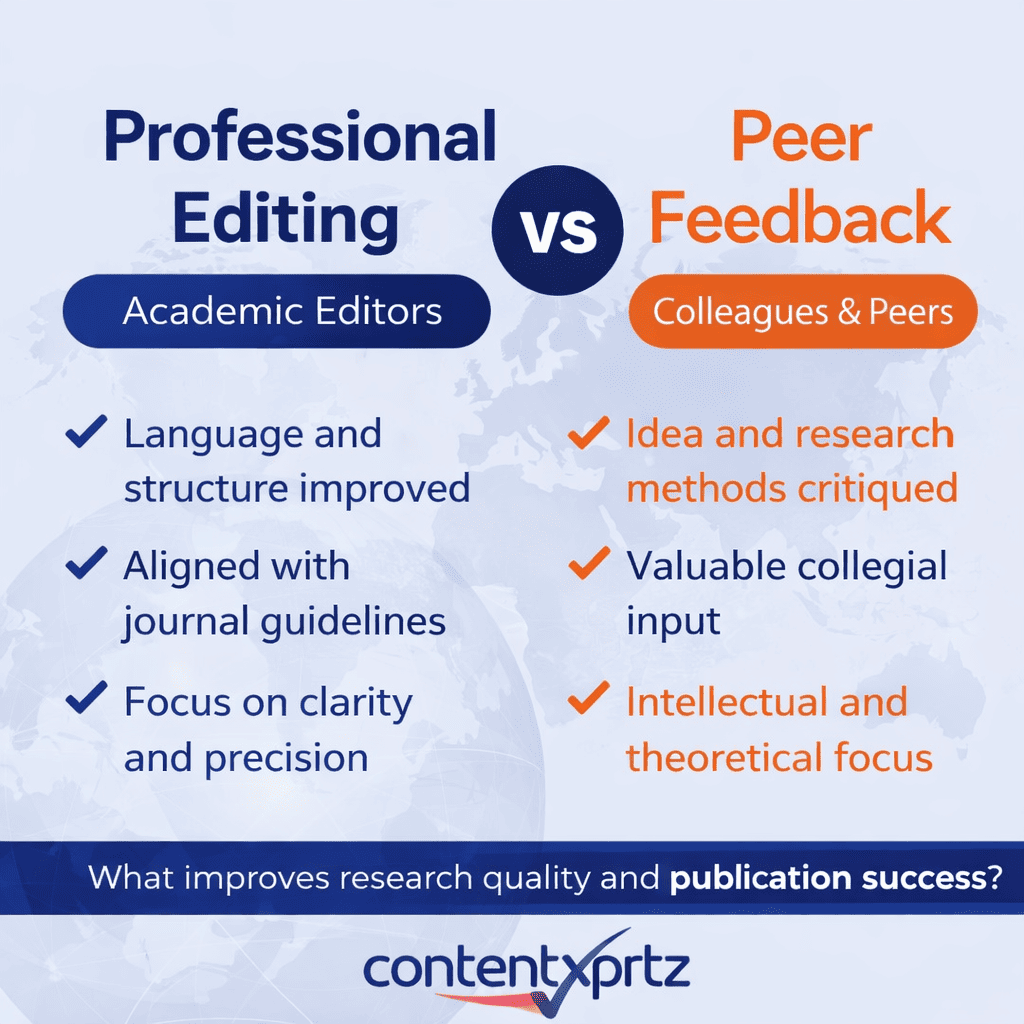
Peer feedback often prioritizes intellectual contribution, while professional editing focuses on presentation and compliance. In professional editing vs peer feedback for manuscripts, this distinction is fundamental. Peer reviewers may overlook grammatical inconsistencies or structural issues, whereas professional editors systematically address them.
Objectivity and Bias
Professional editors operate under strict ethical guidelines, ensuring objectivity and confidentiality. Peer feedback, while well-intentioned, may be influenced by academic politics, competition, or mentorship dynamics.
Turnaround Time and Reliability
Professional editing services offer predictable timelines and accountability. Peer feedback depends on availability and goodwill, which can delay submission during critical windows.
Alignment with Journal Expectations
Professional editors are trained to interpret journal guidelines, reviewer expectations, and publisher standards. Peer feedback rarely addresses these operational details, despite their importance in acceptance decisions.
When Peer Feedback Is Most Effective
Peer feedback is particularly effective:
-
During early conceptualization of research
-
For theoretical refinement and methodological critique
-
In grant writing and proposal development
-
When developing discipline-specific arguments
For these stages, peer engagement enhances intellectual rigor and scholarly dialogue.
When Professional Editing Is Essential
Professional editing becomes essential:
-
Before journal submission
-
After receiving reviewer comments
-
When targeting high-impact international journals
-
For non-native English authors
-
When institutional deadlines are strict
In these scenarios, professional editing mitigates avoidable rejection risks.
Ethical Considerations in Academic Editing
According to COPE and APA guidelines, ethical editing enhances clarity without altering intellectual ownership. Reputable services do not fabricate data, manipulate results, or ghostwrite content.
ContentXprtz adheres to strict ethical editing principles, ensuring transparency and academic integrity across all services.
Integrating Peer Feedback and Professional Editing Strategically
Rather than viewing professional editing vs peer feedback for manuscripts as a binary choice, successful scholars integrate both approaches. Peer feedback strengthens content. Professional editing refines presentation. Together, they create submission-ready manuscripts.
Frequently Asked Questions
FAQ 1: Is professional editing considered unethical in academic publishing?
Professional editing is widely accepted when conducted ethically. Publishers such as Elsevier and Springer explicitly recognize language editing as permissible. Ethical editing focuses on clarity, structure, and compliance, not content creation.
FAQ 2: Can peer feedback replace professional editing entirely?
Peer feedback cannot fully replace professional editing, particularly for language precision and journal compliance. While peers enhance intellectual depth, editors ensure technical readiness.
FAQ 3: Do journals detect professional editing?
Journals do not penalize professionally edited manuscripts. In fact, improved clarity often facilitates smoother peer review.
FAQ 4: Is professional editing only for non-native English speakers?
No. Native speakers also benefit from professional editing, especially when targeting high-impact journals with strict stylistic standards.
FAQ 5: How does professional editing affect acceptance rates?
Studies cited by Elsevier indicate that manuscripts with clear language and structure face lower desk rejection rates.
FAQ 6: What level of editing is appropriate for PhD theses?
PhD theses benefit from comprehensive editing, including language, structure, and formatting, while preserving author voice.
FAQ 7: Can professional editors help with reviewer comments?
Yes. Editors assist in clarifying revisions, restructuring responses, and ensuring alignment with reviewer expectations.
FAQ 8: How do I choose a reliable editing service?
Choose providers with academic credentials, ethical policies, transparent processes, and global experience.
FAQ 9: Does professional editing guarantee publication?
No ethical service guarantees acceptance. Editing improves readiness, not editorial decisions.
FAQ 10: Can I combine supervisor feedback with professional editing?
Yes. Combining both yields optimal outcomes by strengthening content and presentation.
How ContentXprtz Supports Researchers Across Academic Stages
ContentXprtz offers tailored academic editing services, PhD thesis help, and research paper writing support through specialized service pages:
-
Explore comprehensive PhD thesis help through our PhD and Academic Services
-
Access expert academic editing services via Writing and Publishing Services
-
Support undergraduate and postgraduate needs through Student Writing Services
-
Collaborate on long-form projects with Book Authors Writing Services
-
Enhance professional documentation with Corporate Writing Services
Conclusion: Making an Informed, Strategic Choice
The debate around professional editing vs peer feedback for manuscripts reflects broader changes in global academia. As publication standards rise and competition intensifies, scholars must adopt strategic, ethical, and evidence-based support systems.
Peer feedback nurtures intellectual growth. Professional editing ensures technical excellence. Together, they transform strong research into publishable scholarship.
For PhD scholars and researchers navigating complex academic landscapes, the question is not whether to seek help, but how to do so responsibly and effectively.
Explore ContentXprtz’s PhD Assistance Services to strengthen your manuscripts with confidence, clarity, and ethical integrity.
At ContentXprtz, we don’t just edit — we help your ideas reach their fullest potential.
