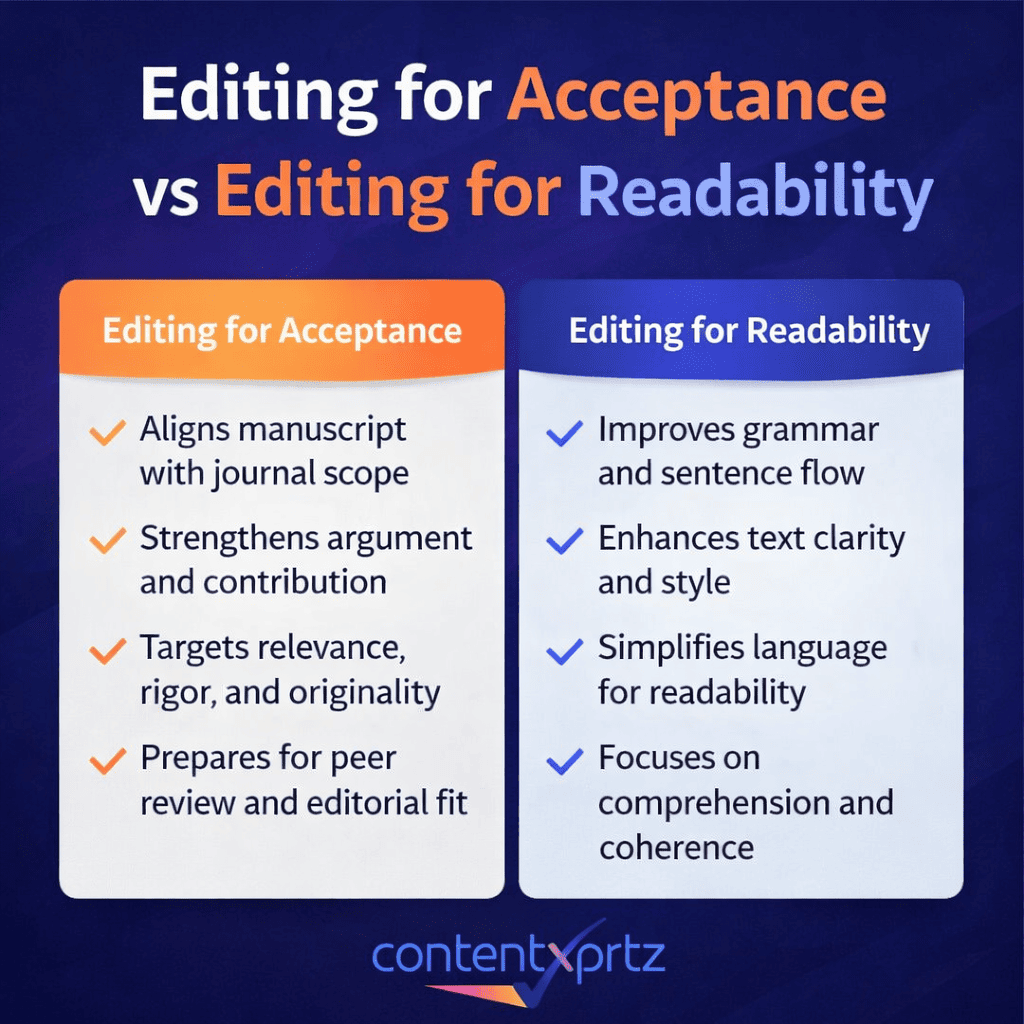

Editing for Acceptance vs Editing for Readability: What PhD Scholars Must Understand Before Journal Submission
Introduction
For PhD scholars, early-career researchers, and academic professionals, publishing is not just an academic milestone; it is a career-defining requirement. Yet, despite years of rigorous research, many manuscripts face rejection at the journal desk review stage. One of the most misunderstood reasons behind this outcome lies in the difference between Editing for Acceptance vs Editing for Readability.
At first glance, these two concepts may appear similar. After all, both involve improving language, structure, and clarity. However, in academic publishing, they serve fundamentally different purposes. Editing for readability ensures that your work is clear, fluent, and accessible to readers. Editing for acceptance, by contrast, aligns your manuscript with journal expectations, editorial standards, reviewer criteria, ethical requirements, and discipline-specific conventions. Confusing one for the other is a common but costly mistake.
Globally, the pressure to publish has intensified. According to data published by Elsevier, over 3 million scholarly articles are submitted annually, while acceptance rates for top-tier journals often fall below 20 percent. Springer Nature reports that a significant proportion of rejections occur before peer review due to issues related to structure, language precision, journal mismatch, and non-compliance with author guidelines. These are not failures of research quality; they are failures of preparation.
PhD scholars today face unprecedented challenges. Time constraints, teaching responsibilities, grant deadlines, family commitments, and the mental load of long-term research all compete for attention. At the same time, journals are becoming more selective, reviewers more critical, and editorial standards more stringent. Rising publication costs, open-access fees, and formatting requirements further complicate the process. In this environment, understanding the difference between editing for acceptance and editing for readability is no longer optional; it is essential.
Many researchers rely on basic proofreading or language polishing services, assuming this is sufficient for publication success. Unfortunately, this approach often leads to frustration when manuscripts are rejected with comments such as “language requires substantial improvement,” “manuscript does not meet journal scope,” or “argument lacks coherence.” These comments signal deeper issues that readability editing alone cannot address.
This article offers a comprehensive, evidence-based exploration of Editing for Acceptance vs Editing for Readability, specifically tailored for students, PhD scholars, and academic researchers. Drawing on publishing standards from Elsevier, Springer, Emerald Insight, Taylor and Francis, and APA, the discussion clarifies what each type of editing entails, when it is needed, and how it affects publication outcomes. Practical examples, expert insights, and best practices are integrated throughout.
As a global academic support provider established in 2010, ContentXprtz has worked with scholars across disciplines and regions. This experience informs a nuanced understanding of editorial expectations and ethical academic support. The goal of this article is not only to inform but also to empower researchers to make informed decisions about academic editing and publication strategy.
By the end of this guide, you will understand why readability alone does not secure acceptance, how acceptance-focused editing strengthens reviewer confidence, and how to choose the right editorial support for your research journey.
Understanding the Core Difference Between Editing for Acceptance vs Editing for Readability
What Is Editing for Readability?
Editing for readability focuses on improving how easily a reader can understand your text. Its primary objective is linguistic clarity. This form of editing addresses grammar, spelling, punctuation, sentence flow, word choice, and overall coherence at the surface level.
Readability editing ensures that:
-
Sentences are grammatically correct and concise
-
Vocabulary is appropriate for the target audience
-
Transitions between ideas are smooth
-
Paragraphs are logically structured
-
The text reads fluently without ambiguity
For non-native English speakers, readability editing plays a critical role. Journals such as those published by Taylor and Francis emphasize that language quality should not impede peer review. However, they also clarify that language clarity alone does not compensate for conceptual or structural weaknesses.
Readability editing is often the first level of academic editing. It is particularly useful for:
-
Early drafts of theses and dissertations
-
Conference papers
-
Coursework submissions
-
Internal reviews and supervisor feedback
While readability editing improves presentation, it does not address deeper issues related to journal alignment, argumentation strength, or methodological transparency.
What Is Editing for Acceptance?
Editing for acceptance is a strategic, publication-oriented process. It goes beyond language to address how your manuscript is evaluated by editors and reviewers. This form of editing aligns your work with the explicit and implicit expectations of a specific journal or publisher.
Editing for acceptance typically includes:
-
Journal scope and audience alignment
-
Structural conformity to author guidelines
-
Strengthening research arguments and logical flow
-
Ensuring methodological clarity and rigor
-
Improving abstract, introduction, and discussion sections
-
Aligning citations and references with required styles
-
Addressing ethical declarations and reporting standards
Publishers such as Elsevier and Emerald Insight consistently highlight that manuscripts are rejected not only for weak research but also for poor framing, lack of contribution clarity, and misalignment with journal aims. Acceptance-focused editing directly targets these concerns.
This type of editing is essential at the pre-submission stage, particularly for:
-
High-impact journal submissions
-
PhD thesis-based articles
-
Revised manuscripts after reviewer feedback
-
Grant-linked or time-sensitive publications
Why the Distinction Matters
The distinction between editing for acceptance vs editing for readability determines how your manuscript is perceived. A readable paper may still be rejected if it fails to meet scholarly expectations. Conversely, a paper edited for acceptance communicates credibility, relevance, and rigor from the first page.
Understanding this difference allows researchers to invest wisely in academic editing services and avoid repeated rejections that delay graduation, promotion, or funding opportunities.
Why Journals Reject Readable Papers: An Editor’s Perspective
Journal editors operate under immense pressure. They manage hundreds of submissions monthly while maintaining journal quality and reputation. According to Springer Nature’s editorial guidelines, editors conduct initial screening to assess suitability before peer review. At this stage, readability is necessary but insufficient.
Common reasons editors reject readable papers include:
-
Misalignment with journal scope
-
Weak articulation of research contribution
-
Poorly structured arguments
-
Inadequate methodological explanation
-
Outdated or inappropriate references
-
Failure to follow author instructions
For example, a manuscript may be grammatically flawless yet fail to position its findings within current debates. Emerald Insight emphasizes that editors seek clarity of contribution above linguistic polish. Editing for acceptance ensures that your research speaks directly to these editorial priorities.
Editing for Acceptance vs Editing for Readability in the PhD Context
The PhD Thesis Challenge
PhD theses are extensive documents designed to demonstrate original contribution and scholarly independence. However, journals require concise, focused articles with clear narratives. Editing for readability may improve language but does not adapt thesis chapters into publishable articles.
Acceptance-focused editing helps:
-
Reframe thesis content into journal-ready manuscripts
-
Align arguments with journal-specific debates
-
Reduce redundancy and improve focus
-
Strengthen discussion and implication sections
For scholars seeking PhD thesis help, understanding this distinction is crucial. ContentXprtz provides tailored PhD support through its dedicated PhD & Academic Services
https://contentxprtz.com/phd-academic-services
Ethical Considerations in Academic Editing
Ethical editing is a critical concern in academic publishing. Organizations such as the APA clearly distinguish between acceptable language editing and unethical authorship intervention. Editing for acceptance, when done ethically, enhances clarity and structure without altering research ownership.
At ContentXprtz, all academic editing services adhere to international ethical standards, ensuring that the author retains full intellectual responsibility.
Practical Examples: Readability Editing vs Acceptance Editing
Example 1: Abstract Revision
Readability editing improves grammar and flow. Acceptance editing ensures that the abstract:
-
Clearly states the research gap
-
Highlights methodological approach
-
Emphasizes theoretical or practical contribution
Elsevier’s author resources stress that abstracts influence editorial decisions significantly.
Example 2: Literature Review
Readability editing corrects language. Acceptance editing:
-
Strengthens critical synthesis
-
Aligns citations with current debates
-
Demonstrates theoretical positioning
Taylor and Francis journals consistently prioritize analytical depth over descriptive summaries.
Choosing the Right Academic Editing Approach
When Readability Editing Is Enough
-
Coursework submissions
-
Early-stage drafts
-
Internal reviews
-
Non-submission documents
When Editing for Acceptance Is Essential
-
Journal submissions
-
Reviewer revisions
-
Grant-related publications
-
Book proposals
Researchers seeking comprehensive research paper writing support often require acceptance-focused editing combined with subject-matter expertise. ContentXprtz offers integrated Writing & Publishing Services
https://contentxprtz.com/writing-publishing-services
Integrated FAQs on Editing for Acceptance vs Editing for Readability
FAQ 1: Is editing for readability sufficient for journal acceptance?
Editing for readability is rarely sufficient for journal acceptance, especially in reputable academic journals. While readability ensures grammatical accuracy and smooth language flow, journals assess manuscripts on multiple dimensions beyond language. Editors and reviewers focus on originality, theoretical contribution, methodological rigor, alignment with journal scope, and relevance to current scholarly debates. According to Elsevier’s author guidelines, many manuscripts are rejected at the desk review stage despite being linguistically polished because they fail to meet conceptual or structural expectations. Editing for acceptance addresses these deeper issues by aligning your manuscript with journal requirements, strengthening arguments, and ensuring compliance with editorial standards. Therefore, while readability is necessary, it is only one component of a successful submission strategy.
FAQ 2: How does editing for acceptance improve reviewer feedback?
Editing for acceptance improves reviewer feedback by presenting your research in a way that anticipates reviewer expectations. Reviewers are more likely to engage constructively when a manuscript is well-structured, clearly positioned within the literature, and methodologically transparent. Acceptance-focused editing refines argument flow, clarifies research contributions, and ensures that claims are adequately supported by evidence. Emerald Insight notes that well-prepared manuscripts receive more focused and actionable reviewer comments, reducing the likelihood of major revisions or rejection. This approach ultimately shortens the revision cycle and improves publication efficiency.
FAQ 3: Can acceptance editing change my research meaning?
Ethical acceptance editing does not change the meaning or ownership of your research. Instead, it enhances clarity, coherence, and alignment with publication standards. Reputable academic editors follow strict ethical guidelines, such as those outlined by the APA, which prohibit content fabrication or authorship manipulation. Acceptance editing may suggest reorganization, highlight gaps in explanation, or recommend clearer articulation of findings, but all decisions remain with the author. At ContentXprtz, editorial support is designed to strengthen presentation without altering intellectual contribution.
FAQ 4: Do non-native English speakers need both types of editing?
Non-native English speakers often benefit from both readability and acceptance editing. Readability editing addresses language fluency and grammatical accuracy, which is essential for clear communication. Acceptance editing ensures that the manuscript meets disciplinary and journal-specific expectations. Springer Nature emphasizes that language quality should not hinder peer review, but clarity alone does not guarantee acceptance. Combining both approaches provides comprehensive support, particularly for high-impact journal submissions.
FAQ 5: How early should I invest in acceptance-focused editing?
Ideally, acceptance-focused editing should be considered once the core research and analysis are complete. Engaging too early may lead to unnecessary revisions, while engaging too late can delay submission timelines. Many PhD scholars benefit from acceptance editing during the pre-submission stage or after supervisor feedback. This timing allows editors to refine structure, argumentation, and compliance before journal submission. For structured academic support, ContentXprtz offers Student Writing Services
https://contentxprtz.com/student-career-academic-writing-services
FAQ 6: Is acceptance editing the same as peer review?
Acceptance editing is not a substitute for peer review, but it complements it. Peer review evaluates the scholarly merit of your research, while acceptance editing prepares your manuscript to withstand that evaluation. Acceptance editing anticipates common reviewer concerns and strengthens the manuscript accordingly. According to Taylor and Francis, well-prepared manuscripts progress more smoothly through peer review, as reviewers can focus on content rather than presentation issues.
FAQ 7: How does acceptance editing help with revise-and-resubmit decisions?
Revise-and-resubmit decisions require careful interpretation of reviewer comments. Acceptance-focused editors help authors respond strategically by prioritizing revisions, clarifying responses, and ensuring alignment with reviewer expectations. This process improves the likelihood of eventual acceptance. Elsevier highlights that thoughtful, well-structured revision responses significantly influence editorial decisions.
FAQ 8: Can acceptance editing help with book proposals?
Yes, acceptance editing is particularly valuable for book proposals. Publishers such as Springer and Emerald Insight assess proposals based on market relevance, originality, structure, and audience fit. Acceptance editing refines proposal narratives, strengthens justification, and ensures alignment with publisher guidelines. ContentXprtz supports authors through its Book Authors Writing Services
https://contentxprtz.com/book-authors-writing-services
FAQ 9: What role does acceptance editing play in corporate and policy research?
In corporate and policy research, acceptance editing ensures clarity, credibility, and alignment with stakeholder expectations. Reports intended for publication or dissemination must meet professional and academic standards. Acceptance-focused editing strengthens executive summaries, data presentation, and argument coherence. ContentXprtz extends this expertise through Corporate Writing Services
https://contentxprtz.com/corporate-writing-services
FAQ 10: How do I choose a reliable academic editing provider?
Choosing a reliable provider requires evaluating experience, ethical standards, subject expertise, and transparency. Reputable providers demonstrate familiarity with journal standards, maintain confidentiality, and adhere to ethical guidelines. Established providers like ContentXprtz, with global experience since 2010, offer tailored academic editing services grounded in scholarly best practices and ethical integrity.
Conclusion: Making the Right Editorial Choice for Publication Success
Understanding Editing for Acceptance vs Editing for Readability is a turning point in any academic career. While readability ensures clarity, acceptance-focused editing ensures credibility, relevance, and alignment with journal expectations. In an increasingly competitive publishing landscape, relying on language polishing alone is insufficient.
PhD scholars and researchers who invest in acceptance-oriented academic editing gain a strategic advantage. They reduce rejection risk, improve reviewer engagement, and accelerate publication timelines. More importantly, they present their research in a manner that reflects its true scholarly value.
ContentXprtz combines global experience, ethical standards, and subject expertise to support researchers at every stage of their academic journey. Whether you need PhD thesis help, academic editing services, or research paper writing support, tailored solutions are available to meet your goals.
Explore our PhD Assistance Services and take the next step toward confident, successful publication.
At ContentXprtz, we don’t just edit; we help your ideas reach their fullest potential.
