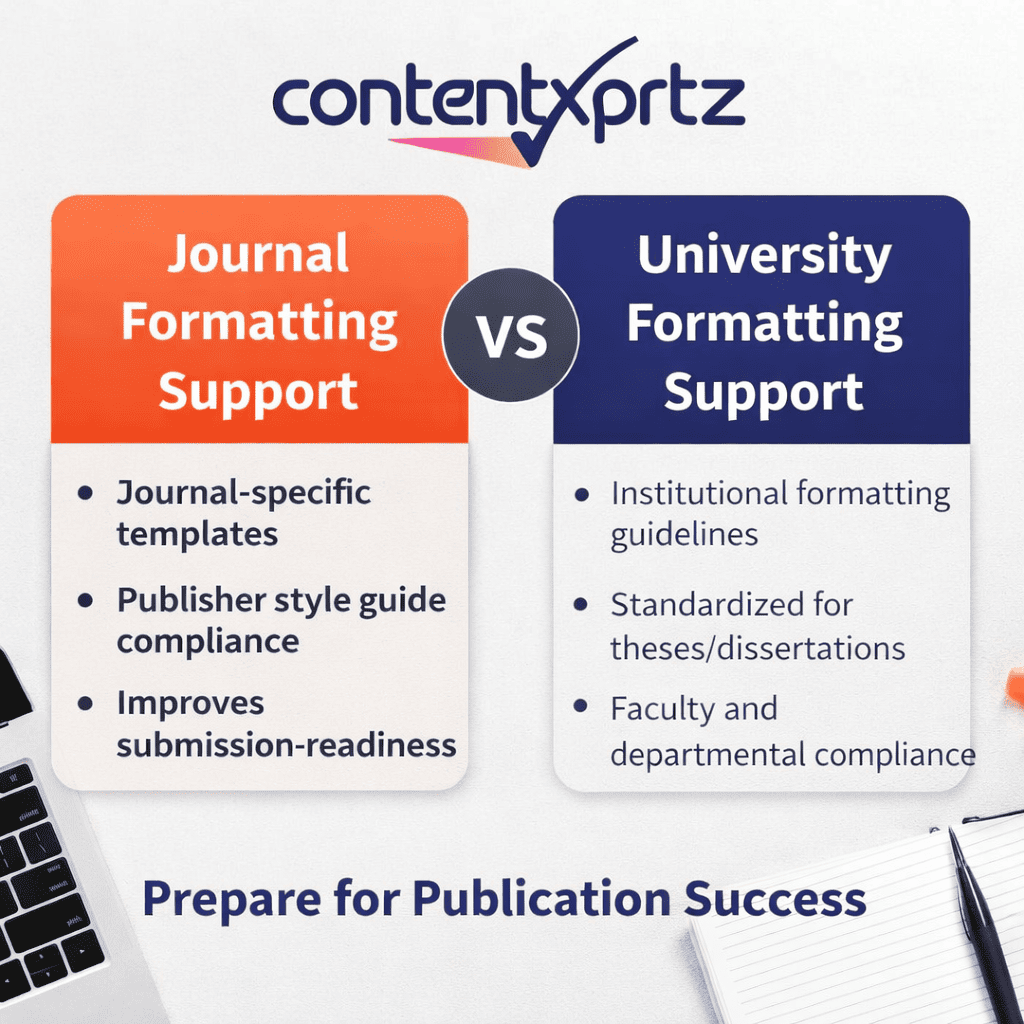

Journal Formatting Support vs University Formatting Support: What PhD Scholars Must Understand Before Submission
Introduction: Why Formatting Is No Longer a “Minor” Academic Task
For PhD scholars, academic researchers, and postgraduate students, the journey from manuscript completion to successful submission is rarely straightforward. While much attention is given to research design, methodology, originality, and contribution, a critical component is often underestimated until the final stages: formatting compliance. In today’s competitive academic environment, Journal Formatting Support vs University Formatting Support is not merely a technical distinction. Instead, it represents two fundamentally different systems of academic compliance, each with its own risks, expectations, and consequences.
Across disciplines, rejection rates in top-tier journals routinely exceed 70 percent, according to data published by Elsevier and Springer Nature. While novelty and methodological rigor remain decisive, editorial screening frequently eliminates manuscripts before peer review due to formatting non-compliance. At the same time, universities worldwide are tightening thesis submission standards, driven by accreditation bodies, plagiarism scrutiny, and digital archiving protocols. As a result, formatting errors now translate directly into delays, resubmissions, and in some cases, degree postponement.
PhD scholars face these pressures amid mounting constraints. Global doctoral completion timelines have lengthened, research funding has become more competitive, and the expectation to publish during candidature has intensified. A 2023 OECD report highlights that doctoral candidates increasingly juggle teaching responsibilities, publication mandates, and institutional audits, all while managing mental fatigue and financial stress. Within this context, formatting is no longer an administrative afterthought. It is a gatekeeping mechanism that determines whether research even enters evaluation.
This is where confusion often arises. Many scholars assume that formatting requirements are universal or transferable. In reality, journal formatting and university formatting operate under entirely different logics. Journals prioritize discoverability, reproducibility, and publisher branding. Universities prioritize archival consistency, examination clarity, and institutional policy alignment. Applying one framework to the other leads to systematic rejection and revision cycles.
At ContentXprtz, we have supported researchers across more than 110 countries since 2010. One recurring pattern is clear. Scholars who understand the distinction between Journal Formatting Support vs University Formatting Support make faster progress, experience fewer revisions, and submit with greater confidence. Those who do not often lose months correcting avoidable errors.
This article offers a comprehensive, evidence-based comparison of both systems. It explains how they differ, when each is required, and how professional academic support mitigates risk at every stage. Whether you are preparing a doctoral thesis, a Scopus-indexed manuscript, or a book proposal, understanding this distinction is essential for timely success.
Understanding Academic Formatting as a Scholarly Gatekeeper
Academic formatting is not about aesthetics. It is about standardization, validation, and credibility. Formatting conventions allow editors, examiners, and reviewers to evaluate research efficiently. When formatting deviates, it signals non-compliance, regardless of research quality.
Why Formatting Directly Impacts Acceptance
Formatting affects:
-
Editorial desk screening decisions
-
Peer review readability and navigation
-
Indexing accuracy in databases such as Scopus and Web of Science
-
Institutional archiving and examination workflows
Publishers such as Elsevier and Taylor and Francis explicitly state that manuscripts not adhering to author guidelines may be returned without review. Universities adopt similar policies for thesis submissions, especially under digital repository mandates.
Defining University Formatting Support
University formatting support focuses on compliance with institution-specific regulations governing thesis and dissertation submission.
Core Characteristics of University Formatting
University formatting requirements typically include:
-
Prescribed margin settings and page layouts
-
Specific font families and sizes
-
Chapter sequencing and numbering protocols
-
Referencing style mandates (APA, Harvard, Vancouver, Chicago)
-
Front matter and back matter structuring
-
Compliance with plagiarism declaration formats
These requirements are often detailed in institutional handbooks and enforced by graduate schools or doctoral committees.
Why Universities Enforce Rigid Formatting
Universities prioritize:
-
Examination fairness and consistency
-
Long-term digital archiving
-
Accreditation and audit compliance
-
Legal defensibility of awarded degrees
Even minor deviations may trigger administrative rejection, forcing resubmission and delaying graduation.
Defining Journal Formatting Support
Journal formatting support aligns manuscripts with publisher-specific author guidelines.
Core Characteristics of Journal Formatting
Journal formatting includes:
-
Structured abstracts and keyword placement
-
Journal-specific reference and citation styles
-
Figure and table placement rules
-
Heading hierarchy and numbering conventions
-
Supplementary material structuring
-
Ethical declarations and data availability statements
Unlike university formatting, journal formatting varies significantly between publishers and even between journals under the same publisher.
Why Journals Demand Precision
Journals prioritize:
-
Editorial workflow efficiency
-
Brand consistency
-
Indexing accuracy
-
Reader usability
According to Springer Nature, formatting compliance improves editorial turnaround times and reduces production costs, directly influencing acceptance probability.
Journal Formatting Support vs University Formatting Support: A Structural Comparison
Purpose and End Goal
University formatting aims to validate a degree. Journal formatting aims to disseminate research globally.
Flexibility vs Rigidity
University formatting is rigid but stable. Journal formatting is flexible but volatile, often changing annually.
Audience Orientation
University formatting targets examiners and archivists. Journal formatting targets editors, reviewers, and readers.
Risk Profile
University formatting errors delay graduation. Journal formatting errors delay publication and harm academic visibility.
When Scholars Need Both Forms of Support
Many PhD scholars require both university and journal formatting, often simultaneously.
Common scenarios include:
-
Publishing thesis-derived articles
-
Submitting papers during candidature
-
Converting dissertations into monographs
-
Responding to revise-and-resubmit decisions
In such cases, applying journal formatting to a thesis or vice versa leads to systematic rework.
Professional PhD thesis help ensures that formatting frameworks are applied contextually rather than generically.
The Hidden Costs of DIY Formatting
Many scholars attempt formatting independently. While understandable, this approach introduces hidden costs:
-
Time lost correcting iterative errors
-
Increased stress close to submission deadlines
-
Misinterpretation of ambiguous guidelines
-
Reduced focus on research quality
Emerald Insight reports that administrative revisions account for a significant portion of post-review delays.
How Professional Formatting Support Adds Academic Value
Professional academic editing services do more than apply templates. They interpret guidelines, resolve conflicts, and future-proof submissions.
At ContentXprtz, formatting support integrates:
-
Publisher and institutional compliance expertise
-
Ethical editing practices aligned with COPE standards
-
Version control across multiple submission targets
-
Cross-checking against updated author instructions
This approach reduces revision cycles and improves submission confidence.
Explore our dedicated PhD thesis help through our
👉 PhD & Academic Services: https://contentxprtz.com/phd-academic-services
FAQs: Addressing Common Scholarly Concerns
FAQ 1: Can the same formatting be used for both thesis submission and journal publication?
No. University formatting and journal formatting serve different compliance frameworks. While content may overlap, formatting must be adapted separately. Journals reject manuscripts that resemble theses due to structural and stylistic incompatibility.
FAQ 2: Do journals really reject papers only for formatting reasons?
Yes. Elsevier confirms that non-compliant manuscripts may be desk-rejected before peer review. Formatting signals professionalism and adherence to scholarly norms.
FAQ 3: Is formatting considered unethical assistance?
No. Formatting support is ethical when it does not alter intellectual content. APA and COPE guidelines recognize formatting and language editing as permissible academic assistance.
FAQ 4: When should formatting be finalized in the PhD timeline?
University formatting should begin after final supervisor approval. Journal formatting should begin after target journal selection, not before.
FAQ 5: How often do journal formatting guidelines change?
Many journals update guidelines annually. This is why relying on outdated templates increases rejection risk.
FAQ 6: Does formatting affect citation indexing?
Yes. Incorrect references affect DOI linking and citation tracking in databases like Scopus.
FAQ 7: Can formatting influence peer reviewer perception?
Absolutely. Reviewers associate formatting accuracy with methodological rigor and credibility.
FAQ 8: Are automated formatting tools sufficient?
Automated tools help but cannot interpret nuanced or conflicting guidelines. Human expertise remains essential.
FAQ 9: What happens if university formatting is incorrect after viva?
Most universities require correction and resubmission, delaying degree conferral.
FAQ 10: Why outsource formatting instead of internal university support?
University support is limited and non-accountable. Professional services offer accountability, turnaround assurance, and multi-framework expertise.
Why Scholars Worldwide Trust ContentXprtz
Since 2010, ContentXprtz has supported researchers across disciplines, institutions, and publishing platforms. Our services extend beyond formatting to encompass ethical editing, reviewer response support, and publication strategy.
Explore our comprehensive solutions:
-
Academic editing services via
👉 https://contentxprtz.com/writing-publishing-services -
Research paper writing support for scholars at all stages
👉 https://contentxprtz.com/student-career-academic-writing-services -
Book and monograph support for post-PhD authors
👉 https://contentxprtz.com/book-authors-writing-services
Conclusion: Making the Right Formatting Choice at the Right Time
Understanding Journal Formatting Support vs University Formatting Support is not optional in modern academia. It is a strategic necessity. Each framework serves a distinct purpose, audience, and compliance logic. Applying them interchangeably undermines months or years of scholarly effort.
Professional support ensures that formatting becomes a facilitator, not a barrier. It protects timelines, credibility, and academic confidence.
If you are preparing a thesis, manuscript, or publication pipeline, explore our PhD Assistance Services and submit with assurance.
At ContentXprtz, we don’t just edit — we help your ideas reach their fullest potential.
