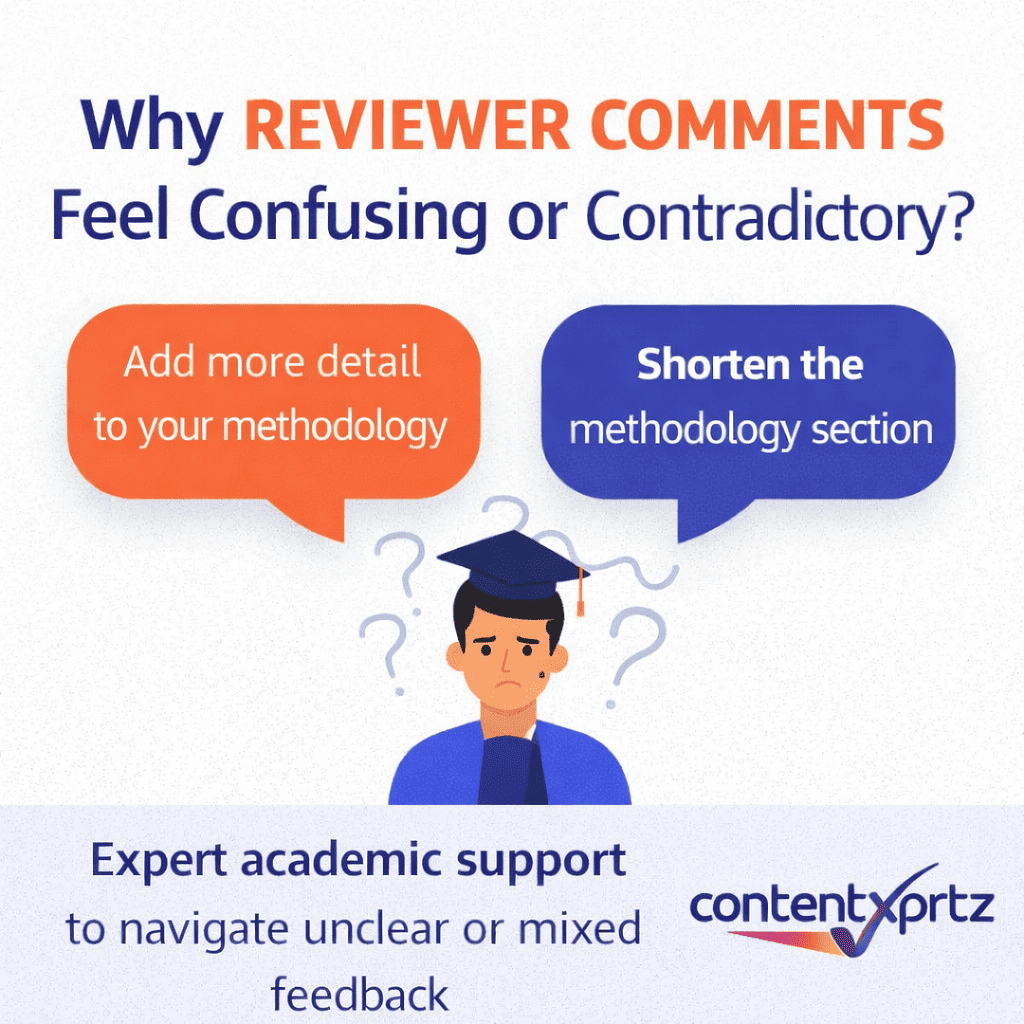

Why Reviewer Comments Feel Confusing or Contradictory: An Academic Guide for PhD Scholars and Researchers Navigating Peer Review
Introduction: Understanding the Emotional and Academic Reality of Reviewer Feedback
For many PhD scholars and academic researchers, few moments are as emotionally charged as opening an email titled “Decision on Your Manuscript.” Hope, anxiety, exhaustion, and anticipation converge in a single click. When the reviewer comments finally appear, however, that emotional build-up often gives way to confusion. Instead of clear direction, scholars encounter remarks that feel contradictory, vague, or even conflicting. At this moment, a question arises repeatedly in the minds of researchers across disciplines and continents: why reviewer comments feel confusing or contradictory, especially when months or years of rigorous research lie behind the manuscript.
This confusion is not a reflection of a scholar’s intellectual ability or research quality. Rather, it reflects the structural complexity of peer review itself. Academic publishing operates within a system shaped by disciplinary norms, editorial constraints, reviewer subjectivity, and institutional expectations. For early-career researchers and doctoral candidates in particular, these layers remain largely invisible until the first round of review arrives.
Globally, the pressure to publish has intensified. According to Elsevier’s research insights, the number of active researchers worldwide surpassed nine million in recent years, while top journals maintain acceptance rates below 10 percent. Springer Nature reports that many journals reject more than half of submissions in the first screening alone. Meanwhile, Emerald Insight highlights that doctoral scholars face rising publication costs, extended revision cycles, and increasing expectations for theoretical originality. These realities contribute to a climate where reviewer comments are not only decisive but deeply consequential.
Adding to this challenge, PhD candidates often balance publication demands alongside teaching, coursework, funding constraints, and institutional deadlines. Time pressure limits their ability to decode complex feedback carefully. Emotional investment amplifies every perceived contradiction. As a result, reviewer comments that are intended to strengthen a manuscript may instead feel discouraging or incoherent.
This article offers an evidence-based, educational exploration of why reviewer comments feel confusing or contradictory, what these comments truly represent, and how scholars can respond strategically. Drawing on best practices from academic publishing, editorial ethics, and professional academic editing, this guide aims to transform reviewer feedback from a source of frustration into a structured roadmap for publication success. For researchers seeking clarity, confidence, and informed support, understanding reviewer logic is the first step forward.
The Peer Review System: Designed for Rigor, Not Simplicity
Peer review is the cornerstone of scholarly publishing. Yet, it is not designed to be simple, linear, or emotionally neutral. Instead, it is designed to test research rigor from multiple angles.
Reviewers are independent experts invited by editors to evaluate a manuscript’s contribution, methodology, theoretical grounding, and relevance. Importantly, reviewers do not collaborate with one another. Each review emerges from an individual scholar’s intellectual framework, disciplinary training, and research priorities. As Taylor and Francis explain in their editorial guidelines, divergence in reviewer opinion is not a flaw but an expected outcome of scholarly debate.
This structural independence explains why reviewer comments often appear contradictory. One reviewer may request theoretical expansion, while another asks for tighter focus. One may praise methodological rigor, while another questions sampling decisions. These differences do not cancel each other out. Instead, they reflect how the same work can be interpreted through multiple scholarly lenses.
For PhD scholars unfamiliar with this dynamic, the result feels disorienting. The manuscript appears to fail contradictory standards simultaneously. However, understanding that peer review is dialogical rather than deterministic helps scholars contextualize feedback more constructively.
Why Reviewer Comments Feel Confusing or Contradictory: Core Academic Reasons
Disciplinary Paradigms Shape Interpretation
Academic disciplines are not monolithic. Even within a single field, epistemological traditions differ. A qualitative researcher trained in interpretivism evaluates arguments differently from a positivist quantitative scholar. When reviewers come from distinct paradigms, their expectations naturally diverge.
For example, one reviewer may prioritize theoretical depth, while another emphasizes empirical robustness. Both perspectives are valid within their frameworks. The confusion arises when authors assume there is one correct academic standard rather than multiple coexisting ones.
Reviewer Roles Differ from Editorial Authority
Reviewers advise, but editors decide. Many scholars mistakenly treat all reviewer comments as mandatory. In reality, editors weigh reviewer input strategically. Conflicting comments often indicate areas where editorial judgment becomes central.
Understanding this distinction empowers authors to respond selectively, justifying their choices rather than attempting to satisfy every comment literally. This is a core principle taught by publication ethics bodies such as the Committee on Publication Ethics (COPE).
Ambiguity in Academic Language
Academic critique often uses cautious language. Phrases such as “could be strengthened,” “may require clarification,” or “appears somewhat limited” are intentionally indirect. Reviewers use hedging to maintain collegiality. However, for doctoral scholars, this indirectness feels unclear.
Without training in academic discourse analysis, scholars may overinterpret or misinterpret these comments. Professional academic editing services often help decode such language, translating implied expectations into actionable revision strategies.
The Psychological Dimension of Reviewer Feedback
Beyond structural factors, emotional responses significantly shape how reviewer comments are perceived. Research published by the American Psychological Association shows that scholars experience heightened stress when feedback threatens academic identity. Doctoral candidates, whose professional identities are still forming, are particularly vulnerable.
When scholars are emotionally invested in their work, contradictory comments feel personal. The brain seeks coherence, yet peer review offers multiplicity. This mismatch intensifies frustration. Recognizing this psychological layer helps normalize emotional reactions without allowing them to derail revision progress.
How Experienced Researchers Interpret Reviewer Contradictions
Senior academics rarely interpret reviewer comments literally. Instead, they read between the lines. They ask strategic questions:
-
What core issue are multiple reviewers circling?
-
Which comments align with the journal’s aims and scope?
-
Where does the editor emphasize priority concerns?
This interpretive skill develops over time. For early-career researchers, external guidance through PhD thesis help or academic editing services accelerates this learning curve. Structured support transforms confusion into clarity.
Strategic Approaches to Responding to Conflicting Reviewer Comments
Effective responses follow academic logic rather than emotional impulse. Best practices include:
-
Grouping comments by theme rather than reviewer
-
Identifying negotiable versus non-negotiable revisions
-
Providing reasoned justifications when choosing one suggestion over another
-
Maintaining respectful academic tone in response letters
Elsevier’s author resources emphasize that clarity, transparency, and scholarly justification matter more than compliance alone. Editors value thoughtful engagement over mechanical revision.
Frequently Asked Questions (Integrated Academic Guidance)
FAQ 1: Why do reviewers contradict each other so often in academic journals?
Contradictory reviewer comments arise because peer review reflects intellectual diversity rather than consensus. Reviewers evaluate manuscripts independently, guided by their disciplinary training, methodological preferences, and theoretical orientations. Academic publishing values pluralism because it strengthens scholarly debate. For PhD scholars, this diversity initially feels destabilizing. However, experienced researchers recognize contradictions as indicators of scholarly engagement rather than rejection. The key is identifying overlapping concerns beneath surface disagreement. Professional research paper writing support often helps scholars map these intersections clearly.
FAQ 2: Should I try to satisfy every reviewer comment to avoid rejection?
Attempting to satisfy every comment indiscriminately often weakens a manuscript. Editors do not expect authors to comply blindly. Instead, they expect reasoned responses grounded in academic justification. When comments conflict, authors should explain their decisions respectfully in the response letter. This demonstrates scholarly maturity. Academic editing services assist in crafting responses that balance compliance with intellectual integrity, which significantly improves editorial outcomes.
FAQ 3: How can I tell which reviewer comments are most important?
Priority is signaled through editorial summaries, repeated themes across reviews, and alignment with journal scope. Comments addressing theoretical contribution, methodological validity, or clarity of argument typically carry greater weight. Minor stylistic suggestions are secondary. Understanding this hierarchy requires familiarity with editorial decision-making. PhD support services often provide targeted guidance on prioritization to prevent over-revision.
FAQ 4: Are confusing reviewer comments a sign of poor research quality?
No. Confusion often indicates that research engages complex ideas or interdisciplinary questions. Innovative work frequently challenges established norms, prompting divergent reactions. Many highly cited papers faced extensive revision due to initial reviewer disagreement. Rather than signaling failure, confusion often signals potential impact. Academic mentors and professional editors help scholars refine articulation without diluting originality.
FAQ 5: How should I emotionally cope with contradictory reviewer feedback?
Emotional regulation is an underdiscussed academic skill. Taking time before responding, separating personal identity from scholarly critique, and seeking external perspective are essential strategies. Institutions increasingly acknowledge reviewer stress as part of doctoral training. Engaging academic editing services introduces objectivity, reducing emotional overload while preserving scholarly intent.
FAQ 6: Can professional academic editors ethically help with reviewer responses?
Yes, when done ethically. Reputable services focus on clarity, structure, and argumentation rather than content fabrication. According to COPE guidelines, language editing and response structuring are acceptable forms of support. Ethical academic editing enhances transparency and communication without compromising authorship integrity.
FAQ 7: Why do reviewers sometimes ask for opposite revisions?
Opposite requests reflect different evaluations of scope, depth, or audience. One reviewer may prefer expansion to address theory, while another seeks concision for readability. Authors must contextualize these requests within journal priorities. Editors expect authors to navigate these tensions thoughtfully rather than mechanically.
FAQ 8: How long should I take before responding to reviewer comments?
While journals set deadlines, scholars should allow sufficient cognitive distance before revision. Immediate responses often reflect emotional reactivity. Strategic planning improves revision quality. Many scholars allocate one to two weeks for interpretation before active rewriting. Structured PhD thesis help services often include revision timelines aligned with journal expectations.
FAQ 9: What if I disagree strongly with a reviewer’s suggestion?
Disagreement is acceptable when articulated academically. Authors should explain their reasoning respectfully, citing literature or methodological rationale. Editors value scholarly confidence supported by evidence. Academic editing professionals often help frame disagreements diplomatically, preserving reviewer goodwill while defending research integrity.
FAQ 10: How can ContentXprtz support me through confusing reviewer feedback?
ContentXprtz offers structured academic editing services, PhD support, and research paper assistance tailored to peer review navigation. Our experts analyze reviewer logic, prioritize revisions, and craft response strategies aligned with journal expectations. By combining editorial insight with ethical academic practice, we help scholars move from confusion to confident revision.
Internal Academic Support Resources
For scholars seeking structured assistance, explore ContentXprtz’s specialized services:
-
PhD thesis help through our PhD and Academic Services
-
Comprehensive Writing and Publishing Services
-
Dedicated Student Writing Services
-
Professional support for long-form projects via Book Authors Writing Services
-
Industry-aligned documentation through Corporate Writing Services
Conclusion: Transforming Reviewer Confusion into Scholarly Growth
Reviewer comments feel confusing or contradictory not because scholars fail, but because academic knowledge is complex, pluralistic, and dialogical. Understanding the structural, psychological, and epistemological foundations of peer review empowers researchers to respond strategically rather than react emotionally.
With informed interpretation, ethical academic editing, and structured PhD support, reviewer feedback becomes a roadmap rather than a roadblock. At ContentXprtz, we partner with scholars globally to navigate this journey with clarity, integrity, and confidence.
Explore our PhD Assistance Services today and move one step closer to successful publication.
At ContentXprtz, we do not just edit. We help your ideas reach their fullest potential.
