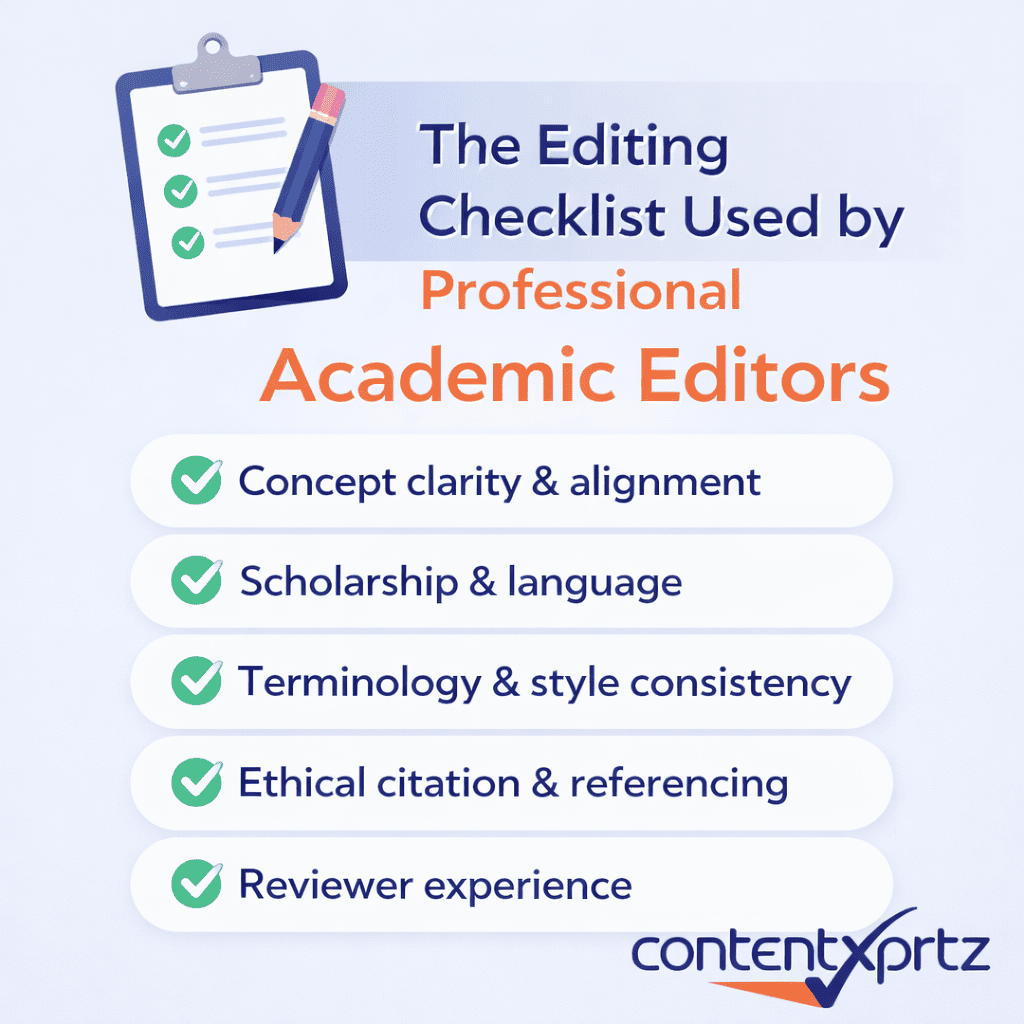

Beyond Grammar: The Editing Checklist Used by Professional Academic Editors to Prepare Research for Publication
Introduction
For most PhD scholars, academic writing is not merely a task; it is a prolonged intellectual journey marked by pressure, precision, and persistent uncertainty. You may spend years refining your research question, collecting data, and developing arguments, only to realize that the final outcome depends heavily on how clearly and convincingly your work is written. In this context, The Editing Checklist Used by Professional Academic Editors becomes more than a technical guide. It becomes a strategic framework that protects your research from rejection, misinterpretation, and unnecessary revision cycles.
Across disciplines, doctoral researchers face shared challenges. These include shrinking submission deadlines, increasing publication competition, linguistic barriers for non-native English speakers, and the rising cost of prolonged doctoral enrollment. According to data published by Elsevier, global research output has grown by more than 20 percent over the last decade, while journal acceptance rates have declined in many high-impact outlets. In some Q1 journals, acceptance rates now fall below 10 percent. As submission volumes increase, editorial scrutiny becomes sharper, and poorly edited manuscripts are often rejected before peer review.
At the same time, PhD scholars are expected to juggle teaching responsibilities, grant applications, administrative duties, and personal commitments. Editing, therefore, becomes rushed or postponed. Unfortunately, journals do not evaluate intentions or effort. They evaluate clarity, coherence, and scholarly rigor. Even groundbreaking research can be undermined by unclear structure, inconsistent terminology, or stylistic ambiguity.
Professional academic editors do not simply correct grammar. They follow a systematic, multi-layered process designed to align manuscripts with disciplinary norms, journal expectations, and international academic standards. This process is governed by a structured checklist that addresses everything from argument logic to citation ethics. Understanding this checklist allows researchers to anticipate editorial expectations and significantly improve publication outcomes.
At ContentXprtz, where we have supported scholars in more than 110 countries since 2010, we consistently observe one truth. Manuscripts that undergo professional, checklist-driven editing are not only clearer but also more persuasive and resilient during peer review. This article explains that checklist in detail, offering transparency into how professional academic editors work and why their approach matters for PhD scholars and researchers worldwide.
Why Professional Academic Editing Has Become Essential
Academic publishing has evolved into a high-stakes environment. Journals now prioritize readability, methodological transparency, and ethical compliance as much as theoretical contribution. According to Springer Nature, editorial desk rejections increasingly cite language quality and structural clarity as primary reasons, particularly in interdisciplinary and international submissions.
Professional editing addresses this shift by functioning as quality assurance rather than cosmetic correction. Editors evaluate whether arguments progress logically, whether terminology remains consistent, and whether the manuscript aligns with the rhetorical expectations of the target journal. Importantly, ethical academic editing preserves the author’s voice while improving precision and coherence.
Understanding the Editing Checklist Used by Professional Academic Editors
Conceptual Clarity and Research Alignment
The first step in professional editing is conceptual alignment. Editors assess whether the manuscript clearly communicates its research purpose, contribution, and scope.
Editors check:
-
Whether the research question is explicitly stated and consistently addressed
-
Alignment between objectives, methodology, results, and conclusions
-
Logical progression of arguments across sections
-
Consistency in theoretical framing and conceptual definitions
A common issue in PhD theses and research papers is conceptual drift, where early objectives are not fully addressed in later chapters. Editors identify and flag these inconsistencies early.
Structural Integrity and Section Coherence
Professional academic editors evaluate structure at both macro and micro levels. This includes chapter sequencing, paragraph development, and internal transitions.
Editors focus on:
-
Clear introductions and conclusions for each section
-
Paragraph unity, where each paragraph addresses one idea
-
Logical transitions that guide readers through complex arguments
-
Balanced section lengths that reflect academic conventions
This step ensures that readers, including reviewers, can follow the research narrative without cognitive strain.
Language Precision and Academic Tone
Language editing goes far beyond grammar. Editors refine syntax, vocabulary, and tone to meet international academic standards.
Key checks include:
-
Elimination of ambiguity and vague phrasing
-
Reduction of redundancy and over-explanation
-
Appropriate use of discipline-specific terminology
-
Maintenance of formal academic tone without sounding mechanical
Publishers such as Taylor & Francis emphasize clarity as a key determinant of reader engagement and citation potential.
Consistency in Terminology and Style
Inconsistent terminology can confuse reviewers and weaken arguments. Professional editors maintain strict consistency across the manuscript.
This includes:
-
Uniform use of key terms and abbreviations
-
Consistent spelling conventions (American or British English)
-
Alignment with journal style guides
-
Standardized headings, tables, and figure labels
Consistency enhances credibility and professionalism.
Citation Accuracy and Ethical Referencing
Editors verify that all sources are cited accurately and ethically. This step protects authors from unintentional plagiarism and referencing errors.
Editors check:
-
In-text citations against reference lists
-
Compliance with APA, MLA, Chicago, or journal-specific styles
-
Proper attribution of paraphrased ideas
-
Accuracy of DOIs and publication details
Guidelines published by the American Psychological Association stress that citation accuracy is central to academic integrity.
Methodological Transparency
Professional editors examine whether methods are described clearly enough for replication. This is especially critical in empirical research.
Editors assess:
-
Clarity of sampling procedures
-
Transparency of data collection and analysis methods
-
Alignment between research questions and analytical techniques
-
Adequate reporting of limitations
Methodological opacity is a frequent reason for revision requests.
Argument Strengthening and Logical Flow
Editors do not alter research findings. However, they strengthen how arguments are presented.
This includes:
-
Clarifying causal relationships
-
Eliminating unsupported claims
-
Improving evidence integration
-
Enhancing discussion depth without speculation
This step improves persuasiveness without compromising academic ethics.
Readability and Reviewer Experience
Editors view manuscripts from a reviewer’s perspective. They aim to reduce cognitive load and improve reading flow.
They address:
-
Overly long sentences
-
Dense paragraphs
-
Unclear references to tables or figures
-
Inconsistent tense usage
Readable manuscripts often receive more constructive reviews.
Final Quality Assurance Review
Before submission, professional editors conduct a final holistic review.
This includes:
-
Cross-checking formatting requirements
-
Ensuring submission readiness
-
Verifying adherence to journal guidelines
-
Confirming that revisions did not introduce new inconsistencies
This final step minimizes avoidable desk rejections.
How Professional Editing Supports PhD Scholars at Different Stages
Professional editing is not limited to final drafts. It supports researchers across stages.
At proposal stage, editors refine research questions and coherence. During data analysis, they improve methodological clarity. At submission stage, they ensure compliance with journal standards. ContentXprtz offers tailored support through its PhD thesis help and academic editing services, designed to align with these evolving needs.
Frequently Asked Questions Integrated into the Academic Editing Process
How is professional academic editing different from proofreading
Professional academic editing addresses structure, argument logic, and scholarly tone, while proofreading focuses only on surface errors. Editors evaluate conceptual clarity, methodological alignment, and citation ethics. Proofreading alone cannot resolve deeper issues that often lead to rejection. For PhD scholars, editing offers strategic value by aligning manuscripts with reviewer expectations and disciplinary norms.
Does professional editing change the author’s research voice
Ethical academic editing preserves authorial voice. Editors refine expression without altering meaning, argument, or interpretation. At ContentXprtz, editors follow strict guidelines to ensure originality remains intact. Editing clarifies ideas rather than reshaping them. This approach aligns with publisher standards outlined by Emerald Insight.
When should PhD scholars seek professional editing
Editing is most effective when sought before submission, not after rejection. Early editing prevents structural flaws from becoming entrenched. Many scholars also benefit from chapter-level editing during thesis development. Engaging editors early reduces revision cycles and improves confidence.
Can editing improve journal acceptance chances
While editing cannot guarantee acceptance, it significantly reduces avoidable rejection risks. Journals often reject manuscripts due to clarity issues rather than content weakness. Professionally edited papers are easier to review and more likely to receive constructive feedback.
Is professional editing ethical in academic publishing
Yes, when conducted transparently. Ethical editing improves language and structure without contributing content. Major publishers explicitly permit language editing. ContentXprtz adheres to global ethical standards, ensuring compliance with institutional and journal policies.
How do editors handle non-native English manuscripts
Editors address linguistic clarity while respecting cultural and disciplinary nuances. They simplify sentence structures, correct idiomatic misuse, and enhance academic tone. This process ensures global researchers can compete on equal footing.
What documents benefit most from professional editing
PhD theses, journal articles, grant proposals, and conference papers benefit significantly. Editing improves clarity, coherence, and compliance across formats. Researchers preparing monographs can also benefit through book author writing services.
How long does professional editing take
Turnaround depends on document length and complexity. A journal article may require a few days, while a full thesis requires staged editing. ContentXprtz offers flexible timelines to support urgent and long-term projects.
Can editing help with reviewer comments
Yes. Editors assist in interpreting reviewer feedback and revising manuscripts accordingly. This support is crucial during resubmission stages, where clarity and responsiveness determine outcomes.
How does ContentXprtz ensure quality consistency
ContentXprtz uses a multi-editor review system and standardized checklists. Editors specialize by discipline and follow internal quality benchmarks. This process ensures consistent, high-quality outcomes across projects.
What should authors prepare before submitting for editing
Authors should clarify target journals, submission deadlines, and specific concerns. Providing journal guidelines helps editors tailor revisions effectively. Clear communication improves outcomes and efficiency.
The Role of ContentXprtz in Professional Academic Editing
ContentXprtz integrates professional editing within a broader ecosystem of research paper writing support, corporate writing services, and publication guidance. Since 2010, our global editorial teams have supported scholars across disciplines, languages, and academic systems.
Our editors follow the same checklist outlined in this article, ensuring transparency and consistency. Importantly, we prioritize ethical compliance, confidentiality, and author empowerment.
Conclusion
Understanding The Editing Checklist Used by Professional Academic Editors empowers researchers to approach writing with clarity and confidence. Professional editing is not an optional luxury. It is a strategic investment in research integrity, readability, and publication success. As academic competition intensifies, manuscripts must meet both intellectual and communicative standards.
At ContentXprtz, we combine editorial rigor with empathy for the researcher journey. Our services are designed to support scholars at every stage, from thesis development to journal resubmission.
Explore our PhD Assistance Services to strengthen your research and publication outcomes.
At ContentXprtz, we don’t just edit — we help your ideas reach their fullest potential.
