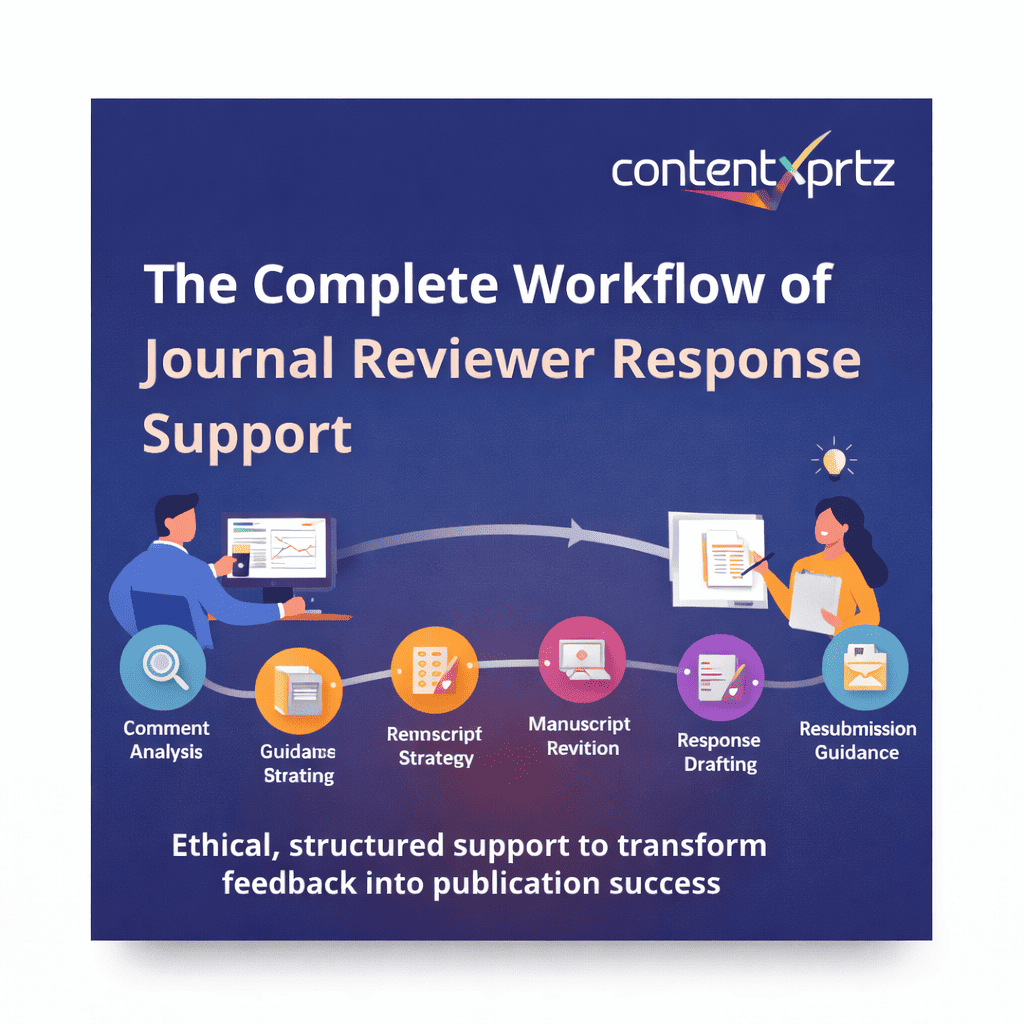

Navigating Revisions with Confidence: The Complete Workflow of Journal Reviewer Response Support for Academic Publishing Success
Introduction
For many PhD scholars, postdoctoral researchers, and early-career academics, receiving reviewer comments from a journal can be both a milestone and a moment of deep anxiety. On one hand, it signals that the manuscript has passed an initial editorial screening, which already places it ahead of a large proportion of submissions. On the other hand, reviewer feedback often arrives dense, technical, and sometimes sharply critical, leaving authors uncertain about how to respond effectively. It is within this delicate phase of scholarly communication that The Complete Workflow of Journal Reviewer Response Support becomes not merely helpful but essential.
In today’s global research ecosystem, academic publishing has become increasingly competitive. According to data from Elsevier’s Research Futures reports, the global volume of research submissions has grown steadily over the past decade, with millions of articles submitted annually across disciplines. Yet, acceptance rates at reputable journals remain modest. Many high-impact journals report acceptance rates below 20 percent, while elite journals in science, management, and social sciences may accept fewer than 10 percent of submissions. For PhD scholars, whose academic progression, funding opportunities, and professional credibility often depend on successful publication, this reality creates immense pressure.
Beyond competition, doctoral researchers face additional challenges that complicate the revision process. Time constraints are a major concern, especially for scholars balancing teaching responsibilities, grant deadlines, and dissertation milestones. Financial pressures also loom large, as extended candidature periods increase living and tuition costs. Furthermore, many researchers operate in multilingual environments, where English-language academic writing standards differ significantly from local academic conventions. In such contexts, even well-designed studies can struggle to meet the rhetorical and stylistic expectations of international journals.
Against this backdrop, responding to reviewers is not a mechanical task. It is a strategic, rhetorical, and scholarly exercise that requires clarity, diplomacy, and deep familiarity with journal norms. Reviewers expect authors to demonstrate intellectual maturity, openness to critique, and the ability to revise rigorously without compromising theoretical coherence. Editors, meanwhile, look for structured responses that show respect for peer review while clearly justifying methodological and conceptual choices. Without structured guidance, many promising manuscripts falter at this stage.
This is where The Complete Workflow of Journal Reviewer Response Support plays a transformative role. Rather than treating reviewer comments as isolated critiques, a systematic workflow frames them as part of an iterative scholarly dialogue. It helps authors decode reviewer intent, prioritize revisions, articulate reasoned rebuttals, and align revised manuscripts with editorial expectations. When executed professionally, this workflow not only improves acceptance prospects but also strengthens the overall quality and impact of the research.
At ContentXprtz, we work closely with PhD scholars and academic researchers worldwide to demystify this process. Drawing on over a decade of experience supporting manuscripts across disciplines and publishers, we view reviewer responses as a critical learning opportunity rather than a procedural hurdle. The sections that follow provide an in-depth, educational exploration of the complete reviewer response workflow, offering evidence-based insights, practical guidance, and best practices aligned with global publishing standards.
Understanding the Purpose of Reviewer Comments in Academic Publishing
Before examining the workflow itself, it is important to understand why reviewer comments matter so deeply in scholarly communication. Peer review is not designed to obstruct publication but to safeguard the integrity, rigor, and cumulative progress of academic knowledge. As emphasized by major publishers such as Elsevier and Springer Nature, reviewers act as disciplinary gatekeepers who evaluate originality, methodological soundness, theoretical contribution, and clarity of presentation.
Reviewer comments typically fall into several categories. Some focus on conceptual framing, questioning the novelty of the research question or the adequacy of the theoretical lens. Others scrutinize methodology, including sampling strategies, data analysis techniques, or validity claims. A third category addresses structure and writing, highlighting issues related to coherence, argument flow, or language precision. Understanding these categories allows authors to respond strategically rather than defensively.
Importantly, journals do not expect authors to agree uncritically with every comment. Instead, they expect reasoned engagement. A strong reviewer response demonstrates that the author has carefully considered each point, revised where appropriate, and provided scholarly justification where disagreement exists. This expectation underpins the logic of The Complete Workflow of Journal Reviewer Response Support, which emphasizes structured analysis over emotional reaction.
The Complete Workflow of Journal Reviewer Response Support: An Overview
At its core, the complete workflow is a multi-stage, iterative process that transforms reviewer feedback into a revised, publication-ready manuscript. While workflows may vary slightly by discipline or journal, a robust model typically includes the following stages:
-
Initial interpretation and emotional distancing
-
Categorization and prioritization of reviewer comments
-
Strategic revision planning
-
Manuscript-level revisions and academic editing
-
Development of the point-by-point response document
-
Tone calibration and scholarly positioning
-
Final compliance checks and resubmission readiness
Each stage contributes uniquely to publication success. Skipping steps or approaching them superficially often results in fragmented responses, unresolved reviewer concerns, and eventual rejection. In the following sections, each stage is examined in depth, with practical insights drawn from real-world academic publishing practices.
Stage One: Interpreting Reviewer Feedback with Scholarly Objectivity
The first and often most underestimated step in the workflow is interpretation. Receiving reviewer comments can trigger stress, frustration, or self-doubt, especially when feedback appears contradictory or overly critical. However, successful authors learn to create intellectual distance between their personal investment and the scholarly critique presented.
At this stage, it is advisable to read the reviewer comments multiple times over several days. The first reading allows authors to grasp the overall tone and decision outcome, whether major revisions, minor revisions, or revise and resubmit. Subsequent readings should focus on identifying substantive issues rather than surface-level criticism. According to guidance published by Taylor and Francis, authors who rush into revisions without fully understanding reviewer intent often misinterpret requests, leading to incomplete or misaligned responses.
Professional reviewer response support emphasizes contextual interpretation. For example, a reviewer’s request for additional literature may signal concerns about theoretical grounding rather than mere citation volume. Similarly, a comment questioning sample size may reflect concerns about generalizability rather than statistical competence. Understanding these underlying concerns is critical for crafting effective responses.
Stage Two: Categorizing and Prioritizing Reviewer Comments
Once reviewer comments are clearly understood, the next stage in The Complete Workflow of Journal Reviewer Response Support involves systematic categorization. This step transforms an often overwhelming list of comments into a manageable revision roadmap.
A widely accepted best practice is to categorize comments into major and minor revisions. Major comments typically address core aspects of the research, such as theoretical framing, methodology, or interpretation of results. Minor comments often involve clarifications, additional references, formatting corrections, or language improvements. Editors generally expect all major comments to be addressed comprehensively, while minor comments should be resolved fully unless justified otherwise.
Beyond this binary classification, advanced workflows also group comments thematically. For instance, all comments related to methodology can be addressed cohesively, ensuring consistency across sections. This thematic approach reduces the risk of fragmented revisions that inadvertently introduce contradictions into the manuscript.
At ContentXprtz, our academic editing services often involve creating a detailed reviewer matrix that maps each comment to specific manuscript sections. This structured approach enhances traceability and ensures that no comment is overlooked, a common reason for rejection after revision.
Stage Three: Strategic Revision Planning and Editorial Alignment
Revision planning is the intellectual backbone of the workflow. Rather than making ad hoc changes, authors should develop a clear strategy that aligns revisions with journal scope, reviewer expectations, and the manuscript’s original contribution. This stage benefits significantly from professional guidance, especially for interdisciplinary or high-impact journals.
A strategic plan typically outlines which sections will be revised, expanded, or reframed. It also identifies areas where the author intends to respectfully disagree with reviewers. Contrary to popular belief, disagreement is acceptable when supported by evidence, disciplinary norms, or methodological justification. Emerald Insight’s author resources emphasize that clear justification often strengthens an author’s credibility rather than undermining it.
Planning also involves time management. Journals usually provide specific deadlines for resubmission, and missing these deadlines can result in administrative rejection. A structured plan allocates sufficient time for substantive revisions, academic editing, internal review, and final checks.
For scholars seeking structured guidance, exploring professional PhD thesis help and publication planning support through services such as
https://contentxprtz.com/phd-academic-services
can provide clarity and accountability during this stage.
Stage Four: Implementing Revisions through Academic Editing and Content Refinement
With a clear plan in place, authors move to the execution phase, where revisions are implemented directly within the manuscript. This stage goes beyond surface-level editing and often requires deep engagement with theoretical arguments, methodological explanations, and result interpretations.
Academic editing at this stage serves multiple purposes. It ensures linguistic precision, improves argument flow, and aligns the manuscript with the stylistic conventions of the target journal. For non-native English speakers, professional editing can be particularly valuable in addressing subtle issues of tone and clarity that reviewers frequently highlight.
Importantly, revisions should be transparent. Editors and reviewers appreciate when changes are clearly marked, either through tracked changes or highlighted text, depending on journal guidelines. Transparency signals respect for the review process and facilitates efficient reassessment.
Authors seeking comprehensive academic editing services and manuscript refinement can explore
https://contentxprtz.com/writing-publishing-services
for structured, discipline-specific support.
Stage Five: Crafting the Point-by-Point Reviewer Response Document
The reviewer response document is arguably the most visible outcome of The Complete Workflow of Journal Reviewer Response Support. This document serves as a bridge between the original critique and the revised manuscript, demonstrating how each concern has been addressed.
Best practices recommend responding to each comment individually, quoting the reviewer’s text followed by a clear, concise response. Responses should indicate precisely where changes were made, including page and line numbers where possible. When authors disagree with a comment, the response should remain respectful and evidence-based, citing literature or methodological standards where relevant.
Tone is critical in this document. Even when comments appear harsh, responses should remain professional and appreciative. Research published by the American Psychological Association highlights that courteous responses positively influence editorial decisions, particularly in borderline cases.
Stage Six: Tone Calibration and Scholarly Positioning
Beyond technical accuracy, successful reviewer responses reflect mature scholarly positioning. This involves acknowledging limitations, clarifying contributions, and situating the research within broader disciplinary debates. Tone calibration ensures that responses are neither defensive nor overly deferential.
At this stage, many authors benefit from external review. Independent academic editors or mentors can identify unintended tone issues, ambiguous phrasing, or gaps in justification. Such external perspectives are especially valuable for early-career researchers navigating unfamiliar journal cultures.
For interdisciplinary authors or professionals transitioning into academic publishing, targeted research paper writing support and mentoring can be accessed through
https://contentxprtz.com/student-career-academic-writing-services
to refine scholarly voice and positioning.
Stage Seven: Final Compliance Checks and Resubmission Readiness
The final stage of the workflow involves ensuring full compliance with journal guidelines. This includes formatting checks, reference style verification, ethical statements, and supplementary materials. Even minor non-compliance can delay review or result in desk rejection.
Authors should verify that all reviewer comments have been addressed explicitly in the response document. A final cross-check between comments, revisions, and responses reduces the risk of oversight. Once complete, the manuscript and response files should be prepared according to submission system requirements.
At this point, the workflow culminates in a resubmission that reflects scholarly rigor, responsiveness, and professionalism.
Frequently Asked Questions Integrated into the Workflow
How long should a reviewer response document be, and does length affect acceptance?
A reviewer response document should be as long as necessary to address all comments comprehensively. There is no ideal word count, as length depends on the number and complexity of reviewer comments. However, clarity and completeness matter more than brevity. Editors prefer detailed, structured responses that demonstrate serious engagement with feedback. Excessively short responses may signal superficial revisions, while overly verbose responses can obscure key points. The goal is balance, ensuring each comment receives adequate attention without unnecessary repetition.
Is it acceptable to disagree with reviewers, and how should disagreement be framed?
Yes, disagreement is acceptable when grounded in scholarly reasoning. Journals do not expect blind compliance but thoughtful engagement. When disagreeing, authors should acknowledge the reviewer’s perspective, explain their rationale clearly, and support their position with credible references. Maintaining a respectful tone is essential. Disagreement framed as academic dialogue often strengthens an author’s credibility rather than weakening it.
What role does academic editing play in reviewer response success?
Academic editing plays a critical role by improving clarity, coherence, and tone. Many reviewer criticisms relate not to the research itself but to how it is presented. Professional editing helps align manuscripts with disciplinary writing norms, reduces linguistic ambiguity, and ensures that revisions address reviewer concerns effectively. Editing also supports the development of a polished reviewer response document.
How should authors handle contradictory reviewer comments?
Contradictory comments are common, especially in interdisciplinary research. In such cases, authors should prioritize the editor’s guidance if provided. When no guidance exists, authors can explain how they balanced differing perspectives or justify their chosen approach. Transparency and reasoned explanation are key. Editors understand that not all reviewer suggestions can be implemented simultaneously.
Are minor comments as important as major comments?
While major comments carry more weight, minor comments should not be ignored. Addressing minor comments demonstrates thoroughness and respect for the review process. Accumulated minor oversights can create the impression of carelessness, potentially influencing editorial decisions negatively.
How many revision rounds are typical before acceptance?
The number of revision rounds varies by journal and manuscript quality. Many papers are accepted after one or two rounds of revision. However, high-impact journals may require multiple rounds. Each round should be approached with the same rigor, as later revisions often focus on refinement rather than fundamental issues.
Can professional reviewer response support improve acceptance rates?
While no service can guarantee acceptance, structured reviewer response support significantly improves alignment with editorial expectations. By ensuring that comments are addressed comprehensively and professionally, authors reduce common reasons for rejection after revision. Support services also help authors learn transferable skills for future submissions.
Should reviewer responses reference page and line numbers?
Yes, referencing page and line numbers enhances clarity and efficiency for reviewers. It allows them to locate revisions quickly, facilitating reassessment. This practice is widely recommended by publishers such as Springer Nature and Elsevier.
How does reviewer response support differ from general proofreading?
Reviewer response support is more strategic than proofreading. While proofreading focuses on surface-level errors, reviewer response support addresses conceptual clarity, argument structure, and scholarly positioning. It integrates revisions with a clear rationale linked to reviewer feedback, making it a higher-level academic service.
When should authors seek external support during revisions?
Authors should consider external support when facing complex methodological critiques, language barriers, or high-stakes submissions. Early engagement with professional support can prevent missteps and improve efficiency, especially under tight deadlines.
Conclusion: Turning Reviewer Feedback into Publication Success
Responding to journal reviewers is one of the most demanding yet rewarding stages of academic publishing. When approached systematically, it becomes an opportunity to refine arguments, strengthen methodology, and enhance scholarly impact. The Complete Workflow of Journal Reviewer Response Support provides a structured pathway through this complexity, transforming critique into constructive progress.
For PhD scholars and researchers navigating an increasingly competitive publishing landscape, professional guidance can make a meaningful difference. By combining editorial expertise, disciplinary insight, and ethical academic practices, ContentXprtz supports scholars at every stage of the publication journey.
If you are preparing to respond to reviewer comments or seeking to improve your manuscript’s acceptance prospects, explore our comprehensive PhD and publication assistance services at
https://contentxprtz.com/phd-academic-services
At ContentXprtz, we don’t just edit — we help your ideas reach their fullest potential.
