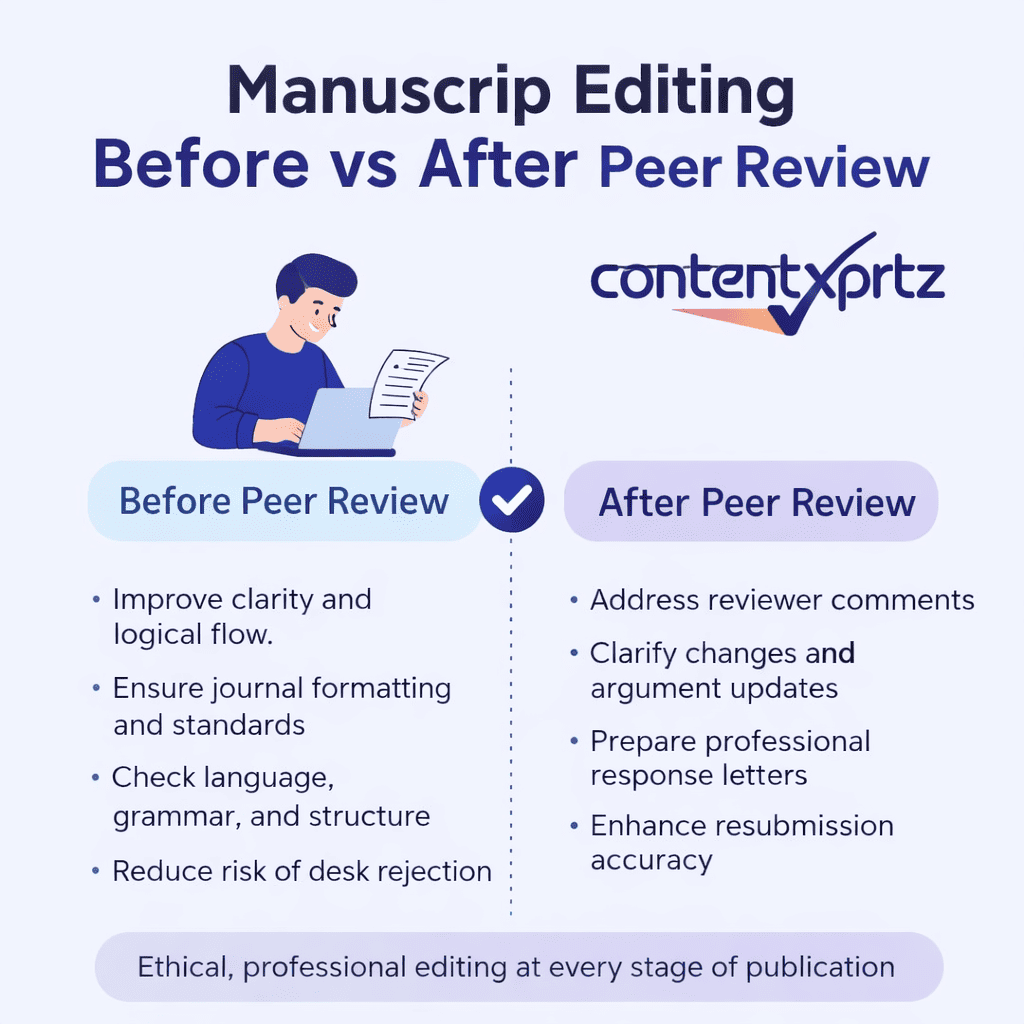

Manuscript Editing Before vs After Peer Review: A Strategic Guide for PhD Scholars and Academic Researchers
Introduction: Why the Timing of Manuscript Editing Can Define Your Publication Success
For PhD scholars, postdoctoral researchers, and academic professionals, publishing in reputable journals is no longer just an academic milestone. It is a career-defining requirement. Publications determine doctoral completion, funding eligibility, promotions, institutional rankings, and global academic visibility. Yet, despite years of rigorous research, many high-quality manuscripts fail to reach publication. One overlooked reason lies in a critical strategic decision: Manuscript Editing Before vs After Peer Review.
This decision is not merely technical. It shapes how reviewers perceive your research, how editors assess its readiness, and how efficiently your work progresses through the publication pipeline. In the increasingly competitive academic landscape, where top journals often report acceptance rates below 10 percent, even minor issues in language clarity, structure, or argument flow can lead to desk rejection.
Globally, the pressure on researchers has intensified. According to Elsevier’s Research Futures report, the number of active researchers worldwide has crossed nine million, while journal space has not expanded proportionately. At the same time, submission volumes to leading publishers such as Springer Nature, Emerald Insight, and Taylor and Francis continue to rise annually. This imbalance has increased reviewer fatigue and shortened editorial tolerance for manuscripts that require excessive polishing.
PhD scholars face additional challenges. Many balance teaching loads, grant applications, administrative duties, and personal responsibilities. Rising publication costs, extended review timelines, and repeated revisions often result in burnout. For non-native English speakers, linguistic precision adds another layer of complexity, even when the research itself is methodologically sound.
Against this backdrop, professional academic editing has emerged as a strategic necessity rather than a luxury. However, a recurring question remains unresolved for many scholars: should manuscript editing be done before peer review, after peer review, or at both stages?
This article offers a comprehensive, evidence-based analysis of Manuscript Editing Before vs After Peer Review. Drawing on global publishing standards, journal expectations, and academic best practices, it provides a clear roadmap to help researchers make informed decisions. The discussion integrates ethical considerations, cost implications, real-world examples, and discipline-specific insights, while aligning with the needs of PhD scholars and academic researchers seeking reliable publication support.
Throughout the article, we also highlight how structured academic editing, when aligned with the publication lifecycle, can significantly improve reviewer engagement, reduce revision cycles, and increase acceptance probability. Importantly, the focus is not on superficial language correction but on strengthening scholarly communication.
Whether you are preparing your first journal submission, revising a manuscript after major reviewer comments, or planning a long-term publication strategy, understanding Manuscript Editing Before vs After Peer Review can save time, reduce stress, and protect the intellectual value of your research.
Understanding Manuscript Editing in the Academic Publishing Ecosystem
Manuscript editing in academic publishing extends far beyond grammar checks or stylistic refinement. At its core, academic editing ensures that research is communicated with clarity, coherence, and credibility, in alignment with disciplinary conventions and journal expectations.
What Academic Manuscript Editing Actually Involves
Professional academic editing typically includes multiple layers, depending on the manuscript’s stage and needs:
-
Language editing, focusing on grammar, syntax, punctuation, and academic tone
-
Structural editing, ensuring logical flow across sections such as introduction, literature review, methodology, results, and discussion
-
Clarity and coherence enhancement, improving argument progression and reader comprehension
-
Formatting and style compliance, aligning the manuscript with journal-specific guidelines such as APA, Chicago, or Harvard
-
Consistency checks, covering terminology, citations, tables, and figures
Leading publishers like Elsevier and Springer Nature explicitly state that language quality and clarity influence editorial decisions, even when research quality is strong. Reviewers are instructed to assess not only originality and rigor but also readability and presentation.
Why Timing Matters in Manuscript Editing
The timing of editing determines the type of value it delivers. Editing before peer review aims to present the manuscript at its strongest possible version to editors and reviewers. Editing after peer review focuses on responding strategically to feedback and ensuring revisions meet reviewer expectations.
Understanding Manuscript Editing Before vs After Peer Review requires recognizing that these are not interchangeable stages. Each serves a distinct purpose within the publication lifecycle.
Manuscript Editing Before Peer Review: Building a Strong First Impression
What Is Pre-Peer Review Editing?
Pre-peer review editing refers to comprehensive manuscript refinement before submission to a journal. At this stage, the manuscript has not yet undergone external evaluation. The goal is to ensure that the research is communicated clearly, professionally, and persuasively from the outset.
This form of academic editing often includes language polishing, structural refinement, argument strengthening, and alignment with the target journal’s scope and formatting requirements.
Why Pre-Review Editing Matters More Than Ever
Editors increasingly rely on initial screening to manage high submission volumes. Desk rejection rates in many journals exceed 50 percent. According to Springer Nature, manuscripts that fail to meet language and presentation standards are often rejected without peer review, regardless of research merit.
Pre-peer review editing addresses this risk by ensuring:
-
Clear articulation of research objectives and contributions
-
Logical progression of arguments across sections
-
Professional academic tone consistent with international standards
-
Compliance with journal formatting and referencing rules
Benefits of Editing Before Peer Review
Improved Editorial Screening Outcomes
Editors are more likely to send a well-edited manuscript for peer review, as it signals seriousness, professionalism, and respect for reviewer time.
Enhanced Reviewer Engagement
Reviewers focus on evaluating research quality rather than correcting language or structural issues. This often results in more constructive feedback.
Reduced Risk of Misinterpretation
Clear language minimizes the risk that reviewers misunderstand methods, results, or theoretical positioning.
Time Efficiency in the Long Term
Although pre-review editing requires upfront investment, it often reduces the number of revision rounds later.
When Pre-Review Editing Is Especially Critical
-
First-time PhD authors submitting to international journals
-
Non-native English-speaking researchers
-
Interdisciplinary research targeting broad audiences
-
Manuscripts submitted to high-impact or Q1 journals
Researchers seeking PhD thesis help or research paper writing support often benefit significantly from early-stage editing, as it strengthens foundational academic communication.
Manuscript Editing After Peer Review: Responding Strategically to Reviewer Feedback
What Is Post-Peer Review Editing?
Post-peer review editing occurs after reviewers have evaluated the manuscript and provided comments. At this stage, the focus shifts from presentation readiness to revision accuracy and response effectiveness.
This editing phase supports authors in addressing reviewer concerns, revising arguments, and ensuring that changes are integrated seamlessly into the manuscript.
The Role of Editing After Peer Review
Reviewer comments can be extensive, technical, and sometimes contradictory. Post-review editing helps researchers:
-
Interpret reviewer feedback objectively
-
Revise sections while preserving academic voice
-
Maintain consistency across newly modified sections
-
Improve clarity in response letters and revised manuscripts
According to Emerald Insight’s author guidelines, clear and well-structured revisions significantly influence acceptance decisions in subsequent rounds.
Benefits of Editing After Peer Review
Precision in Revisions
Editors ensure that reviewer comments are addressed thoroughly without introducing new inconsistencies.
Improved Response Letters
Clear, professional responses increase editor confidence in the author’s scholarly competence.
Preservation of Authorial Intent
Experienced academic editors help maintain the original contribution while implementing required changes.
Higher Acceptance Probability
Well-edited revisions demonstrate responsiveness and professionalism, often leading to favorable editorial decisions.
Challenges of Relying Only on Post-Review Editing
While post-peer review editing is valuable, relying solely on it can be risky. If the manuscript was unclear or poorly structured initially, reviewers may already have formed negative impressions. Some rejections are final and do not allow resubmission.
This reality underscores the importance of comparing Manuscript Editing Before vs After Peer Review as complementary, not competing, strategies.
Manuscript Editing Before vs After Peer Review: A Comparative Perspective
Understanding Manuscript Editing Before vs After Peer Review requires evaluating them across multiple dimensions.
Purpose and Focus
-
Before peer review: Preventive, presentation-focused, and strategic
-
After peer review: Corrective, feedback-driven, and precision-oriented
Impact on Publication Outcomes
-
Pre-review editing increases the likelihood of entering peer review
-
Post-review editing increases the likelihood of acceptance after revision
Cost and Time Considerations
-
Pre-review editing often reduces total revision cycles
-
Post-review editing can become costly if major restructuring is required
Risk Management
-
Early editing minimizes desk rejection risk
-
Late editing mitigates rejection after revision but cannot reverse initial rejection
For most serious researchers, the optimal approach is not choosing one over the other but integrating both into a structured publication strategy.
Ethical Considerations in Academic Editing
Ethical academic editing respects authorship integrity and scholarly standards. Leading publishers such as the American Psychological Association emphasize that editing must not alter the intellectual ownership of research.
Ethical editing involves:
-
Language and clarity enhancement without data manipulation
-
Structural improvement without content fabrication
-
Transparent collaboration between author and editor
Professional academic editing services adhere to these principles, ensuring compliance with journal ethics policies.
How Professional Editing Aligns With Journal Expectations
Major publishers explicitly encourage authors to seek professional language editing when needed. For example:
-
Elsevier recommends language editing for authors concerned about clarity
-
Taylor and Francis highlights clear writing as essential for peer review
-
Springer Nature offers author services focused on manuscript preparation
These guidelines reinforce the legitimacy of professional editing at both pre- and post-review stages.
Frequently Asked Questions on Manuscript Editing Before vs After Peer Review
FAQ 1: Is manuscript editing before peer review mandatory for PhD scholars?
Manuscript editing before peer review is not formally mandatory, but it is increasingly essential in practice. Most international journals expect submissions to meet high language and presentation standards from the outset. For PhD scholars, especially those submitting to Q1 or Q2 journals, pre-review editing significantly improves the chances of passing editorial screening. Editors often desk reject manuscripts that require extensive language correction, regardless of research quality. Pre-review editing ensures that reviewers focus on your contribution rather than presentation flaws. It also demonstrates academic professionalism and respect for reviewer time. In competitive publishing environments, this strategic advantage can make the difference between review and rejection.
FAQ 2: Can I rely only on post-peer review editing to save costs?
Relying only on post-peer review editing may appear cost-effective initially, but it often leads to higher long-term costs. Manuscripts that are poorly structured or unclear are more likely to receive major revision requests or outright rejection. In such cases, post-review editing may require extensive restructuring, increasing both time and expense. Pre-review editing reduces these risks by addressing issues early. From a strategic standpoint, combining both stages often results in fewer revision cycles and faster publication, ultimately saving resources.
FAQ 3: How does manuscript editing differ from proofreading?
Manuscript editing is broader and more substantive than proofreading. Editing addresses language clarity, structure, argument flow, and academic tone. Proofreading focuses only on surface-level errors such as spelling and punctuation. In the context of Manuscript Editing Before vs After Peer Review, editing is crucial at both stages, while proofreading is typically most effective just before final submission or publication.
FAQ 4: Does professional editing influence reviewer bias?
Professional editing does not influence reviewer bias in terms of research evaluation, but it does shape reviewer perception. Clear, well-organized manuscripts are easier to evaluate and often receive more constructive feedback. Reviewers are human and may respond more positively to manuscripts that respect their time. Editing enhances communication without altering scientific content, thereby supporting fair evaluation.
FAQ 5: Is manuscript editing ethical under journal policies?
Yes, manuscript editing is ethical when conducted responsibly. Publishers such as Elsevier, Springer Nature, and APA explicitly permit language and structural editing. Ethical editing does not involve data manipulation, ghostwriting, or authorship misrepresentation. Reputable providers adhere to strict ethical guidelines, ensuring compliance with journal policies.
FAQ 6: Should I edit my PhD thesis differently from journal manuscripts?
Yes, PhD theses and journal manuscripts serve different purposes. A thesis demonstrates comprehensive research competence, while a journal article emphasizes concise contribution. Editing strategies differ accordingly. Pre-review editing for journal manuscripts focuses on clarity and impact, while thesis editing often addresses consistency, coherence across chapters, and institutional formatting requirements.
FAQ 7: How many rounds of editing are typically needed?
The number of editing rounds depends on manuscript quality and journal feedback. Well-prepared manuscripts often require one comprehensive pre-review edit and one targeted post-review edit. Manuscripts submitted without early editing may require multiple rounds, increasing time and cost. Strategic planning reduces unnecessary revisions.
FAQ 8: Can editing help with reviewer response letters?
Yes, post-peer review editing often includes support with response letters. Clear, respectful, and structured responses improve editor confidence. Editors assess not only revisions but also how authors engage with feedback. Editing ensures that responses are professional, precise, and aligned with reviewer expectations.
FAQ 9: Is editing equally important across all disciplines?
Editing is important across disciplines, but its focus varies. Humanities and social sciences emphasize argument clarity and narrative flow. STEM fields prioritize precision and consistency. Interdisciplinary research requires especially careful editing to ensure accessibility. Understanding disciplinary norms is essential for effective editing.
FAQ 10: How does ContentXprtz support manuscript editing at different stages?
ContentXprtz provides tailored editing support aligned with publication stages. Pre-review services strengthen clarity, structure, and journal alignment. Post-review services focus on revision accuracy, response strategy, and acceptance readiness. With global expertise and ethical standards, ContentXprtz supports researchers throughout the publication lifecycle.
Integrating Editing Into a Sustainable Publication Strategy
Rather than viewing editing as a one-time intervention, successful researchers integrate it into a long-term publication strategy. This approach aligns with best practices recommended by leading academic institutions and publishers.
Researchers seeking academic editing services or PhD thesis help benefit from early planning, realistic timelines, and expert guidance.
You may explore tailored support through ContentXprtz’s:
-
Writing and Publishing Services: https://contentxprtz.com/writing-publishing-services
-
PhD and Academic Services: https://contentxprtz.com/phd-academic-services
-
Student Writing Services: https://contentxprtz.com/student-career-academic-writing-services
-
Book Authors Writing Services: https://contentxprtz.com/book-authors-writing-services
-
Corporate Writing Services: https://contentxprtz.com/corporate-writing-services
Conclusion: Choosing the Right Editing Strategy for Academic Success
The debate around Manuscript Editing Before vs After Peer Review is not about choosing one stage over the other. It is about understanding how each stage contributes to publication success. Pre-peer review editing strengthens first impressions, reduces desk rejection risk, and enhances reviewer engagement. Post-peer review editing ensures precise revisions, effective responses, and higher acceptance probability.
For PhD scholars and academic researchers navigating intense publication pressure, a strategic, ethical, and stage-specific editing approach is essential. Professional academic editing is not a shortcut; it is a scholarly investment that protects the value of years of research.
If you are seeking reliable, ethical, and globally aligned academic support, explore ContentXprtz’s PhD assistance and publication services to strengthen your research journey.
At ContentXprtz, we don’t just edit, we help your ideas reach their fullest potential.
