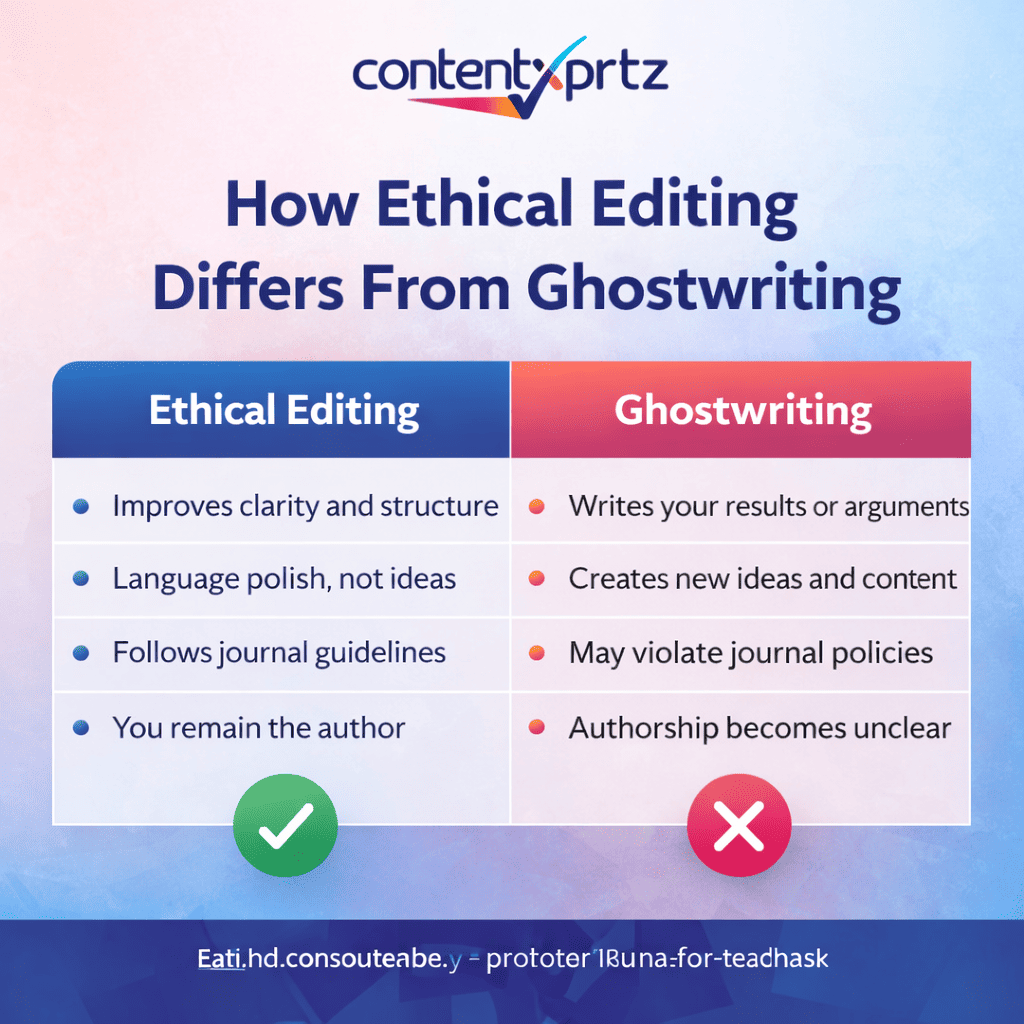

Beyond Assistance: How Ethical Editing Differs From Ghostwriting in Modern Academic Publishing
Introduction: Why This Distinction Matters More Than Ever (400+ words)
For PhD scholars, early-career researchers, and academic professionals, the journey from research idea to published work is rarely linear. It is demanding, time-intensive, and often emotionally exhausting. Within this pressure-filled environment, many scholars actively seek professional academic support to refine language, improve structure, and meet increasingly stringent journal expectations. This is where a critical and often misunderstood distinction emerges: how ethical editing differs from ghostwriting.
Understanding this difference is no longer optional. It directly affects academic integrity, degree validity, career credibility, and even long-term employability.
Globally, research output is growing at an unprecedented pace. According to Elsevier’s Research Futures Report, more than 5.1 million scholarly articles are published annually, yet acceptance rates in top-tier journals often remain below 10–15%. At the same time, doctoral completion rates remain concerning. Data from the Council of Graduate Schools suggests that nearly 40–50% of PhD candidates fail to complete their programs, with writing and publication pressure cited as a primary cause.
Add to this the realities faced by modern scholars:
-
Heavy teaching and administrative workloads
-
Limited supervision time
-
Rising publication costs and APCs
-
Language barriers for non-native English speakers
-
Increasing scrutiny around research ethics
In this context, professional academic editing has become a legitimate, widely accepted form of scholarly support. Major publishers such as Elsevier, Springer Nature, Taylor and Francis, and Emerald openly recommend language editing for authors who wish to improve clarity and presentation.
However, the growing demand for academic help has also fueled a parallel industry that operates in ethical grey zones. Ghostwriting services often promise guaranteed publications, fast-track PhDs, or “done-for-you” theses. While such offers may appear attractive under pressure, they fundamentally violate academic integrity.
This article addresses a question many scholars silently struggle with: How ethical editing differs from ghostwriting, and how to choose support that strengthens your work without compromising your academic identity.
At ContentXprtz, a global academic support provider established in 2010 and trusted by researchers across 110+ countries, we consistently emphasize one principle: editing should enhance your voice, not replace it. Ethical editing empowers scholars to communicate their ideas clearly, confidently, and compliantly.
This comprehensive guide explains the distinction in detail, grounded in academic standards, publisher guidelines, and real-world research practices. Whether you are working on a PhD thesis, journal manuscript, conference paper, or academic book, this clarity will help you make informed, ethical, and future-proof decisions.
Understanding Ethical Editing in Academic Writing
What Is Ethical Academic Editing?
Ethical academic editing refers to language, structure, and clarity enhancement that preserves the author’s original ideas, arguments, and intellectual ownership. The editor works with the manuscript, not instead of the author.
Reputable academic publishers define ethical editing as support that:
-
Improves grammar, syntax, and readability
-
Enhances logical flow and academic tone
-
Ensures consistency with journal or university guidelines
-
Does not alter research data, interpretations, or conclusions
According to the Committee on Publication Ethics (COPE) and the American Psychological Association (APA), ethical editing is permissible when it does not constitute authorship.
What Ethical Editors Do and Do Not Do
Ethical editors may:
-
Correct language and stylistic errors
-
Suggest restructuring for clarity
-
Flag logical inconsistencies or unclear arguments
-
Improve coherence across chapters or sections
-
Ensure adherence to formatting and citation standards
Ethical editors never:
-
Generate original content on behalf of the author
-
Modify data or results
-
Add references the author has not consulted
-
Write arguments, analyses, or conclusions
This distinction ensures that the scholar remains the sole intellectual contributor.
Why Ethical Editing Is Widely Accepted
Leading academic publishers explicitly acknowledge the legitimacy of editing support:
-
Elsevier encourages authors to use language editing services to “improve the clarity and readability of manuscripts.”
-
Springer Nature emphasizes that editing does not affect authorship.
-
Emerald Insight allows professional editing provided transparency is maintained.
Ethical editing, therefore, is not a shortcut. It is a quality assurance process that strengthens scholarly communication.
What Is Ghostwriting and Why It Is Problematic
Defining Ghostwriting in Academia
Ghostwriting occurs when a third party creates substantial portions or the entirety of an academic work, while the named author claims full authorship. This includes:
-
Writing theses or dissertations
-
Drafting journal articles from scratch
-
Creating literature reviews or analyses without author input
Unlike ethical editing, ghostwriting replaces the researcher’s intellectual contribution.
Why Ghostwriting Violates Academic Integrity
Academic integrity rests on transparency, originality, and accountability. Ghostwriting undermines all three.
Most universities classify ghostwriting as:
-
Academic misconduct
-
Plagiarism by proxy
-
Grounds for degree revocation or disciplinary action
Journals increasingly use AI detection, stylometric analysis, and authorship contribution statements to identify inconsistencies.
Long-Term Risks of Ghostwriting
While ghostwriting may seem like a temporary solution, it carries lasting consequences:
-
Loss of research credibility
-
Inability to defend work during viva or peer review
-
Ethical violations on CVs and grant applications
-
Career-ending reputational damage
Understanding how ethical editing differs from ghostwriting is therefore essential for academic survival.
How Ethical Editing Differs From Ghostwriting: A Clear Comparison
Core Differences at a Glance
| Aspect | Ethical Editing | Ghostwriting |
|---|---|---|
| Intellectual ownership | Author retains full ownership | Ownership transferred |
| Role of service provider | Improves clarity | Creates content |
| Compliance with ethics | Fully compliant | Violates standards |
| Acceptance by journals | Accepted | Prohibited |
| Risk to author | Minimal | Severe |
Ethical Editing Strengthens Your Research Voice
Ethical editors act as facilitators. They help scholars articulate ideas more effectively without changing meaning. This is especially valuable for:
-
Non-native English-speaking researchers
-
Interdisciplinary studies
-
Complex methodological papers
Ghostwriters, in contrast, impose their own voice, often leading to inconsistencies during peer review or defense.
Why the Distinction Matters for PhD Scholars
Degree Validity and Examination
During thesis defenses, examiners assess:
-
Depth of understanding
-
Consistency of argumentation
-
Ability to justify methodological choices
Ghostwritten work often collapses under questioning. Ethical editing does not.
Publication Ethics and Retractions
According to Retraction Watch, ethical violations, including ghostwriting, are a leading cause of paper retractions. Retractions remain permanently visible in academic databases.
Ethical editing helps scholars avoid retractions, not risk them.
Publisher and Institutional Perspectives on Ethical Editing
What Major Publishers Say
-
Elsevier: Editing services are acceptable if authors maintain intellectual control.
-
Springer Nature: Language editing is permitted but authorship must reflect contribution.
-
Taylor and Francis: Transparency in editorial assistance is encouraged.
These policies reinforce why ethical editing is compatible with global research standards.
Choosing Ethical Academic Support: What to Look For
Key Indicators of Ethical Editing Services
When seeking academic editing services, ensure the provider:
-
Clearly states it does not offer ghostwriting
-
Emphasizes author responsibility
-
Provides tracked changes and explanations
-
Encourages reviewer engagement
At ContentXprtz, ethical boundaries are explicitly defined across all services, including PhD thesis help, academic editing services, and research paper writing support.
You can explore:
-
PhD-level support via PhD & Academic Services: https://contentxprtz.com/phd-academic-services
-
Comprehensive Writing & Publishing Services: https://contentxprtz.com/writing-publishing-services
-
Tailored Student Writing Services: https://contentxprtz.com/student-career-academic-writing-services
FAQs: Ethical Editing, Ghostwriting, and Academic Publishing (Integrated)
1. Is ethical editing allowed for PhD theses?
Yes. Most universities explicitly permit language and structural editing, provided intellectual content remains unchanged. Ethical editing enhances clarity without compromising authorship.
2. Can journals detect ghostwritten papers?
Increasingly, yes. Journals use plagiarism detection, AI-based stylometry, and reviewer expertise to flag inconsistencies.
3. Does using editing services need disclosure?
Some journals encourage acknowledging language editing support. Ethical services guide authors on appropriate disclosure.
4. Is ghostwriting considered plagiarism?
Yes. Ghostwriting constitutes misrepresentation of authorship and is treated as plagiarism by proxy.
5. How does ethical editing improve acceptance rates?
Clear language, logical flow, and adherence to guidelines reduce desk rejections and reviewer confusion.
6. Are editing services expensive?
Ethical editing is generally cost-effective compared to the long-term costs of rejection, revision cycles, or misconduct.
7. Can ethical editors suggest improvements?
Yes. Suggestions are allowed, but authors must approve and implement them.
8. What happens if ghostwriting is discovered?
Consequences include degree cancellation, retraction, bans from journals, and reputational damage.
9. Is using AI tools equivalent to ghostwriting?
Not necessarily. However, unacknowledged AI-generated content raises ethical concerns similar to ghostwriting.
10. Why choose ContentXprtz for ethical editing?
ContentXprtz combines subject expertise, ethical compliance, and global publishing insight, ensuring scholars remain confident and compliant.
Conclusion: Making the Right Choice for Your Academic Future
The pressure to publish, complete degrees, and meet institutional expectations is real. However, compromising academic integrity is never a sustainable solution. Understanding how ethical editing differs from ghostwriting empowers scholars to seek help responsibly.
Ethical editing strengthens your work without erasing your intellectual identity. Ghostwriting, by contrast, creates risks that can shadow your entire career.
If you are seeking PhD thesis help, academic editing services, or research paper writing support that respects scholarly ethics, explore ContentXprtz’s dedicated services:
-
Writing and Publishing Support: https://contentxprtz.com/writing-publishing-services
-
PhD and Academic Assistance: https://contentxprtz.com/phd-academic-services
At ContentXprtz, we don’t just edit. We help your ideas reach their fullest potential.
