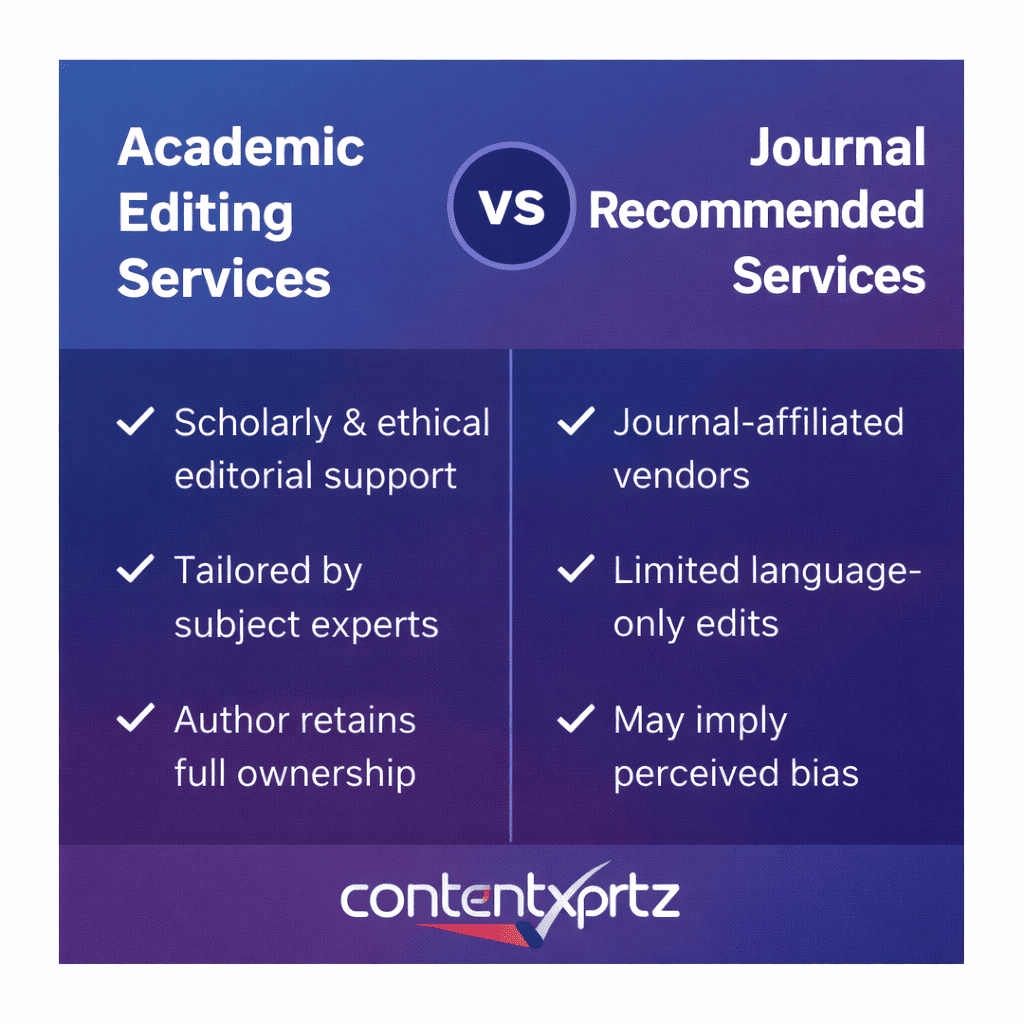

Academic Editing Services vs Journal Recommended Services: A Critical Guide for PhD Scholars and Researchers
Introduction: Navigating Editorial Choices in High-Stakes Academic Publishing
For PhD scholars and academic researchers, publishing is not merely an academic milestone. Instead, it is a decisive factor that shapes careers, funding prospects, institutional recognition, and long-term scholarly credibility. In this high-pressure environment, the question of Academic Editing Services vs Journal Recommended Services has become increasingly relevant and often confusing.
Early-career researchers frequently assume that once a journal recommends an editing service, it must be the safest or most effective option. However, seasoned scholars know that the choice of editorial support directly influences manuscript clarity, ethical compliance, turnaround time, and ultimately, acceptance probability. Therefore, making an informed decision is not optional; it is essential.
Globally, research output has increased at an unprecedented pace. According to Elsevier’s Research Futures Report, more than 3 million scholarly articles are published annually, with submission volumes rising faster than journal capacity. At the same time, acceptance rates for high-impact journals remain extremely selective. For instance, Springer Nature reports average acceptance rates between 7 percent and 15 percent across top-tier journals. Consequently, even strong research often faces rejection due to language issues, structural inconsistencies, or lack of alignment with journal expectations.
Moreover, PhD scholars face compounded challenges. Tight deadlines, teaching responsibilities, funding pressure, and increasing publication costs leave little margin for error. In response, many researchers turn to professional academic editing. Yet the market offers two dominant pathways: independent academic editing services and journal recommended services. Each option claims authority, reliability, and journal alignment. However, their actual value differs significantly when examined through the lenses of quality, ethics, transparency, and scholar-centric support.
This article provides an in-depth, evidence-based comparison of Academic Editing Services vs Journal Recommended Services. It is written for PhD scholars, postdoctoral researchers, and academic professionals seeking clarity rather than marketing promises. Drawing on best practices from established publishers such as Elsevier, Springer, Emerald Insight, Taylor and Francis, and APA, this guide aims to empower scholars to make informed, ethical, and strategic decisions.
Throughout this article, you will gain practical insights, real-world examples, and expert guidance grounded in more than a decade of academic publishing experience. Importantly, the discussion aligns with the ethical standards expected by global journals and institutions. By the end, you will understand which option truly serves your research goals and why a scholar-first approach often makes the decisive difference.
Understanding the Academic Publishing Ecosystem
Why Editing Matters More Than Ever
Academic publishing has evolved into a highly standardized, quality-driven ecosystem. Journals expect manuscripts that demonstrate methodological rigor, conceptual clarity, and linguistic precision. While peer reviewers evaluate scientific merit, editors often make initial decisions based on presentation quality. Studies published in Learned Publishing indicate that manuscripts rejected at desk review stage often fail due to poor structure, unclear argumentation, or language issues rather than weak research design.
Therefore, academic editing has shifted from optional refinement to strategic necessity. Effective academic editing enhances clarity without altering scholarly ownership. It ensures adherence to journal style guides, improves logical flow, and strengthens academic tone. Most importantly, it reduces cognitive load for reviewers, allowing them to focus on intellectual contribution rather than linguistic correction.
Two Dominant Models of Editorial Support
The editorial support landscape broadly consists of:
-
Independent academic editing services
-
Journal recommended editing services
Although both aim to improve manuscripts, their operating models, accountability, and researcher experience differ considerably. Understanding these differences is crucial before committing time and financial resources.
What Are Journal Recommended Editing Services?
Definition and Operational Model
Journal recommended services are editing providers listed or promoted by academic publishers. These services often appear on journal submission pages under sections such as “Language Editing Services” or “Author Services.” Major publishers, including Elsevier and Springer Nature, maintain partnerships with third-party vendors to offer standardized editing solutions.
Typically, these services focus on language polishing, grammar correction, and basic formatting. They operate at scale, handling thousands of manuscripts across disciplines. As a result, turnaround times are predictable, but customization is limited.
Perceived Advantages for Authors
Many authors perceive journal recommended services as safer options due to their association with reputable publishers. Common perceived benefits include:
-
Alignment with journal language standards
-
Reduced fear of ethical violations
-
Simplified submission workflow
However, publishers explicitly state that using recommended services does not guarantee acceptance. Elsevier, for example, clarifies that editorial decisions remain independent of any editing service used.
Limitations and Structural Constraints
Despite their visibility, journal recommended services have notable limitations:
-
Limited subject-matter depth
-
Standardized editing templates
-
Minimal interaction with editors
-
High per-word costs
-
No support beyond language editing
For complex PhD theses or interdisciplinary manuscripts, these constraints often result in superficial improvements rather than substantive clarity.
What Are Independent Academic Editing Services?
Definition and Scholar-Centric Approach
Independent academic editing services operate outside publisher ecosystems. They serve researchers directly, offering tailored support across manuscript types, including journal articles, PhD theses, dissertations, grant proposals, and books.
Reputable providers focus on ethical editing, academic integrity, and discipline-specific expertise. Unlike volume-driven models, independent services emphasize collaboration, feedback, and long-term researcher development.
Core Features of High-Quality Academic Editing
A credible academic editing service typically offers:
-
Subject-specific editors with PhD or postdoctoral experience
-
Structural and developmental editing
-
Journal alignment guidance
-
Reviewer comment support
-
Transparent pricing and timelines
At ContentXprtz, for example, academic editing is integrated within a broader research support framework. Scholars receive not only language refinement but also strategic guidance tailored to their publication goals.
Explore professional academic editing services through our Writing and Publishing Services designed for global researchers.
Academic Editing Services vs Journal Recommended Services: A Detailed Comparison
Quality of Editing
Independent academic editing services prioritize depth over speed. Editors engage critically with arguments, ensuring coherence, logical flow, and disciplinary conventions. In contrast, journal recommended services primarily focus on surface-level language correction.
Subject-Matter Expertise
Journal recommended services assign editors based on availability rather than specialization. Independent services match manuscripts with domain experts, ensuring terminological accuracy and conceptual clarity.
Ethical Transparency
Both models adhere to ethical standards. However, independent services often provide clearer documentation on authorship boundaries, plagiarism checks, and compliance with guidelines from APA and COPE.
Cost and Value
While journal recommended services often charge premium rates due to publisher branding, independent services provide flexible pricing models. Moreover, the value delivered per word is typically higher when editing includes structural and strategic support.
Researcher Experience
Independent academic editing fosters dialogue. Scholars can ask questions, request revisions, and seek publication advice. Journal recommended services offer minimal interaction, limiting learning opportunities.
When Journal Recommended Services May Be Suitable
Although independent academic editing services offer broader benefits, journal recommended services may be suitable in specific scenarios:
-
Minor language polishing for near-final manuscripts
-
Authors with strong institutional editing support
-
Short communications with minimal structural complexity
Even in these cases, scholars should carefully review service scope and limitations.
When Academic Editing Services Offer Clear Advantages
For PhD scholars and early-career researchers, independent academic editing services often provide decisive advantages:
-
First-time submissions to high-impact journals
-
Manuscripts requiring restructuring
-
Reviewer comment responses
-
Theses and dissertations with institutional evaluation
Scholars seeking comprehensive PhD thesis help can explore our PhD and Academic Services tailored for doctoral research demands.
Ethical Editing and Publication Integrity
What Reputable Journals Expect
Publishers such as Taylor and Francis and Emerald Insight emphasize that editing must not alter intellectual ownership. Ethical editing improves clarity while preserving author voice.
How Independent Services Uphold Integrity
High-quality academic editing services implement strict ethical frameworks. These include plagiarism screening, author consent protocols, and transparent revision tracking. Such practices align with global standards and enhance trust.
Integrated FAQs: Academic Editing and Publication Support
FAQ 1: Is using academic editing services ethical for PhD scholars?
Yes, using academic editing services is widely accepted and encouraged when conducted ethically. Reputable journals such as those published by Springer and Elsevier explicitly acknowledge the role of professional editing in improving manuscript clarity. Ethical academic editing focuses on language, structure, and coherence without altering research findings or intellectual ownership. For PhD scholars, editing support often bridges the gap between strong research and publishable presentation. Moreover, many universities recommend language editing for non-native English speakers. However, scholars must avoid services that offer ghostwriting or data manipulation, as these violate academic integrity standards.
FAQ 2: Do journal recommended services increase acceptance chances?
Journal recommended services do not guarantee acceptance. Publishers clearly state that editorial decisions remain independent. While these services may improve language quality, acceptance depends on research originality, methodology, and relevance. Independent academic editing services often provide deeper support, addressing reviewer expectations and journal alignment more comprehensively.
FAQ 3: How do I choose between academic editing services vs journal recommended services?
The choice depends on manuscript complexity, career stage, and publication goals. For surface-level language correction, journal recommended services may suffice. However, for PhD theses, interdisciplinary research, or high-impact submissions, independent academic editing services offer greater value through customized support and expert feedback.
FAQ 4: Are independent academic editing services recognized by journals?
Yes, journals recognize and accept manuscripts edited by independent academic editing services, provided ethical guidelines are followed. Many editors and reviewers are themselves affiliated with independent services. Transparency and adherence to standards matter more than service origin.
FAQ 5: What types of editing do PhD scholars typically need?
PhD scholars often require a combination of language editing, structural editing, and consistency checks. Additionally, alignment with journal style guides and clarity in argumentation are crucial. Independent academic editing services are better equipped to provide this multi-layered support.
FAQ 6: Can academic editing help with reviewer comments?
Yes, addressing reviewer comments is a specialized skill. Independent academic editing services often offer targeted support for revision rounds, helping scholars respond strategically and professionally. Journal recommended services rarely provide this level of engagement.
FAQ 7: How does academic editing differ from proofreading?
Academic editing involves substantive improvements to clarity, flow, and structure. Proofreading focuses on final error correction. PhD scholars benefit more from editing during earlier stages rather than last-minute proofreading alone.
FAQ 8: Is academic editing affordable for PhD students?
Many independent services offer flexible pricing and student-friendly packages. Considering the long-term value of publication success, academic editing is often a cost-effective investment compared to repeated submission failures.
FAQ 9: Do academic editing services support book manuscripts?
Yes, reputable providers support book proposals and manuscripts. Scholars preparing monographs can explore our Book Authors Writing Services for structured editorial guidance.
FAQ 10: How does ContentXprtz ensure quality and trust?
ContentXprtz operates with subject-specialist editors, ethical frameworks, and transparent workflows. Established in 2010, it supports researchers across 110+ countries. Services extend beyond editing to holistic research support, including Student Writing Services and Corporate Writing Services.
Conclusion: Making the Right Editorial Choice for Your Research Journey
Choosing between Academic Editing Services vs Journal Recommended Services is not merely a logistical decision. It is a strategic investment in your academic future. While journal recommended services offer convenience, they often fall short in addressing the nuanced needs of PhD scholars and serious researchers.
Independent academic editing services provide depth, ethical rigor, and personalized support. They empower scholars to present research with clarity, confidence, and credibility. In a competitive publishing landscape, such advantages often make the difference between rejection and recognition.
If you are seeking reliable, ethical, and expert-led publication support, explore our comprehensive PhD Assistance Services through ContentXprtz. Our global team is committed to helping your research reach its highest potential.
At ContentXprtz, we don’t just edit. We help your ideas reach their fullest potential.
