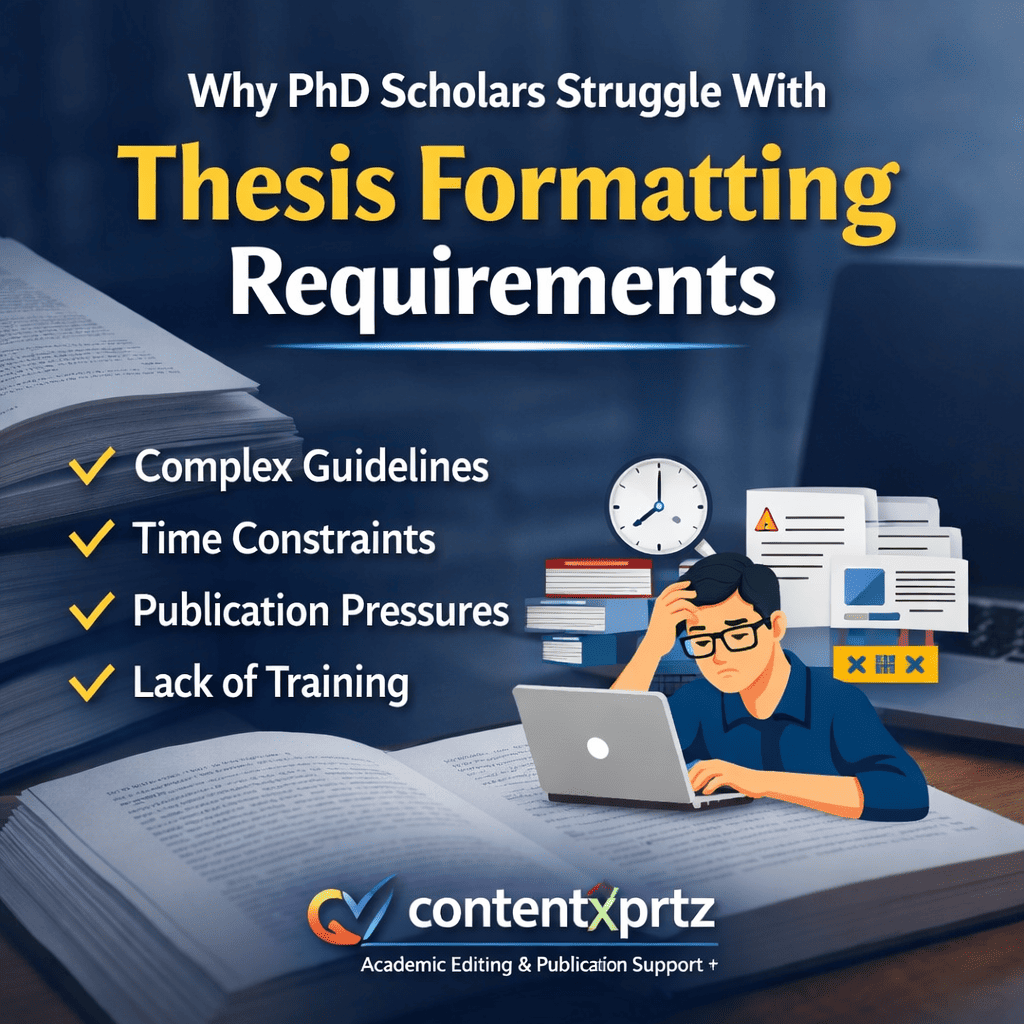

Why PhD Scholars Struggle With Thesis Formatting Requirements in a High-Stakes Academic Environment
Introduction
For many PhD scholars, writing a doctoral thesis represents the culmination of years of intellectual labor, emotional resilience, and professional sacrifice. However, despite strong research contributions and original insights, a significant number of doctoral candidates face repeated revisions, submission delays, or even rejection due to one persistent challenge: thesis formatting requirements. Understanding why PhD scholars struggle with thesis formatting requirements requires looking beyond technical guidelines and into the broader realities of modern doctoral education.
Globally, doctoral education has become increasingly complex. Universities now demand strict adherence to formatting rules that align not only with institutional regulations but also with international publication standards. These requirements cover everything from citation styles and reference lists to margins, fonts, tables, figures, headings, appendices, and ethical declarations. While these elements may appear secondary to research quality, they often play a decisive role in thesis evaluation and approval.
At the same time, PhD scholars face mounting pressures. According to reports published by Elsevier and Springer Nature, global research output has increased steadily over the past decade, intensifying competition for publication and academic recognition. Acceptance rates in high-impact journals remain low, often below 20 percent in leading disciplines. Universities respond to this competition by tightening quality controls, including formatting compliance, to ensure that doctoral submissions meet international benchmarks.
Moreover, PhD candidates today juggle multiple responsibilities. Many work part-time or full-time, teach undergraduate courses, publish research papers, and navigate funding constraints. Rising tuition costs, extended program durations, and mental health challenges further complicate the doctoral journey. In this context, formatting is rarely perceived as a priority, even though it carries disproportionate consequences.
The challenge is not a lack of intelligence or academic capability. Instead, it reflects a structural mismatch between the expectations placed on doctoral candidates and the practical support available to meet them. Formatting rules are often communicated through dense manuals, fragmented guidelines, or outdated templates. Supervisors may focus primarily on content, assuming students will independently manage technical compliance. As a result, scholars frequently discover formatting issues only at the final submission stage, when revisions become costly and stressful.
This article explores in depth why PhD scholars struggle with thesis formatting requirements, examining academic, institutional, cognitive, and systemic factors. It also provides evidence-based insights, practical strategies, and expert guidance to help doctoral candidates navigate formatting challenges effectively. Throughout the discussion, the perspective remains grounded in academic integrity, ethical editing practices, and global publishing standards.
The Expanding Complexity of PhD Thesis Formatting Standards
Institutional Diversity and Inconsistent Guidelines
One of the primary reasons PhD scholars struggle with thesis formatting requirements lies in institutional diversity. Universities across regions adopt different formatting frameworks, often combining local academic traditions with international standards. For example, a doctoral thesis submitted in the United Kingdom may follow conventions that differ significantly from those in the United States, Europe, or East Asia.
Even within the same institution, formatting guidelines may vary by faculty, department, or discipline. Engineering theses often emphasize technical diagrams and equations, while social sciences prioritize structured argumentation and referencing. Humanities dissertations may require extensive footnotes and archival citations. Navigating these differences requires a level of technical literacy that many doctoral candidates are not formally trained to develop.
Compounding the issue, universities frequently update formatting rules without providing adequate transition support. Templates become outdated, online guidelines conflict with printed manuals, and students receive mixed instructions from administrators and supervisors. These inconsistencies create confusion and increase the likelihood of non-compliance.
Alignment With International Publishing Standards
Modern doctoral theses increasingly serve dual purposes. They function both as academic assessments and as foundations for journal publications. Consequently, universities expect formatting to align with globally recognized styles such as APA, Harvard, Chicago, or discipline-specific journal guidelines.
Organizations such as the American Psychological Association emphasize that formatting is not merely aesthetic but integral to clarity, transparency, and scholarly credibility. However, mastering these standards requires familiarity with nuanced rules governing citations, headings, tables, and supplementary materials. For non-native English speakers and early-career researchers, this learning curve can be steep.
Scholars often attempt to reconcile institutional guidelines with journal requirements independently, leading to formatting inconsistencies. This challenge becomes particularly acute during revisions, when supervisors request structural changes that disrupt previously formatted sections.
The Cognitive and Emotional Burden of Formatting During Doctoral Research
Cognitive Overload and Divided Attention
Doctoral research demands sustained cognitive effort. Scholars must design studies, analyze data, engage critically with literature, and articulate original arguments. Formatting, by contrast, requires meticulous attention to detail and procedural accuracy. Switching between these cognitive modes can be exhausting.
Research in academic psychology suggests that task-switching reduces efficiency and increases error rates. When PhD scholars attempt to format complex documents while simultaneously refining arguments, they are more likely to overlook inconsistencies. This explains why formatting errors persist even among highly capable researchers.
Furthermore, formatting tasks often involve repetitive adjustments. A single change in margin settings or heading styles can cascade through hundreds of pages, creating new errors. Without advanced document management skills, scholars find themselves trapped in cycles of correction and re-correction.
Stress, Anxiety, and Perfectionism
Doctoral candidates frequently experience heightened anxiety around submission deadlines. Formatting issues amplify this stress because they are perceived as avoidable yet difficult to control. Scholars may feel frustration when minor technical errors overshadow substantive contributions.
Perfectionism, common among high-achieving academics, further complicates formatting. Some candidates spend excessive time adjusting visual elements, delaying progress on substantive revisions. Others avoid formatting altogether until the final stage, increasing the risk of last-minute complications.
Mental health studies published by academic institutions indicate that doctoral students report higher levels of stress and burnout compared to other student populations. Formatting challenges, while seemingly minor, contribute to this emotional burden by creating additional uncertainty during critical stages of the PhD journey.
Lack of Formal Training in Academic Formatting and Editing
Limited Instruction in Doctoral Programs
Despite its importance, thesis formatting is rarely taught systematically within doctoral curricula. Most PhD programs prioritize research methods, theoretical frameworks, and disciplinary knowledge. Technical writing skills are often assumed rather than explicitly developed.
Workshops on academic writing may focus on argumentation and publication strategies, leaving formatting as an afterthought. As a result, scholars rely on self-directed learning, trial-and-error, or informal peer support to manage formatting requirements.
This gap disproportionately affects international students and first-generation scholars, who may be unfamiliar with Western academic conventions. Without structured guidance, they struggle to interpret complex formatting manuals and implement them consistently.
Overreliance on Software Without Strategic Understanding
Many PhD scholars depend heavily on word processing software to manage formatting. While tools such as Microsoft Word and LaTeX offer powerful features, effective use requires strategic understanding. Automatic styles, reference managers, and cross-referencing systems can simplify formatting, but misapplication often creates hidden errors.
For instance, manual formatting overrides style settings, leading to inconsistencies that are difficult to detect. Reference management software may misformat citations if metadata is incomplete or incorrectly imported. Scholars who lack advanced technical skills may not recognize these issues until final review.
Academic publishers such as Elsevier emphasize the importance of standardized formatting to facilitate peer review and indexing. However, without professional guidance, scholars struggle to align software outputs with formal requirements.
Time Constraints and Competing Academic Responsibilities
Balancing Research, Teaching, and Employment
Time scarcity is a defining feature of doctoral life. Many PhD scholars balance research with teaching responsibilities, grant applications, conference presentations, and administrative duties. Others work outside academia to support themselves financially.
Formatting, which requires uninterrupted focus, often receives low priority amid these demands. Scholars may postpone formatting tasks until submission deadlines loom, reducing opportunities for thorough review.
In addition, funding constraints can limit access to institutional support services. While some universities offer writing centers or formatting assistance, availability is often limited and insufficient for lengthy doctoral documents.
Publication Pressure and Parallel Writing Tasks
The contemporary academic environment emphasizes publication productivity. Doctoral candidates are encouraged, and sometimes required, to publish during their PhD. Managing multiple manuscripts alongside a thesis increases cognitive load and formatting complexity.
Each journal imposes its own formatting rules, forcing scholars to switch between styles. This fragmentation increases the likelihood of errors within the thesis itself, particularly when content is repurposed from published articles.
Ethical Boundaries and Fear of External Assistance
Misconceptions About Academic Integrity
A significant yet often overlooked reason why PhD scholars struggle with thesis formatting requirements is uncertainty about ethical boundaries. Many candidates fear that seeking external assistance may violate academic integrity policies.
Universities typically prohibit ghostwriting but permit language editing, formatting support, and technical assistance. However, these distinctions are not always clearly communicated. As a result, scholars may avoid legitimate support services, attempting to manage formatting independently even when overwhelmed.
Professional academic editing organizations emphasize transparency and ethical compliance. Formatting assistance, when provided responsibly, enhances clarity without altering intellectual content. Nevertheless, misconceptions persist, discouraging scholars from seeking timely help.
Supervisor Expectations and Unspoken Assumptions
Supervisors often assume that doctoral candidates will independently manage formatting. While well-intentioned, this assumption overlooks the technical complexity of modern thesis requirements.
Feedback from supervisors may focus on conceptual issues, leaving formatting errors unaddressed until final submission. At that stage, revisions become more stressful and time-consuming.
Why Formatting Matters More Than Ever in Doctoral Evaluation
Gatekeeping Function of Formatting Compliance
Formatting functions as a gatekeeping mechanism in doctoral assessment. Examiners and administrative reviewers expect theses to conform to established standards as evidence of scholarly professionalism.
According to guidance published by Springer Nature, standardized formatting facilitates readability, evaluation, and archival storage. Non-compliance can signal carelessness, even when research quality is high.
In some institutions, theses that fail formatting checks are returned without evaluation, delaying graduation. For international scholars facing visa or employment constraints, such delays carry significant consequences.
Digital Archiving and Indexing Requirements
Modern theses are archived digitally and indexed in institutional repositories. Formatting consistency ensures compatibility with digital platforms and long-term accessibility.
Elements such as metadata, reference formatting, and figure labeling play critical roles in discoverability. Scholars who neglect these aspects risk reducing the visibility and impact of their work.
How Professional Academic Support Addresses Formatting Challenges
Role of Specialized Academic Editing Services
Professional academic editing services bridge the gap between research excellence and technical compliance. By applying expertise in formatting standards, editors ensure that theses meet institutional and international requirements.
Ethical academic editing focuses on structure, clarity, and consistency without altering scholarly arguments. This distinction aligns with guidelines issued by organizations such as the Committee on Publication Ethics.
For scholars seeking reliable assistance, services offering academic editing services and PhD thesis help provide structured support tailored to disciplinary norms.
Learn more about comprehensive support options through ContentXprtz Writing and Publishing Services at https://contentxprtz.com/writing-publishing-services.
Integrated Support Across the Doctoral Lifecycle
Effective formatting support is not a one-time intervention. It integrates with broader doctoral needs, including manuscript preparation, journal submission, and reviewer response management.
Dedicated PhD and Academic Services such as those offered at https://contentxprtz.com/phd-academic-services help scholars maintain consistency across all research outputs.
For early-stage scholars, student writing services at https://contentxprtz.com/student-career-academic-writing-services provide foundational guidance that prevents formatting issues from accumulating.
Frequently Asked Questions About PhD Thesis Formatting Challenges
Why do formatting errors persist even after multiple revisions?
Formatting errors persist because doctoral theses are dynamic documents. Each revision introduces structural changes that affect headings, references, tables, and figures. Without systematic style management, these changes create inconsistencies. Additionally, scholars often focus on content revisions, unintentionally overlooking formatting details. Professional formatting reviews provide a holistic check that catches errors missed during content-focused editing.
Is thesis formatting the same as language editing?
No, thesis formatting and language editing serve distinct purposes. Formatting addresses technical compliance, including layout, styles, citations, and visual consistency. Language editing focuses on grammar, clarity, and academic tone. While both are important, formatting ensures institutional acceptance, whereas language editing enhances readability. Ethical academic support separates these functions while coordinating them effectively.
Can poor formatting affect thesis evaluation outcomes?
Yes, poor formatting can significantly affect evaluation outcomes. Examiners expect compliance with institutional standards as evidence of scholarly discipline. Formatting errors may distract reviewers, create confusion, or signal lack of professionalism. In some cases, theses are returned for correction before evaluation, delaying graduation.
Why is formatting particularly difficult for international PhD scholars?
International scholars often face additional challenges due to unfamiliarity with local academic conventions. Citation styles, structural norms, and documentation requirements vary across regions. Language barriers may also complicate interpretation of formatting manuals. Access to culturally informed academic support helps bridge these gaps effectively.
How early should formatting be addressed in the PhD process?
Formatting should be addressed from the early stages of thesis writing. Applying consistent styles, reference management, and structural templates prevents cumulative errors. Early intervention reduces stress during final submission and ensures smoother integration of revisions. Many scholars underestimate the benefits of proactive formatting strategies.
Are universities clear about what formatting support is allowed?
Universities generally permit formatting and language editing but prohibit content creation by third parties. However, policies are not always explicit. Scholars should consult institutional guidelines and seek transparent, ethical support services that comply with academic integrity standards. Reputable providers clearly define the scope of assistance.
Does using reference management software solve formatting problems?
Reference management software can help, but it is not a complete solution. Incorrect metadata, incompatible styles, or manual overrides can introduce errors. Effective use requires technical knowledge and regular quality checks. Professional review ensures that automated tools function as intended.
How does formatting influence future publication opportunities?
Well-formatted theses facilitate manuscript extraction and journal submission. Consistent structure, accurate citations, and clear presentation reduce revision cycles during peer review. Publishers such as Emerald Insight emphasize that formatting compliance accelerates editorial processes and improves publication efficiency.
What role do supervisors play in formatting compliance?
Supervisors primarily focus on research quality and conceptual rigor. While they may provide general guidance, they often expect students to manage technical details independently. This division of labor highlights the importance of specialized support for formatting and compliance.
When should a PhD scholar consider professional formatting assistance?
PhD scholars should consider professional assistance when formatting requirements become overwhelming, time-consuming, or error-prone. Seeking support is not a sign of weakness but a strategic decision to ensure compliance and reduce stress. Ethical services enhance presentation while preserving academic ownership.
Conclusion: Transforming Formatting From Obstacle to Advantage
Understanding why PhD scholars struggle with thesis formatting requirements reveals that the issue extends beyond technical incompetence. It reflects systemic pressures, cognitive overload, inconsistent guidance, and limited institutional support. Formatting challenges persist because doctoral education prioritizes research excellence while underestimating the complexity of presentation standards.
Yet, formatting does not have to remain an obstacle. With early planning, strategic use of tools, and ethical professional support, doctoral candidates can transform formatting into a strength that enhances clarity, credibility, and academic impact.
ContentXprtz offers integrated solutions designed to support scholars at every stage of their academic journey. Whether through research paper writing support, academic editing services, or comprehensive PhD thesis help, our global teams ensure that your work meets the highest standards of excellence.
Explore tailored academic assistance through ContentXprtz PhD and Academic Services at https://contentxprtz.com/phd-academic-services and discover how expert support can streamline your path to submission success.
At ContentXprtz, we do not just edit. We help your ideas reach their fullest potential.
