
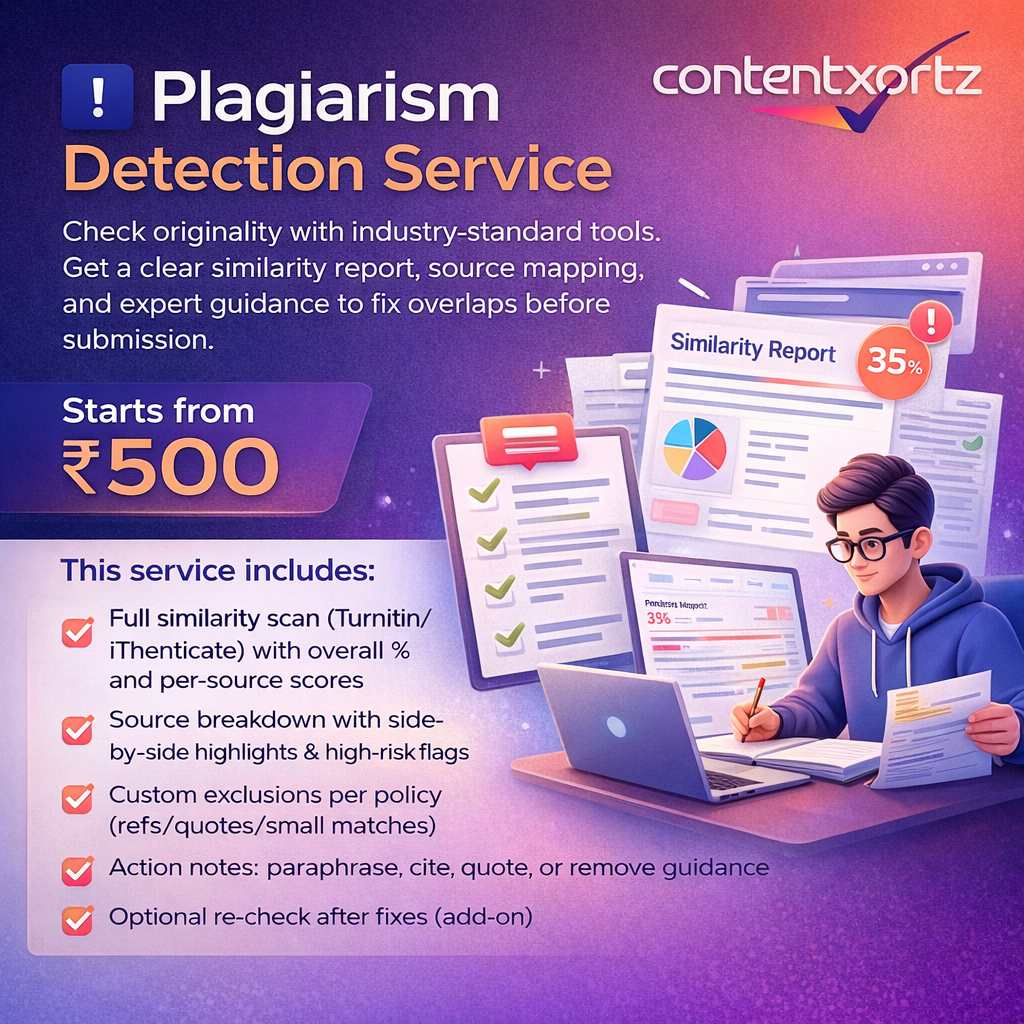
🔍 Plagiarism Check Before Submission—Because Originality Matters
Ensure your research stands on ethical ground before it reaches reviewers.
At ContentXprtz, our Plagiarism Detection Service helps you verify originality using industry-standard tools—so you submit with clarity, confidence, and compliance.
📘 What you get:
• Full similarity scan (Turnitin / iThenticate) with clear % scores
• Source-wise breakdown with highlighted overlaps & risk flags
• Policy-based exclusions (references, quotes, minor matches)
• Expert action notes: where to paraphrase, cite, quote, or remove
• Optional re-check after revisions (add-on)
🎓 Ethics-first approach
We do not rewrite or alter your work. You retain full authorship and ownership—our role is to guide you responsibly toward originality and journal readiness.
💰 Starts from ₹500
📄 Avoid last-minute rejections. Submit with confidence.
📲 Message us on WhatsApp to get started today
WhatsApp: https://wa.me/917065013200
🌐 Website: https://contentxprtz.com
#ContentXprtz #PlagiarismCheck #AcademicIntegrity #PhDLife #ResearchEthics #JournalSubmission #Turnitin #iThenticate #ResearchSupport #PhDScholars #AcademicWriting #PublishOrPerish #ResearchStudents #ScholarlyPublishing #ThesisSupport #ManuscriptPreparation #HigherEducation #UniversityResearch #DoctoralResearch #OriginalResearch #AcademicServices #PostdocLife #ResearchCareers
Plagiarism Detection Service for Academic Integrity, Trust, and Successful Publication
Introduction: Why Plagiarism Detection Has Become Non-Negotiable in Global Academia
For PhD scholars, postgraduate students, and academic researchers, originality is not just an expectation. It is the foundation on which academic credibility, career progression, and publication success are built. In today’s hyper-competitive research environment, a Plagiarism Detection Service is no longer an optional add-on. It is a critical safeguard against unintentional ethical breaches, manuscript rejection, and reputational damage.
Across disciplines and geographies, researchers face mounting pressure. Doctoral timelines are shrinking, publication requirements are increasing, and journal standards are becoming more stringent. According to data from major academic publishers, top-tier journals now reject between 70% and 90% of submitted manuscripts, with ethical non-compliance and similarity issues ranking among the most common early-stage rejection reasons. This reality places enormous strain on PhD scholars, especially those balancing teaching loads, funding constraints, family responsibilities, and institutional performance targets.
Moreover, globalization has reshaped academic writing itself. Researchers often work in multilingual contexts, collaborate across borders, and build upon an expanding universe of published literature. While this enriches scholarship, it also increases the risk of unintentional textual overlap, improper paraphrasing, and citation inconsistencies. Even well-intentioned scholars can face accusations of self-plagiarism or excessive similarity if their work is not rigorously screened before submission.
Universities, publishers, and indexing bodies now rely heavily on advanced similarity detection tools. Journals under major publishers such as Elsevier, Springer Nature, Emerald Insight, and Taylor and Francis routinely screen submissions using sophisticated plagiarism detection systems before peer review even begins. As a result, manuscripts that fail similarity checks are often desk-rejected without detailed feedback. This makes proactive plagiarism management essential rather than reactive.
At the same time, the cost of research has risen sharply. Article processing charges, editing fees, data access subscriptions, and conference costs add up quickly. A single rejection due to avoidable plagiarism concerns can delay graduation, increase financial burden, and derail academic momentum. For early-career researchers, the reputational consequences can be even more severe.
This is where a professional Plagiarism Detection Service plays a decisive role. When combined with expert academic editing, ethical rewriting, and publication guidance, plagiarism screening becomes a strategic advantage rather than a last-minute compliance check.
At ContentXprtz, we understand these pressures deeply. Since 2010, we have supported researchers across more than 110 countries, helping them navigate the complex intersection of originality, ethics, and publication success. In the sections that follow, this article offers an in-depth, evidence-based exploration of plagiarism detection in academic writing, its role in PhD research, and how scholars can protect their work while strengthening its scholarly impact.
Understanding Plagiarism in Academic Research Contexts
Plagiarism in academia is often misunderstood as deliberate copying. In reality, it is far more nuanced. Universities and publishers recognize multiple forms of plagiarism, many of which occur unintentionally.
Common Forms of Academic Plagiarism
Academic integrity policies typically identify several categories:
-
Direct plagiarism, where text is copied verbatim without attribution
-
Mosaic plagiarism, involving patchwork use of phrases from multiple sources
-
Paraphrasing plagiarism, where structure and meaning remain too close to the original
-
Self-plagiarism, where authors reuse their own published material without disclosure
-
Citation plagiarism, involving incomplete, incorrect, or missing references
Publishers increasingly treat self-plagiarism with the same seriousness as other forms, particularly in journal submissions and doctoral theses. This shift has surprised many experienced researchers who were trained under earlier norms.
According to the American Psychological Association, ethical writing requires both originality of expression and transparent attribution, even when building upon one’s own prior work. You can explore APA’s official guidance on plagiarism and self-plagiarism here:
https://apastyle.apa.org/style-grammar-guidelines/citations/plagiarism
Why Journals Rely on Plagiarism Detection Services
Modern plagiarism detection systems go far beyond simple text matching. They analyze billions of published articles, conference papers, dissertations, and web sources to identify similarity patterns.
Major publishers such as Elsevier and Springer Nature mandate similarity checks at the submission stage. Elsevier, for example, integrates plagiarism screening into its editorial workflow across thousands of journals. Details on their publication ethics framework can be found here:
https://www.elsevier.com/editors/perk/plagiarism-complaints
This reliance reflects three core concerns:
-
Preserving academic integrity across disciplines
-
Reducing editorial workload by filtering non-compliant submissions early
-
Protecting publisher reputation and indexing eligibility
For authors, this means plagiarism screening is unavoidable. The only question is whether it happens under your control or after submission, when correction options are limited.
What a Professional Plagiarism Detection Service Actually Delivers
Not all plagiarism checks are equal. Free online tools often provide misleading similarity scores, lack access to academic databases, and fail to distinguish between acceptable overlap and problematic similarity.
A professional Plagiarism Detection Service offers far more than a percentage number.
Core Components of High-Quality Plagiarism Screening
A robust service typically includes:
-
Access to publisher-grade similarity databases
-
Detailed source-by-source similarity reports
-
Differentiation between references, methodology overlap, and core content
-
Expert interpretation of results within journal-specific thresholds
-
Actionable recommendations for ethical revision
At ContentXprtz, plagiarism detection is integrated with academic editing services. This ensures that similarity reduction never compromises scholarly voice, argument coherence, or methodological clarity.
Plagiarism Detection and PhD Thesis Writing: A Critical Intersection
Doctoral theses face unique scrutiny. Universities often require mandatory plagiarism screening at multiple stages, including proposal submission, pre-defense, and final deposit.
Why PhD Theses Are Especially Vulnerable
Several factors increase plagiarism risk in doctoral work:
-
Extensive literature review sections
-
Reuse of conference papers or published articles
-
Collaborative research outputs
-
Long writing timelines spanning several years
Even well-documented theses can exceed institutional similarity thresholds if not carefully edited. Many universities now set similarity limits between 10% and 20%, excluding references. Exceeding these limits can delay graduation or require substantial rewriting.
A professional plagiarism detection service allows PhD scholars to identify risks early, well before institutional deadlines.
The Role of Academic Editing in Ethical Similarity Reduction
Plagiarism detection alone does not solve similarity issues. Ethical reduction requires deep subject knowledge, linguistic precision, and familiarity with disciplinary writing norms.
How Academic Editing Supports Originality
Expert academic editors focus on:
-
Advanced paraphrasing that preserves meaning while restructuring expression
-
Clarifying authorial voice across sections
-
Ensuring citation accuracy and consistency
-
Aligning writing style with target journal expectations
This process is fundamentally different from mechanical rewriting. It respects intellectual ownership while strengthening clarity and originality.
You can explore ethical editing standards through resources provided by Committee on Publication Ethics at:
https://publicationethics.org/resources/guidelines
Integrating Plagiarism Detection into the Publication Workflow
Rather than treating plagiarism checks as a final hurdle, experienced researchers integrate them strategically.
Best Practice Workflow for Researchers
A recommended sequence includes:
-
Initial drafting and self-review
-
Professional academic editing
-
Plagiarism detection service screening
-
Ethical revision based on report analysis
-
Final language polishing and formatting
-
Journal submission
This approach minimizes rejection risk and improves peer review outcomes.
Why ContentXprtz Is Trusted for Plagiarism Detection Services
Since 2010, ContentXprtz has supported thousands of scholars across disciplines, institutions, and publication goals. Our approach combines technology, expertise, and empathy.
What Sets Our Plagiarism Detection Service Apart
-
Publisher-aligned similarity tools
-
Subject-matter expert interpretation
-
Integration with academic editing services
-
Transparent reporting and guidance
-
Strict confidentiality and ethical standards
Our services are designed to support, not police, researchers. We work collaboratively to protect originality while enhancing scholarly impact.
Researchers seeking PhD thesis help and academic editing services often begin with our
Writing & Publishing Services
and expand into comprehensive support through our
PhD & Academic Services.
Frequently Asked Questions About Plagiarism Detection Services
What similarity percentage is acceptable for PhD theses and journal articles?
Acceptable similarity percentages vary by institution, discipline, and publisher. Most universities set thesis similarity limits between 10% and 20%, excluding references, quotations, and bibliographies. Journals often have stricter thresholds, particularly in humanities and social sciences. However, similarity percentage alone is not decisive. Editors evaluate where overlap occurs. Methodology sections may allow higher similarity, while literature reviews and discussion sections face closer scrutiny. A professional plagiarism detection service helps interpret similarity contextually rather than focusing on arbitrary numbers.
Is plagiarism detection mandatory before journal submission?
While not always mandatory at the author level, plagiarism detection is effectively unavoidable. Major publishers screen submissions automatically using internal systems. Authors who submit without prior screening risk desk rejection with limited opportunity for revision. Proactive plagiarism detection allows authors to address issues ethically and confidently before submission, improving acceptance prospects and reducing publication delays.
Can plagiarism detection tools detect paraphrasing?
Advanced plagiarism detection systems can identify close paraphrasing, structural similarity, and conceptual overlap. Simple word substitution is often insufficient to avoid detection. Ethical paraphrasing requires rethinking sentence structure, argument flow, and emphasis. This is why plagiarism detection should be paired with expert academic editing rather than automated rewriting.
How does self-plagiarism affect academic publishing?
Self-plagiarism is increasingly treated as a serious ethical issue, especially in journal publishing. Reusing text from published articles, conference papers, or dissertations without disclosure can lead to rejection or retraction. Many publishers require authors to declare prior dissemination. A plagiarism detection service helps identify self-overlap and guides ethical reuse through proper citation or rewriting.
Are free plagiarism checkers reliable for academic work?
Free tools often rely on limited web databases and exclude subscription-based academic content. As a result, they may underestimate similarity or miss critical overlaps. Publisher-grade plagiarism detection services access extensive scholarly databases, making them far more reliable for academic writing and publication purposes.
How early should PhD students use plagiarism detection services?
Ideally, plagiarism detection should be used at multiple stages. Early screening during drafting helps shape writing habits, while final screening before submission ensures compliance. Waiting until the final week before submission increases stress and limits revision options.
Does plagiarism detection compromise data confidentiality?
Reputable academic service providers follow strict confidentiality protocols. At ContentXprtz, manuscripts are never uploaded to public databases or reused for training purposes. Confidentiality agreements protect intellectual property and unpublished research.
Can plagiarism detection improve writing quality?
Indirectly, yes. Reviewing similarity reports encourages clearer paraphrasing, stronger authorial voice, and better citation practices. Over time, researchers develop more confident and original writing styles.
How does plagiarism detection differ for books and monographs?
Book manuscripts face similar ethical expectations but often allow greater flexibility in reusing previously published material with disclosure. Publishers still conduct similarity checks, particularly for academic monographs. Authors seeking support can explore our
Book Authors Writing Services
for tailored guidance.
Is plagiarism detection relevant for corporate and professional writing?
Yes. White papers, policy documents, and corporate research outputs increasingly undergo originality checks. Professionals can benefit from ethical screening through our
Corporate Writing Services,
which align academic rigor with industry standards.
Supporting Students Beyond PhD Research
While PhD scholars face the highest scrutiny, postgraduate and undergraduate students also encounter plagiarism challenges. Coursework, dissertations, and grant proposals are routinely screened by universities.
ContentXprtz offers dedicated support through our
Student Writing Services,
helping students develop ethical writing practices early in their academic journeys.
The Future of Plagiarism Detection in Academic Publishing
Plagiarism detection technologies continue to evolve. Artificial intelligence, semantic analysis, and cross-language similarity detection are becoming standard. Publishers are also exploring tools that assess idea originality, not just textual overlap.
For researchers, this means ethical writing practices will only grow in importance. Investing in professional plagiarism detection and academic editing is no longer about compliance alone. It is about future-proofing academic careers.
Emerald Insight discusses evolving publication ethics standards here:
https://www.emeraldgrouppublishing.com/publishing/ethical-guidelines-authors
Conclusion: Protecting Originality, Advancing Scholarship
In an academic landscape defined by competition, scrutiny, and global standards, a Plagiarism Detection Service is a vital ally for students, PhD scholars, and researchers. It protects intellectual integrity, reduces rejection risk, and supports ethical scholarship.
At ContentXprtz, we combine plagiarism detection with expert academic editing, research paper assistance, and publication guidance. Our approach is grounded in empathy, expertise, and ethical responsibility.
If you are preparing a thesis, journal article, book manuscript, or professional research document, explore our comprehensive PhD assistance services and take control of your publication journey.
At ContentXprtz, we don’t just edit – we help your ideas reach their fullest potential.
