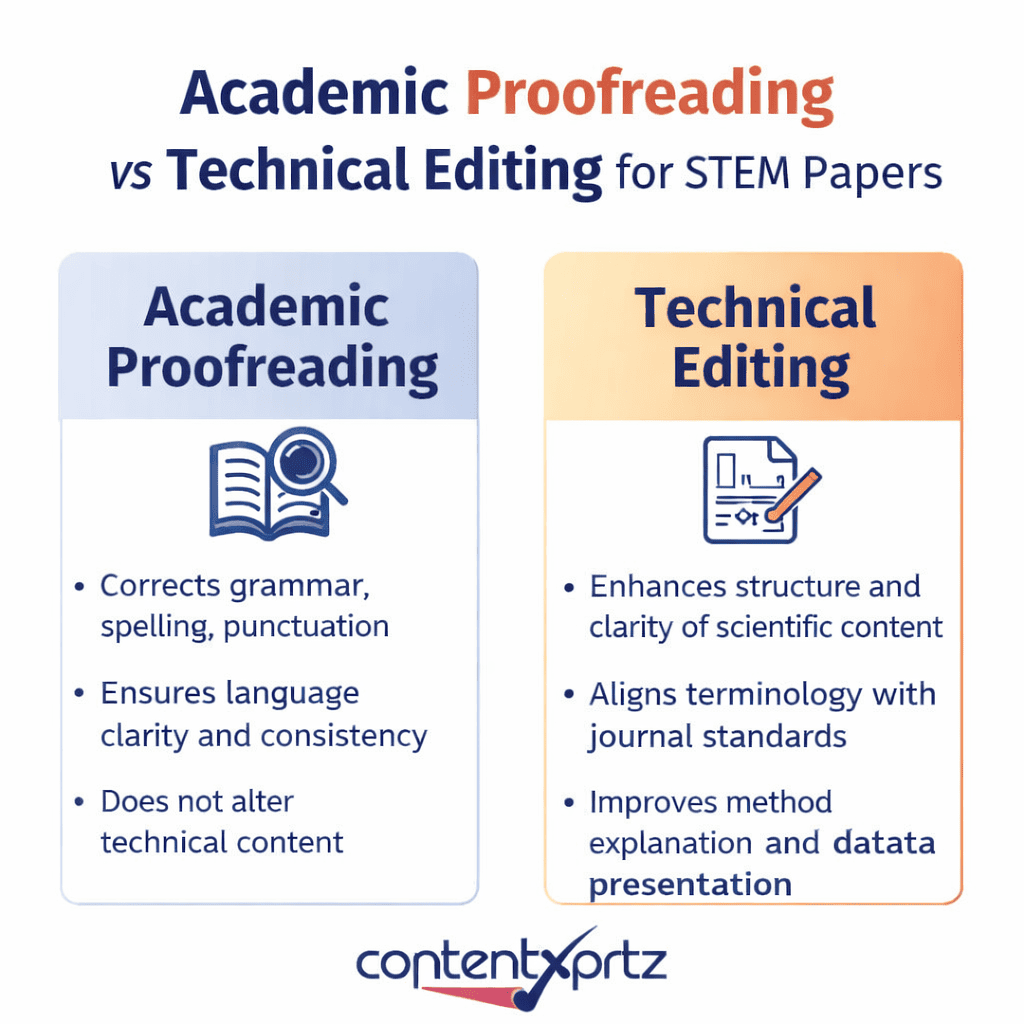

Beyond Grammar and Equations: Academic Proofreading vs Technical Editing for STEM Papers
Introduction: Why This Distinction Matters More Than Ever for STEM Scholars (400+ words)
For PhD scholars and academic researchers in science, technology, engineering, and mathematics (STEM), publishing is no longer a milestone achieved at the end of research. Instead, it has become a continuous, high-stakes process that determines funding opportunities, academic promotions, postdoctoral placements, and institutional reputation. Within this pressure-filled ecosystem, one critical but often misunderstood decision repeatedly surfaces: Academic Proofreading vs Technical Editing for STEM Papers.
Many doctoral candidates assume that proofreading alone is sufficient before journal submission. Others invest heavily in technical editing without fully understanding whether their manuscript actually requires it. This confusion is understandable. STEM papers are inherently complex, blending advanced mathematics, experimental protocols, domain-specific terminology, data visualisation, and strict journal formatting rules. A single weakness in language clarity or technical precision can result in desk rejection, even when the research itself is novel and robust.
Global research output continues to grow at an unprecedented pace. According to data reported by Scopus and publishers such as Elsevier, more than 3 million research articles are published annually, with STEM disciplines accounting for the majority. However, journal acceptance rates have not risen proportionally. High-impact journals often report acceptance rates below 10–15 percent, and language quality remains one of the most frequently cited reasons for rejection, particularly for authors writing in English as an additional language.
At the same time, PhD scholars face mounting constraints. Time to completion is shrinking. Publication expectations are increasing. Research funding is becoming more competitive. In many countries, doctoral candidates must publish multiple Scopus- or Web of Science-indexed papers before thesis submission. These pressures amplify the need for professional academic editing, but not all editing services deliver the same value.
Understanding the difference between academic proofreading and technical editing is therefore not a semantic exercise. It is a strategic decision that directly affects publication success, reviewer perception, and academic credibility. Proofreading focuses on surface-level linguistic accuracy. Technical editing, by contrast, engages deeply with the scientific structure, logic, terminology, and compliance standards of a STEM manuscript.
This article offers a comprehensive, evidence-based comparison tailored specifically for STEM researchers. Drawing on international publishing standards from Springer, Emerald Insight, and the American Psychological Association, it explains when each service is appropriate, how journals evaluate edited manuscripts, and how scholars can make cost-effective, ethical decisions.
For researchers seeking trusted PhD thesis help, academic editing services, or research paper writing support, clarity on this distinction is not optional. It is essential.
Understanding the Editing Spectrum in STEM Publishing
Before comparing academic proofreading and technical editing directly, it is important to understand where they sit within the broader academic editing spectrum.
What Is Academic Editing in a STEM Context?
Academic editing is an umbrella term that includes multiple levels of intervention, ranging from light language correction to deep structural and conceptual refinement. In STEM disciplines, editing must respect scientific integrity, data authenticity, and authorship ethics while enhancing clarity and compliance.
Publishers such as Elsevier and Springer explicitly differentiate between language editing and substantive editing in their author guidelines. Choosing the wrong level can either waste resources or leave critical weaknesses unaddressed.
What Is Academic Proofreading for STEM Papers?
Definition and Scope
Academic proofreading is the final quality-control stage of a manuscript. It assumes that the research design, methodology, data interpretation, and technical accuracy are already sound. The proofreader focuses exclusively on linguistic correctness and presentation consistency.
In STEM papers, proofreading typically occurs after peer feedback has been incorporated or immediately before journal submission.
Core Tasks in Academic Proofreading
Academic proofreading for STEM manuscripts includes:
-
Correcting grammar, spelling, and punctuation errors
-
Improving sentence flow without altering technical meaning
-
Ensuring consistency in terminology, abbreviations, and symbols
-
Checking references for formatting accuracy
-
Correcting minor typographical issues in equations and units
Importantly, a proofreader does not reinterpret data, question methodologies, or restructure arguments.
When Academic Proofreading Is Appropriate
Proofreading is suitable when:
-
The manuscript has already undergone peer or supervisory review
-
The author is confident in technical accuracy
-
The target journal has not requested major revisions
-
English proficiency is high but minor errors remain
For experienced researchers submitting incremental findings, proofreading can be sufficient and cost-effective.
What Is Technical Editing for STEM Papers?
Definition and Scope
Technical editing goes far beyond surface-level correction. It involves domain-aware evaluation of how scientific content is presented, interpreted, and aligned with disciplinary norms.
A technical editor typically holds advanced subject expertise and understands not only language mechanics but also experimental logic, mathematical reasoning, and publication standards specific to STEM fields.
Core Tasks in Technical Editing
Technical editing may include:
-
Clarifying complex methodologies and experimental workflows
-
Ensuring equations, variables, and units are used correctly and consistently
-
Improving logical flow between hypotheses, methods, results, and discussion
-
Refining technical terminology for precision and discipline alignment
-
Aligning the manuscript with journal-specific author guidelines
-
Flagging ambiguities, unsupported claims, or inconsistent interpretations
Unlike proofreading, technical editing may involve commentary and suggestions, allowing the author to make informed revisions.
When Technical Editing Is Necessary
Technical editing is strongly recommended when:
-
Submitting to high-impact or Q1 journals
-
The manuscript involves complex models, simulations, or datasets
-
Reviewer feedback indicates clarity or structure issues
-
The author is a non-native English speaker working in a technical field
-
The paper integrates interdisciplinary methods
For PhD candidates preparing their first journal article, technical editing often makes the difference between rejection and revision.
Academic Proofreading vs Technical Editing for STEM Papers: A Direct Comparison
Depth of Intervention
-
Proofreading focuses on language accuracy only
-
Technical editing addresses both language and scientific presentation
Required Expertise
-
Proofreaders require advanced language proficiency
-
Technical editors require subject-matter expertise and publication experience
Impact on Acceptance Rates
Studies cited by Springer indicate that manuscripts receiving substantive technical editing demonstrate higher reviewer clarity scores, particularly in engineering and biomedical fields.
Cost and Time Considerations
-
Proofreading is faster and less expensive
-
Technical editing requires more time but delivers higher strategic value
Ethical Considerations in STEM Editing
Ethical editing is a growing concern in academic publishing. Organizations such as the APA clearly state that editors must not alter data, fabricate results, or assume authorship.
At ContentXprtz, all services adhere to international ethical guidelines. Editors suggest revisions without rewriting scientific conclusions, ensuring that authors retain full intellectual ownership.
Choosing the Right Service as a PhD Scholar
Selecting between proofreading and technical editing should be based on manuscript readiness, not budget alone. Early-stage drafts benefit from technical editing. Final drafts benefit from proofreading.
Researchers seeking structured support often combine both services sequentially.
For comprehensive assistance, many scholars explore PhD thesis help and academic editing services through professional providers.
How ContentXprtz Supports STEM Researchers Globally
ContentXprtz offers tailored support across the academic lifecycle, from early drafts to final submission.
-
PhD and Academic Services: https://contentxprtz.com/phd-academic-services
-
Writing and Publishing Services: https://contentxprtz.com/writing-publishing-services
-
Student Writing Services: https://contentxprtz.com/student-career-academic-writing-services
-
Book Author Services: https://contentxprtz.com/book-authors-writing-services
-
Corporate and Technical Writing: https://contentxprtz.com/corporate-writing-services
Each service integrates ethical editing, subject expertise, and journal alignment.
Frequently Asked Questions (Integrated Section)
FAQ 1: Is academic proofreading enough for a first journal submission in STEM?
Academic proofreading alone is rarely sufficient for a first-time STEM submission. Early-career researchers often struggle with structuring arguments, presenting methods clearly, and aligning terminology with journal expectations. Technical editing provides deeper guidance that proofreading cannot address.
FAQ 2: Do journals know if a paper has been professionally edited?
Reputable journals encourage ethical language and technical editing. Publishers such as Elsevier explicitly recommend professional editing for non-native English speakers. What matters is transparency and ethical compliance.
FAQ 3: Can technical editing change my research findings?
No. Ethical technical editing focuses on clarity, not content alteration. Editors may flag inconsistencies or ambiguities, but authors retain full control over revisions.
FAQ 4: How does technical editing help with reviewer comments?
Technical editors help interpret reviewer feedback, restructure responses, and improve clarity in revised manuscripts, significantly increasing resubmission success rates.
FAQ 5: Is technical editing considered ghostwriting?
No. Ghostwriting involves creating content without attribution. Technical editing improves existing content while preserving authorship and intellectual ownership.
FAQ 6: What STEM fields benefit most from technical editing?
Engineering, computer science, biomedical sciences, applied mathematics, and interdisciplinary fields benefit significantly due to methodological complexity.
FAQ 7: How early should I use technical editing in my PhD journey?
Ideally, technical editing should be used before journal submission or thesis finalisation, particularly when preparing publications required for graduation.
FAQ 8: Can proofreading catch errors in equations and formulas?
Proofreaders may catch typographical errors, but technical editors are better equipped to evaluate equation logic and consistency.
FAQ 9: How do I budget for editing during my PhD?
Strategic planning helps. Use technical editing for key submissions and proofreading for minor revisions to balance cost and impact.
FAQ 10: Why choose a specialized provider like ContentXprtz?
General editing services lack disciplinary depth. ContentXprtz combines subject expertise, ethical standards, and publication insight developed over more than a decade of global academic support.
Conclusion: Making the Right Choice for Your Research Impact
The debate around Academic Proofreading vs Technical Editing for STEM Papers is not about which service is better in absolute terms. It is about choosing the right intervention at the right stage of your research journey.
Proofreading polishes language. Technical editing strengthens scientific communication. Both are valuable when applied strategically.
For PhD scholars and researchers navigating competitive publishing environments, informed decisions about editing are essential investments in academic success.
Explore professional PhD Assistance Services and tailored research paper writing support through ContentXprtz to ensure your work meets the highest global standards.
At ContentXprtz, we don’t just edit — we help your ideas reach their fullest potential.
