
Beyond Corrections: Thesis Proofreading vs Thesis Editing and How to Choose the Right Academic Support
Introduction
For many PhD scholars and postgraduate researchers, the final stages of thesis submission are often the most demanding. Years of data collection, theoretical framing, and analysis culminate in a single document that must meet strict academic, linguistic, and ethical standards. At this critical juncture, students frequently ask one decisive question: Thesis Proofreading vs Thesis Editing: Which One Do You Need?
This question is not merely semantic. It reflects deeper concerns around quality assurance, institutional expectations, examiner scrutiny, and the pressure to graduate on time. Across disciplines, doctoral candidates face mounting challenges such as publication-driven evaluation systems, shrinking supervisory bandwidth, rising tuition costs, and increasingly competitive academic environments. According to data reported by Elsevier, global research output has doubled over the past two decades, while journal acceptance rates in top-tier publications often remain below 15 percent. These dynamics have raised expectations not only for originality and rigor, but also for clarity, coherence, and scholarly presentation.
At the same time, many PhD candidates are non-native English speakers working in English-dominant academic systems. Springer Nature highlights that linguistic clarity significantly influences peer-review outcomes, even when methodological quality is strong. As a result, professional academic support has moved from being optional to essential for many scholars. However, misunderstanding the difference between proofreading and editing can lead to mismatched expectations, wasted resources, or even ethical concerns.
Thesis proofreading and thesis editing serve distinct purposes. Proofreading focuses on surface-level accuracy, while editing engages deeply with structure, argumentation, and academic style. Choosing the wrong service at the wrong stage may result in unresolved conceptual gaps or, conversely, unnecessary expenditure on extensive revisions when only minor corrections are needed.
This educational guide is designed to help PhD scholars, postgraduate students, and academic researchers clearly understand the difference between proofreading and editing, assess their own needs objectively, and make informed decisions aligned with institutional requirements and publication goals. Drawing on best practices from global academic publishing standards set by organizations such as Elsevier, Taylor and Francis, Emerald Insight, and the American Psychological Association, this article provides a comprehensive, evidence-based perspective.
At ContentXprtz, we work closely with researchers across more than 110 countries, supporting them through every stage of the academic lifecycle. This article reflects that experience, combining academic precision with practical clarity to ensure that scholars select the right level of support at the right time.
Understanding Academic Quality Control in Thesis Writing
Academic writing is not evaluated solely on the originality of ideas. Examiners and reviewers assess clarity of expression, logical flow, methodological transparency, and adherence to disciplinary conventions. A thesis may contain groundbreaking research, yet still face revisions or rejection due to poor language control or structural weaknesses.
Quality control in thesis writing typically operates at three levels:
-
Content integrity, ensuring arguments are logical and evidence-based
-
Structural coherence, ensuring chapters align with research objectives
-
Linguistic accuracy, ensuring grammar, syntax, and formatting meet academic norms
Professional academic editing and proofreading address these layers differently. Understanding this distinction is essential before selecting support services.
What Is Thesis Proofreading?
Definition and Scope
Thesis proofreading is the final quality-check performed on a near-complete document. Its primary purpose is to eliminate surface-level errors without altering meaning, structure, or academic voice. Proofreading assumes that the thesis is already conceptually sound and structurally complete.
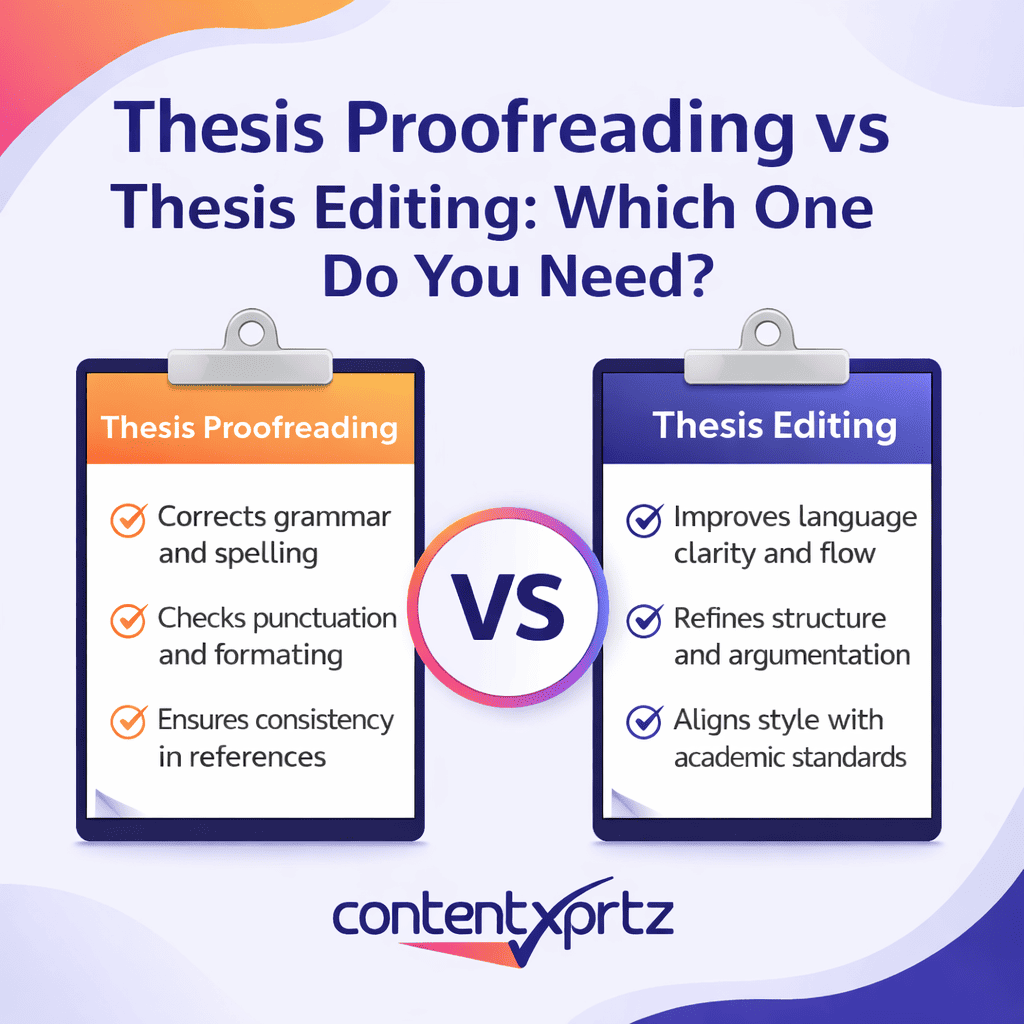
What Proofreading Covers
-
Grammar, spelling, and punctuation errors
-
Typographical mistakes
-
Inconsistent capitalization and hyphenation
-
Formatting inconsistencies in headings, tables, and figures
-
Reference list accuracy and citation consistency
Proofreading does not involve rewriting sentences, restructuring arguments, or questioning methodological decisions. According to APA guidelines, proofreading is considered a permissible form of academic support because it preserves authorship and intellectual ownership.
When Proofreading Is Appropriate
Proofreading is suitable when:
-
Supervisor feedback has already been fully addressed
-
The thesis has a clear structure and logical flow
-
The language is mostly accurate but requires polishing
-
Submission deadlines are near
Many universities explicitly recommend proofreading as a final-stage support mechanism, particularly for international students.
What Is Thesis Editing?
Definition and Scope
Thesis editing is a more comprehensive and intellectually engaged process. It focuses on improving clarity, coherence, academic tone, and structural integrity while preserving the author’s original ideas. Editing is iterative and analytical, often involving multiple rounds of review.
What Editing Covers
-
Sentence restructuring for clarity and precision
-
Paragraph-level coherence and logical flow
-
Consistency in academic tone and terminology
-
Chapter alignment with research objectives
-
Improvement of argument development
-
Compliance with disciplinary style guides
Unlike proofreading, editing may involve rewriting sections for clarity, reorganizing paragraphs, and suggesting improvements to transitions and framing.
Ethical Editing Practices
Reputable academic editors follow strict ethical standards. According to Taylor and Francis publishing ethics, editors may enhance clarity but must not add original ideas, fabricate data, or alter research outcomes. At ContentXprtz, editing is conducted with full transparency and adherence to international academic integrity norms.
Thesis Proofreading vs Thesis Editing: Which One Do You Need?
The decision between proofreading and editing depends on your thesis stage, language proficiency, and examiner expectations.
Key Differences at a Glance
-
Proofreading corrects errors; editing improves expression
-
Proofreading is surface-level; editing is structural
-
Proofreading is faster; editing is more intensive
-
Proofreading assumes readiness; editing supports development
If your thesis reads clearly but contains minor errors, proofreading is sufficient. If arguments feel unclear, chapters lack cohesion, or feedback repeatedly highlights language issues, editing is the appropriate choice.
Common Misconceptions Among PhD Scholars
Many doctoral candidates assume that proofreading will resolve deeper writing challenges. This misconception often leads to repeated revisions. Editing addresses root causes, not just symptoms.
Another common belief is that editing compromises academic integrity. In reality, ethical academic editing is widely accepted and endorsed by publishers such as Emerald Insight, provided authorship is respected.
Institutional and Journal Expectations
Universities increasingly expect doctoral theses to meet publication-level standards. Emerald Insight reports that clarity and structure significantly influence examiner evaluations. Similarly, Elsevier notes that manuscripts with strong language quality progress faster through peer review.
Selecting the correct support service aligns your thesis with these expectations and reduces the risk of major revisions.
How ContentXprtz Approaches Academic Support
At ContentXprtz, thesis support is tailored rather than standardized. Our academic editing services are delivered by subject specialists who understand disciplinary conventions. Proofreading is performed by language experts trained in academic style guides.
Students seeking comprehensive PhD thesis help often begin with developmental editing and conclude with final proofreading. This integrated approach ensures both intellectual clarity and linguistic precision.
You can explore our full range of academic editing services through our
Writing and Publishing Services
and specialized doctoral support via our
PhD and Academic Services.
Integrated FAQs Section
FAQ 1: Can proofreading alone improve my chances of thesis acceptance?
Proofreading improves surface accuracy but does not address structural or argumentative weaknesses. If examiners have previously highlighted clarity or coherence issues, proofreading alone is insufficient. Editing strengthens the academic narrative, which is often critical for successful evaluation.
FAQ 2: Is thesis editing allowed by universities?
Most universities permit editing as long as it does not alter intellectual content. Institutions often differentiate between language editing and content development. Ethical academic editing aligns with global standards outlined by APA and Springer Nature.
FAQ 3: How do I know if my thesis needs editing or proofreading?
If feedback mentions grammar and typos, proofreading is adequate. If comments reference unclear arguments, weak transitions, or inconsistent tone, editing is recommended. A professional assessment can help determine the appropriate service.
FAQ 4: Does editing change my academic voice?
Ethical editors preserve the author’s voice. Editing enhances clarity without imposing stylistic preferences. At ContentXprtz, editors work within the scholar’s disciplinary norms.
FAQ 5: Can editing help with supervisor feedback?
Yes. Editing often integrates and clarifies supervisor comments, ensuring revisions are coherently incorporated across chapters.
FAQ 6: Is editing useful for non-native English speakers?
Editing is particularly beneficial for non-native speakers. Springer Nature emphasizes that language clarity significantly affects peer review outcomes.
FAQ 7: How long does proofreading take compared to editing?
Proofreading typically requires fewer days, while editing depends on thesis length and complexity. Early planning reduces time pressure.
FAQ 8: Can editing help with future publication?
Yes. Edited theses are often closer to journal-ready manuscripts. This supports faster conversion into research papers.
FAQ 9: Are proofreading and editing expensive?
Costs vary by depth of service. However, investing in the correct service often reduces long-term revision costs.
FAQ 10: Can I combine editing and proofreading?
Yes. Many scholars opt for staged support, beginning with editing and concluding with proofreading. ContentXprtz offers integrated solutions for this purpose.
Choosing the Right Support Service Strategically
Selecting between proofreading and editing should be a strategic decision aligned with academic goals. Rushed decisions often lead to inefficiencies. A structured approach ensures maximum return on investment and smoother submission outcomes.
Students can also explore tailored support through our
Student Writing Services
or specialized manuscript assistance via our
Book Authors Writing Services.
Conclusion
Understanding Thesis Proofreading vs Thesis Editing: Which One Do You Need? empowers PhD scholars to take control of their academic journey. Proofreading ensures technical accuracy, while editing strengthens scholarly communication. Both play critical roles at different stages of thesis development.
At ContentXprtz, our global experience and ethical academic practices ensure that researchers receive precise, transparent, and discipline-specific support. Whether refining language or enhancing clarity, our services are designed to meet international academic standards and institutional expectations.
If you are preparing for submission or publication, explore our comprehensive PhD Assistance Services to ensure your work reflects its true intellectual value.
At ContentXprtz, we don’t just edit, we help your ideas reach their fullest potential.
