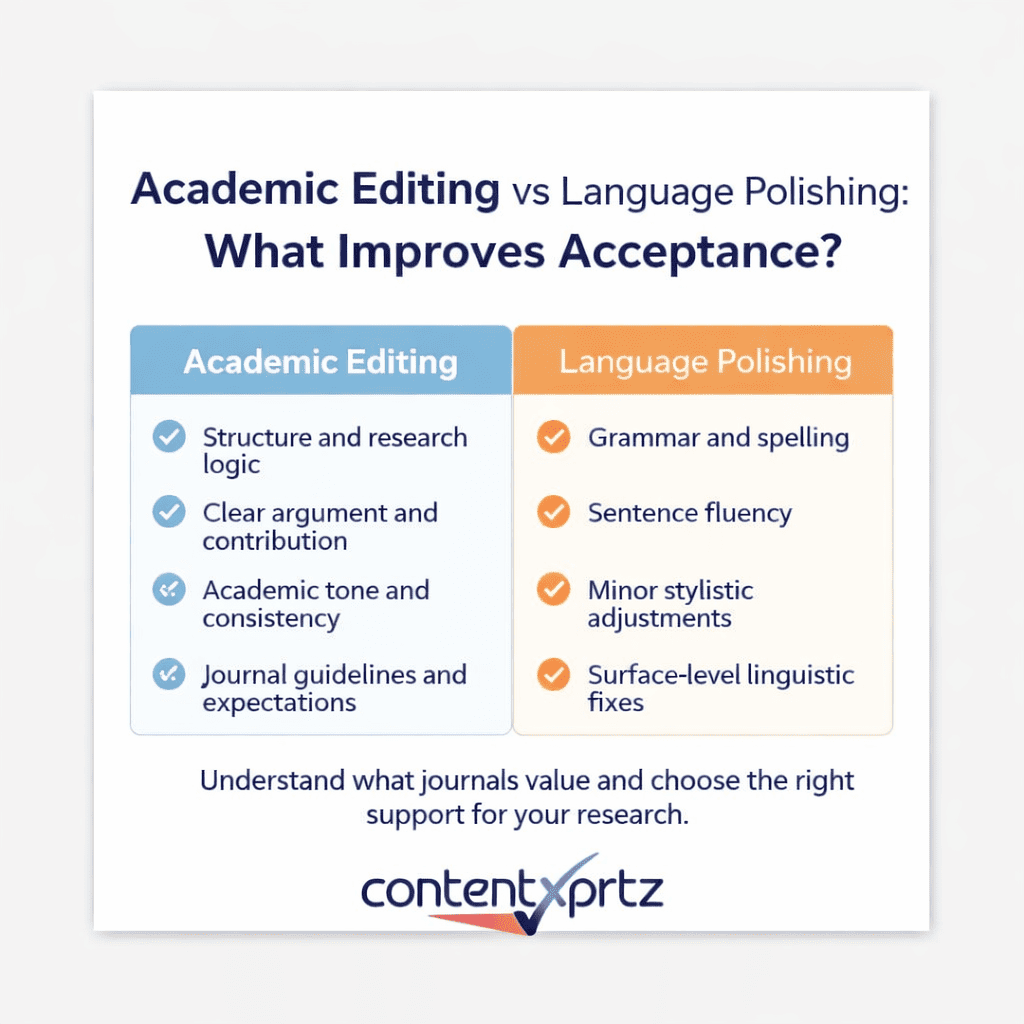

Beyond Grammar Corrections: Academic Editing vs Language Polishing and What Truly Improves Journal Acceptance
Introduction: Why This Distinction Matters More Than Ever (400+ words)
For PhD scholars, early-career researchers, and seasoned academics alike, publishing in reputable journals has never been more demanding. The pressure to publish in Scopus- or Web of Science-indexed journals, the race against deadlines, and the rising expectations of reviewers create a perfect storm of stress. Within this context, a crucial yet often misunderstood question arises: Academic Editing vs Language Polishing: What Improves Acceptance?
Many researchers assume that correcting grammar and improving sentence flow are enough to satisfy journal requirements. However, rejection letters tell a different story. Editors frequently cite issues such as lack of clarity in argumentation, weak methodological description, inconsistent terminology, and poor alignment with journal scope. These problems go far beyond surface-level language errors.
Globally, the academic publishing ecosystem has expanded rapidly. According to data from the STM Global Brief, more than 3 million research articles are published every year, with annual growth rates between 4 percent and 5 percent. At the same time, acceptance rates for top-tier journals continue to decline. Studies reported by Elsevier suggest that many high-impact journals accept less than 20 percent of submissions. For PhD students, particularly those writing in English as an additional language, the challenge is even greater.
Time constraints compound the problem. Doctoral candidates juggle coursework, teaching responsibilities, data collection, funding pressures, and personal commitments. Revising a manuscript to meet international publication standards often becomes an overwhelming task. Moreover, professional editing services vary widely in quality, scope, and ethical standards. Choosing between academic editing and language polishing without understanding their differences can lead to wasted resources and delayed publications.
This article addresses that gap with clarity and evidence. It explains what academic editing truly involves, how it differs from language polishing, and which approach genuinely improves acceptance rates. Drawing on publishing guidelines from Elsevier, Springer Nature, Taylor and Francis, Emerald Insight, and the APA, this guide provides a comprehensive, trustworthy roadmap for researchers seeking professional support.
By the end of this article, you will understand when language polishing is sufficient, when academic editing is essential, and how the right choice can significantly strengthen your manuscript. More importantly, you will learn how structured, ethical academic editing aligned with journal expectations can transform reviewer feedback from rejection to revision and, ultimately, acceptance.
Understanding the Focus Keyphrase: Academic Editing vs Language Polishing
Before comparing outcomes, it is important to define the two services accurately. Misunderstanding these terms often leads to unrealistic expectations and dissatisfaction.
What Is Language Polishing?
Language polishing focuses primarily on surface-level linguistic improvements. It aims to make the text grammatically correct, stylistically smoother, and easier to read. This service typically includes:
-
Correcting grammar, spelling, and punctuation
-
Improving sentence flow and readability
-
Removing awkward phrasing
-
Standardizing basic formatting and style consistency
Language polishing does not address the academic substance of the manuscript. It does not question whether the research question is clear, whether arguments are logically developed, or whether the discussion aligns with current literature.
What Is Academic Editing?
Academic editing is a far more comprehensive and intellectually engaged process. It involves critical review of the manuscript within its scholarly context. Academic editing typically includes:
-
Structural and logical coherence review
-
Clarity of research questions, objectives, and hypotheses
-
Consistency and accuracy of terminology
-
Alignment with journal aims and scope
-
Methodological clarity and transparency
-
Strengthening of argumentation and discussion
-
Ethical compliance with publication standards
Academic editing respects authorship while enhancing scholarly rigor. According to Elsevier’s Language Editing Guidelines, effective academic editing improves not only language quality but also content clarity and presentation, which directly influences editorial decisions.
Why Journals Reject Manuscripts: Evidence from Publishers
Understanding rejection reasons clarifies why the debate around Academic Editing vs Language Polishing: What Improves Acceptance? is so important.
Publishers consistently report that language errors alone are rarely the primary reason for rejection. Instead, editors focus on:
-
Poorly articulated research contribution
-
Weak theoretical framing
-
Methodological ambiguity
-
Incoherent structure
-
Inadequate engagement with existing literature
Springer Nature emphasizes that manuscripts must demonstrate clarity of thought and scholarly positioning, not just correct English. Similarly, Emerald Insight highlights that manuscripts often fail because arguments are not developed convincingly, even when the language is fluent.
This distinction explains why many authors invest in language polishing yet continue to face rejections. The manuscript may read smoothly, but it still fails to meet academic expectations.
Academic Editing vs Language Polishing: A Comparative Analysis
Depth of Intervention
Language polishing operates at the sentence level. Academic editing operates at the manuscript level. While polished language enhances readability, academic editing enhances meaning, logic, and scholarly impact.
Reviewer Perspective
Reviewers assess manuscripts for originality, rigor, and contribution. Language polishing helps reviewers read comfortably. Academic editing helps reviewers understand, evaluate, and appreciate the research.
Ethical Alignment
Professional academic editing adheres to ethical standards outlined by the Committee on Publication Ethics (COPE). It improves clarity without altering research outcomes. Language polishing alone may leave ethical issues unaddressed, such as unclear data reporting or ambiguous claims.
When Language Polishing Is Enough
Language polishing may be sufficient in limited scenarios:
-
The manuscript has already undergone rigorous supervision
-
The research design and argumentation are strong
-
The target journal is low to mid-tier
-
The author is confident in academic structure but seeks linguistic refinement
In such cases, language polishing can enhance readability and professionalism.
When Academic Editing Becomes Essential
Academic editing is critical when:
-
Submitting to Q1 or high-impact journals
-
Writing a PhD thesis or dissertation
-
Addressing major reviewer comments
-
Writing in a second or third language
-
Struggling with coherence, argument flow, or positioning
In these scenarios, language polishing alone rarely improves acceptance outcomes.
The Role of Professional Academic Support in PhD Success
PhD candidates increasingly seek structured support to navigate complex publishing landscapes. According to a report cited by Taylor and Francis, early-career researchers who receive professional editorial guidance are more likely to publish within shorter timeframes.
At ContentXprtz, academic editing is delivered by subject-matter experts who understand disciplinary conventions and journal expectations. This approach ensures manuscripts are not only linguistically refined but also intellectually robust.
You can explore comprehensive academic editing services through ContentXprtz’s
Writing and Publishing Services
which are designed to support researchers across disciplines.
Integrated FAQs: Addressing Common Researcher Concerns
FAQ 1: Does academic editing guarantee journal acceptance?
Academic editing cannot guarantee acceptance because editorial decisions depend on originality, relevance, and peer review. However, it significantly improves acceptance probability by eliminating avoidable weaknesses. Editors at Elsevier and Springer repeatedly emphasize clarity, structure, and argument strength as decisive factors. Academic editing addresses these systematically, whereas language polishing does not.
FAQ 2: How is academic editing different from proofreading?
Proofreading is the final stage of review, focusing on minor errors after content is finalized. Academic editing occurs earlier and engages deeply with structure, logic, and scholarly presentation. Proofreading improves correctness. Academic editing improves quality and impact.
FAQ 3: Is academic editing ethical under journal guidelines?
Yes, when conducted ethically. COPE and APA guidelines allow language and academic editing as long as the intellectual ownership remains with the author. Reputable providers like ContentXprtz follow strict ethical boundaries and do not fabricate content or data.
FAQ 4: Can academic editing help with reviewer comments?
Absolutely. Academic editing is particularly effective for revision rounds. Editors help interpret reviewer feedback, restructure arguments, and align revisions with editorial expectations. This process often determines whether a revise-and-resubmit leads to acceptance.
FAQ 5: Should PhD students use academic editing before supervisor review?
Many supervisors encourage early academic editing to reduce revision cycles. Edited drafts allow supervisors to focus on intellectual contribution rather than language or structure, leading to more productive feedback.
FAQ 6: How does academic editing support non-native English researchers?
Non-native English scholars often struggle with implicit academic conventions rather than grammar alone. Academic editing clarifies rhetorical flow, argument positioning, and discipline-specific language, which language polishing alone cannot achieve.
FAQ 7: Is language polishing cheaper than academic editing?
Yes, but cost-effectiveness should be measured by outcomes, not price. Language polishing may save money initially but lead to repeated rejections. Academic editing often reduces long-term costs by improving acceptance efficiency.
FAQ 8: Can academic editing improve thesis examination outcomes?
Examiners evaluate coherence, argumentation, and methodological clarity. Academic editing strengthens these dimensions, reducing major revision requests and accelerating degree completion.
FAQ 9: How early should researchers seek academic editing support?
Ideally, academic editing should occur after a complete draft is ready but before journal submission. Early intervention allows structural improvements that are difficult to implement at later stages.
FAQ 10: How do I choose a trustworthy academic editing service?
Look for transparency, subject expertise, ethical policies, and global experience. Providers like ContentXprtz, with a long-standing academic focus since 2010, offer credibility, accountability, and tailored support.
Academic Editing and EEAT: Why Trust Matters
EEAT principles are not limited to SEO. Journals implicitly apply similar standards. Manuscripts must demonstrate expertise, methodological experience, authoritative engagement with literature, and trustworthy reporting.
Academic editing reinforces all four dimensions. It ensures accurate citations, consistent terminology, and credible argumentation aligned with journal standards from Emerald Insight, Elsevier, and Springer Nature.
Practical Tips to Maximize Editing Outcomes
-
Choose editing based on manuscript maturity
-
Align editing type with journal tier
-
Provide clear objectives to editors
-
Share target journal guidelines
-
Allow sufficient revision time
Researchers seeking structured PhD-level assistance can explore
PhD and Academic Services
for comprehensive, discipline-specific support.
Conclusion: Making the Right Choice for Publication Success
The debate around Academic Editing vs Language Polishing: What Improves Acceptance? is not about choosing one universally. It is about choosing wisely based on your research goals, manuscript readiness, and target journal expectations.
Language polishing enhances readability. Academic editing enhances publishability.
For researchers aiming at high-impact journals, timely graduation, and academic credibility, academic editing is not a luxury. It is a strategic investment. It bridges the gap between strong research and successful publication by aligning scholarly content with global standards.
If you are seeking expert-guided, ethical, and publication-focused support, explore ContentXprtz’s comprehensive academic solutions through its
Student Writing Services
and
Corporate Writing Services.
At ContentXprtz, we don’t just edit. We help your ideas reach their fullest potential.
