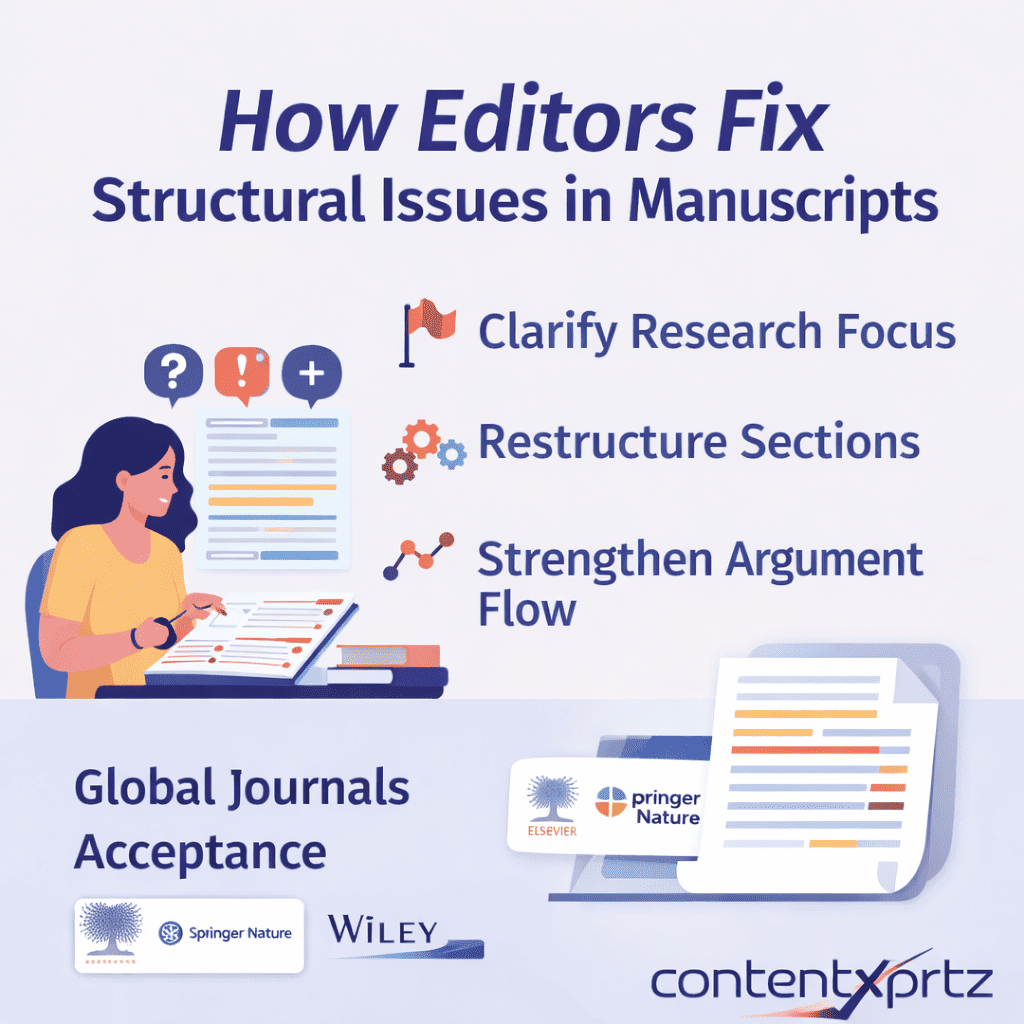

How Editors Fix Structural Issues in Manuscripts: An Academic Guide for PhD Scholars and Researchers
Introduction: Why Structural Editing Determines Academic Success
For many PhD scholars and academic researchers, the moment a manuscript is completed feels like the end of a long and exhausting journey. Years of data collection, theoretical framing, analysis, and interpretation finally culminate in a written document. Yet, for a significant number of scholars worldwide, this is precisely where the most critical challenges begin. Journals do not reject manuscripts solely because of weak ideas or insufficient data. More often, rejections stem from structural weaknesses that obscure otherwise strong research contributions. Understanding how editors fix structural issues in manuscripts is therefore essential for any researcher seeking successful publication.
Structural issues are not about grammar or punctuation alone. Instead, they relate to how ideas are organized, how arguments unfold, and how each section contributes to the manuscript’s overall purpose. When structure is unclear, even groundbreaking research struggles to gain acceptance. According to Elsevier’s editorial insights, over 60 percent of desk rejections occur due to poor organization, unclear research objectives, or inconsistent argument flow rather than methodological flaws. This statistic highlights a difficult truth: quality research can fail if it is not structurally sound.
Globally, PhD scholars face mounting pressure to publish quickly and frequently. Doctoral candidates juggle teaching responsibilities, funding deadlines, supervisory expectations, and personal commitments. At the same time, journal standards continue to rise. Acceptance rates for top-tier journals often remain below 15 percent, while revision cycles grow longer and more demanding. For international scholars, additional challenges include language barriers, unfamiliar academic conventions, and cultural differences in scholarly writing styles. These pressures collectively create what many researchers describe as “publication anxiety,” a condition intensified by structural uncertainty in manuscripts.
Editors serve as the bridge between research ideas and reader comprehension. Their role extends far beyond surface-level corrections. Professional academic editors diagnose structural weaknesses, realign arguments, and ensure logical coherence across chapters or sections. They work closely with authors to clarify research questions, strengthen theoretical positioning, and align findings with journal expectations. This process transforms manuscripts into publication-ready documents without altering the author’s intellectual ownership.
This educational guide explores how editors fix structural issues in manuscripts in a systematic and ethical manner. It explains common structural problems, outlines professional editorial strategies, and offers practical insights tailored to PhD scholars, early-career researchers, and experienced academics alike. Drawing on established publishing standards from Elsevier, Springer, Emerald Insight, Taylor and Francis, and APA, this article demonstrates how structural editing improves clarity, credibility, and acceptance potential.
For readers seeking professional academic editing, PhD support, or research paper assistance, this guide also reflects the expertise and global experience of ContentXprtz. Since 2010, ContentXprtz has supported researchers across more than 110 countries, helping manuscripts evolve from complex drafts into clear, coherent, and impactful scholarly works. The sections that follow provide a detailed look into the editorial process that makes this transformation possible.
Understanding Structural Issues in Academic Manuscripts
What Are Structural Issues in Scholarly Writing?
Structural issues refer to problems in the organization, logic, and flow of a manuscript. Unlike language errors, which affect sentence-level clarity, structural problems influence how readers understand the research as a whole. These issues often emerge when sections are misaligned, arguments are repetitive, or transitions between ideas are unclear.
Common structural challenges include:
-
Weak or unfocused introductions
-
Literature reviews that lack synthesis
-
Methodology sections disconnected from research questions
-
Results presented without narrative coherence
-
Discussions that repeat results instead of interpreting them
-
Conclusions that fail to reinforce the study’s contribution
Editors approach these issues holistically. They examine how each section supports the manuscript’s objectives and whether the progression of ideas meets disciplinary expectations.
Why Structure Matters More Than Many Scholars Realize
Academic readers, including reviewers and editors, approach manuscripts with limited time and high expectations. A well-structured paper allows them to quickly identify the research problem, assess methodological rigor, and understand the study’s contribution. Conversely, poor structure creates cognitive friction, forcing readers to search for meaning rather than engage with ideas.
Springer Nature emphasizes that clarity of structure significantly influences reviewer perceptions of research quality. Even strong datasets can appear weak if embedded in a disorganized narrative. Structural editing therefore plays a decisive role in shaping how research is evaluated and remembered.
How Editors Diagnose Structural Problems
Initial Manuscript Assessment
Professional editors begin by conducting a comprehensive manuscript review. This stage focuses on macro-level organization rather than sentence-level corrections. Editors examine:
-
Alignment between title, abstract, and content
-
Logical sequencing of sections
-
Consistency of research objectives
-
Balance between theoretical, methodological, and empirical content
At ContentXprtz, this diagnostic stage forms the foundation of ethical academic editing. Editors avoid rewriting ideas and instead focus on clarifying how those ideas are presented.
Mapping Argument Flow
Editors often create an internal outline of the manuscript to visualize argument progression. This process identifies gaps, redundancies, or abrupt shifts in focus. When arguments lack continuity, editors recommend reordering sections or merging overlapping content.
For example, if a literature review introduces concepts that never appear in the discussion, editors flag this inconsistency. Similarly, if results are presented before methods are fully explained, structural adjustments become necessary.
Editorial Strategies for Fixing Structural Issues
Strengthening the Introduction
Editors often start by refining the introduction because it frames the entire manuscript. A structurally sound introduction typically includes:
-
Contextual background
-
Clear research gap
-
Explicit objectives or hypotheses
-
Significance of the study
Editors ensure that these elements appear in logical order and align with journal-specific expectations. According to APA guidelines, clarity in the introduction improves reader engagement and reviewer confidence.
Reorganizing the Literature Review
A common structural flaw involves literature reviews that summarize sources without synthesis. Editors restructure such sections by grouping studies thematically, highlighting debates, and linking literature to research objectives.
Emerald Insight recommends that literature reviews demonstrate critical engagement rather than descriptive listing. Editors guide authors to emphasize relevance and scholarly positioning.
Aligning Methods With Research Questions
Editors examine whether the methodology directly addresses stated research questions. Structural adjustments may include:
-
Reordering subsections
-
Clarifying variable definitions
-
Removing irrelevant procedural details
This alignment strengthens methodological transparency and enhances replicability.
Enhancing Results Presentation
Editors improve results sections by ensuring logical sequencing and clear signposting. Tables and figures are aligned with textual explanations, and redundant descriptions are minimized. Structural clarity helps readers follow complex data narratives without confusion.
Deepening the Discussion Section
One of the most common structural issues occurs in discussion sections that restate results instead of interpreting them. Editors encourage authors to:
-
Link findings to existing literature
-
Explain theoretical implications
-
Address limitations and future research
Taylor and Francis publishing standards emphasize interpretive depth as a marker of scholarly maturity.
Refining the Conclusion
Editors restructure conclusions to reinforce key contributions and practical implications. Strong conclusions summarize insights without introducing new data. They also highlight the study’s relevance to the field.
Ethical Boundaries in Structural Editing
Professional editors adhere to strict ethical guidelines. Structural editing does not involve data manipulation, authorship claims, or idea ownership. Instead, it focuses on clarity, coherence, and compliance with publication standards.
Organizations such as Elsevier and COPE clearly distinguish ethical editing from unethical ghostwriting. ContentXprtz follows these principles rigorously, ensuring that authors retain full intellectual responsibility for their work.
The Role of Professional Academic Editing Services
Structural editing requires disciplinary expertise, publishing knowledge, and editorial judgment. Many scholars benefit from professional academic editing services because supervisors often lack the time to provide detailed structural feedback.
Researchers seeking comprehensive support can explore academic editing services through ContentXprtz’s Writing and Publishing Services. These services address structure, language, formatting, and submission readiness.
PhD scholars can also benefit from tailored PhD thesis help offered via PhD and Academic Services, which focuses on long-form academic documents.
Frequently Asked Questions on Structural Editing
FAQ 1: How do editors fix structural issues in manuscripts without changing the author’s ideas?
Editors focus on organization rather than content ownership. They identify where ideas appear unclear or misplaced and suggest restructuring sections to improve clarity. For example, an editor may recommend moving a theoretical explanation from the discussion to the literature review. The core idea remains unchanged, but its placement enhances reader comprehension. Ethical editors never introduce new arguments or data. Instead, they act as facilitators, helping authors present existing ideas more effectively.
FAQ 2: Why do journals prioritize structure during peer review?
Reviewers assess manuscripts under time constraints. Clear structure allows them to evaluate contributions efficiently. Poor structure signals weak scholarly communication, even if the research itself is sound. Journals rely on structure as a proxy for academic rigor. Editors therefore ensure manuscripts meet disciplinary conventions before submission.
FAQ 3: Can structural editing improve acceptance rates?
While no service can guarantee acceptance, structural editing significantly improves a manuscript’s chances. Studies published by Elsevier indicate that manuscripts with clear organization and argument flow progress further in peer review. Structural clarity reduces reviewer confusion and negative bias.
FAQ 4: How is structural editing different from proofreading?
Proofreading focuses on surface errors such as spelling and punctuation. Structural editing addresses macro-level organization, coherence, and argument development. Both are important, but structural editing has a greater impact on scholarly credibility.
FAQ 5: When should PhD scholars seek structural editing?
Structural editing is most effective after the first complete draft. At this stage, editors can evaluate the manuscript holistically. Early editing may disrupt research development, while late editing may limit revision flexibility.
FAQ 6: Is structural editing suitable for thesis writing?
Yes. Doctoral theses often face structural challenges due to length and complexity. Editors help align chapters, reduce redundancy, and maintain narrative coherence. ContentXprtz provides dedicated PhD thesis help tailored to institutional guidelines.
FAQ 7: How do editors handle interdisciplinary manuscripts?
Interdisciplinary research often lacks clear structural conventions. Editors help authors balance disciplinary expectations by clarifying audience focus and organizing content accordingly. This process enhances accessibility without oversimplifying complexity.
FAQ 8: Are structural edits accepted by journal ethics committees?
Yes, when conducted ethically. Reputable publishers such as Springer and APA permit professional editing that improves clarity without altering intellectual content. Transparency in acknowledgments is recommended.
FAQ 9: How long does structural editing take?
Timelines depend on manuscript length and complexity. Journal articles may require one to two weeks, while theses may take longer. Professional services provide realistic timelines aligned with submission deadlines.
FAQ 10: How does ContentXprtz approach structural editing differently?
ContentXprtz combines editorial expertise with disciplinary understanding. Editors work collaboratively with authors, offering detailed explanations rather than silent revisions. This educational approach empowers scholars to improve future writing.
Conclusion: Turning Structure Into Scholarly Strength
Structural clarity is not an optional enhancement in academic writing. It is a foundational requirement for publication success. Understanding how editors fix structural issues in manuscripts empowers researchers to view editing as a collaborative and ethical process rather than a corrective measure. Through careful diagnosis, strategic reorganization, and adherence to publishing standards, editors transform complex drafts into coherent scholarly narratives.
For students, PhD scholars, and academic researchers seeking reliable support, ContentXprtz offers comprehensive solutions through its Student Writing Services, Book Authors Writing Services, and Corporate Writing Services. These services reflect a commitment to academic integrity, clarity, and global excellence.
If you are preparing a manuscript, thesis, or research paper for submission, explore ContentXprtz’s PhD assistance and academic editing services today. Let expert editors help refine your structure, strengthen your arguments, and enhance your publication readiness.
At ContentXprtz, we don’t just edit — we help your ideas reach their fullest potential.
