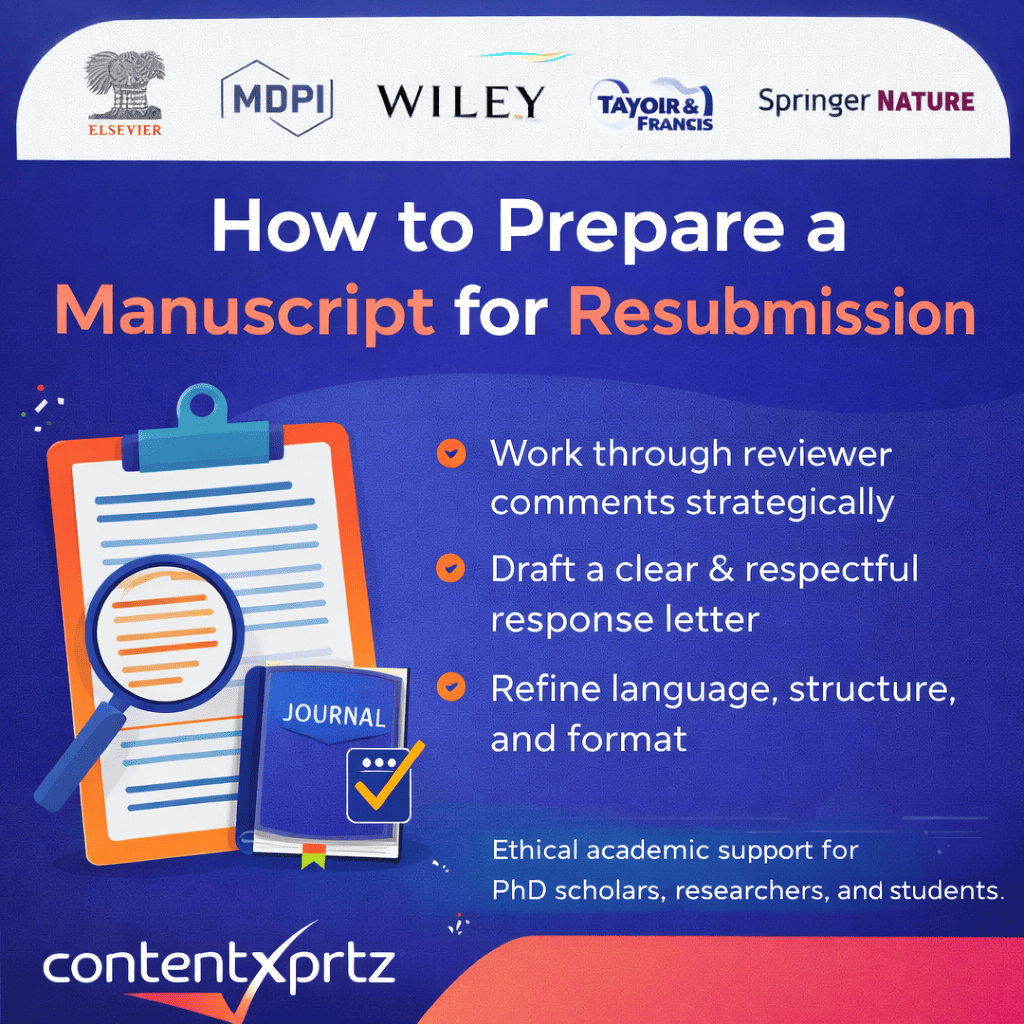

Mastering How to Prepare a Manuscript for Resubmission: A PhD Scholar’s Comprehensive Guide
Introduction
Resubmission is one of the most pivotal phases in a PhD scholar’s publication journey. If you’ve ever stared at reviewer comments that seem to stretch on endlessly, felt overwhelmed by revisions, or questioned whether your manuscript will ever see the light of publication — you are not alone. Understanding how to prepare a manuscript for resubmission is both an art and a science that combines academic rigor, clarity of expression, strategic revision, and publication insight.
In an era where global research output increases by double‑digit percentages annually, submission pressures have intensified across disciplines. According to data from major publishers, the volume of research manuscripts submitted to peer‑reviewed journals has grown steadily over the last decade, far outpacing available publication slots. Journal acceptance rates, especially in high‑impact titles, frequently fall below 20 percent, creating heightened competition and stress for doctoral candidates and early‑career researchers. The implication is clear: to enhance your chances of success, resubmissions must be meticulously prepared, strategically executed, and grounded in evidence‑based revision methods.
PhD students and academic researchers often juggle multiple responsibilities: coursework, teaching, data collection, analysis, and the writing itself. Layered on top of these duties are concerns about publication quality, meeting deadlines, adhering to submission guidelines, and managing rising costs of open access and editorial services. The emotional toll is real — from disappointment at rejection to self‑doubt about scholarly writing skills — and yet, with the right approach to resubmission, many manuscripts ultimately thrive.
This article is designed specifically for scholars like you who aim not just to revise but to elevate your manuscript into a fully publication‑ready form. It combines actionable advice, academic best practices, and seasoned insights drawn from years of working with researchers worldwide. Whether you are confronting reviewer feedback for the first time or polishing your tenth revision, this guide will help you navigate the process with confidence.
We will explore practical strategies to interpret reviewer comments, revise your manuscript efficiently, enhance clarity and structure, and ultimately prepare a resubmission that reflects your research’s full potential. Along the way, we will touch upon themes like academic editing, research communication, and publishing ethics to support your entire scholarly journey.
Why Resubmission Matters: From Revision to Acceptance
Resubmission is not merely “fixing errors.” It is an opportunity to:
-
Clarify complex arguments for a broader readership
-
Address reviewer concerns with precision and respect
-
Strengthen methodological soundness
-
Enhance coherence and scholarly impact
Peer review is designed to improve the quality of research. According to publishers like Elsevier, peer reviewers serve as “critical friends” who help authors refine their work toward academic excellence (Elsevier Reviewer Guidelines, Elsevier.com). Their feedback, while sometimes demanding, is a gift — a roadmap toward stronger research communication.
Section 1: Understanding Reviewer Feedback
What Reviewer Comments Really Mean
Reviewer feedback can often feel overwhelming, especially when it includes suggestions for extensive revisions, additional experiments, or restructuring. However, understanding the intent behind comments is the first step toward productive revision.
-
Distinguish between major and minor revisions:
Major revisions often relate to theoretical framing, methodology, or significant interpretative elements. Minor revisions typically focus on clarity, formatting, or typographical issues. -
Look for patterns across comments:
If multiple reviewers raise similar issues, these are likely priority changes. -
Avoid defensive thinking:
Respond to feedback objectively, focusing on how your revisions improve the manuscript for the broader audience.
Effective Techniques for Reading Reviewer Reports
-
Create a reviewer comments log:
List each comment and your planned action beside it. -
Group similar comments:
This helps streamline your revision plan. -
Prioritize changes by impact:
Address high‑impact revisions first — these are often at the heart of the reviewers’ core concerns.
Section 2: Planning Your Revision Strategy
Step‑by‑Step Revision Plan
-
Read all comments at least twice
Resist making changes on the first pass. Reading twice helps you see both content and tone. -
Acknowledge the editor’s and reviewers’ positions
Begin your resubmission with a professional, grateful tone. -
Draft a clear revision timetable
Give yourself time for quality evaluation — rushed revisions often miss critical improvements. -
Consult co‑authors and mentors
Additional perspectives refine your approach and may reveal overlooked issues.
Practical Tools to Organize Revisions
-
Revision tables:
A clear, tabulated document that shows reviewer comment → author response → manuscript change location. -
Version control:
Use tracked changes or revision versions systematically to document the progression of edits. -
Peer review from colleagues:
External input before resubmission is invaluable — even before the formal round.
Section 3: Enhancing Manuscript Clarity and Structure
Strengthening Your Academic Narrative
Academic readers seek clarity and logical flow. A strong narrative thread ensures that your research is not only valid but compelling.
-
Revisit your thesis statement and research questions:
Ensure they are unambiguous, well justifiable, and central throughout the manuscript. -
Use signposted sections:
Transitional phrases and clear headings guide the reader and enhance readability. -
Avoid jargon overload:
Technical language should be precise, not impenetrable.
Methods and Results: Precision and Transparency
A common point of feedback relates to methods or results interpretation. To address this:
-
Provide justification for analytical choices
-
Include limitations and rationale for exclusions
-
Use tables and figures effectively for data presentation
-
Cross‑check statistical claims with methodological standards
Refer to publishing standards from Springer’s Author Resources (https://www.springer.com/gp/authors‑editors) for best practices in transparent reporting.
Section 4: Common Pitfalls in Manuscript Resubmission
Overlooking Submission Guidelines
One of the simplest, yet most critical mistakes is not following the journal’s formatting and submission guidelines. These are typically available on the journal’s website under author instructions.
-
Page layout and reference style
-
Word limits
-
Figure and table formats
Failing to adhere to these can delay review or result in desk rejection.
Section 5: Academic Editing and Professional Support
Resubmission often calls for fine‑tuned academic communication. Many scholars benefit from professional academic editing to ensure clarity, consistency, and publication readiness.
Roles of Academic Editing Services
-
Language polishing
-
Structural coherence
-
Formatting to journal standards
-
Reference and citation checks
At ContentXprtz, our PhD thesis help and academic editing services are designed to complement your expertise and ensure your manuscript speaks clearly to reviewers and editors alike.
Integrated FAQs (10 Questions)
FAQ 1: What Should Be My First Step After Receiving a “Revise and Resubmit” Decision?
The initial step is to read the reviewer comments thoroughly, ideally more than once. Resist the urge to revise immediately. Begin by categorizing comments into major and minor revisions. Major issues often involve theoretical framing, methodology, or data interpretation, while minor edits pertain to clarity, formatting, and grammar.
Next, construct a revision plan. A practical tool is a revision tracking table, where you list each reviewer comment alongside your proposed action and the location of the change in your manuscript. This serves a dual purpose: it ensures thorough attention to each concern and provides documentation for your response to reviewers document.
Consult with co‑authors, mentors, or peers to interpret ambiguous comments. Scholarly insight from others can save time and rework. Finally, schedule your work timeline realistically. High‑impact revisions require thoughtful reflection — rushing often leads to superficial fixes that reviewers may flag again.
FAQ 2: How Do I Handle Conflicting Reviewer Comments?
Conflicting recommendations — such as one reviewer asking for more explanation while another asks for less detail — can be challenging. Your approach should balance respect for reviewer input with academic judgment.
First, evaluate the core intent of each request. Conflicts often stem from different expectations about audience expertise or disciplinary focus. Address each comment on its own merit, but where conflict arises, provide a clear justification in your response. For instance, you can note that you have preserved critical details for clarity but streamlined sections where repetition occurred.
Include rationale in your response to reviewers document that explains why certain choices were made. Editors value transparency and scholarly reasoning. If the conflict remains uncertain, consider reaching out to colleagues who understand both the topic and publication norms.
FAQ 3: Should I Rewrite the Entire Manuscript Before Resubmission?
A complete rewrite is rarely necessary and can sometimes introduce inconsistencies. Instead, revisions should be targeted and precise. Focus on areas highlighted by reviewers: theory, methodology, results interpretation, or narrative clarity.
A complete rewrite might be warranted in cases where feedback suggests fundamental flaws in structure or argumentation. In such scenarios, assess whether the manuscript’s conceptual framework is still sound. If the core research question remains valid, strategic restructuring — not a full rewrite — is typically sufficient.
Professional academic editors can help ensure revisions improve clarity without losing your scholarly voice. ContentXprtz’s academic editing services can assist with targeted revisions that respect your original research contributions.
FAQ 4: What Are the Best Practices for Writing a Response to Reviewers?
A well‑crafted response begins with gratitude. Start by thanking reviewers for their time and insights. Then, use a point‑by‑point structure where each reviewer comment is followed by a clear explanation of how you addressed it.
Be specific: cite line numbers, refer to revised sections, and explain the rationale for changes. Use professional language — even when disagreeing. If you choose not to make a requested change, justify this decision with academic reasoning.
Include both comment reproduction and your response in a merged document. This format is clearer for editors and shows that you took all feedback seriously.
FAQ 5: How Important Is Journal Formatting for Resubmission?
Journal guidelines are not trivial; failing to follow them can lead to desk rejection. These guidelines include formatting, reference styles, figure and table requirements, and word limits. They reflect editorial policies that support consistent publishing standards.
Before resubmission, double‑check:
-
Title page and author details
-
Abstract structure
-
Headings and subheadings formatting
-
Reference style and citation consistency
-
Ethical declarations
Tools such as reference managers (e.g., Zotero or EndNote) help enforce consistent citation styles. Ensuring formatting compliance signals professionalism and attention to detail, improving editorial reception.
FAQ 6: Can I Use Professional Editing Services for Resubmission?
Yes — many scholars use professional editing services to enhance clarity, structure, and readability before resubmission. Academic editing focuses on language precision, logical flow, and adherence to publication norms.
Services like research paper writing support and PhD thesis help at ContentXprtz (https://contentxprtz.com/phd-academic-services) can offer tailored support. Professional editors do not write your research for you, but they refine your manuscript so that your ideas are communicated effectively to reviewers and editors. Ethical editing preserves your authorship while enhancing clarity and impact.
FAQ 7: How Do I Improve the Quality of My Literature Review During Resubmission?
Improving your literature review involves ensuring it:
-
Reflects the current state of research
-
Integrates key debates and gaps
-
Justifies your theoretical framework
Start by incorporating recent studies that strengthen your argument’s context. Use academic databases like Scopus or Web of Science to identify recent, relevant publications. Summarize major themes succinctly and link them directly to your research.
Ensure coherence by grouping studies thematically and critically. Rather than simply listing past research, compare and contrast findings, highlight gaps, and show how your study addresses these gaps. This approach demonstrates depth and positions your work within scholarly discourse.
FAQ 8: What If Reviewer Feedback Asks for Additional Experiments or Data?
Requests for additional data or experiments can be challenging, especially with time or resource constraints. First, assess whether the requested data genuinely strengthens your research claims. If it does and is feasible, include it with clear explanation and updated analyses.
If the request is not feasible due to constraints, explain why in your response to reviewers. Provide alternative evidence or reanalyze existing data to support your claims. Transparency and scholarly justification matter more than simply saying “not possible.”
FAQ 9: How Long Should I Take Before Resubmitting a Revised Manuscript?
There is no fixed timeline, but quality should never be compromised for speed. A thorough revision process often takes several weeks to months, depending on the complexity of feedback. Rushing can lead to superficial edits that fail to address core issues, leading to further rounds of revision.
Set milestones: complete major content edits first, followed by language refinement and formatting compliance. Allow time for feedback from colleagues or academic editing services to ensure thorough polish before resubmission.
FAQ 10: How Do I Maintain Academic Voice While Addressing Reviewer Feedback?
Maintaining your authentic academic voice is essential. Address feedback with clarity and professionalism, while preserving the intellectual contributions that define your work.
Respond to reviewers as a scholar — not defensively but confidently. When you make changes, do so in a way that enhances readability and argument strength. When you choose not to implement a suggested change, provide a reasoned, evidence‑based explanation.
Balancing reviewer input with your academic voice reflects maturity and respect for scholarly norms. This balance often distinguishes strong resubmissions that succeed.
Conclusion
Preparing your manuscript for resubmission is a defining step toward academic publication success. It requires careful interpretation of reviewer feedback, structured revision planning, clear communication, and strategic refinement. By respecting reviewer insights, enhancing narrative clarity, and attending to journal requirements, you elevate both your research and your scholarly voice.
If you seek professional support at any stage — from detailed editing to comprehensive writing guidance — ContentXprtz’s services in PhD support, academic editing, and research paper assistance are here to help. Our team of expert editors and academic consultants ensures that your manuscript is publication‑ready and aligned with global standards.
Take the next step with confidence. Explore ContentXprtz’s PhD and academic services and transform your research into scholarly impact.
At ContentXprtz, we don’t just edit — we help your ideas reach their fullest potential.
