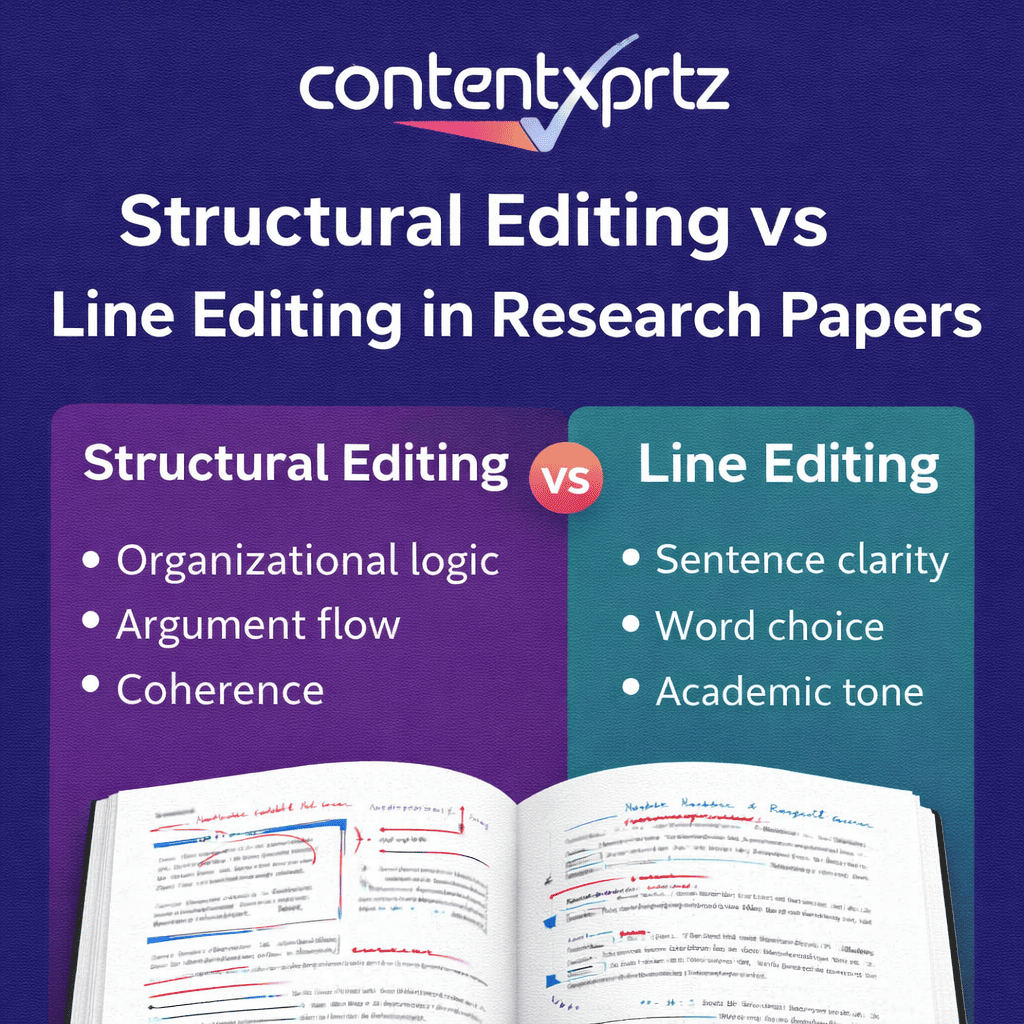

Structural Editing vs Line Editing in Research Papers: A Scholarly Guide for PhD Students and Academic Researchers
Introduction: Why Editing Choices Define Research Success
For PhD scholars and academic researchers, writing a research paper is never just about presenting results. It is about entering a global scholarly conversation where rigor, clarity, structure, and originality are scrutinized at the highest level. In this demanding ecosystem, the distinction between Structural Editing vs Line Editing in Research Papers is not merely technical. It is strategic, ethical, and often decisive for publication success.
Across disciplines, doctoral candidates face growing pressures. According to data published by Elsevier, global research output has more than doubled over the past two decades, intensifying competition for journal acceptance. Acceptance rates for top-tier journals often fall below 10 percent. Meanwhile, PhD scholars juggle teaching responsibilities, grant writing, administrative tasks, and personal obligations, leaving limited time for deep manuscript refinement. Rising publication fees, stricter reviewer expectations, and language barriers further compound these challenges.
Within this context, academic editing has evolved from a luxury into a necessity. However, many researchers struggle to identify which type of editing they actually need. Some invest in surface-level corrections when their argument lacks coherence. Others request high-level revisions when only stylistic refinement is required. This mismatch often leads to reviewer rejection, revision fatigue, and wasted resources.
Understanding Structural Editing vs Line Editing in Research Papers allows scholars to make informed decisions at critical stages of their research journey. Structural editing focuses on the architecture of your paper, including argument flow, logic, and alignment with journal scope. Line editing, by contrast, refines the language, ensuring precision, clarity, and academic tone. Both are essential, but their value depends on timing and purpose.
At ContentXprtz, a global academic support provider established in 2010, we have worked with researchers from more than 110 countries. Our experience consistently shows that publication success improves dramatically when scholars apply the right editing intervention at the right time. This article offers a comprehensive, evidence-based guide to help you do exactly that.
Understanding the Editing Spectrum in Academic Writing
Why Academic Editing Is Not One-Size-Fits-All
Academic manuscripts progress through distinct developmental stages. Early drafts focus on idea formation and theoretical positioning. Later drafts emphasize refinement, coherence, and compliance with journal standards. Editing services mirror this progression.
Professional academic editing generally falls into four categories:
-
Structural or developmental editing
-
Substantive editing
-
Line editing
-
Copyediting and proofreading
Among these, structural editing and line editing are the most frequently misunderstood and misapplied. Clarifying their scope is essential for effective PhD support and research paper assistance.
What Is Structural Editing in Research Papers?
The Foundation of Scholarly Argumentation
Structural editing, often called developmental editing, addresses the macro-level design of a research paper. It examines whether the manuscript works as a coherent academic argument rather than as a collection of sections.
A structural editor evaluates:
-
Research problem clarity and significance
-
Alignment between objectives, methods, and findings
-
Logical flow across sections and chapters
-
Theoretical positioning within existing literature
-
Compliance with journal aims and scope
Rather than correcting grammar, structural editing reshapes the intellectual backbone of the manuscript.
Key Elements of Structural Editing
1. Argument Coherence and Flow
Editors assess whether each section contributes meaningfully to the central thesis. Redundant or misplaced content is identified and reorganized.
2. Section-Level Alignment
A frequent reviewer criticism concerns misalignment. For example, results that do not address stated research questions. Structural editing resolves these inconsistencies.
3. Literature Review Integration
Editors ensure the literature review is analytical rather than descriptive and that it clearly positions the research gap.
4. Methodological Transparency
Structural editors evaluate whether methods are justified, replicable, and aligned with the study’s objectives.
5. Conclusion Strength
The conclusion must synthesize findings, articulate contributions, and suggest future research directions without repetition.
When Structural Editing Is Essential
Structural editing is particularly valuable:
-
Before journal submission
-
After major reviewer comments
-
When supervisors request conceptual clarity
-
For interdisciplinary or international journals
Researchers seeking PhD thesis help or comprehensive research paper writing support often benefit most from this stage.
What Is Line Editing in Research Papers?
Precision, Clarity, and Academic Voice
Line editing operates at the micro-level, focusing on how ideas are expressed rather than what ideas are presented. It polishes language to meet scholarly standards while preserving the author’s voice.
Line editors refine:
-
Sentence structure and flow
-
Word choice and terminology consistency
-
Academic tone and formality
-
Transitions between sentences and paragraphs
Unlike proofreading, line editing enhances readability and rhetorical impact.
Key Elements of Line Editing
1. Sentence-Level Clarity
Long, complex sentences are streamlined for readability without oversimplification.
2. Terminology Consistency
Editors ensure consistent use of key terms, acronyms, and discipline-specific language.
3. Voice and Tone
Line editing adjusts informal phrasing to match academic conventions while avoiding excessive jargon.
4. Cohesion and Transitions
Improved transitions enhance narrative flow and reader engagement.
When Line Editing Is Most Effective
Line editing is ideal:
-
After structural issues are resolved
-
For manuscripts near submission readiness
-
When targeting high-impact journals
-
For non-native English researchers
It is often combined with academic editing services to ensure linguistic excellence.
Structural Editing vs Line Editing in Research Papers: A Comparative Perspective
| Dimension | Structural Editing | Line Editing |
|---|---|---|
| Focus | Argument and structure | Language and style |
| Scope | Macro-level | Micro-level |
| Typical Stage | Early to mid-draft | Late draft |
| Main Goal | Conceptual coherence | Linguistic precision |
| Reviewer Impact | Addresses major critiques | Enhances readability |
This comparison highlights why choosing between Structural Editing vs Line Editing in Research Papers depends on manuscript maturity and submission goals.
Why Journals Expect Both Levels of Editing
Leading publishers such as Springer and Taylor & Francis emphasize clarity, originality, and methodological rigor in their author guidelines. Poor structure often leads to desk rejection, while weak language undermines credibility even when research quality is high.
According to guidance published by Emerald Insight, manuscripts must demonstrate logical progression and polished academic expression to meet peer review standards. This reinforces the complementary nature of structural and line editing.
Ethical Editing Practices in Academic Publishing
Professional editing must respect academic integrity. Ethical editors:
-
Do not alter research findings
-
Preserve authorial ownership
-
Avoid ghostwriting
-
Provide transparent revision rationales
At ContentXprtz, our editing workflows align with recommendations from the American Psychological Association, ensuring ethical compliance across disciplines.
FAQs: Addressing Common Academic Editing and Publication Concerns
FAQ 1: How do I know whether my research paper needs structural editing or line editing?
Determining whether your manuscript requires structural editing or line editing depends primarily on where you are in the research writing process. If reviewers, supervisors, or peers comment on unclear arguments, weak logic, or misaligned sections, structural editing is necessary. Structural editing examines whether your research questions, methods, results, and conclusions are conceptually aligned. Conversely, if feedback focuses on awkward phrasing, unclear sentences, or inconsistent terminology, line editing is more appropriate. Many PhD scholars benefit from an initial diagnostic review to identify the most effective editing intervention before submission.
FAQ 2: Can line editing fix reviewer comments about weak arguments?
Line editing alone cannot address weak or underdeveloped arguments. Reviewers who criticize logic, contribution, or structure expect conceptual revisions rather than linguistic polishing. Line editing enhances expression but does not reorganize content or strengthen theoretical positioning. In such cases, structural editing is essential. Once the argument is solid, line editing ensures clarity and professionalism. This staged approach aligns with best practices recommended by major publishers and improves resubmission outcomes significantly.
FAQ 3: Is structural editing suitable for early PhD drafts?
Yes. Structural editing is particularly valuable during early PhD writing stages. At this point, research ideas are still evolving, and feedback on structure, argument flow, and theoretical positioning can prevent major revisions later. Early structural editing helps PhD scholars align chapters with research objectives and avoid cumulative inconsistencies. It also supports supervisor discussions by clarifying conceptual direction. This proactive approach saves time and reduces revision fatigue during later stages.
FAQ 4: How does professional academic editing differ from supervisor feedback?
Supervisor feedback is invaluable but often constrained by time and institutional responsibilities. Professional academic editing complements supervision by providing focused, manuscript-specific analysis. Editors assess clarity, structure, and language from a journal reviewer’s perspective. They also offer detailed revision suggestions without altering scholarly ownership. This dual support system enhances manuscript quality while respecting academic mentorship boundaries.
FAQ 5: Are journal editors able to detect professional editing?
Reputable journals accept professionally edited manuscripts, provided ethical guidelines are followed. Editors and reviewers focus on research quality, originality, and clarity rather than whether editing support was used. Publishers such as Elsevier and Springer explicitly acknowledge language editing services as acceptable. Problems arise only when editing crosses into authorship or data manipulation, which ethical academic services avoid entirely.
FAQ 6: Should non-native English researchers prioritize line editing?
Non-native English researchers often benefit significantly from line editing, particularly when targeting international journals. Language precision affects reviewer comprehension and perceived credibility. However, language support should not replace structural coherence. Many successful scholars combine structural editing with line editing to ensure both conceptual strength and linguistic clarity. This integrated approach improves acceptance rates and reviewer confidence.
FAQ 7: How does editing improve journal acceptance rates?
Editing improves acceptance indirectly by aligning manuscripts with journal expectations. Structural editing addresses scope fit, logical coherence, and contribution clarity. Line editing enhances readability and academic tone. Together, they reduce reviewer burden and minimize avoidable criticisms. Studies published by academic publishers indicate that well-edited manuscripts progress through peer review more efficiently, with fewer revision cycles.
FAQ 8: Can editing help with desk rejections?
Yes, especially when desk rejection results from poor structure, unclear objectives, or language issues. Structural editing can reposition the manuscript to better match journal scope, while line editing ensures clarity and professionalism. However, editing cannot compensate for flawed methodology or insufficient data. Editors often provide candid assessments to help authors decide whether revision or journal redirection is the best strategy.
FAQ 9: Is it better to edit before or after selecting a journal?
Ideally, journal selection should precede structural editing. Knowing the target journal informs argument framing, structure, and length. Structural editors can then tailor the manuscript accordingly. Line editing typically occurs after journal-specific formatting and stylistic adjustments are complete. This sequence maximizes efficiency and minimizes rework.
FAQ 10: How does ContentXprtz support researchers throughout the editing process?
ContentXprtz offers end-to-end academic support, including structural editing, line editing, and publication guidance. Our editors specialize in discipline-specific standards and international journal expectations. Researchers can explore our academic editing services through PhD thesis help, research paper writing support, and student writing services, all designed to uphold ethical integrity and scholarly excellence.
How ContentXprtz Integrates Structural and Line Editing for Publication Success
Our editing model is diagnostic and researcher-centric. We begin by assessing manuscript maturity and publication goals. Based on this evaluation, we recommend:
-
Structural editing for conceptual refinement
-
Line editing for linguistic excellence
-
Combined editing for high-impact submissions
Explore our services here:
-
PhD thesis help and academic editing services: https://contentxprtz.com/phd-academic-services
-
Research paper writing support and publishing guidance: https://contentxprtz.com/writing-publishing-services
-
Student writing services for academic growth: https://contentxprtz.com/student-career-academic-writing-services
-
Book and monograph editing for scholars: https://contentxprtz.com/book-authors-writing-services
-
Corporate and professional writing services: https://contentxprtz.com/corporate-writing-services
Conclusion: Choosing the Right Editing Strategy for Academic Excellence
Understanding Structural Editing vs Line Editing in Research Papers empowers scholars to invest wisely in their academic journey. Structural editing builds a strong intellectual framework, while line editing ensures clarity, precision, and scholarly tone. Neither replaces the other. Instead, they function as complementary pillars of publication-ready research.
For PhD scholars navigating time constraints, reviewer pressure, and publication uncertainty, professional editing offers clarity and confidence. When applied ethically and strategically, it transforms manuscripts into credible contributions to global scholarship.
Explore ContentXprtz’s PhD Assistance and Academic Editing Services today to strengthen your research impact and publication success.
At ContentXprtz, we don’t just edit — we help your ideas reach their fullest potential.
