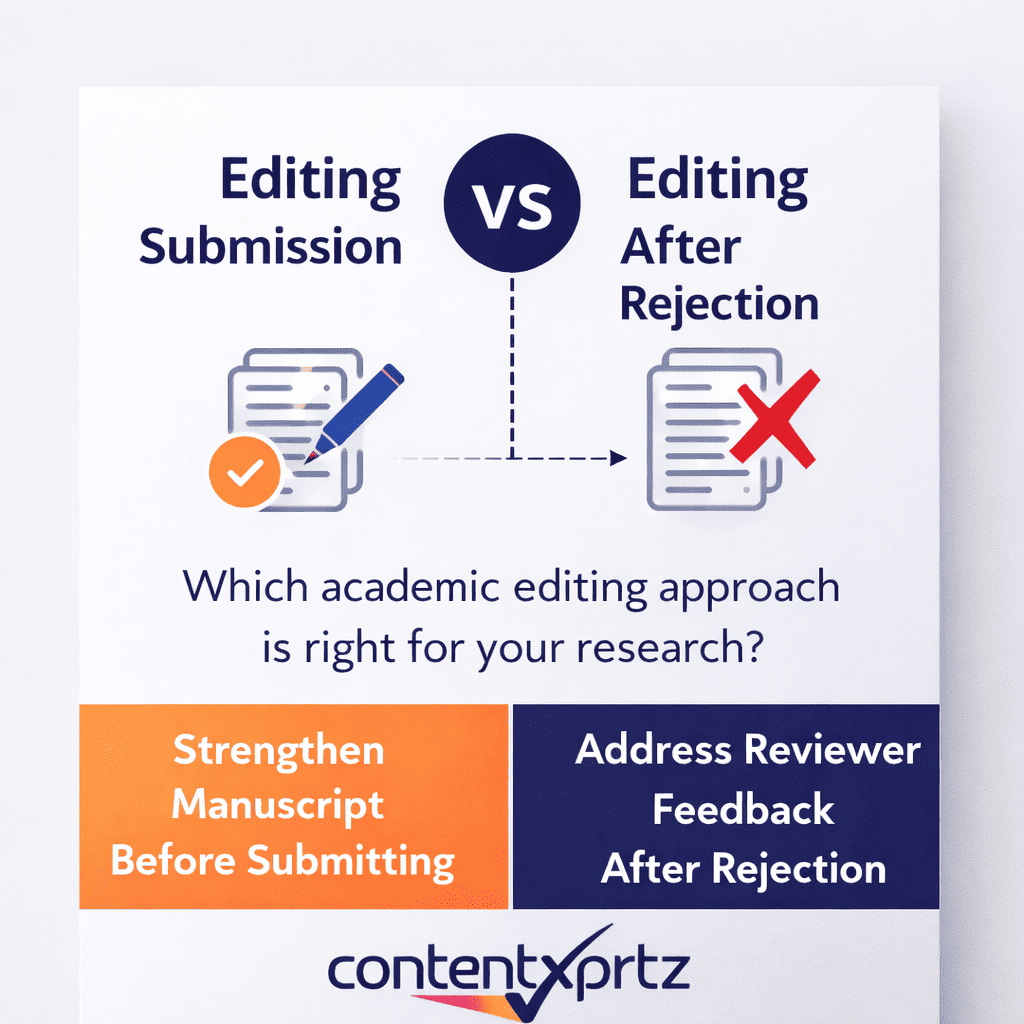

Editing Before Submission vs Editing After Rejection: A Strategic Decision Every Researcher Must Make
Introduction: Why the Timing of Academic Editing Can Define Your Research Journey
For PhD scholars, early-career researchers, and academic professionals, publishing is no longer just an achievement. It is a survival metric. Doctoral completion timelines, grant renewals, academic promotions, and institutional rankings are increasingly tied to publication outcomes. In this environment, a single rejection can delay a PhD by months or even years. A series of rejections can erode confidence, drain financial resources, and stall academic momentum.
This is precisely where the debate around Editing Before Submission vs Editing After Rejection becomes critically important.
Many researchers approach editing reactively. They submit their manuscript independently, wait for reviewer feedback, and only seek professional academic editing after facing rejection. Others take a proactive route, investing in rigorous academic editing before submission to strengthen clarity, argumentation, methodology alignment, and journal compliance from the outset.
The difference between these two approaches is not cosmetic. It is strategic.
According to Elsevier’s global publishing data, the average acceptance rate for high-impact journals ranges between 8% and 15%, with desk rejections accounting for nearly 50% of declined manuscripts. Common reasons include poor language quality, weak structure, unclear contribution, and failure to follow journal guidelines. These are not issues of intelligence or research depth. They are issues of presentation, framing, and academic communication.
At the same time, global PhD enrollment has risen sharply over the past decade, particularly in Asia, Europe, and emerging research economies. With more manuscripts competing for limited journal space, editors and reviewers apply increasingly strict filters. In this competitive ecosystem, submitting an unedited or under-edited manuscript is no longer a calculated risk. It is a structural disadvantage.
This article provides an in-depth, evidence-based comparison of Editing Before Submission vs Editing After Rejection, tailored for PhD scholars, postdoctoral researchers, and academic professionals. Drawing on publication ethics, editorial best practices, and real-world academic workflows, it explores when editing delivers the highest return on investment, how timing affects acceptance probability, and why strategic editing is no longer optional in serious academic publishing.
Throughout the article, we integrate expert insights, credible academic references, and practical guidance aligned with global publishing standards from Elsevier, Springer Nature, Emerald Insight, Taylor and Francis, and the APA. We also reflect the editorial philosophy and ethical positioning of ContentXprtz, a global academic support provider established in 2010, supporting researchers across more than 110 countries.
Understanding Academic Editing in the Modern Publishing Ecosystem
What Academic Editing Truly Involves
Academic editing extends far beyond grammar correction. In high-stakes scholarly publishing, professional editing operates at multiple levels:
-
Language and clarity editing to improve readability and precision
-
Structural editing to strengthen logical flow and coherence
-
Argument refinement to sharpen research contribution and positioning
-
Methodology alignment to ensure consistency between objectives, methods, and findings
-
Journal compliance editing to meet formatting, referencing, and submission requirements
Major publishers such as Springer Nature explicitly state that language quality and manuscript clarity influence editorial decisions, even before peer review begins. Reviewers expect to evaluate ideas, not decode poorly presented arguments.
Editing, therefore, is not a cosmetic service. It is an academic risk management strategy.
Editing Before Submission: A Proactive and Preventive Strategy
Why Editing Before Submission Is Increasingly Preferred
Editing before submission allows researchers to submit their strongest possible manuscript to the target journal. This approach aligns with how journal editors and reviewers actually operate.
Most high-impact journals apply a two-stage filtering process:
-
Editorial screening (desk review)
-
External peer review
Manuscripts that fail the first stage rarely receive constructive feedback. They are simply declined.
Professional academic editing before submission directly addresses the most common desk rejection triggers:
-
Poor language quality
-
Unclear research contribution
-
Weak abstract and introduction framing
-
Inconsistent methodology description
-
Non-compliance with journal guidelines
According to Springer Nature’s author guidelines, manuscripts with strong conceptual clarity and polished academic language are more likely to progress to peer review. Editing before submission increases the probability of entering this critical second stage.
Key Benefits of Editing Before Submission
Higher Probability of Desk Acceptance
Editors are more likely to send a well-edited manuscript for review. Clear writing signals scholarly seriousness and respect for editorial standards.
Reduced Revision Cycles
Well-edited manuscripts receive more focused reviewer comments. Instead of language corrections, reviewers engage with theory, methods, and findings.
Time and Cost Efficiency
Multiple rejection cycles can add six to twelve months to the publication timeline. Editing before submission reduces this risk substantially.
Stronger Author Confidence
Submitting a polished manuscript improves confidence during the review process and prepares authors for academic dialogue with reviewers.
Editing After Rejection: A Reactive but Sometimes Necessary Approach
Why Researchers Seek Editing After Rejection
Despite best intentions, many researchers only seek professional editing after facing rejection. Common reasons include:
-
Budget constraints during early PhD stages
-
Overconfidence in self-editing abilities
-
Institutional pressure to submit quickly
-
Misinterpretation of reviewer expectations
Editing after rejection often becomes a corrective measure rather than a strategic investment.
What Editing After Rejection Typically Involves
When editing follows rejection, the scope expands significantly:
-
Response-to-reviewer editing
-
Manuscript restructuring based on critical feedback
-
Repositioning the research contribution for a new journal
-
Extensive language and coherence repair
While this process can rescue a manuscript, it often requires deeper intervention and higher editorial effort.
Limitations of Editing After Rejection
-
Reviewer feedback may be vague or inconsistent
-
Emotional fatigue can affect revision quality
-
Time pressure increases due to resubmission deadlines
-
Some structural flaws may be difficult to correct post hoc
Editing after rejection is valuable, but it is rarely the most efficient starting point.
Editing Before Submission vs Editing After Rejection: A Comparative Analysis
| Dimension | Editing Before Submission | Editing After Rejection |
|---|---|---|
| Timing | Proactive | Reactive |
| Cost Efficiency | Higher | Lower due to rework |
| Acceptance Probability | Increased early | Dependent on revision quality |
| Emotional Impact | Confidence-building | Stress-intensive |
| Reviewer Focus | Content-driven | Error and clarity-driven |
| Publication Timeline | Shorter | Often extended |
From an academic strategy perspective, editing before submission consistently delivers stronger outcomes.
Ethical Dimensions of Academic Editing
What Ethical Editing Is and Is Not
Professional editing must comply with global publication ethics. According to the Committee on Publication Ethics (COPE) and the APA, ethical editing:
-
Improves clarity without altering authorship
-
Preserves original data and interpretations
-
Avoids ghostwriting or content fabrication
ContentXprtz adheres strictly to these principles, ensuring that every manuscript remains the intellectual property of the author.
When Editing After Rejection Is the Right Choice
While proactive editing is ideal, editing after rejection is justified in specific scenarios:
-
Reviewer feedback reveals misalignment with journal scope
-
Language barriers significantly affected reviewer understanding
-
Structural issues were not evident before peer review
In such cases, expert-led revision and resubmission support becomes essential.
Integrating Professional Editing into the PhD Lifecycle
PhD scholars benefit most when editing is integrated strategically:
-
Proposal stage: Conceptual clarity
-
Mid-stage drafts: Structural consistency
-
Pre-submission: Language and compliance editing
-
Post-review: Targeted revision support
This lifecycle approach reduces cumulative stress and improves overall research quality.
FAQs: Editing, Submission, and Publication Strategy (10 FAQs, minimum 200 words each)
FAQ 1: Is editing before submission really necessary for native English speakers?
Yes. Even native English-speaking researchers benefit significantly from professional academic editing. Academic writing follows conventions that differ from everyday English. Reviewers assess clarity, coherence, and disciplinary tone rather than linguistic fluency alone. Editing before submission ensures that arguments are logically structured, terminology is consistent, and journal-specific expectations are met. According to Elsevier’s author resources, clarity and structure are as important as language correctness. Professional editing also helps eliminate implicit bias, overlong sentences, and ambiguous phrasing that can undermine reviewer confidence.
FAQ 2: Does professional editing guarantee acceptance?
No ethical editor can guarantee acceptance. Journal decisions depend on originality, methodological rigor, and contribution to the field. However, professional editing significantly increases the probability of progressing beyond desk rejection and receiving constructive peer review. Springer Nature emphasizes that language quality influences editorial screening outcomes. Editing improves how research is evaluated, not what is evaluated.
FAQ 3: Is editing after rejection more expensive than pre-submission editing?
In most cases, yes. Editing after rejection often requires restructuring, repositioning, and extensive revisions based on reviewer feedback. This increases editorial time and cost. Pre-submission editing is usually more focused and cost-effective.
FAQ 4: How do I know whether my manuscript needs editing before submission?
If you are unsure about journal fit, reviewer expectations, language precision, or structural coherence, editing before submission is strongly recommended. Many journals explicitly advise non-native English authors to seek professional editing prior to submission.
FAQ 5: Can editing help with journal selection?
Yes. Experienced academic editors often provide guidance on journal scope alignment, acceptance thresholds, and formatting requirements. This reduces the risk of desk rejection due to scope mismatch.
FAQ 6: How long does professional editing take?
Turnaround time depends on manuscript length and complexity. Most pre-submission editing services range from three to seven working days. Revision editing after rejection may take longer due to complexity.
FAQ 7: Is professional editing allowed by journals?
Yes. Major publishers including Elsevier, Taylor and Francis, and Emerald Insight explicitly allow professional language editing, provided authorship integrity is maintained.
FAQ 8: What is the difference between proofreading and academic editing?
Proofreading corrects surface-level errors. Academic editing addresses structure, clarity, argumentation, and journal alignment. For publication, academic editing is far more impactful.
FAQ 9: Can editing improve reviewer comments quality?
Yes. Clear manuscripts encourage reviewers to focus on intellectual contribution rather than language issues, leading to more meaningful feedback.
FAQ 10: How does ContentXprtz ensure ethical editing?
ContentXprtz follows COPE and APA guidelines. Editors improve clarity without altering data or authorship. Every manuscript remains fully author-owned.
Trusted Academic Resources for Further Reading
-
Elsevier Author Services: https://www.elsevier.com/authors
-
Springer Nature Author Guidelines: https://www.springernature.com/gp/authors
-
Emerald Insight Publishing Support: https://www.emeraldgrouppublishing.com/publish-with-us
-
APA Style and Publication Ethics: https://apastyle.apa.org
How ContentXprtz Supports Researchers at Every Stage
ContentXprtz offers structured academic support through:
-
PhD thesis help via https://contentxprtz.com/phd-academic-services
-
Academic editing services through https://contentxprtz.com/writing-publishing-services
-
Student writing services at https://contentxprtz.com/student-career-academic-writing-services
-
Book and monograph support via https://contentxprtz.com/book-authors-writing-services
-
Corporate and professional research writing at https://contentxprtz.com/corporate-writing-services
Each service is delivered by subject-matter experts with deep publishing experience.
Conclusion: Making the Right Editing Decision for Long-Term Academic Success
The debate around Editing Before Submission vs Editing After Rejection is ultimately about strategy, not preference. Evidence from global publishing practices clearly favors proactive editing as a means of reducing rejection risk, saving time, and strengthening scholarly impact.
Editing before submission empowers researchers to enter the publication process confidently. Editing after rejection can recover valuable work, but often at a higher emotional and financial cost.
For PhD scholars and academic professionals navigating an increasingly competitive publishing landscape, professional editing is no longer optional. It is foundational.
Explore expert PhD assistance and academic editing services today and position your research for success.
At ContentXprtz, we don’t just edit — we help your ideas reach their fullest potential.
