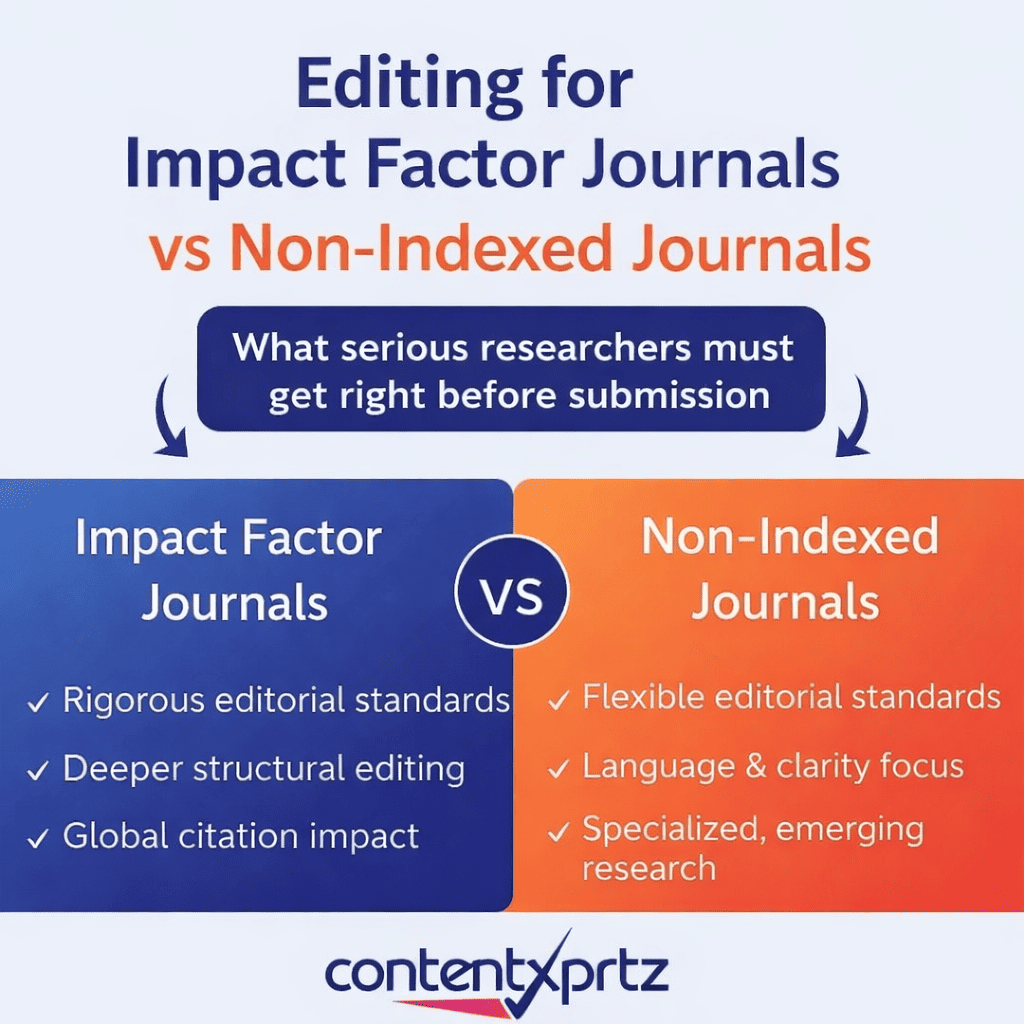

Editing for Impact Factor Journals vs Non-Indexed Journals: A Strategic Guide for PhD Scholars and Academic Researchers
Introduction
For PhD scholars and academic researchers, publishing is no longer just an academic milestone. It has become a defining factor for career progression, funding opportunities, postdoctoral positions, and global academic recognition. Yet, despite years of rigorous research, many manuscripts fail to reach publication not because the research lacks merit, but because the editing standard does not match the expectations of the target journal. This challenge becomes even more critical when scholars must choose between editing for impact factor journals vs non-indexed journals, a decision that directly shapes the depth, cost, rigor, and strategic focus of academic editing.
Across disciplines, doctoral candidates face mounting pressures. Time constraints intensify as scholars balance coursework, teaching responsibilities, grant writing, and personal obligations. At the same time, journal rejection rates continue to rise. According to data published by Elsevier, top-tier journals now report rejection rates exceeding 80 percent, even for technically sound research. Springer Nature similarly highlights that language quality, clarity of argumentation, and methodological transparency are among the most common reasons for desk rejection. These realities place editing at the center of the publication journey, not as a final cosmetic step, but as a strategic academic intervention.
For researchers in emerging economies and non-native English speakers, the challenge deepens further. Global research output has expanded rapidly, with UNESCO reporting a more than 50 percent increase in global research publications over the past decade. However, acceptance remains highly uneven. Manuscripts submitted to indexed journals such as Scopus or Web of Science must compete against submissions that have already undergone multiple rounds of professional academic editing, often supported by institutional funding. Without comparable editorial support, even strong research risks being overlooked.
This is where understanding the difference between editing for impact factor journals vs non-indexed journals becomes essential. Editing is not a one-size-fits-all service. A manuscript prepared for a local or institutional journal requires a different editorial approach than one targeting journals indexed by Scopus, SSCI, or SCI. The expectations around theoretical contribution, citation rigor, methodological reporting, ethical disclosure, and academic tone vary significantly.
At ContentXprtz, we have worked with PhD scholars and researchers in more than 110 countries since 2010. Our experience consistently shows that scholars who align their editing strategy with their publication target improve not only acceptance rates, but also reviewer engagement and long-term citation impact. This article provides a comprehensive, evidence-based comparison of editing for impact factor journals vs non-indexed journals, helping you make informed decisions that protect your research investment and academic future.
Understanding Journal Categories in Academic Publishing
What Are Impact Factor Journals?
Impact factor journals are peer-reviewed academic journals indexed in globally recognized databases such as Web of Science, Scopus, and PubMed. Their influence is measured using citation-based metrics, most notably the Journal Impact Factor calculated by Clarivate Analytics. These journals prioritize originality, theoretical advancement, methodological rigor, and global relevance.
Examples include journals published by Elsevier, Springer Nature, Taylor and Francis, and Emerald Insight. These publishers follow strict editorial and ethical guidelines, often aligned with COPE and APA standards.
What Are Non-Indexed Journals?
Non-indexed journals include institutional journals, regional publications, emerging open-access platforms, and niche disciplinary outlets that are not listed in major citation databases. While many maintain legitimate peer-review processes, their editorial standards and international visibility vary widely.
Such journals may serve early-career researchers, regional research communities, or applied disciplines where rapid dissemination is prioritized over citation metrics.
Editing for Impact Factor Journals vs Non-Indexed Journals: Core Differences
Editorial Depth and Scope
Editing for impact factor journals requires multilayered academic editing. This includes structural editing, substantive editing, language refinement, and compliance checks. Editors assess argument coherence, theoretical positioning, methodological transparency, and citation accuracy.
In contrast, non-indexed journal editing typically focuses on language correction, formatting consistency, and basic academic tone. Structural changes are often minimal unless explicitly requested.
Language and Academic Style Expectations
Impact factor journals demand advanced academic English with discipline-specific terminology, precise argumentation, and logical flow. Reviewers expect clarity without oversimplification and sophistication without ambiguity.
Non-indexed journals often accept simpler academic language, provided the research question and findings are understandable to the intended audience.
Ethical and Compliance Requirements
Indexed journals enforce strict ethical disclosure standards, including plagiarism checks, authorship declarations, conflict of interest statements, and data transparency. Editing must ensure full compliance before submission.
Non-indexed journals may have fewer formal compliance requirements, though ethical editing remains essential.
Why Editing Standards Matter More for Impact Factor Journals
Reviewer Expectations and Desk Rejection Risks
According to Taylor and Francis editorial guidelines, manuscripts that fail to meet language and structural standards are frequently rejected without peer review. This means inadequate editing can eliminate your research before its scientific value is evaluated.
Citation and Long-Term Research Visibility
Articles published in impact factor journals achieve higher citation rates, contributing to h-index growth and academic reputation. Editing directly influences readability, which in turn affects citation behavior.
Funding, Promotions, and Institutional Metrics
Universities and funding bodies increasingly rely on indexed publications as performance indicators. Editing quality becomes an indirect determinant of career advancement.
Editing Approaches for Non-Indexed Journals
When Non-Indexed Journals Make Strategic Sense
Non-indexed journals can be appropriate for pilot studies, regional research, practitioner-focused work, or early-stage doctoral outputs. Editing here focuses on clarity, coherence, and basic academic standards.
Cost and Turnaround Considerations
Editing for non-indexed journals is generally faster and more cost-effective. This can benefit students with limited funding or tight deadlines.
Choosing the Right Editing Strategy for Your Research Goals
Selecting between editing for impact factor journals vs non-indexed journals should align with your academic objectives, funding availability, and career stage.
At ContentXprtz, our academic editing services are tailored to journal tier, discipline, and author background. Learn more about our comprehensive support through our Writing and Publishing Services and specialized PhD and Academic Services.
Common Editing Mistakes PhD Scholars Make
-
Submitting to indexed journals with language-only editing
-
Ignoring journal-specific author guidelines
-
Underestimating the importance of argumentative coherence
-
Failing to align references with journal citation style
-
Treating editing as a final step rather than an iterative process
Frequently Asked Questions: Editing for Impact Factor Journals vs Non-Indexed Journals
1. Is editing mandatory for submitting to impact factor journals?
Editing is not officially mandatory, but in practice, it is essential. Impact factor journals receive thousands of submissions annually. Editors and reviewers expect manuscripts to meet international academic writing standards. Even minor language inconsistencies can signal lack of rigor, increasing desk rejection risk. Professional academic editing helps ensure clarity, coherence, and compliance with publisher guidelines such as those outlined by Elsevier and Springer Nature.
2. Can the same edited manuscript be submitted to both indexed and non-indexed journals?
Technically yes, but strategically no. A manuscript edited for a non-indexed journal may lack the theoretical depth and structural refinement expected by indexed journals. Conversely, a manuscript edited for an impact factor journal may exceed the requirements of a non-indexed outlet, potentially delaying review due to perceived misalignment.
3. How does editing affect peer reviewer perception?
Reviewers subconsciously associate language quality with research credibility. Well-edited manuscripts allow reviewers to focus on scientific contribution rather than linguistic flaws. This improves review tone, reduces revision rounds, and increases acceptance probability.
4. What type of editing is best for PhD thesis-based journal articles?
For thesis-derived articles targeting indexed journals, substantive editing is critical. This includes restructuring chapters into article format, refining arguments, and aligning with journal scope. ContentXprtz offers dedicated research paper writing support to manage this transition effectively.
5. Are non-indexed journals easier to publish in?
Generally yes, but ease does not equate to low standards. Many non-indexed journals maintain rigorous peer review. Editing remains important to ensure clarity, ethical compliance, and academic tone.
6. How long does professional academic editing take?
Turnaround depends on manuscript length, complexity, and journal tier. Editing for impact factor journals typically takes longer due to multiple review layers. Non-indexed journal editing is often faster. Our academic editing services offer flexible timelines to meet submission deadlines.
7. Does editing guarantee acceptance?
No ethical editing service guarantees acceptance. However, professional editing significantly improves manuscript quality, reviewer engagement, and resubmission success.
8. How does editing differ across disciplines?
STEM manuscripts emphasize methodological clarity and data presentation. Social sciences prioritize theoretical framing and argumentation. Humanities focus on narrative coherence and critical analysis. Editing strategies must reflect disciplinary norms.
9. Is AI-based editing sufficient for indexed journals?
AI tools assist with grammar but lack disciplinary judgment, ethical sensitivity, and contextual understanding. Indexed journals increasingly scrutinize AI-assisted writing. Human expert editing remains essential.
10. How can I choose the right academic editing partner?
Choose providers with demonstrated experience, ethical transparency, subject-matter expertise, and global exposure. ContentXprtz has supported scholars worldwide since 2010, offering tailored editing aligned with journal expectations. Explore our Student Writing Services, Book Authors Writing Services, and Corporate Writing Services to understand our multidisciplinary capabilities.
Conclusion: Aligning Editing Strategy with Publication Success
Understanding the distinction between editing for impact factor journals vs non-indexed journals is no longer optional for serious academic researchers. Editing influences not only acceptance outcomes but also long-term academic visibility, citation impact, and professional credibility. Indexed journals demand comprehensive, strategic editing that aligns language, structure, ethics, and theory with global scholarly standards. Non-indexed journals, while valuable, follow different expectations that require a tailored editorial approach.
At ContentXprtz, we bring over a decade of global experience in academic editing and publication support. Our services are designed to meet scholars where they are and guide them toward where they aspire to publish.
If you are preparing your next manuscript or transitioning your PhD thesis into journal articles, we invite you to explore our PhD assistance services and speak with our academic consultants today.
At ContentXprtz, we do not just edit. We help your ideas reach their fullest potential.
