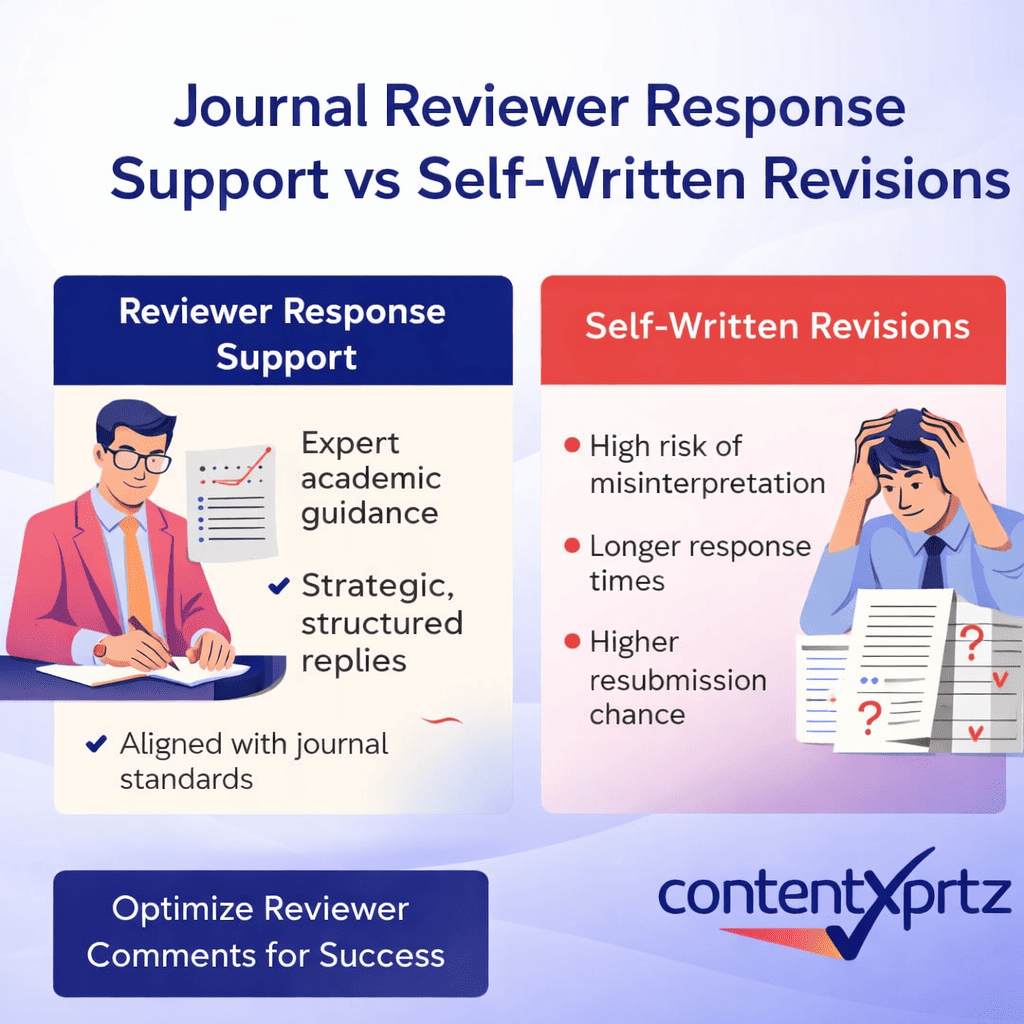

Journal Reviewer Response Support vs Self-Written Revisions: A Strategic Choice Every Researcher Must Make
Introduction: Navigating the Most Decisive Stage of Academic Publishing
For many PhD scholars, early-career researchers, and academic professionals, receiving reviewer comments from a journal is both a moment of relief and renewed anxiety. Relief because the manuscript has survived the initial editorial screening. Anxiety because the real challenge often begins after peer review. At this stage, authors must decide between Journal Reviewer Response Support vs Self-Written Revisions, a decision that can determine whether months or even years of research progress toward publication or stall indefinitely.
Across disciplines, peer review is increasingly rigorous. According to data reported by Elsevier, the global acceptance rate of academic journals across STEM, social sciences, and humanities ranges between 15% and 35%, with top-tier journals often accepting fewer than 10% of submissions. Springer Nature similarly notes that over 50% of manuscripts requiring major revisions are eventually rejected, often due to inadequate or poorly structured responses to reviewer comments rather than flaws in the underlying research. These figures highlight a crucial reality: publication success depends not only on research quality but also on how effectively authors engage with reviewers.
For PhD students, this challenge is compounded by structural pressures. Many scholars balance teaching responsibilities, grant deadlines, family commitments, and institutional expectations to publish within strict timelines. International researchers face additional hurdles, including language proficiency, unfamiliarity with journal conventions, and cultural differences in academic communication. At the same time, the cost of repeated submissions, open-access fees, and delayed graduation continues to rise globally, increasing stress at an already demanding stage of an academic career.
Against this backdrop, the debate around Journal Reviewer Response Support vs Self-Written Revisions has become more relevant than ever. Should researchers handle reviewer comments independently, relying on their own judgment and experience? Or should they seek structured, professional support to ensure that revisions and response letters meet the expectations of editors and reviewers?
This article addresses that question in depth. Drawing on established publication standards from Elsevier, Springer, Emerald Insight, Taylor and Francis, and APA, it provides an evidence-based comparison of self-written revisions and professional reviewer response support. The goal is not to promote dependency but to help researchers make an informed, strategic decision aligned with academic integrity, efficiency, and long-term career goals.
Throughout this guide, we integrate practical examples, ethical considerations, and expert insights grounded in real-world publication practice. Whether you are revising your first manuscript or managing multiple revise-and-resubmit decisions, this article offers clarity, confidence, and direction. By the end, you will understand not only the differences between these two approaches but also when each is most appropriate and how professional academic editing services can be used responsibly to strengthen your scholarly voice.
Understanding Journal Reviewer Comments: More Than Simple Corrections
Why Reviewer Comments Are Often Misinterpreted
Peer reviewers do far more than correct grammar or suggest additional citations. Their feedback reflects disciplinary standards, methodological expectations, and the journal’s strategic positioning. According to Emerald Insight, reviewers often assess manuscripts across multiple dimensions, including theoretical contribution, methodological rigor, clarity of argumentation, and relevance to the journal’s audience.
However, many authors interpret reviewer comments too literally. For example, a comment such as “The theoretical contribution needs to be clarified” may signal deeper concerns about novelty or positioning rather than a request for minor textual edits. Misreading such feedback can result in superficial revisions that fail to address core issues, increasing the likelihood of rejection after resubmission.
The Hidden Language of Peer Review
Experienced editors note that reviewer language often follows implicit conventions. Phrases like “The manuscript would benefit from” or “The authors may wish to consider” are frequently polite indicators of required changes rather than optional suggestions. Taylor and Francis publishing guidelines emphasize that successful revisions depend on demonstrating respect for reviewer expertise while clearly justifying any decisions to diverge from recommendations.
Understanding this hidden language is central to the Journal Reviewer Response Support vs Self-Written Revisions discussion. Professional support services specialize in decoding reviewer intent and aligning author responses with editorial expectations without compromising scholarly independence.
Self-Written Revisions: Strengths, Risks, and Realities
Advantages of Writing Revisions Independently
Self-written revisions remain a valid and sometimes preferable option, particularly for experienced researchers. Writing responses independently allows authors to maintain complete control over intellectual decisions and rhetorical style. It also fosters deeper engagement with reviewer feedback, which can strengthen future submissions.
Key benefits include:
-
Full ownership of scholarly voice and argumentation
-
No financial cost for external support
-
Development of long-term peer review literacy
For scholars with extensive publication experience or strong mentorship support, self-written revisions may be both efficient and effective.
Common Challenges Faced by PhD Scholars
Despite these advantages, self-written revisions present significant challenges, especially for doctoral candidates and early-career researchers. Common issues include:
-
Emotional responses to critical feedback, leading to defensive or dismissive replies
-
Difficulty prioritizing reviewer comments when feedback is extensive or contradictory
-
Limited familiarity with journal-specific response formats
-
Language and tone issues, particularly for non-native English speakers
APA’s publication manual underscores that tone in reviewer responses must remain objective, respectful, and evidence-based. However, achieving this balance can be difficult without editorial guidance.
When Self-Written Revisions Increase Rejection Risk
Evidence from Springer Nature suggests that manuscripts rejected after revision frequently fail due to inadequate response letters rather than insufficient revisions. Common red flags for editors include vague responses, unstructured rebuttals, and failure to clearly indicate changes made in the manuscript.
In such cases, the decision between Journal Reviewer Response Support vs Self-Written Revisions becomes less about capability and more about risk management.
Journal Reviewer Response Support: What It Involves and Why It Matters
Defining Professional Reviewer Response Support
Journal reviewer response support is a specialized academic service focused on helping authors respond strategically to peer review feedback. Unlike ghostwriting or unethical manuscript rewriting, this support emphasizes:
-
Interpreting reviewer and editor comments accurately
-
Structuring clear, point-by-point response letters
-
Aligning revisions with journal scope and standards
-
Preserving the author’s intellectual ownership
At ContentXprtz, reviewer response support operates within strict ethical boundaries, consistent with COPE and APA guidelines. The author remains the decision-maker, while expert editors act as strategic advisors and language specialists.
Core Components of Reviewer Response Support
Effective reviewer response support typically includes:
-
Detailed analysis of reviewer and editor comments
-
A structured response matrix mapping comments to revisions
-
Language refinement for clarity, tone, and academic precision
-
Guidance on how to justify methodological or theoretical choices
Elsevier’s author resources highlight that clear response matrices significantly improve editorial confidence during resubmission.
Why Professional Support Improves Publication Outcomes
Professional reviewer response support addresses both cognitive and communicative gaps. By externalizing the revision process, authors gain objectivity and strategic clarity. This is particularly valuable when reviewer comments conflict or require nuanced negotiation.
From the perspective of Journal Reviewer Response Support vs Self-Written Revisions, professional support does not replace scholarly competence. Instead, it enhances how that competence is communicated to gatekeepers of academic publishing.
Comparative Analysis: Journal Reviewer Response Support vs Self-Written Revisions
Time Efficiency and Cognitive Load
Self-written revisions often require repeated reading of reviewer comments, extensive trial-and-error drafting, and emotional labor. In contrast, structured support reduces cognitive load by providing a clear revision roadmap.
For PhD candidates facing submission deadlines, this time efficiency can be decisive.
Quality of Argumentation and Clarity
Professional support enhances clarity by ensuring that each reviewer comment is addressed explicitly and coherently. This systematic approach aligns with best practices recommended by Emerald and Springer.
Ethical Considerations and Academic Integrity
A common concern is whether professional support compromises academic integrity. Reputable services operate transparently, focusing on editing, structuring, and advisory support rather than content fabrication. APA explicitly permits language and editorial assistance, provided authors retain intellectual responsibility.
When to Choose Self-Written Revisions and When to Seek Support
Situations Favoring Self-Written Revisions
-
Minor revisions with limited reviewer comments
-
Strong supervisory or mentorship support
-
Extensive prior publication experience
Situations Where Reviewer Response Support Is Strategic
-
Major or mixed revisions with complex feedback
-
High-impact or Q1 journal submissions
-
Language barriers or interdisciplinary submissions
-
Time-sensitive graduation or funding requirements
For many researchers, the decision is not binary. A hybrid approach combining self-written revisions with targeted academic editing services often delivers the best results.
Integrating Professional Support Responsibly
Professional support should be viewed as capacity-building rather than dependency. Over time, authors develop stronger peer review literacy and greater confidence in handling revisions independently.
Researchers seeking ethical, transparent assistance can explore specialized academic editing services through ContentXprtz’s
PhD & Academic Services
or tailored research paper writing support available under
Writing & Publishing Services.
Frequently Asked Questions: Clarifying Common Researcher Concerns
FAQ 1: Is using reviewer response support considered unethical in academic publishing?
No, using reviewer response support is not unethical when it complies with established academic guidelines. Organizations such as the APA and COPE clearly distinguish between acceptable editorial assistance and unethical practices like ghostwriting or data fabrication. Reviewer response support focuses on language refinement, structural clarity, and strategic interpretation of feedback. The intellectual content, methodological decisions, and scholarly arguments remain the author’s responsibility. Many journals explicitly acknowledge that authors may seek language or editorial assistance, particularly when English is not their first language. The key ethical principle is transparency and ownership. As long as authors fully understand and approve all revisions, professional support enhances clarity without compromising integrity.
FAQ 2: Can professional support improve acceptance rates after major revisions?
While no service can guarantee acceptance, evidence from publishers such as Elsevier and Springer suggests that well-structured response letters significantly improve editorial confidence. Major revisions often fail when authors address comments selectively or unclearly. Professional support ensures that each reviewer concern is acknowledged, justified, and linked to concrete manuscript changes. This systematic approach reduces the risk of desk rejection after resubmission and improves the likelihood of progressing to acceptance or minor revisions.
FAQ 3: How does reviewer response support differ from full manuscript editing?
Reviewer response support is targeted and strategic. Unlike full academic editing, which focuses on overall language, coherence, and formatting, reviewer response support concentrates specifically on peer review feedback. It involves mapping reviewer comments to manuscript changes, refining rebuttal language, and aligning responses with journal expectations. Many authors combine both services, particularly for high-impact submissions. ContentXprtz offers flexible models under its
Student Writing Services
and advanced academic support programs.
FAQ 4: Is self-written revision always sufficient for minor revisions?
Minor revisions are often manageable independently, especially when comments focus on formatting, citations, or clarity. However, even minor revisions require careful response letters. Editors expect professionalism regardless of revision level. Authors who choose self-written revisions should still follow structured response formats recommended by publishers and ensure respectful tone and explicit referencing of manuscript changes.
FAQ 5: How do editors evaluate response letters during resubmission?
Editors assess response letters to determine whether reviewers’ concerns have been taken seriously. According to Emerald Insight, clear, polite, and detailed responses increase editorial trust. Editors look for evidence of engagement, such as page and line references, methodological justification, and transparent explanations for any disagreements. Poorly written responses can undermine otherwise strong revisions.
FAQ 6: Can reviewer response support help with contradictory reviewer comments?
Yes, contradictory comments are common, particularly in interdisciplinary research. Professional support helps authors navigate these situations diplomatically by acknowledging both perspectives and proposing balanced revisions. This approach demonstrates intellectual maturity and editorial awareness, qualities valued by journals like those under Taylor and Francis.
FAQ 7: Does professional support reduce my learning as a researcher?
When used responsibly, professional support enhances learning rather than replacing it. Many authors report improved understanding of peer review conventions after working with experienced editors. Over time, this knowledge transfers to future submissions, reducing reliance on external assistance.
FAQ 8: What role does language proficiency play in revision success?
Language clarity is central to how reviewers interpret arguments. Non-native English speakers face additional challenges in conveying nuance and defending methodological choices. Language-focused reviewer response support ensures that arguments are presented accurately and persuasively without altering scholarly intent.
FAQ 9: Are reviewer response services suitable for humanities and social sciences?
Absolutely. While STEM fields often emphasize methodological precision, humanities and social sciences require careful theoretical positioning and argumentative coherence. Reviewer response support adapts to disciplinary norms, ensuring that responses align with field-specific expectations and journal scope.
FAQ 10: How do I choose a trustworthy reviewer response support provider?
Choose providers with transparent processes, clear ethical policies, and demonstrated academic expertise. Established services like ContentXprtz, with global experience since 2010, emphasize author ownership, confidentiality, and compliance with international publication standards. Researchers can also explore specialized services for book chapters and monographs under
Book Authors Writing Services
or professional research communication through
Corporate Writing Services.
Conclusion: Making an Informed, Strategic Publishing Decision
The choice between Journal Reviewer Response Support vs Self-Written Revisions is not about competence versus weakness. It is about strategy, context, and responsible use of available resources. Self-written revisions foster independence and deep engagement, while professional support offers clarity, efficiency, and risk reduction during critical publication stages.
For PhD scholars and academic researchers navigating an increasingly competitive publishing landscape, the ability to respond effectively to peer review is a core professional skill. When used ethically, reviewer response support complements this skill by enhancing communication, reducing avoidable errors, and aligning manuscripts with editorial expectations.
Researchers seeking structured, ethical, and publication-focused assistance can explore ContentXprtz’s comprehensive academic solutions designed for global scholars at every career stage.
Explore PhD Assistance and Academic Publishing Support Today
At ContentXprtz, we don’t just edit we help your ideas reach their fullest potential.
