
PhD Thesis Editing vs Supervisor Review: Which Is More Effective for Research Success?
Introduction
For every PhD scholar, the thesis is more than a document. It is the culmination of years of intellectual labor, personal sacrifice, and professional ambition. Yet, despite deep subject expertise, many doctoral candidates struggle at the final stages of thesis development. Language precision, structural coherence, methodological clarity, and publication readiness often become significant obstacles. This is where the debate around PhD Thesis Editing vs Supervisor Review: Which Is More Effective? becomes both relevant and urgent.
Across the globe, doctoral education is becoming increasingly demanding. According to data published by Elsevier, the number of PhD graduates worldwide has grown by more than 50 percent over the last two decades, while journal acceptance rates in leading indexed journals remain below 20 percent in many disciplines. Supervisors face mounting responsibilities, students face time constraints, and institutions expect faster completions without compromising quality. As a result, PhD scholars often find themselves navigating a high-pressure environment where feedback is limited, delayed, or narrowly focused.
Supervisor review remains central to doctoral training. Supervisors guide research direction, theoretical framing, and methodological rigor. However, supervisors are also researchers, administrators, grant writers, and educators. Their availability is often constrained, and their feedback may prioritize intellectual contribution over linguistic precision, formatting compliance, or publisher-specific requirements. This creates a critical gap, particularly for non-native English speakers and interdisciplinary researchers.
Professional PhD thesis editing has emerged as a complementary support system rather than a replacement for supervision. Ethical academic editing focuses on clarity, coherence, structure, and compliance while preserving authorial voice and intellectual ownership. Reputable academic service providers operate within strict ethical boundaries set by bodies such as the Committee on Publication Ethics (COPE) and the American Psychological Association.
For students facing submission deadlines, repeated revisions, or journal desk rejections, the question is not whether supervision is necessary. Instead, it is whether supervisor review alone is sufficient in today’s competitive academic ecosystem. Understanding the distinct roles, strengths, and limitations of both approaches allows PhD scholars to make informed decisions that protect academic integrity while improving outcomes.
This article provides a comprehensive, evidence-based comparison of PhD thesis editing and supervisor review. It draws on global academic publishing standards, real doctoral workflows, and best practices endorsed by major publishers such as Elsevier, Springer, Emerald Insight, and Taylor and Francis. The goal is to help doctoral candidates choose the most effective support strategy for timely submission, successful examination, and long-term publication impact.
Understanding the Role of Supervisor Review in a PhD Journey
Academic Mentorship and Intellectual Oversight
Supervisor review is foundational to doctoral education. Supervisors shape the research question, theoretical framework, and methodological design. They ensure that the thesis contributes original knowledge to the field and aligns with disciplinary expectations. Their role is deeply intellectual and cannot be substituted.
Supervisors also mentor students in academic thinking, ethical research conduct, and scholarly argumentation. Feedback at this level often focuses on:
-
Conceptual rigor and originality
-
Theoretical alignment and contribution
-
Methodological validity
-
Alignment with institutional requirements
This guidance is critical, particularly in the early and middle stages of doctoral research.
Limitations of Supervisor-Centered Feedback
Despite its importance, supervisor review has structural limitations. Many supervisors manage multiple doctoral candidates alongside heavy teaching and research workloads. Feedback cycles may be slow, fragmented, or high-level. Linguistic clarity, stylistic consistency, and formatting accuracy may receive limited attention.
Studies published by Springer have shown that language-related issues account for a significant proportion of desk rejections, even when research quality is strong. Supervisors may identify that a chapter lacks clarity but may not have the time to rewrite sentences, restructure paragraphs, or align the document with publisher style guides.
This gap often becomes visible during final submission or journal resubmission stages, when delays are costly and stressful.
What Is Professional PhD Thesis Editing?
Scope and Ethical Boundaries
Professional PhD thesis editing focuses on improving the presentation of research without altering its intellectual content. Ethical editors do not add ideas, analyze data, or rewrite arguments. Instead, they enhance clarity, coherence, and compliance.
Core areas of academic editing include:
-
Language accuracy and academic tone
-
Structural flow across chapters
-
Consistency in terminology and referencing
-
Compliance with institutional and publisher guidelines
Publishers such as Elsevier explicitly recommend professional language editing for authors who want to improve clarity and readability without compromising academic integrity. You can review Elsevier’s author services guidance here:
https://www.elsevier.com/authors/author-services
Types of Thesis Editing
PhD thesis editing typically falls into several levels:
-
Proofreading: Grammar, punctuation, spelling
-
Copyediting: Sentence structure, clarity, consistency
-
Substantive editing: Logical flow, cohesion, transitions
Reputable academic editing services clearly define these levels and allow students to choose based on need and stage of submission.
PhD Thesis Editing vs Supervisor Review: A Comparative Analysis
Focus and Expertise
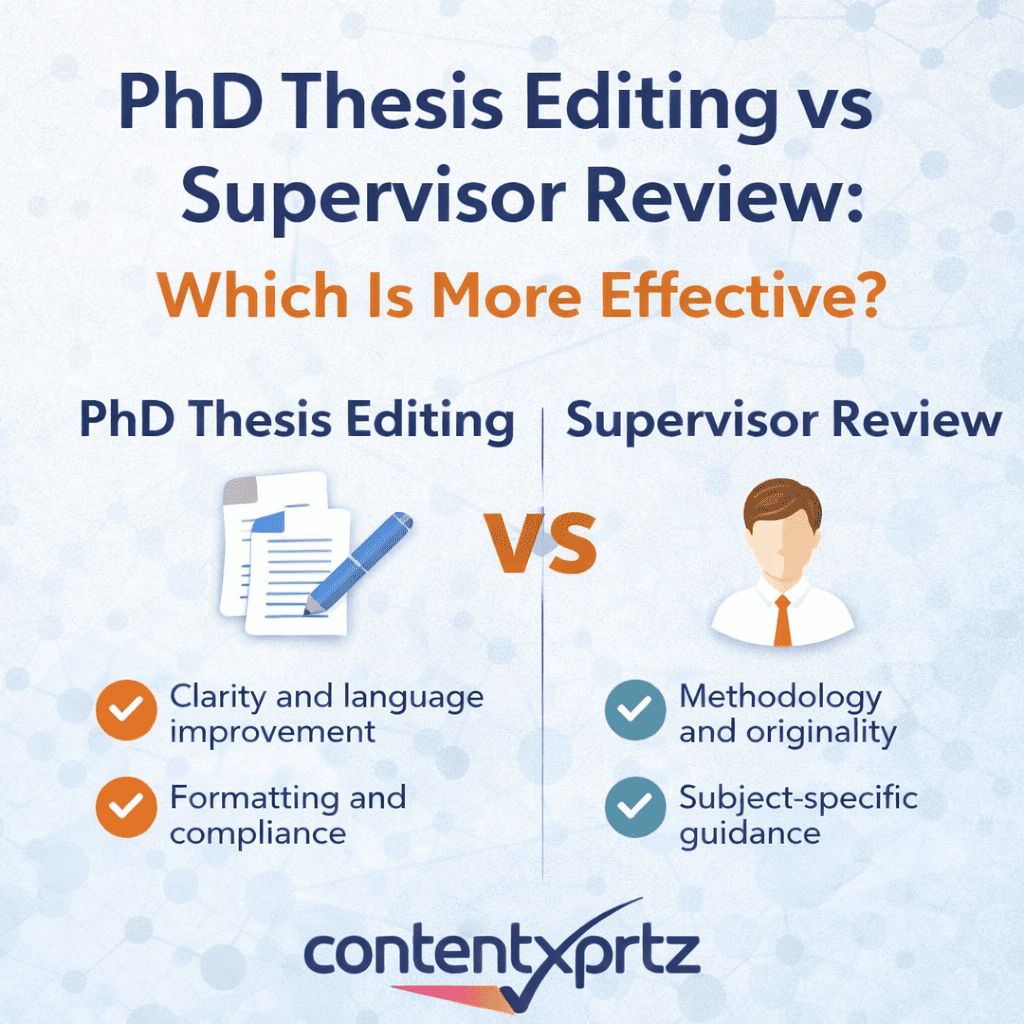
Supervisor review prioritizes intellectual depth, originality, and disciplinary alignment. Professional editing prioritizes clarity, structure, and compliance. Both forms of feedback address different dimensions of quality.
While supervisors evaluate whether the research is worthy of a PhD, editors ensure that the research is communicated effectively to examiners, reviewers, and readers.
Time Efficiency and Turnaround
Supervisor feedback cycles can take weeks or months. In contrast, professional editing services operate on defined timelines, which is particularly valuable near submission deadlines or journal resubmission windows.
For doctoral candidates balancing employment, teaching responsibilities, or funding deadlines, this time efficiency can be decisive.
Objectivity and Reader Perspective
Editors approach the thesis as informed but independent readers. This allows them to identify ambiguity, repetition, or assumptions that insiders may overlook. This reader-centered perspective aligns closely with how examiners and journal reviewers engage with manuscripts.
Why Many PhD Scholars Choose a Combined Approach
Increasingly, doctoral candidates combine supervisor review with professional academic editing. This hybrid approach leverages the strengths of both systems while minimizing their limitations.
A common workflow includes:
-
Supervisor feedback on conceptual and methodological aspects
-
Revision by the student
-
Professional editing for clarity, structure, and compliance
-
Final supervisor approval
This approach respects academic hierarchy while enhancing efficiency and quality.
Ethical Considerations in PhD Thesis Editing
Academic integrity is non-negotiable. Ethical editing adheres to international standards set by organizations such as COPE and APA. According to APA guidelines, editing for language and clarity is permissible, provided the author retains full intellectual ownership.
You can review APA’s position on ethical editing here:
https://apastyle.apa.org/style-grammar-guidelines
Reputable providers clearly state what they do and do not do. Transparency protects both the student and the institution.
Frequently Asked Questions Integrated for Doctoral Researchers
FAQ 1: Is professional PhD thesis editing allowed by universities?
Most universities explicitly allow language and structural editing, particularly for non-native English speakers. Policies typically prohibit ghostwriting or data manipulation, not ethical editing. Students should always review institutional guidelines and disclose editing support if required.
FAQ 2: Can thesis editing replace supervisor review?
No. Thesis editing cannot and should not replace supervisor review. Supervisors assess originality, theoretical contribution, and academic merit. Editing complements this by improving communication and presentation.
FAQ 3: At what stage should I use PhD thesis editing services?
Editing is most effective after content is finalized. Early-stage editing may lead to repeated costs if chapters change significantly. Many scholars opt for editing after supervisor approval of major revisions.
FAQ 4: Will editors change my research arguments?
Ethical editors do not alter arguments or add content. Their role is to improve clarity and coherence while preserving authorial voice and intent.
FAQ 5: How does editing improve viva or defense outcomes?
Clear structure and precise language help examiners focus on ideas rather than errors. Many examiners note that well-edited theses are easier to evaluate, which positively influences examination experience.
FAQ 6: Is thesis editing useful for journal publication later?
Yes. A well-edited thesis provides a strong foundation for converting chapters into journal articles. Journals published by Taylor and Francis emphasize clarity and structure as key acceptance criteria:
https://authorservices.taylorandfrancis.com
FAQ 7: How do I choose a trustworthy academic editing service?
Look for transparency, subject expertise, ethical guidelines, and established experience. Providers with long-term global presence and discipline-specific editors offer greater reliability.
FAQ 8: Does editing improve acceptance rates?
While editing does not guarantee acceptance, studies published by Emerald Insight indicate that language clarity significantly reduces desk rejection risk:
https://www.emeraldgrouppublishing.com/
FAQ 9: Can supervisors recommend professional editing?
Many supervisors actively encourage editing support, especially for international students. This reflects a growing recognition of workload constraints and global academic competition.
FAQ 10: How does ContentXprtz support ethical PhD editing?
ContentXprtz operates under strict ethical standards, offering editing, proofreading, and publication guidance without compromising academic integrity or authorship.
How ContentXprtz Supports PhD Scholars Globally
Since 2010, ContentXprtz has supported doctoral candidates across more than 110 countries. Our services are designed to complement supervision, not replace it.
Our academic editing services help scholars present their work with clarity and confidence. Our PhD thesis help solutions are tailored to institutional guidelines and disciplinary norms. Through our research paper writing support, we assist scholars in transforming theses into publishable articles.
Explore our specialized services here:
-
PhD thesis help and academic editing services:
https://contentxprtz.com/phd-academic-services -
Research paper writing support and publishing guidance:
https://contentxprtz.com/writing-publishing-services -
Student-focused academic writing assistance:
https://contentxprtz.com/student-career-academic-writing-services -
Book and monograph support for doctoral researchers:
https://contentxprtz.com/book-authors-writing-services -
Corporate and professional research documentation services:
https://contentxprtz.com/corporate-writing-services
Our regional teams in India, Australia, East Asia, Europe, and North America ensure culturally aware and discipline-specific support.
Conclusion: Choosing What Is Most Effective for Your PhD Success
The question PhD Thesis Editing vs Supervisor Review: Which Is More Effective? does not have a binary answer. Supervisor review remains essential for intellectual rigor and academic legitimacy. Professional thesis editing enhances clarity, structure, and compliance in an increasingly competitive research environment.
For most PhD scholars, the most effective strategy is not choosing one over the other, but integrating both. This balanced approach respects academic ethics while improving efficiency, readability, and publication readiness.
If you are approaching submission, facing repeated revisions, or preparing your thesis for journal conversion, professional support can make a meaningful difference.
Explore our PhD Assistance Services today and strengthen your research with clarity and confidence.
At ContentXprtz, we don’t just edit – we help your ideas reach their fullest potential.
