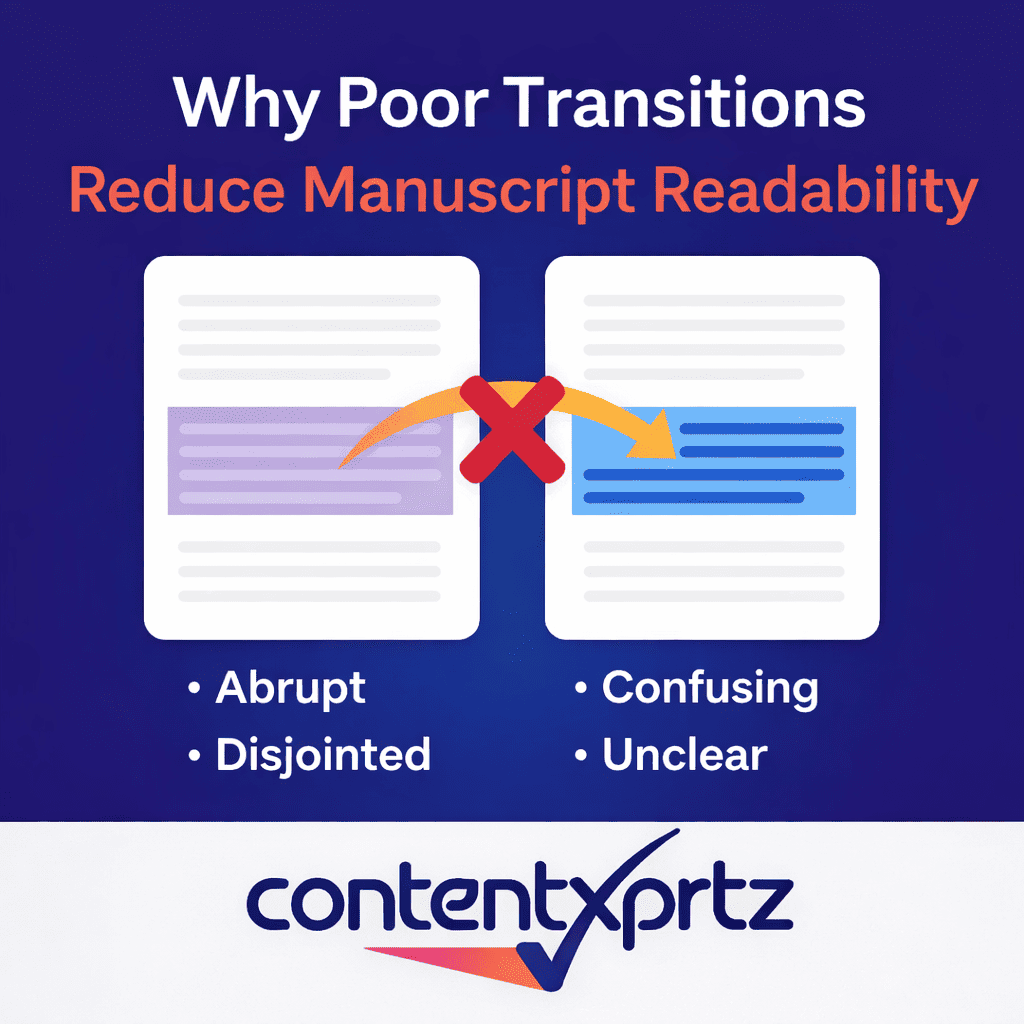

Why Poor Transitions Reduce Manuscript Readability and Undermine Academic Impact
Introduction: Why Transitions Matter More Than Most Scholars Realize
For many PhD scholars and academic researchers, writing is not merely a task but a sustained intellectual struggle. Years of rigorous research often culminate in manuscripts that fail to communicate their full value. One of the most underestimated reasons for this failure is why poor transitions reduce manuscript readability. While grammar, methodology, and citations receive intense scrutiny, transitions are frequently treated as cosmetic rather than structural. This misconception quietly damages otherwise strong academic work.
Across disciplines, doctoral candidates face growing pressures. Time to completion is shrinking, publication expectations are rising, and journal rejection rates remain high. According to Elsevier’s global publishing data, leading journals accept only 5 to 15 percent of submitted manuscripts. Springer Nature reports that lack of clarity and weak narrative flow are among the most common reviewer criticisms, even when research design is sound. These issues rarely stem from poor ideas. Instead, they arise because readers cannot follow the argument with ease.
Academic writing operates under cognitive constraints. Editors, reviewers, and readers process hundreds of manuscripts each year. When transitions between sentences, paragraphs, or sections are weak, readers expend unnecessary mental energy reconstructing meaning. As a result, arguments appear fragmented, contributions feel underdeveloped, and research impact diminishes. This explains why poor transitions reduce manuscript readability so consistently across disciplines.
For PhD scholars, this challenge is amplified by external stressors. Many juggle teaching loads, grant deadlines, administrative responsibilities, and personal commitments. Rising publication costs, article processing charges, and increasing competition for limited journal space intensify anxiety. Under such conditions, transitions become an afterthought, addressed hastily during final revisions rather than embedded strategically from the outset.
Yet transitions are not decorative elements. They function as intellectual bridges. They guide readers through complex theoretical frameworks, connect empirical findings to research questions, and signal shifts in argumentation. Without them, even the most innovative research risks being misunderstood or undervalued.
This educational article examines why poor transitions reduce manuscript readability from linguistic, cognitive, and editorial perspectives. Drawing on best practices from academic publishing standards at Elsevier, Springer, Emerald Insight, Taylor and Francis, and APA, it explains how transitions shape clarity, coherence, and scholarly credibility. It also demonstrates how professional academic editing, structured PhD support, and ethical research paper assistance can transform fragmented drafts into publication-ready manuscripts.
For scholars seeking clarity, confidence, and higher acceptance rates, understanding transitions is not optional. It is foundational.
Understanding Transitions in Academic Writing
What Are Transitions in Scholarly Contexts
Transitions are linguistic and logical devices that connect ideas across sentences, paragraphs, and sections. In academic writing, transitions do more than signal sequence. They clarify relationships such as cause and effect, contrast, continuation, and synthesis. Effective transitions help readers understand not only what comes next, but why it matters.
In research manuscripts, transitions appear at multiple levels. Sentence-level transitions link claims and evidence. Paragraph-level transitions connect themes and subarguments. Section-level transitions guide readers across literature reviews, methodologies, results, and discussions. When these connections are weak or absent, manuscripts feel disjointed.
Why Poor Transitions Reduce Manuscript Readability at Every Level
Readability is not simply about short sentences or simple words. It is about cognitive flow. When transitions are missing, readers must infer relationships independently. This cognitive burden increases fatigue and frustration. Reviewers may perceive the manuscript as poorly structured, even when the content itself is strong.
Emerald Insight’s author guidelines emphasize coherence and logical progression as essential evaluation criteria. Manuscripts that lack transitions often receive comments such as “argument unclear,” “literature review reads like a list,” or “discussion does not connect to results.” These critiques illustrate precisely why poor transitions reduce manuscript readability in practical review settings.
Cognitive Load Theory and Academic Readability
How Readers Process Scholarly Texts
Cognitive load theory explains how working memory processes information. Academic texts already impose high intrinsic cognitive load due to complex concepts, technical language, and dense data. When transitions are absent, extraneous cognitive load increases. Readers must work harder to connect ideas, leaving less capacity to evaluate originality or significance.
Taylor and Francis publishing resources highlight that clear transitions reduce extraneous cognitive load, allowing reviewers to focus on contribution rather than structure. Conversely, manuscripts with weak transitions often feel heavier than they are, leading to premature rejection.
Transitions as Cognitive Signposts
Transitions act as signposts that orient readers. Words such as “however,” “therefore,” “in contrast,” and “building on this finding” signal direction. Without these signals, readers lose orientation. This disorientation explains why poor transitions reduce manuscript readability even in well-researched papers.
Structural Consequences of Weak Transitions
Fragmented Literature Reviews
Literature reviews frequently suffer from poor transitions. Many PhD scholars summarize studies sequentially without synthesizing them. Without transitional phrases that compare, contrast, or build upon prior work, the review reads like an annotated bibliography.
Springer’s author tutorials stress synthesis as a defining feature of publishable literature reviews. Transitions enable this synthesis by explicitly linking studies. Their absence undermines scholarly depth.
Disconnected Methodology and Results
Another common problem occurs between methodology and results sections. When transitions fail to remind readers of research questions or hypotheses, results appear detached. Reviewers struggle to see alignment, reinforcing why poor transitions reduce manuscript readability and perceived rigor.
Editorial and Peer Review Perspectives
How Editors Interpret Poor Transitions
Editors assess manuscripts quickly. Poor transitions signal weak writing skills, lack of clarity, or insufficient revision. Even when editors recognize strong research potential, they may reject papers due to readability concerns, recommending extensive revision before resubmission.
Elsevier’s reviewer guidelines explicitly mention clarity and logical flow as evaluation criteria. Manuscripts with poor transitions are often flagged early in the review process.
Reviewer Fatigue and Decision Bias
Reviewers are human. When manuscripts require excessive effort to follow, negative bias emerges. This psychological reality explains why poor transitions reduce manuscript readability and indirectly affect acceptance decisions.
Ethical and Professional Dimensions of Academic Editing
Professional academic editing services address transitions ethically by improving clarity without altering intellectual ownership. At ContentXprtz, editors focus on strengthening logical bridges while preserving author voice. This distinction matters because ethical editing enhances readability without compromising academic integrity.
Scholars who seek structured PhD thesis help or research paper writing support often discover that transitions, once corrected, dramatically improve reviewer reception.
Practical Strategies to Improve Transitions
Sentence-Level Techniques
Effective sentence transitions use connectors that reflect logical relationships. Overuse should be avoided, but strategic placement improves flow.
Paragraph-Level Coherence
Opening and closing sentences should reference previous and upcoming ideas. This framing prevents abrupt shifts.
Section-Level Signposting
Introductions and conclusions of major sections should guide readers explicitly. These transitions frame expectations and reinforce coherence.
The Role of Professional PhD Support in Transition Refinement
Many scholars lack time or distance to revise transitions effectively. Professional PhD support services provide structural editing that focuses on flow. At ContentXprtz, editors trained across disciplines apply journal-specific readability standards, ensuring alignment with publisher expectations.
You can explore structured academic assistance through PhD thesis help and academic editing services offered at
https://contentxprtz.com/phd-academic-services
https://contentxprtz.com/writing-publishing-services
Frequently Asked Questions: Transitions, Readability, and Academic Success
FAQ 1: Why do reviewers focus so much on readability when research quality is high
Reviewers assess manuscripts holistically. While methodological rigor is essential, readability determines whether that rigor is accessible. Journals receive far more submissions than they can publish. Reviewers therefore prioritize manuscripts that communicate contributions clearly and efficiently. When transitions are weak, reviewers must invest extra cognitive effort to follow the argument. This effort creates frustration and increases the likelihood of rejection. Readability signals professionalism, preparation, and respect for the reader’s time. Strong transitions reduce ambiguity and help reviewers evaluate originality rather than struggle with structure.
FAQ 2: How do poor transitions affect PhD thesis examinations
In doctoral examinations, examiners assess coherence across chapters. Poor transitions make theses appear fragmented, raising concerns about conceptual integration. Examiners may question whether the candidate fully understands the research narrative. Even when data quality is strong, weak transitions undermine confidence in scholarly maturity. Improving transitions through structured PhD thesis help ensures arguments unfold logically, reinforcing examiner trust and reducing revision demands.
FAQ 3: Can language proficiency issues worsen transition problems
Yes. Non-native English speakers often focus on sentence correctness, overlooking flow. While grammar may be accurate, transitions may remain implicit or culturally patterned. Academic English requires explicit signaling. Professional academic editing services help bridge this gap by making transitions explicit without altering meaning.
FAQ 4: Are transitions equally important in STEM and social sciences
Transitions matter across disciplines, though their form varies. In STEM, transitions clarify experimental logic and result interpretation. In social sciences and humanities, they guide theoretical development and argumentation. In all cases, why poor transitions reduce manuscript readability remains consistent because cognitive processing principles apply universally.
FAQ 5: How many transitions are too many
Overuse of transitions can feel mechanical. Effective academic writing balances clarity and subtlety. Editors often recommend prioritizing paragraph and section transitions over excessive sentence connectors. Strategic placement matters more than frequency.
FAQ 6: Do journals explicitly reject papers for poor transitions
Rarely in explicit terms. However, rejection letters frequently cite lack of clarity, weak structure, or poor flow. These critiques often stem from transition issues. Understanding why poor transitions reduce manuscript readability helps scholars interpret feedback more accurately.
FAQ 7: Can automated grammar tools fix transition problems
Grammar tools address surface-level issues. They cannot assess argument flow or conceptual coherence. Professional human editors remain essential for structural transitions and narrative clarity.
FAQ 8: How early should transitions be addressed in writing
Ideally during outlining. Planning transitions at the conceptual stage reduces revision burden. However, many scholars address transitions during advanced drafts with editorial support.
FAQ 9: Is improving transitions considered unethical editing
No. Ethical editing improves clarity while preserving intellectual content. Organizations like the APA recognize language and structural editing as legitimate academic support.
FAQ 10: How can ContentXprtz help specifically with transitions
ContentXprtz applies discipline-specific editorial frameworks. Editors analyze argument structure, cognitive flow, and journal expectations. Through research paper writing support, student writing services, and book authors writing services, transitions are refined systematically, enhancing readability and acceptance potential. Learn more at
https://contentxprtz.com/student-career-academic-writing-services
https://contentxprtz.com/book-authors-writing-services
https://contentxprtz.com/corporate-writing-services
Conclusion: Readability Is Scholarly Responsibility
Understanding why poor transitions reduce manuscript readability is not merely a writing lesson. It is an academic responsibility. Clear transitions honor the reader’s time, amplify research impact, and reflect scholarly maturity. In a competitive publishing landscape, readability often determines whether strong research receives the attention it deserves.
For PhD scholars, researchers, and academic professionals, investing in transition quality is an investment in credibility. Structured support, ethical editing, and expert guidance can transform manuscripts from fragmented drafts into compelling scholarly narratives.
Explore comprehensive PhD Assistance Services and professional academic editing services at ContentXprtz to elevate your research communication.
At ContentXprtz, we don’t just edit we help your ideas reach their fullest potential.
