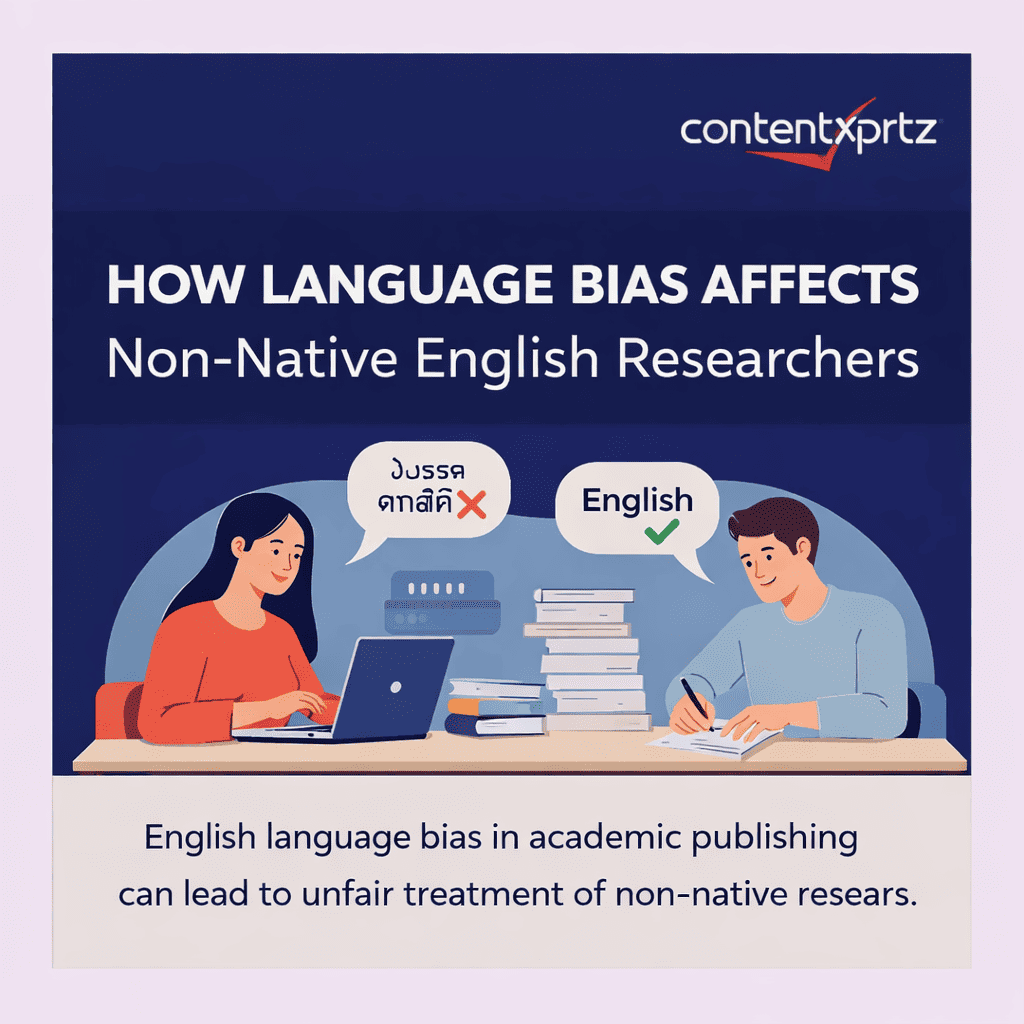

How Language Bias Affects Non-Native English Researchers in Global Academic Publishing
Introduction
For millions of scholars worldwide, academic success depends not only on the originality of ideas or the rigor of methods, but also on the language in which those ideas are expressed. How Language Bias Affects Non-Native English Researchers has become one of the most critical, yet underacknowledged, issues in modern academia. Today, English dominates scholarly communication across disciplines, from medicine and engineering to social sciences and humanities. While a shared language facilitates global knowledge exchange, it also introduces systemic disadvantages for researchers who do not write in English as their first language.
For PhD scholars and early-career researchers, the challenge is deeply personal. Years of data collection, analysis, and theoretical contribution may be overshadowed by reviewers comments about clarity, tone, or phrasing. As a result, high-quality research can face rejection not because of weak science, but due to linguistic barriers. This reality creates emotional strain, delays graduation timelines, increases financial pressure, and often discourages talented scholars from continuing in academia.
The global research landscape highlights the scale of this problem. According to data reported by Elsevier, more than 75 percent of indexed journals publish exclusively in English, despite the fact that the majority of researchers worldwide are non-native English speakers. Meanwhile, acceptance rates for high-impact journals often fall below 10 to 15 percent, leaving little margin for linguistic imperfection. For doctoral candidates facing publication requirements for graduation or funding renewal, this pressure is relentless.
In addition, publication costs continue to rise. Article processing charges, language editing fees, and resubmission expenses can collectively amount to thousands of dollars per paper. For researchers in emerging economies, these costs create unequal access to academic visibility. Language bias, therefore, is not merely a stylistic concern. It intersects with equity, access, and career progression.
Despite these challenges, non-native English researchers contribute substantially to global knowledge production. Their work drives innovation, informs policy, and advances science. The problem lies not in their ideas, but in systems that privilege linguistic fluency over intellectual merit. Understanding how language bias operates is the first step toward addressing it.
This article provides an in-depth, evidence-based analysis of how language bias affects non-native English researchers, its implications across the publication lifecycle, and practical strategies to overcome it. Drawing on insights from leading academic publishers, editorial standards, and real-world publishing practices, the discussion also highlights how ethical academic editing and professional PhD support can level the playing field.
Throughout this guide, we combine scholarly rigor with empathetic insight. Our aim is to help researchers navigate linguistic barriers confidently while preserving their academic voice and intellectual ownership.
The Dominance of English in Academic Publishing
English as the Default Language of Science
English became the dominant language of academic publishing during the twentieth century, driven by geopolitical shifts, globalization, and the expansion of international journals. Today, major indexing databases prioritize English-language content, reinforcing its central role in scholarly communication.
Publishers such as Springer, Elsevier, and Taylor and Francis primarily disseminate research in English, even when authors and audiences are global. While this model increases reach, it also creates implicit expectations around grammar, tone, and rhetorical style that favor native speakers.
Structural Inequality Embedded in Language Norms
Language bias often manifests subtly. Reviewers may comment on fluency, clarity, or phrasing even when the scientific contribution is strong. These critiques, while framed as technical, can disproportionately impact non-native English researchers.
Key structural issues include:
-
Editorial standards shaped by Anglo-American academic conventions.
-
Reviewer pools dominated by native English speakers.
-
Limited tolerance for linguistic variation, even when meaning is clear.
These factors collectively influence editorial decisions, shaping whose knowledge is validated and whose is marginalized.
Understanding Language Bias in Peer Review
What Language Bias Looks Like in Practice
Language bias does not always appear as explicit discrimination. Instead, it often emerges through:
-
Rejections citing poor language quality despite sound methodology.
-
Requests for extensive revisions focused on style rather than substance.
-
Delayed review cycles due to repeated language-related feedback.
Research discussed by American Psychological Association emphasizes that clarity is essential, but it should not overshadow conceptual rigor. Yet in practice, linguistic polish frequently becomes a proxy for perceived quality.
The Psychological Impact on Researchers
Repeated exposure to language-based criticism can erode confidence. PhD scholars may internalize the belief that they are less capable, even when their research meets international standards. This emotional toll contributes to higher dropout rates and reduced publication ambition among non-native English researchers.
Career Consequences of Language Bias
Publication Records and Academic Advancement
Publications determine funding, promotion, and tenure. When language bias limits acceptance rates, it directly affects career trajectories. Scholars from non-English-speaking backgrounds often need more time and resources to achieve the same output as native speakers.
Unequal Visibility and Citation Impact
Language quality influences discoverability and citation rates. Articles perceived as linguistically weak may be cited less frequently, regardless of their contribution. This further compounds inequality in academic recognition.
Ethical Dimensions of Academic Editing
Editing Versus Authorship
One common concern among researchers is whether language support compromises academic integrity. Ethical academic editing focuses on clarity, coherence, and structure without altering intellectual content.
Reputable guidelines from organizations such as Committee on Publication Ethics emphasize transparency and author ownership. Professional editing enhances readability while preserving scholarly voice.
The Role of Professional Academic Editing Services
High-quality academic editing bridges the gap between ideas and expression. It enables non-native English researchers to compete fairly without misrepresenting authorship.
Researchers seeking academic editing services or research paper writing support benefit from editors who understand disciplinary conventions and journal expectations.
Practical Strategies to Overcome Language Bias
Early Language Planning
Integrating language support early in the research process reduces revision cycles. Drafting with clarity in mind and seeking feedback before submission improves outcomes.
Targeted Journal Selection
Choosing journals that value international scholarship and offer language support recommendations can mitigate bias.
Professional PhD Support
Collaborating with experienced academic editors and consultants ensures that manuscripts meet linguistic and stylistic standards without compromising originality.
At ContentXprtz, researchers can access tailored PhD thesis help and academic editing services designed for global scholars.
Explore comprehensive support through:
FAQs Integrated Within the Discussion
Why do journals prioritize language quality so strongly?
Journals emphasize language quality because clarity ensures that research can be evaluated, replicated, and cited accurately. However, this emphasis can unintentionally disadvantage non-native English researchers. Editors aim to maintain readability for a global audience, yet the lack of structured language support within journals shifts the burden entirely onto authors. This imbalance highlights the importance of external academic editing support that aligns manuscripts with journal expectations while preserving scholarly intent.
Does language bias affect all disciplines equally?
Language bias affects all disciplines, but its impact varies. Fields with heavy theoretical exposition, such as social sciences and humanities, are particularly sensitive to linguistic nuance. In contrast, data-driven disciplines may tolerate minor language issues, though high-impact journals remain strict. Understanding disciplinary norms helps researchers anticipate and address potential bias effectively.
Can professional editing increase acceptance rates?
Evidence suggests that professionally edited manuscripts experience smoother peer review and fewer language-related revisions. Editing improves clarity, coherence, and alignment with journal style guides, allowing reviewers to focus on scientific merit. While editing does not guarantee acceptance, it significantly reduces avoidable rejections linked to language.
Is it ethical to use academic editing services?
Yes, when used ethically. Academic editing focuses on language, structure, and presentation, not content creation. Ethical editors follow international guidelines and respect author ownership. Transparency and adherence to journal policies ensure integrity throughout the process.
How early should PhD students seek language support?
Ideally, language support should begin during proposal development. Early intervention improves writing habits and reduces extensive revisions later. Continuous support across drafting stages fosters confidence and consistency in academic voice.
Are native English speakers completely free from bias?
Native speakers also face challenges, but they benefit from implicit familiarity with academic conventions. Non-native speakers must invest additional effort to meet the same standards. Recognizing this disparity is essential for fostering inclusive publishing practices.
Do journals acknowledge language bias?
Some journals acknowledge language barriers and recommend professional editing services. However, systemic solutions remain limited. Greater editorial awareness and reviewer training are needed to reduce unconscious bias.
How can supervisors support non-native English PhD scholars?
Supervisors play a critical role by recognizing language challenges, recommending support services, and focusing feedback on content rather than fluency alone. Encouragement and resource access can significantly improve outcomes.
Does language bias influence citation metrics?
Yes. Articles perceived as linguistically polished often receive more citations due to readability and perceived credibility. Addressing language quality therefore contributes to long-term academic impact.
What long-term strategies help overcome language bias?
Long-term strategies include consistent writing practice, engagement with academic communities, mentorship, and professional editing partnerships. Building linguistic confidence over time empowers researchers to navigate publishing systems effectively.
Conclusion
Understanding how language bias affects non-native English researchers is essential for creating a more equitable academic ecosystem. Language should serve as a bridge for knowledge exchange, not a barrier to scholarly recognition. While systemic change requires collective effort from publishers, editors, and institutions, individual researchers can take proactive steps to protect their work and careers.
Professional academic editing, informed journal selection, and early language planning enable scholars to present their ideas with clarity and confidence. At ContentXprtz, we have supported researchers across 110 plus countries since 2010, helping them overcome linguistic barriers ethically and effectively.
We invite you to explore our specialized PhD Assistance Services and publishing support solutions:
At ContentXprtz, we don’t just edit — we help your ideas reach their fullest potential.
