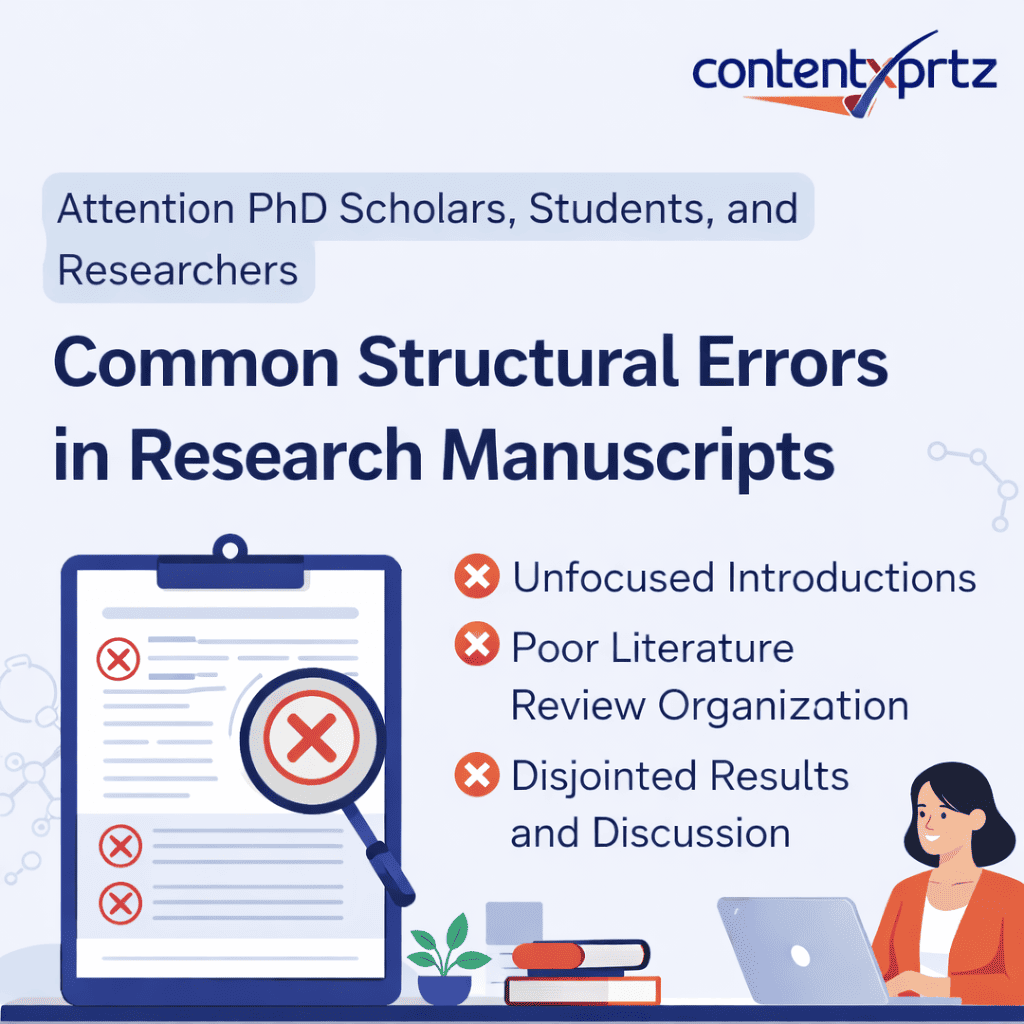

Common Structural Errors in Research Manuscripts: An Educational Guide for PhD Scholars and Academic Researchers
Introduction
For PhD scholars and academic researchers worldwide, writing a research manuscript is not merely a procedural task. It is an intellectual journey that reflects years of rigorous inquiry, methodological discipline, and scholarly ambition. Yet, despite the depth of research, many manuscripts face rejection not because the ideas lack merit, but because of common structural errors in research manuscripts that undermine clarity, coherence, and academic rigor.
Across disciplines and regions, doctoral researchers encounter shared challenges. Time pressure from teaching duties, grant expectations, and personal responsibilities often compress the writing phase. Publication stress continues to rise as top-tier journals tighten acceptance criteria and emphasize methodological transparency and narrative coherence. According to data published by major academic publishers, acceptance rates in high-impact journals frequently range between 5 percent and 15 percent, depending on discipline and journal scope. This reality means that even minor structural inconsistencies can significantly reduce publication success.
Additionally, the cost of repeated submissions, formatting revisions, and language editing has increased globally. Early-career researchers often navigate these pressures without formal training in academic writing structures. As a result, manuscripts may suffer from fragmented arguments, misaligned sections, or inconsistent logic. These issues signal to reviewers that the research, although promising, is not yet publication-ready.
Understanding and correcting common structural errors in research manuscripts is therefore not a peripheral skill. It is a core academic competency. Structural accuracy enables reviewers to engage with the research argument efficiently. It ensures that methods support claims, results answer research questions, and discussions contribute meaningfully to existing literature.
At ContentXprtz, our experience supporting researchers in more than 110 countries since 2010 has shown that structural weaknesses are among the most correctable barriers to publication. Through ethical academic editing, PhD support, and research paper assistance, scholars can transform rejected drafts into coherent, compelling manuscripts aligned with journal expectations.
This educational guide offers an evidence-based, practical exploration of the most frequent structural issues in research manuscripts. It is designed for PhD scholars, postdoctoral researchers, and academic professionals seeking clarity, confidence, and publication success.
Understanding Structure in Academic Research Writing
Why Structure Determines Manuscript Credibility
Academic writing is evaluated not only on originality but also on organization. Reviewers expect a predictable, discipline-aligned structure that guides them logically from problem identification to scholarly contribution. When structure fails, credibility weakens.
A well-structured manuscript achieves the following:
-
Aligns objectives, methods, results, and conclusions
-
Demonstrates methodological rigor
-
Enables reproducibility and peer verification
-
Enhances readability and citation potential
Poor structure, by contrast, obscures strong research and increases reviewer fatigue.
Standard Research Manuscript Architecture
Most peer-reviewed journals follow a structured format, often referred to as IMRaD:
-
Introduction
-
Methods
-
Results
-
Discussion
While variations exist, deviations without justification often lead to desk rejection. Understanding this architecture is foundational to avoiding common structural errors in research manuscripts.
Most Common Structural Errors in Research Manuscripts
Misaligned Introduction and Research Objectives
One frequent issue arises when introductions provide broad background information but fail to articulate precise research questions or hypotheses. Reviewers struggle to identify the manuscript’s purpose.
Best practice: Clearly state objectives in the final paragraph of the introduction and ensure they align with later sections.
Literature Review Without Critical Synthesis
Many manuscripts summarize prior studies without analytical integration. This creates descriptive rather than argumentative literature reviews.
Structural consequences include:
-
Weak theoretical positioning
-
Unclear research gaps
-
Redundant citations
Leading publishers such as Elsevier emphasize synthesis over summary in reviewer guidelines.
Methodology Sections Lacking Logical Flow
A structurally sound methods section should move logically from design to data analysis. Common issues include:
-
Missing justification for methods
-
Inconsistent variable definitions
-
Mixing results with methods
This structural confusion reduces reproducibility and reviewer confidence.
Results That Do Not Correspond to Research Questions
Another common structural error in research manuscripts occurs when results are presented without reference to stated objectives. Tables and figures may appear disconnected from hypotheses.
Corrective strategy: Map each result explicitly to a research question.
Discussion Sections That Repeat Results
The discussion should interpret findings, not restate them. Structural repetition signals weak analytical depth and reduces scholarly contribution.
Publishers like Springer stress theoretical integration and implications in discussion sections.
Weak or Redundant Conclusions
Conclusions often introduce new data or repeat abstracts. Structurally sound conclusions synthesize findings, limitations, and future research directions.
Structural Errors Across Manuscript Sections
Title and Abstract Inconsistencies
Titles may promise one focus, while abstracts describe another. This misalignment creates immediate reviewer skepticism.
Tip: Ensure consistent terminology across title, abstract, and keywords.
Poor Section Transitions
Lack of transitions disrupts narrative flow. Transition words guide readers and improve readability, a key requirement under Yoast SEO standards.
Inconsistent Terminology and Definitions
Structural coherence requires consistent use of key terms. Shifting terminology confuses readers and reviewers.
Ethical Dimensions of Structural Accuracy
Structural integrity is also an ethical issue. Misplaced data, unclear methods, or ambiguous conclusions may misrepresent findings. Organizations such as the American Psychological Association emphasize transparency and structure as ethical obligations.
Practical Strategies to Correct Structural Errors
Pre-Submission Structural Mapping
Create a section-by-section outline and verify alignment with journal guidelines.
Reverse Outlining Technique
Analyze completed drafts by summarizing each paragraph’s purpose. Identify redundancies and gaps.
Professional Academic Editing
Expert academic editing services provide structural diagnostics beyond language correction. ContentXprtz offers tailored academic editing services through its Writing and Publishing Services page.
Integrated FAQs on Common Structural Errors in Research Manuscripts
FAQ 1: Why do journals reject manuscripts with strong data but weak structure?
Strong data alone does not ensure publication. Journals assess whether research contributes meaningfully to scholarly discourse. Weak structure obscures arguments, making it difficult for reviewers to evaluate validity and relevance. Structural flaws also suggest limited familiarity with academic conventions. By improving structure through PhD thesis help or research paper writing support, authors enhance clarity and reviewer engagement.
FAQ 2: How can PhD scholars identify structural errors before submission?
Self-review techniques include reverse outlining, checklist-based reviews, and peer feedback. However, many structural errors remain unnoticed due to familiarity bias. Professional academic editing services provide objective assessment and alignment with journal expectations.
FAQ 3: Are structural errors discipline-specific?
Yes. While core structures remain consistent, disciplines differ in emphasis. For example, humanities manuscripts prioritize theoretical framing, while STEM papers emphasize methodological transparency. Consulting journal guidelines from publishers like Emerald Insight helps avoid discipline-specific structural errors.
FAQ 4: Can language editing alone fix structural problems?
No. Language editing improves grammar and style but does not address logical sequencing or section alignment. Structural editing requires subject-matter expertise and understanding of research design.
FAQ 5: How does structure influence citation impact?
Well-structured manuscripts are easier to read, understand, and cite. Clear arguments and logical flow increase discoverability and academic influence.
FAQ 6: What role does the abstract play in manuscript structure?
The abstract functions as a structural summary. Inconsistencies between abstract and main text often lead to desk rejection. Alignment ensures accurate representation of research.
FAQ 7: How can early-career researchers learn proper structure?
Formal training, mentoring, and exposure to high-quality published articles help. Additionally, platforms like ContentXprtz provide educational support through PhD and Academic Services.
FAQ 8: Are structural checklists recommended?
Yes. Many journals provide submission checklists. Using these systematically reduces common structural errors in research manuscripts.
FAQ 9: How do reviewers perceive structural errors?
Reviewers interpret structural errors as indicators of insufficient preparation. This perception affects overall manuscript evaluation, regardless of data quality.
FAQ 10: When should authors seek professional structural editing?
Authors should seek support when facing repeated rejections, targeting high-impact journals, or submitting doctoral work. ContentXprtz offers comprehensive assistance through its Student Writing Services, Book Authors Writing Services, and Corporate Writing Services.
Conclusion: Turning Structural Precision into Publication Success
Avoiding common structural errors in research manuscripts is not an optional refinement. It is a strategic necessity for academic success. Structural clarity enhances credibility, supports ethical scholarship, and increases acceptance probability in competitive journals.
PhD scholars and researchers who invest in structural excellence position their work for meaningful impact. Through expert academic editing, ethical guidance, and tailored research support, ContentXprtz has helped scholars worldwide achieve publication readiness since 2010.
If you are preparing a manuscript, revising a rejected paper, or seeking PhD thesis help, explore our professional academic support solutions today.
At ContentXprtz, we don’t just edit. We help your ideas reach their fullest potential.
