
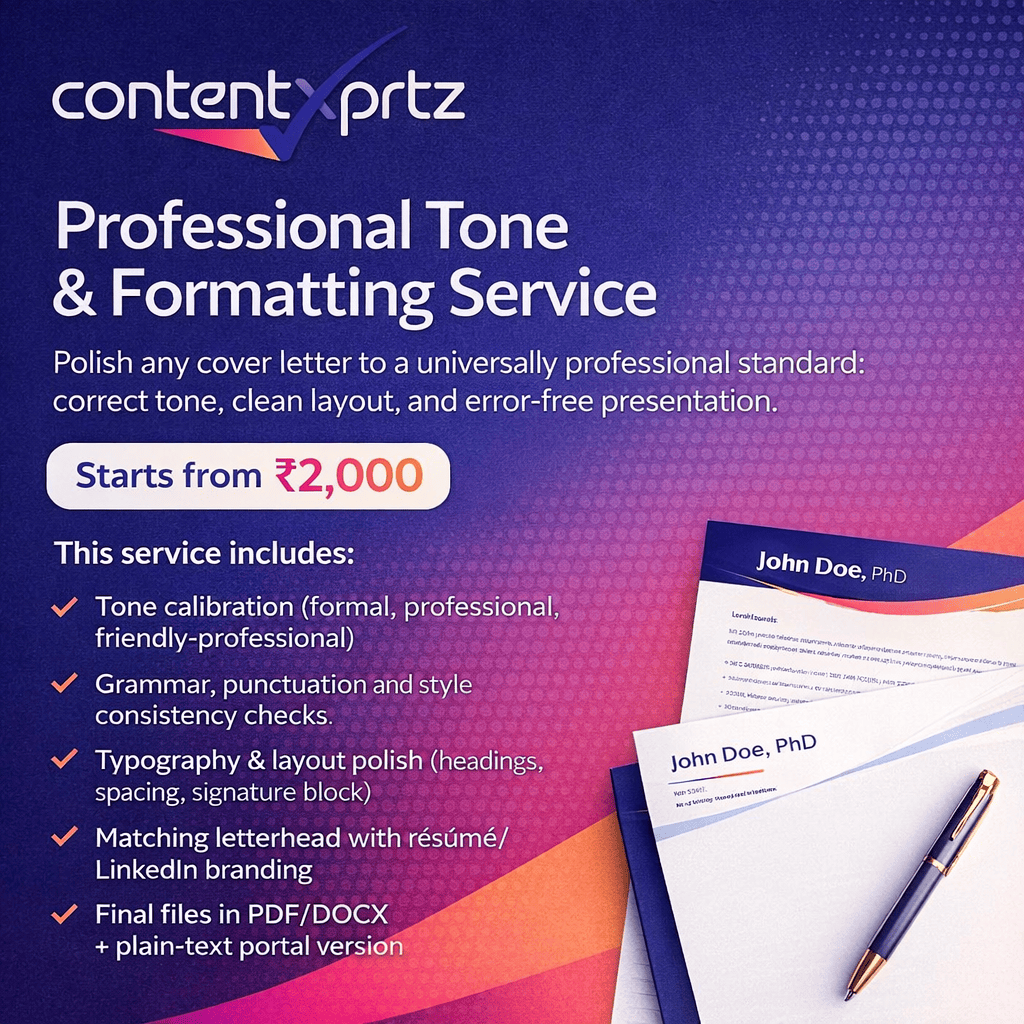
Professional Tone & Formatting—Make Every Cover Letter Count 📄🎓
Because presentation matters as much as content.
At ContentXprtz, our Professional Tone & Formatting Service helps you refine any cover letter to a universally professional standard—clear, polished, and ready to represent you with confidence in academic and professional settings.
What we focus on:
• Tone calibration (formal, professional, friendly-professional)
• Grammar, punctuation, and style consistency checks
• Clean typography and layout (headings, spacing, signature block)
• Letterhead alignment with your résumé and LinkedIn branding
• Final delivery in PDF, DOCX, and plain-text versions for portals
Ethical, transparent, and author-centric.
Your ideas remain yours—we only enhance clarity, structure, and professional presentation while preserving your authentic voice.
Starts from ₹2,000
Message us on WhatsApp to get started today
WhatsApp: https://wa.me/917065013200
Website: https://contentxprtz.com
#ContentXprtz #AcademicWritingSupport #PhDSupport #CoverLetterHelp #ResearchScholars #AcademicCareers #HigherEducation #PhDLife #PostdocLife #JournalSubmission #ResearchWriting #AcademicEditing #ScholarlyWriting #EthicalAcademicSupport #PublicationReady #GraduateStudents #DoctoralStudies #AcademicBranding #ResearchProfessionals #UniversityLife #ManuscriptSupport #PhDScholars #StudentSuccess
Professional Tone & Formatting Service for Academic Excellence in a Competitive Research World
Introduction: Why Professional Tone and Formatting Matter More Than Ever
For PhD scholars, postgraduate students, and academic researchers, writing is never just writing. It is identity, credibility, and intellectual survival combined into one demanding process. From the first proposal draft to the final journal submission, every sentence carries weight. This is precisely where a Professional Tone & Formatting Service becomes not a luxury, but a necessity.
Across the global academic ecosystem, scholars face unprecedented pressure. According to UNESCO data, global research output has more than doubled over the past two decades, intensifying competition for journal space and research funding. Elsevier reports that top-tier journals now reject over 80 percent of submitted manuscripts, often during desk review. One of the most common reasons is not weak ideas, but poor presentation, inconsistent tone, and failure to meet strict formatting requirements.
PhD candidates, in particular, juggle multiple responsibilities. Teaching assignments, grant applications, institutional deadlines, family obligations, and mental fatigue often leave limited time for refining language, formatting references, or aligning manuscripts with journal guidelines. Meanwhile, rising publication costs and processing fees add further stress, especially for early-career researchers and scholars from emerging economies.
In this environment, academic success increasingly depends on precision. Journals published by Elsevier, Springer, Emerald Insight, and Taylor and Francis expect manuscripts that demonstrate clarity, coherence, discipline-specific tone, and exact adherence to formatting standards. Even minor deviations can lead to rejection or costly revision cycles.
A Professional Tone & Formatting Service bridges this gap. It ensures that your research is not only intellectually rigorous but also presented in a way that resonates with reviewers, editors, and evaluators. At ContentXprtz, this service goes beyond surface-level editing. It is about aligning your scholarly voice with global academic expectations, without compromising originality or ethical standards.
This article offers an in-depth, evidence-based exploration of professional tone and formatting services, their role in PhD success, and how ContentXprtz supports scholars worldwide. Whether you are drafting a thesis, revising a journal article, or preparing a book manuscript, this guide is designed to inform, reassure, and empower you.
Understanding Professional Tone in Academic Writing
What Is Professional Academic Tone?
Professional academic tone refers to the consistent, discipline-appropriate voice that conveys authority, neutrality, and scholarly rigor. It avoids emotional language, informal expressions, and ambiguity. At the same time, it ensures clarity, logical flow, and reader engagement.
In peer-reviewed publishing, tone signals competence. Reviewers often interpret inconsistent tone as a lack of academic maturity. A professional tone demonstrates that the author understands disciplinary conventions, epistemological norms, and scholarly discourse.
Why Tone Impacts Publication Outcomes
Studies published by Springer indicate that manuscripts with clear argumentative tone and structured narrative receive faster peer-review decisions. Editors prefer papers that require minimal linguistic intervention, especially when handling hundreds of submissions per issue.
Professional tone also supports:
-
Logical argument development
-
Clear positioning within existing literature
-
Effective response to reviewer comments
-
Ethical representation of data and findings
A Professional Tone & Formatting Service ensures these elements are embedded throughout your manuscript, not added as an afterthought.
Formatting: The Silent Gatekeeper of Academic Publishing
Why Formatting Is Non-Negotiable
Formatting is often underestimated, yet it plays a decisive role in acceptance decisions. Journals specify exact requirements for margins, fonts, headings, citations, tables, figures, and reference styles. Deviations signal non-compliance and increase editorial workload.
Emerald Insight explicitly states that manuscripts not aligned with journal formatting guidelines may be rejected before peer review. Formatting is not cosmetic. It reflects scholarly discipline and respect for editorial standards.
Common Formatting Challenges Faced by Scholars
PhD scholars and researchers frequently encounter:
-
Inconsistent citation styles across chapters
-
Incorrect reference formatting in APA, MLA, Chicago, or Harvard styles
-
Poor alignment of tables and figures
-
Improper heading hierarchies
-
Journal-specific submission errors
A Professional Tone & Formatting Service addresses these systematically, ensuring compliance without altering intellectual content.
The Role of Professional Tone & Formatting Service in PhD Success
Supporting Thesis and Dissertation Excellence
Doctoral theses undergo rigorous evaluation by internal and external examiners. Even strong research can suffer if presentation lacks clarity. Examiners expect coherence, formal tone, and methodological transparency.
Professional support ensures:
-
Consistent academic voice across chapters
-
Accurate formatting aligned with university guidelines
-
Clear articulation of contributions and limitations
ContentXprtz provides specialized PhD thesis help through its PhD & Academic Services, supporting scholars from proposal to final submission.
Enhancing Journal Acceptance Probability
A polished manuscript reduces reviewer fatigue. When reviewers can focus on ideas rather than language errors, the evaluation becomes more favorable. Professional tone and formatting also streamline revision cycles, saving time and publication costs.
Ethical Academic Editing: A Core Principle at ContentXprtz
What Ethical Editing Means
Ethical editing preserves authorial voice and intellectual ownership. It does not fabricate data, manipulate findings, or rewrite arguments beyond clarity enhancement.
According to the Committee on Publication Ethics, editing should support clarity while maintaining author responsibility. ContentXprtz strictly follows these guidelines.
How ContentXprtz Ensures Integrity
Our Professional Tone & Formatting Service includes:
-
Language refinement without content alteration
-
Transparent editing processes
-
Confidential handling of manuscripts
-
Compliance with journal and institutional ethics
This ethical foundation builds trust among scholars and institutions worldwide.
ContentXprtz’s Approach to Professional Tone & Formatting
Expertise Built Since 2010
Established in 2010, ContentXprtz has supported researchers across more than 110 countries. Our editors are subject specialists with deep familiarity with global publishing standards.
Our services integrate seamlessly with:
Each engagement is tailored, confidential, and outcome-focused.
Practical Benefits of Using a Professional Tone & Formatting Service
Time Efficiency for Busy Scholars
Outsourcing technical refinement allows scholars to focus on research, teaching, and grant writing. It reduces burnout and accelerates academic progress.
Improved Reviewer Engagement
Clear tone and structured formatting enhance readability. Reviewers engage more deeply with arguments, improving feedback quality.
Long-Term Academic Credibility
Consistently polished work strengthens your academic profile. It supports career progression, funding success, and collaborative opportunities.
Integrated FAQs: Professional Tone & Formatting Explained
FAQ 1: Is using a Professional Tone & Formatting Service considered ethical in academia?
Using a Professional Tone & Formatting Service is widely accepted and ethical when conducted responsibly. Ethical academic editing focuses on language clarity, structural coherence, and formatting accuracy without altering research findings or intellectual contributions. Leading publishers such as Elsevier and Taylor and Francis explicitly allow language and formatting support, especially for non-native English speakers.
At ContentXprtz, ethical boundaries are clearly defined. Editors refine grammar, tone, and structure while preserving authorial voice. Data interpretation, hypothesis development, and conclusions remain untouched. This approach aligns with guidelines from the Committee on Publication Ethics and university research integrity policies.
Many institutions even recommend professional editing before submission. Ethical services enhance fairness by allowing scholars to compete based on ideas rather than linguistic background. Therefore, when transparency and integrity are maintained, professional tone and formatting support strengthens academic standards rather than undermining them.
FAQ 2: How does professional formatting improve journal acceptance rates?
Professional formatting ensures compliance with journal-specific submission guidelines. Editors often conduct initial screening to filter manuscripts that fail to meet formatting standards. Poor formatting increases rejection risk before peer review.
Studies cited by Springer indicate that well-formatted manuscripts progress faster through editorial stages. Formatting clarity reduces editorial workload and signals professionalism. This creates a positive first impression.
A Professional Tone & Formatting Service addresses citation styles, heading hierarchies, tables, figures, and reference consistency. As a result, reviewers focus on research quality rather than technical errors, indirectly improving acceptance probability.
FAQ 3: Can professional tone refinement change my academic voice?
A reputable Professional Tone & Formatting Service enhances clarity without replacing your scholarly voice. The goal is alignment, not substitution. Editors refine sentence structure, remove ambiguity, and ensure discipline-appropriate tone while preserving originality.
ContentXprtz employs subject-matter experts who understand disciplinary nuances. This ensures your argument remains authentic. Feedback loops allow authors to review changes, ensuring comfort and transparency.
Maintaining authorial identity is central to ethical academic editing. Professional services exist to amplify, not overwrite, your intellectual contribution.
FAQ 4: Is this service useful for non-native English researchers?
Yes, non-native English researchers benefit significantly. Language barriers often lead to misinterpretation of strong ideas. Professional tone refinement ensures clarity, coherence, and academic fluency.
Elsevier highlights language support as a key factor in improving global research inclusivity. Formatting support further reduces technical errors that disproportionately affect non-native scholars.
By using a Professional Tone & Formatting Service, researchers present ideas confidently and compete on equal footing within international journals.
FAQ 5: Does formatting support include reference management?
Yes, comprehensive formatting includes reference accuracy and consistency. Journals require strict adherence to citation styles such as APA, MLA, Chicago, or Harvard.
Professional services verify in-text citations, reference lists, and DOI accuracy. This reduces revision requests and prevents desk rejection.
ContentXprtz integrates reference management into its academic editing services, ensuring end-to-end compliance.
FAQ 6: Can this service help with thesis submission guidelines?
Universities impose detailed thesis formatting requirements. Deviations can delay graduation. Professional formatting ensures compliance with institutional templates, margin settings, font styles, and submission protocols.
PhD candidates often underestimate the time required for final formatting. Outsourcing this stage reduces stress and ensures timely submission.
ContentXprtz provides structured PhD thesis help tailored to university-specific requirements.
FAQ 7: How early should I use professional tone and formatting support?
Early engagement yields better outcomes. Applying professional tone standards during drafting improves coherence and reduces later revisions.
However, services remain effective at any stage. Whether during proposal writing, manuscript revision, or pre-submission checks, professional support adds value.
Strategic timing depends on workload, deadlines, and publication goals.
FAQ 8: Is professional formatting different for journals and books?
Yes, formatting standards vary significantly. Journals prioritize concise structure and strict templates. Books allow more narrative flexibility but require publisher-specific formatting.
Professional services adapt formatting accordingly. ContentXprtz supports both journal manuscripts and book projects through its specialized offerings.
Understanding these distinctions prevents costly revisions and publisher delays.
FAQ 9: How does this service support early-career researchers?
Early-career researchers face steep learning curves. Professional tone and formatting support accelerates skill development. It offers exposure to best practices and reviewer expectations.
This support builds confidence and reduces trial-and-error publishing. Over time, researchers internalize standards, improving independent writing skills.
ContentXprtz positions itself as a long-term academic partner rather than a one-time service provider.
FAQ 10: What makes ContentXprtz different from generic editing services?
ContentXprtz combines academic specialization, ethical integrity, and global experience. Generic services often focus on grammar alone. ContentXprtz integrates tone, structure, formatting, and publication strategy.
With regional teams and subject experts, the service adapts to disciplinary and cultural contexts. Established in 2010, ContentXprtz brings institutional knowledge and trust built over decades.
This holistic approach ensures scholarly success beyond surface-level editing.
Conclusion: Elevating Scholarship Through Precision and Care
In an increasingly competitive academic environment, excellence is defined not only by ideas but by presentation. A Professional Tone & Formatting Service transforms rigorous research into publication-ready scholarship. It reduces rejection risk, saves time, and enhances academic credibility.
ContentXprtz stands as a trusted global partner for scholars seeking ethical, expert, and reliable academic support. From thesis refinement to journal submission, our services empower researchers to communicate ideas with clarity and authority.
Explore our PhD Assistance Services today and experience the difference that precision makes.
At ContentXprtz, we don’t just edit – we help your ideas reach their fullest potential.
