
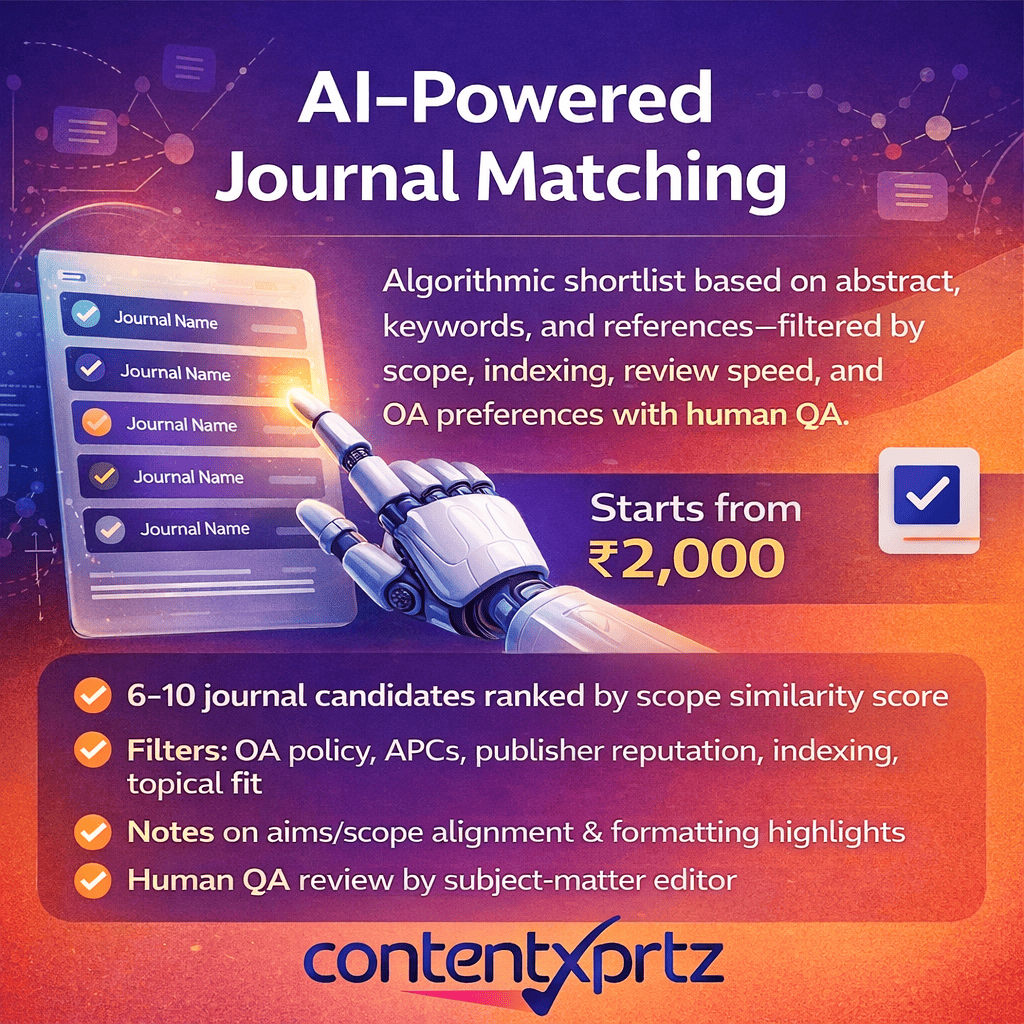
AI-Powered Journal Matching—Submit Smarter, Not Harder 🎓📄
Find the right journal for your research with confidence and clarity.
Choosing the right journal can save months. Our AI-powered journal matching service creates a precise, publication-ready shortlist—combining algorithmic analysis with expert human review to improve fit and reduce desk rejections.
What you get with ContentXprtz:
• 6–10 carefully ranked journal options based on scope similarity
• Filters for OA policy, APCs, indexing, publisher reputation & review speed
• Clear notes on aims/scope alignment and formatting expectations
• Final human QA review by a subject-matter editor
We follow ethical, transparent practices—your research remains fully original, and you retain complete author ownership at every stage.
Message us on WhatsApp to get started today 🧠📘
WhatsApp: https://wa.me/917065013200
Website: https://contentxprtz.com
#ContentXprtz #JournalMatching #AcademicPublishing #ResearchSupport #PhDSupport #ResearchScholars #PublishYourResearch #AcademicWriting #JournalSubmission #PhDLife #PostdocLife #ResearchPaper #ScholarlyPublishing #OpenAccessJournals #ScopusJournals #WebOfScience #HigherEducation #UniversityResearch #ThesisSupport #DissertationHelp #ResearchGuidance #EthicalPublishing #AuthorSupport #AcademicCareers #StudentResearchers
AI-Powered Journal Matching: A Strategic Breakthrough for Smarter, Faster, and Ethical Research Publishing
Introduction
For PhD scholars and academic researchers, publishing is not simply an outcome of research. It is a defining milestone that shapes careers, credibility, and academic mobility. Yet, despite years of rigorous investigation, data collection, and theoretical contribution, many manuscripts face repeated rejection. Often, the problem is not the quality of research but the mismatch between the manuscript and the target journal. This is where AI-Powered Journal Matching has emerged as a transformative solution for modern academic publishing.
Across disciplines, researchers face mounting pressures. Doctoral timelines have tightened globally. Funding cycles demand faster outputs. Publication costs have increased, while journal selectivity has intensified. According to data from Elsevier, leading journals now reject over 70 percent of submissions at the editorial screening stage alone. Springer Nature reports similar trends, with desk rejections frequently linked to scope mismatch rather than methodological flaws. As a result, researchers often lose months, sometimes years, navigating unsuitable journals.
At the same time, the academic publishing ecosystem has grown more complex. Thousands of journals publish across overlapping domains. Hybrid, open-access, and subscription-based models coexist. Impact metrics vary across Scopus, Web of Science, and discipline-specific indices. For early-career researchers and PhD scholars, identifying the right journal has become a research task in itself.
AI-Powered Journal Matching addresses this challenge by using data-driven intelligence to align manuscripts with journals that best match their scope, methodology, theoretical framing, and citation patterns. Rather than relying on guesswork or anecdotal advice, researchers can now use structured insights derived from large-scale publishing data.
At ContentXprtz, we work closely with scholars across more than 110 countries. Since 2010, we have observed a clear pattern. Manuscripts supported by strategic journal targeting not only face fewer rejections but also progress faster through peer review. AI-assisted journal matching, when combined with expert academic editing and ethical publication guidance, significantly improves publication outcomes.
This article explores how AI-powered journal matching works, why it matters, and how researchers can use it responsibly. More importantly, it explains how such tools must be integrated with human expertise to preserve academic integrity and disciplinary nuance. For PhD scholars navigating thesis publications or researchers preparing high-impact submissions, understanding this shift is no longer optional. It is essential.
Understanding AI-Powered Journal Matching in Academic Publishing
AI-powered journal matching refers to the use of machine learning and natural language processing to analyze a manuscript and recommend journals with a high probability of acceptance. Unlike traditional journal selection methods, AI systems evaluate multiple dimensions simultaneously.
These systems analyze manuscript abstracts, keywords, references, methodology descriptions, and thematic structure. They then compare this information against vast journal databases containing editorial aims, previously published articles, citation networks, and acceptance trends.
The result is a ranked list of journals aligned with the manuscript’s intellectual and methodological profile.
How AI Journal Matching Differs from Traditional Methods
Traditional journal selection often relies on manual browsing, mentor advice, or referencing previously cited journals. While valuable, these approaches are time-consuming and subjective. They also fail to account for evolving journal scopes and editorial priorities.
AI-powered journal matching offers structured insights based on real publishing data. It identifies journals that have published similar research recently, increasing the likelihood of editorial alignment.
However, AI does not replace scholarly judgment. Instead, it augments it. At ContentXprtz, we treat AI as a decision-support tool rather than a decision-maker.
Why Journal Mismatch Is One of the Biggest Causes of Rejection
Editorial desk rejection remains the most common outcome for academic submissions. According to data published by Taylor and Francis, more than half of rejected manuscripts are declined before peer review due to scope mismatch, formatting non-compliance, or weak alignment with journal objectives.
Journal mismatch occurs when a manuscript does not fit the journal’s audience, methodological preferences, or theoretical orientation. Even high-quality research fails under such conditions.
AI-powered journal matching reduces this risk by identifying journals where similar work has been accepted recently. This evidence-based targeting increases editorial confidence from the outset.
The Role of AI-Powered Journal Matching in PhD Publishing Strategy
For PhD scholars, publication strategy is inseparable from degree completion and career progression. Many universities now require indexed journal publications as part of thesis submission or graduation criteria.
AI-powered journal matching supports PhD scholars in several ways:
-
It reduces trial-and-error submissions
-
It shortens publication timelines
-
It aligns manuscripts with disciplinary expectations
-
It improves supervisor confidence in journal selection
When combined with professional PhD thesis help and academic editing services, journal matching becomes a strategic advantage rather than a technical step.
Integrating AI with Academic Editing and Research Paper Assistance
AI-powered journal matching performs best when integrated with expert-led academic workflows. A manuscript must meet disciplinary writing standards, ethical guidelines, and journal formatting requirements.
At ContentXprtz, AI-assisted journal selection is integrated with:
-
Advanced academic editing
-
Plagiarism and similarity assessment
-
Structural and argument coherence checks
-
Journal-specific formatting and referencing
This integrated approach ensures that the recommended journal aligns with both content quality and editorial expectations.
Researchers seeking research paper writing support benefit significantly when journal selection informs manuscript revision rather than occurring after writing is complete.
Ethical Considerations in AI-Powered Journal Matching
Ethical publishing remains central to academic credibility. AI-powered journal matching must be used responsibly to avoid predatory journals, unethical fast-track outlets, or misleading acceptance guarantees.
Reputable platforms rely on verified databases from publishers such as Elsevier, Springer Nature, Emerald Insight, and Wiley. They exclude journals flagged for unethical practices or questionable peer review standards.
At ContentXprtz, we apply additional human validation to every AI-generated journal list. Our editors assess journal reputation, indexing status, open-access policies, and publication ethics before recommendations are finalized.
Ethical academic publishing requires transparency, not automation-driven shortcuts.
How Leading Publishers Support Journal Matching Technologies
Major academic publishers have recognized the value of AI-assisted journal selection.
Elsevier offers journal finder tools that analyze abstracts and keywords. Springer Nature provides similar solutions through its journal recommender systems. These tools are designed to support authors while maintaining editorial independence.
However, publisher-specific tools remain limited to their own portfolios. Independent AI-powered journal matching platforms provide cross-publisher insights, which are particularly valuable for interdisciplinary research.
Practical Workflow for AI-Powered Journal Matching at ContentXprtz
Our journal matching workflow follows a structured, researcher-centric process:
-
Manuscript or abstract analysis using AI models
-
Cross-database journal comparison
-
Editorial scope and methodology validation
-
Ethical screening and indexing verification
-
Expert recommendation with acceptance probability insights
This process is embedded within our broader academic editing services and writing and publishing services framework. It ensures that journal matching supports, rather than dictates, scholarly decision-making.
Researchers can explore our integrated support through our
Writing and Publishing Services
and
PhD and Academic Services.
Frequently Asked Questions on AI-Powered Journal Matching
What exactly is AI-powered journal matching, and how reliable is it for academic publishing?
AI-powered journal matching is a data-driven method that uses artificial intelligence to analyze a research manuscript and recommend suitable journals. The reliability of such systems depends on the quality of the underlying data, the transparency of algorithms, and the integration of human expertise.
These systems analyze multiple elements, including keywords, abstract structure, citation patterns, and methodological framing. They then compare these elements with thousands of published articles across indexed journals. This comparison identifies journals that frequently publish similar research.
However, AI alone cannot assess theoretical novelty, argumentative depth, or disciplinary nuance. Therefore, reliability increases significantly when AI outputs are reviewed by subject-matter experts. At ContentXprtz, we treat AI-powered journal matching as an assistive tool, validated by experienced academic editors. This hybrid approach ensures accuracy, ethical compliance, and strategic alignment.
Can AI-powered journal matching improve acceptance rates for PhD scholars?
AI-powered journal matching can improve acceptance rates indirectly by reducing scope mismatch, which is a leading cause of desk rejection. When a manuscript aligns closely with a journal’s aims and recent publications, editors are more likely to send it for peer review.
For PhD scholars, this is particularly valuable because early rejections can delay degree completion. By targeting journals that actively publish similar work, scholars increase the probability of constructive peer feedback and eventual acceptance.
However, acceptance still depends on research quality, originality, and compliance with academic standards. Journal matching does not guarantee acceptance. It improves strategic alignment, which is a critical first step.
Is AI-powered journal matching suitable for interdisciplinary research?
Interdisciplinary research often struggles with journal selection because it falls between traditional disciplinary boundaries. AI-powered journal matching is especially useful in such cases because it analyzes citation networks and thematic overlaps rather than relying on rigid disciplinary labels.
By identifying journals that publish interdisciplinary work, AI tools help researchers avoid journals with narrow methodological preferences. However, interdisciplinary manuscripts still require careful framing and positioning.
At ContentXprtz, interdisciplinary submissions undergo additional editorial review to ensure that journal recommendations reflect both content and audience expectations.
How does AI-powered journal matching differ from publisher-provided journal finders?
Publisher-provided journal finders, such as those offered by Elsevier or Springer Nature, analyze manuscripts only within their own journal portfolios. While useful, they limit visibility across the broader publishing landscape.
Independent AI-powered journal matching systems analyze journals across multiple publishers and indexing platforms. This cross-publisher perspective provides a more comprehensive view, particularly for researchers seeking the best fit rather than a specific publisher.
ContentXprtz combines independent AI tools with expert validation to deliver unbiased, cross-disciplinary recommendations.
Are there risks associated with AI-powered journal matching?
The primary risks involve over-reliance on automation and exposure to unethical journals. Some platforms may prioritize speed over quality or include journals with questionable peer review practices.
To mitigate these risks, researchers should verify indexing status, publisher reputation, and editorial transparency. At ContentXprtz, every AI-generated recommendation undergoes ethical screening and human review.
Responsible use of AI enhances publishing outcomes. Unchecked automation undermines academic integrity.
How does journal matching integrate with academic editing services?
Journal matching informs academic editing by aligning manuscript revisions with journal-specific expectations. When editors know the target journal, they can tailor structure, referencing style, and argumentation accordingly.
This integration improves coherence and reduces revision cycles. Researchers using combined academic editing services and journal matching experience faster review outcomes and clearer peer feedback.
Can AI-powered journal matching help avoid predatory journals?
Yes, when implemented responsibly. Ethical AI-powered journal matching excludes journals flagged by indexing bodies or academic watchdogs. However, not all tools apply such filters.
At ContentXprtz, ethical screening is mandatory. We cross-check journals against recognized databases and publisher guidelines before making recommendations.
Is AI-powered journal matching useful for book chapters and edited volumes?
AI-powered journal matching is most effective for journal articles. However, similar AI-driven analytics can support book proposal targeting and edited volume selection.
Researchers exploring book publications can benefit from our
Book Authors Writing Services, which combine market analysis with editorial guidance.
How early in the writing process should journal matching be done?
Ideally, journal matching should occur during manuscript planning or early drafting. Early targeting informs writing style, structure, and methodological emphasis.
Late-stage journal selection often requires extensive revisions. Early integration saves time and improves alignment.
Does AI-powered journal matching replace supervisor guidance?
No. Supervisor expertise remains invaluable. AI-powered journal matching complements supervisor advice by providing data-driven insights that support informed decision-making.
At ContentXprtz, we encourage scholars to share journal recommendations with supervisors as part of a collaborative publication strategy.
How can researchers get started with AI-powered journal matching at ContentXprtz?
Researchers can begin by submitting an abstract or draft manuscript for analysis. Our team integrates AI-powered journal matching with expert review, academic editing, and publication planning.
Explore our full range of support through our
Student Writing Services
and
Corporate Writing Services.
Conclusion: Publishing Smarter with AI and Human Expertise
AI-powered journal matching represents a significant advancement in academic publishing strategy. By reducing guesswork, minimizing rejections, and aligning manuscripts with the right journals, it empowers researchers to publish more efficiently and ethically.
However, AI alone is not sufficient. Publishing success requires disciplinary insight, editorial expertise, and ethical oversight. At ContentXprtz, we combine advanced AI tools with experienced academic professionals to deliver reliable, transparent, and researcher-centric support.
If you are navigating journal selection, revising a manuscript, or planning your next publication, explore our PhD assistance and academic publishing services today.
At ContentXprtz, we don’t just edit. We help your ideas reach their fullest potential.
