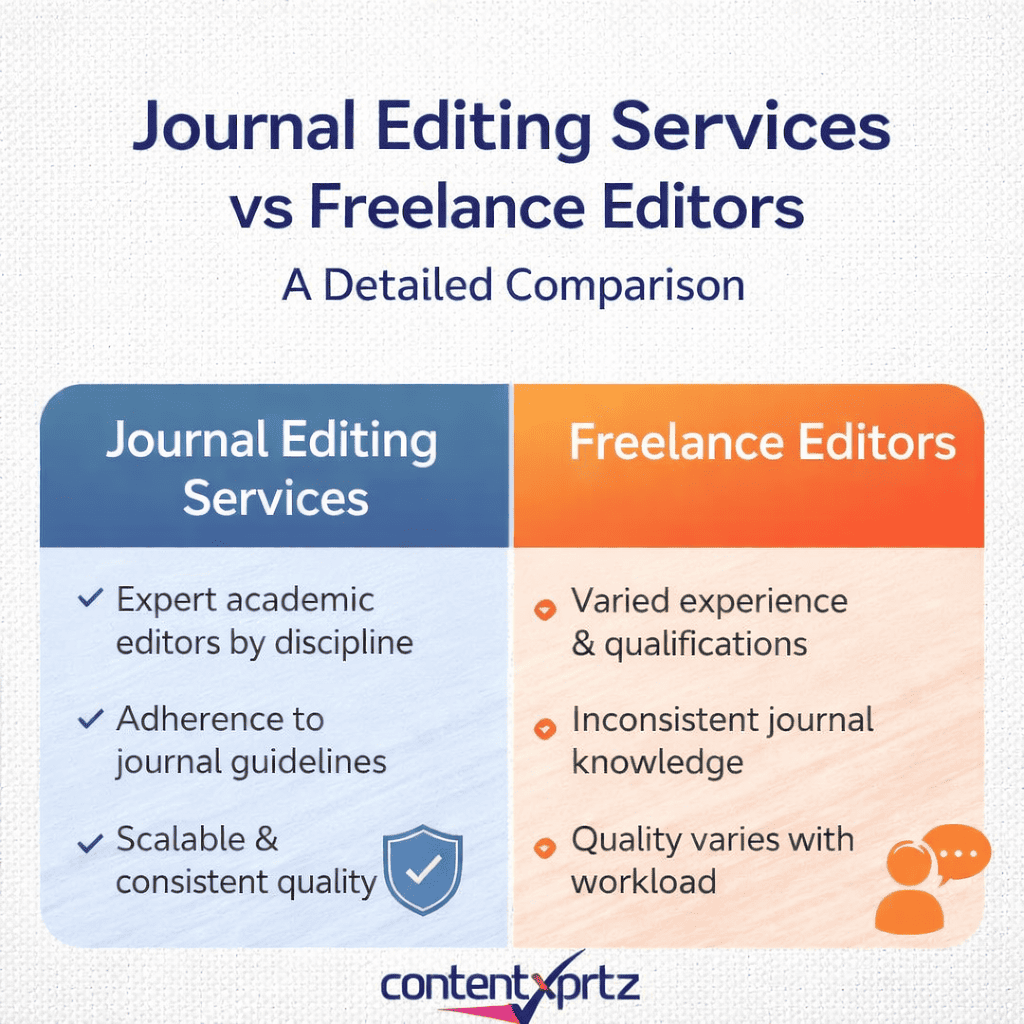

Journal Editing Services vs Freelance Editors: A Detailed Comparison for Serious Researchers
Introduction: Why This Choice Matters More Than Ever
For PhD scholars, early-career researchers, and seasoned academics alike, publishing is no longer just an academic milestone. It is a professional necessity. Promotion decisions, funding outcomes, institutional rankings, and international mobility increasingly depend on where and how often you publish. Against this backdrop, the decision between Journal Editing Services vs Freelance Editors: A Detailed Comparison becomes more than a cost or convenience issue. It becomes a strategic academic decision.
Most PhD students begin their research journey with strong subject knowledge but limited exposure to international journal expectations. Writing a thesis chapter or a conference paper is one thing. Preparing a manuscript that survives editorial screening, peer review, and revision cycles in high-impact journals is quite another. This gap explains why professional academic editing has shifted from a luxury to a near necessity.
Globally, rejection rates at reputable journals remain high. According to publishing insights shared by Elsevier, many journals reject over 70 percent of submissions at the desk review stage alone, often due to clarity, structure, language quality, and failure to meet journal scope. Similar trends are reported by Springer and Taylor & Francis, particularly for submissions from non-native English-speaking researchers.
At the same time, doctoral candidates face mounting pressures. Time constraints intensify as teaching, grant writing, and administrative duties increase. Mental health concerns among PhD students are widely documented. Financial limitations force difficult trade-offs between editing quality and affordability. In this environment, many researchers turn to freelance editors, assuming flexibility and lower cost. Others choose structured journal editing services, seeking reliability and accountability.
However, these two options are not interchangeable. They differ significantly in expertise, ethical safeguards, scalability, and long-term academic impact. This article offers a comprehensive, evidence-based comparison to help you make an informed choice aligned with your publication goals.
Throughout this guide, we draw on international publishing standards, editorial ethics, and real-world academic practice. We also reflect the experience of ContentXprtz, a global academic support provider established in 2010, supporting researchers across more than 110 countries.
Understanding Journal Editing Services
What Are Journal Editing Services?
Journal editing services are structured, institutionally aligned solutions designed specifically to prepare manuscripts for submission to peer-reviewed journals. Unlike general language editing, these services integrate linguistic refinement with journal compliance, academic style, and ethical integrity.
Professional journal editing typically includes:
-
Language and grammar correction aligned with academic conventions
-
Structural coherence across sections such as abstract, introduction, methods, and discussion
-
Consistency in terminology, tense, and scholarly tone
-
Alignment with journal-specific author guidelines
-
Reference and citation style checks, often based on APA or discipline-specific manuals
-
Editorial comments highlighting clarity gaps or reviewer risk areas
At ContentXprtz, these services are delivered by subject-aligned editors, many of whom hold doctoral degrees or have extensive experience reviewing for international journals. You can explore the full scope under our academic editing services and research paper writing support offerings through our Writing and Publishing Services.
How Journal Editing Services Operate
Journal editing services function within a quality-controlled workflow. Manuscripts typically pass through multiple editorial checkpoints, including senior review and quality assurance. This layered approach reduces errors, improves consistency, and ensures accountability.
Key characteristics include:
-
Editor assignment based on subject specialization
-
Transparent revision policies
-
Confidentiality and data protection protocols
-
Ethical compliance with journal and institutional standards
This structure is particularly valuable for PhD candidates submitting to indexed journals for the first time.
Understanding Freelance Editors
Who Are Freelance Editors?
Freelance editors are independent professionals offering editing services on a contract basis. Their backgrounds vary widely. Some are former academics or professional editors. Others are language specialists with limited exposure to scholarly publishing norms.
Freelancers typically offer:
-
Language editing or proofreading
-
Flexible pricing models
-
Direct communication with the editor
While this flexibility appeals to budget-conscious students, outcomes depend heavily on individual expertise.
The Variability Challenge
The freelance editing market lacks standardization. There is no universal accreditation, quality benchmark, or ethical oversight mechanism. As a result, experiences can vary dramatically.
Common risks include:
-
Inconsistent academic tone
-
Limited understanding of journal expectations
-
Absence of subject-matter familiarity
-
No recourse if quality is inadequate
For high-stakes submissions, these risks can outweigh initial cost savings.
Journal Editing Services vs Freelance Editors: Core Differences Explained
Expertise and Subject Alignment
Journal editing services invest heavily in editor specialization. Manuscripts in medicine, engineering, management, or social sciences are handled by editors with domain knowledge. This ensures accurate terminology and contextual clarity.
Freelance editors may lack this alignment. Even skilled language editors can inadvertently alter meaning when unfamiliar with discipline-specific conventions.
Ethical Safeguards and Publication Integrity
Reputable journal editing services follow strict ethical guidelines. They do not add content, fabricate data, or manipulate authorship. These principles align with standards promoted by Emerald Insight and international editorial bodies.
Freelancers may not always adhere to such safeguards, often due to lack of formal training in publication ethics.
Scalability and Consistency
Journal editing services scale efficiently. Whether you submit one paper or multiple manuscripts across a doctoral program, quality remains consistent.
Freelancers, by contrast, may face workload limitations, leading to delays or uneven quality over time.
Cost Considerations: Short-Term Savings vs Long-Term Value
Cost is often the deciding factor for PhD students. Freelance editors typically charge lower upfront fees. However, hidden costs can emerge through repeated revisions, rejections, or resubmissions.
Journal editing services may appear more expensive initially. Yet they often reduce overall publication timelines and rejection risk, resulting in better long-term value.
For structured doctoral support, explore our PhD and Academic Services designed to align with multi-year research journeys.
When Freelance Editors May Be Appropriate
Freelance editors can be suitable in limited scenarios:
-
Early-stage drafts not intended for immediate submission
-
Internal university assessments
-
Budget-constrained projects with low publication risk
Even in these cases, due diligence is essential.
When Journal Editing Services Are the Better Choice
Journal editing services are strongly recommended when:
-
Targeting indexed or high-impact journals
-
Responding to critical reviewer comments
-
Submitting doctoral milestone papers
-
Publishing interdisciplinary research
For students seeking comprehensive academic support, our Student Writing Services offer guided, ethical assistance.
Integrated FAQs: Real Questions from Real Researchers
FAQ 1: Are journal editing services acceptable to international journals?
Yes. Reputable journals explicitly encourage authors to use professional editing services, provided the intellectual content remains the author’s own. Publishers such as Elsevier and Springer clearly state that language editing does not constitute misconduct.
FAQ 2: Can a freelance editor guarantee journal acceptance?
No editor, freelance or institutional, can ethically guarantee acceptance. Acceptance depends on novelty, methodology, and peer review. Claims of guaranteed publication should be treated with caution.
FAQ 3: How do journal editing services handle confidentiality?
Professional services operate under strict confidentiality agreements and secure data protocols. This is critical for unpublished research and sensitive data.
FAQ 4: Is using editing services considered academic dishonesty?
No. Editing for language and clarity is widely accepted. Ethical boundaries are crossed only when editors contribute original ideas or data.
FAQ 5: How early in the PhD process should I seek editing help?
Early engagement is beneficial. Editing support during proposal development and draft stages improves clarity and reduces revision cycles later.
FAQ 6: Do journal editing services help with reviewer responses?
Many services, including ContentXprtz, provide structured guidance on responding to reviewer comments, improving resubmission success.
FAQ 7: Are freelance editors suitable for ESL researchers?
They can be, but only if the editor has proven experience with academic ESL editing. Institutional services offer more consistent ESL support.
FAQ 8: How do I verify an editor’s academic expertise?
For services, review editor credentials and subject matching policies. For freelancers, request samples from similar disciplines.
FAQ 9: What role does editing play in desk rejection?
Language clarity and structural coherence significantly influence editorial screening decisions. Poorly edited papers face higher desk rejection risk.
FAQ 10: Is journal editing worth the investment?
For researchers aiming at long-term academic careers, professional editing is an investment in credibility, efficiency, and confidence.
Choosing the Right Partner for Your Research Journey
Selecting between journal editing services and freelance editors requires honest assessment of your goals, timelines, and risk tolerance. While freelancers offer flexibility, journal editing services provide reliability, ethical assurance, and strategic alignment with publication standards.
ContentXprtz supports not only journal authors but also scholars working on monographs and professional manuscripts. Learn more about our Book Authors Writing Services and Corporate Writing Services for specialized needs.
Conclusion: Making a Strategic Academic Choice
The comparison between Journal Editing Services vs Freelance Editors: A Detailed Comparison reveals a fundamental truth. Academic publishing is not merely about correcting grammar. It is about presenting ideas with clarity, credibility, and confidence in a highly competitive global environment.
Journal editing services offer structured expertise, ethical safeguards, and consistency that freelance arrangements often cannot match. For PhD scholars and researchers serious about publication success, this distinction matters.
If you are preparing a manuscript, thesis, or resubmission, we invite you to explore our PhD Assistance Services and speak with an academic consultant today.
At ContentXprtz, we don’t just edit – we help your ideas reach their fullest potential.
