Journal of Hospitality and Tourism Insights: Scopus, Scope & Submission Guide
Journal of Hospitality and Tourism Insights (JHTI) is an Emerald Publishing journal for contemporary research across hospitality and tourism. Researchers commonly evaluate it for three reasons: its broad disciplinary scope, its visibility in Scopus and Clarivate’s Emerging Sources Citation Index, and its combination of academic and practice-oriented hospitality and tourism research. The supplied Scopus Source ID is 21101045767; Emerald lists print ISSN 2514-9792 and online ISSN 2514-9806.
For authors, the most important decision is not whether the journal has strong metrics, but whether a manuscript genuinely matches its editorial scope and submission requirements. JHTI welcomes theoretical, empirical and applied work, including qualitative, quantitative and mixed-method studies, but the author instructions also set specific expectations for article length, structured abstracts, keywords, references, anonymisation and submission through ScholarOne.
Quick Answer: What Is Journal of Hospitality and Tourism Insights?
Journal of Hospitality and Tourism Insights is a peer-reviewed academic journal published by Emerald Publishing. Its editorial policy focuses on current and cutting-edge research in hospitality and tourism worldwide, and it welcomes multiple disciplines, perspectives and research methods. The journal considers theoretical, empirical, applied, case-based and methodological contributions relevant to hospitality and tourism.
Emerald’s official journal page lists JHTI in Scopus and the Emerging Sources Citation Index (ESCI). It currently displays a 2025 CiteScore of 11.2, a 2026 CiteScore Tracker of 11.7, and a 2025 Journal Impact Factor of 4.8. Metrics can change as databases refresh, so authors using ranking thresholds for PhD, promotion or institutional requirements should verify the latest database record before submitting.
JHTI may be a good candidate for research that makes a clear contribution to hospitality or tourism theory, management, policy or practice. A strong manuscript should still be compared with recent JHTI articles to confirm topical and methodological fit.
Key Takeaways
- Publisher: Emerald Publishing.
- Scopus: indexed; supplied Scopus Source ID 21101045767.
- Identifiers: ISSN 2514-9792; eISSN 2514-9806.
- 2025 CiteScore: 11.2; 2026 CiteScore Tracker: 11.7 on Emerald’s current journal page.
- 2025 Impact Factor: 4.8 as currently displayed by Emerald.
- Peer review: double-anonymous, with at least two independent referees for manuscripts that pass editorial screening.
- Article length: 6,000–9,000 words, including references, tables, figures and appendices, with 280 words allowed for each figure or table.
- Submission: directly by the corresponding author through the journal’s ScholarOne system.
Journal Information at a Glance
| Field | Verified journal information |
|---|---|
| Journal name | Journal of Hospitality and Tourism Insights (JHTI) |
| Source type | Journal |
| Publisher | Emerald Publishing |
| ISSN / eISSN | 2514-9792 / 2514-9806 |
| Scopus Source ID | 21101045767 (supplied source record) |
| Primary field | Hospitality and tourism; multidisciplinary management and social-science perspectives |
| Scopus status | Indexed, according to Emerald’s official indexing list |
| Clarivate status | Emerging Sources Citation Index (ESCI), according to Emerald |
| Peer review | Double-anonymous |
| Article length | 6,000–9,000 words including references, tables, figures and appendices |
| Open access | Hybrid: subscription publication plus optional gold OA; green OA also available |
| Submission system | ScholarOne, linked from Emerald’s official journal page |
Methodology and Sources Used for This Journal Guide
This profile prioritises current, authoritative sources: the official Emerald JHTI page, its author guidelines, indexing and metrics section, editorial-team information, peer-review guidance, Emerald’s open-access and APC information, the publisher’s publishing-ethics policies, and the supplied Scopus source record.
Journal metrics, editorial roles, fees and policies are time-sensitive. Values in this article are dated where possible and should be reconfirmed if an institution requires a specific quartile, indexing status or metric at the date of submission.
Journal Aims and Scope: What Research Does JHTI Cover?
JHTI’s official scope is deliberately broad within hospitality and tourism. Emerald states that the journal seeks current and cutting-edge research worldwide and welcomes different disciplines, perspectives and methods. This means the central test is whether the research question contributes meaningfully to hospitality or tourism knowledge, management, policy, behaviour or practice.
Areas explicitly identified by the journal include planning; accounting and finance; information systems and technology; marketing; consumer behaviour; human resources; economics; international business; operations; strategic management; innovation and entrepreneurship; sustainability and green issues; socio-cultural aspects; corporate social responsibility; stakeholder engagement; planning and development; and ethics in hospitality and tourism.
The journal accepts theoretical, empirical and applied manuscripts. It also welcomes theoretical arguments, empirical findings, case studies and methodological developments, and it explicitly allows qualitative, quantitative and mixed methods. This breadth does not remove the need for a precise problem statement and a clear hospitality or tourism contribution.
What may be less suitable?
As a practical interpretation of the published scope, a manuscript may be weakly aligned if hospitality or tourism is merely a background setting and the paper’s main theoretical or practical contribution belongs elsewhere. Likewise, a generic business, technology or sustainability paper should demonstrate why its findings matter specifically to hospitality or tourism scholarship or practice.
Who Should Consider Submitting?
JHTI may suit academics, PhD scholars, early-career researchers and practitioners whose work directly addresses hospitality or tourism. Emerald particularly welcomes contributions from practitioners, professionals and academics working in private, public and non-profit organisations globally.
For PhD researchers, indexing or ranking alone should not determine journal choice. Check whether your university recognises the journal and database at the relevant date, whether your paper fits the journal’s scope, and whether recent JHTI articles use theories, samples, contexts or methods comparable to yours.
Understanding JHTI Scopus Indexing and Journal Metrics
| Measure | Value / status | Qualification |
|---|---|---|
| Scopus | Indexed | Listed on Emerald’s official journal page; Source ID 21101045767 supplied |
| Emerging Sources Citation Index | Indexed | Listed by Emerald under abstracting and indexing |
| CiteScore | 11.2 | 2025 CiteScore displayed by Emerald |
| CiteScore Tracker | 11.7 | 2026 tracker, updated monthly |
| Journal Impact Factor | 4.8 | 2025 value currently displayed by Emerald |
| 5-year Impact Factor | 4.8 | 2025 value currently displayed by Emerald |
| SJR | Verify current value | A current value was not independently verified from an accessible official Scopus/SCImago record for this article |
| SNIP | Verify current value | Reconfirm in the current Scopus source profile |
| Quartile | Verify current category/year | Quartiles are database-, category- and year-specific; use the current institutional requirement and database record |
The journal is clearly visible in major citation databases, but authors should avoid treating a metric as a permanent label. For promotion, graduation or funding rules that specify “Q1/Q2” or a particular database year, capture the official record that applies on the required date.
Editorial Leadership and Peer Review
Emerald currently lists Professor Fevzi Okumus as Editor-in-Chief and Professor Osman M Karatepe as Co-Editor, supported by associate, assistant and regional editors and an international editorial advisory board. Because editorial appointments can change, authors should verify the current team on the official journal page before addressing correspondence.
JHTI uses double-anonymous peer review. The editor first screens submissions for scope and manuscript quality. If a paper appears suitable, it is sent to at least two independent referees. Following review, the editor may accept, request minor or major revisions, or decline the manuscript.
Operationally, Emerald currently reports an average 18 days to first decision for submissions between 1 April 2024 and 31 March 2025. The author guidelines separately state a goal of informing authors of a first decision within 60 days. These figures describe journal operations and should not be interpreted as guaranteed turnaround times for an individual paper.
What Does JHTI Publish?
During submission, authors select a paper type and category. The official guidelines list Research Paper and Practitioner Paper as paper-type options and describe categories including research paper, viewpoint, technical paper, conceptual paper, case study, literature review and general review.
The journal’s recent output demonstrates the breadth implied by its scope, including research on sustainability and green behaviour, digital and AI-enabled tourism systems, consumer experiences, destination governance, hospitality employees and tourism planning. Recent publication patterns are useful evidence of editorial fit, but they do not replace the official aims and scope.
Is This Journal a Good Match for Your Research?
| Fit question | Strong alignment looks like | Warning sign |
|---|---|---|
| Hospitality/tourism relevance | The core research problem advances hospitality or tourism knowledge or practice | The setting is a hotel/destination, but the contribution is generic and unrelated to the field |
| Research problem | Precise, clearly stated and consequential | Broad descriptive topic without a defined gap or question |
| Literature | Critical review using seminal and recent studies | Reference list is outdated, fragmented or mainly descriptive |
| Methods | Appropriate method is justified and transparently reported | Method choice is weakly justified or cannot support the conclusions |
| Contribution | Conclusions explain implications for theory and practice | Findings repeat known relationships without a clear contribution |
Preparing a Manuscript for JHTI
According to the official author instructions, manuscripts should be prepared in Microsoft Word; a PDF may accompany the Word file, but a PDF alone is not acceptable. LaTeX can be used when an accompanying PDF is supplied.
Length, abstract and keywords
- Target 6,000–9,000 words, counting the structured abstract, references, all text in tables and figures, and appendices.
- Allow 280 words for each figure or table when calculating length.
- Use a structured abstract of no more than 250 words, including keywords and article classification.
- Always include Purpose, Design/methodology/approach, Findings and Originality; optional headings include Research limitations/implications, Practical implications and Social implications.
- Provide up to 12 short keywords.
Tables, figures and supplementary material
Figures should be high quality, numbered consecutively and captioned. Tables are submitted separately from the main article and numbered using Roman numerals. Supplementary material should be supplied before acceptance and identified clearly.
References
JHTI requires a recognised Harvard referencing style. Emerald provides its own Harvard style and asks authors to check reference completeness, accuracy and consistency, including DOI information where available.
Submission Process: How to Submit to JHTI
The corresponding author submits through the journal’s ScholarOne submission system, reached from the official Emerald journal page. Emerald explicitly states that the journal does not accept submissions by email and that authors should not use a third-party agent or proxy to submit on their behalf.
- Re-read the aims and scope and compare your manuscript with recent JHTI papers.
- Prepare the anonymised manuscript and separate author information, biographies or acknowledgements as required.
- Check article length, structured abstract, keywords, figures, tables, references and permissions.
- Confirm authorship order and ensure each contributing author has the required ScholarOne details.
- Submit through ScholarOne and retain the manuscript number in all correspondence.
- Respond to editorial and reviewer requests through the official system.
Open Access, APCs and Publication Fees
JHTI is a hybrid journal. Authors can publish through the journal’s standard subscription route or choose gold open access after acceptance. Emerald states that there is no submission fee; a charge applies only if the author elects gold OA, subject to any applicable agreement, voucher or policy.
Emerald’s current 2026 hybrid-journal APC is £3,222 / US$4,351 / €3,710, plus VAT where applicable. Under the current publisher policy, green open access is available without a publisher embargo, allowing the author accepted manuscript to be made openly available. Authors should verify the current APC and eligibility for institutional agreements before making a funding decision.
Publication Ethics and Responsible AI Use
Emerald states that it follows COPE principles and requires original work, appropriate authorship, conflict-of-interest disclosure, permissions for third-party material, and relevant ethical approval or informed consent. The journal may use Crossref Similarity Check as part of originality screening.
Authors should pay particular attention to Emerald’s current generative-AI policy. The publisher permits AI-assisted copy-editing of an author’s existing original work under its stated conditions, but it does not permit generative AI to copywrite new parts of a submission such as the abstract, introduction, literature review or conclusion. AI use must be handled transparently and authors remain responsible for accuracy, citations, integrity, privacy and confidentiality.
Common Reasons a Manuscript May Be Unsuitable
Emerald notes that an editor may decline or return a paper before peer review if it does not fit the journal’s aims and scope or if language/manuscript quality is too low. More broadly, authors can reduce avoidable mismatch by checking for:
- weak hospitality or tourism relevance;
- unclear research problem or contribution;
- insufficiently critical or outdated literature;
- methodology that is not justified or does not support the claims;
- poor presentation of results and implications;
- failure to meet the 6,000–9,000-word requirement or structured-abstract rules;
- identifying information left in a manuscript intended for double-anonymous review;
- incomplete references, permissions, declarations or ethics information.
Publication-Readiness Checklist
| Check | Before submission |
|---|---|
| Scope fit | Research problem and contribution clearly belong in hospitality or tourism |
| Length | 6,000–9,000 words including all counted elements |
| Abstract | Structured headings used; total within 250 words including keywords/classification |
| Keywords | Up to 12 short, relevant terms |
| Anonymisation | No author-identifying information remains in the review manuscript |
| References | Recognised Harvard style; citations complete and consistent |
| Ethics | Originality, conflicts, funding, permissions, consent/approval and AI-use disclosures addressed |
| Files | Word manuscript plus correctly prepared figures, tables and supplementary files |
| Submission | Corresponding author submits directly through ScholarOne |
How Contentxprtz Can Support Publication Readiness
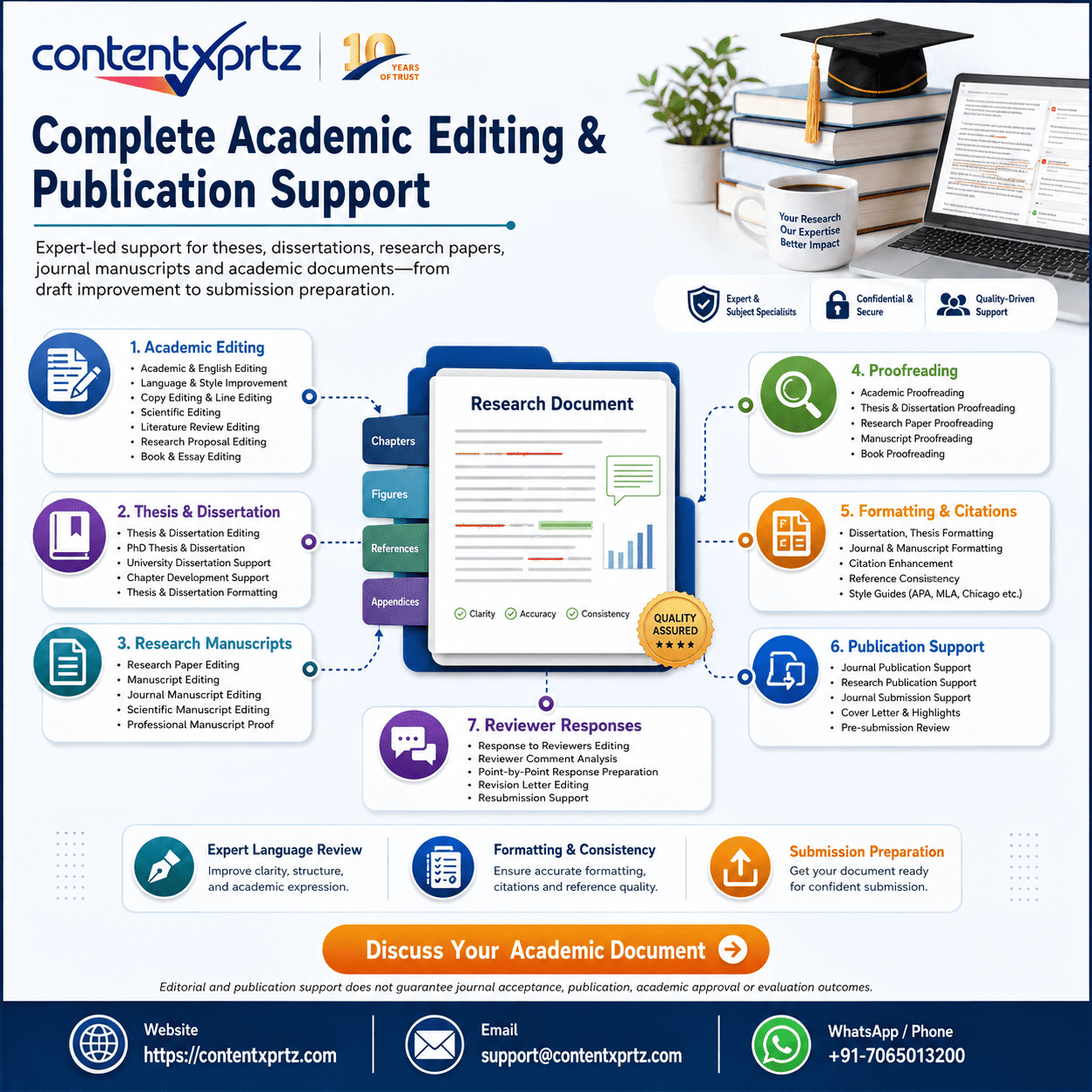
Contentxprtz can support researchers preparing a manuscript for journals such as JHTI through ethical manuscript editing, research-paper proofreading, formatting and reference support, manuscript assessment, journal-fit review and reviewer-response editing.
Support should improve the presentation of the researcher’s own work, not replace the author’s intellectual responsibility. Contentxprtz does not control editorial decisions, peer review or database indexing and does not guarantee acceptance or publication. Authors should also follow Emerald’s current rules on permitted AI-assisted editing and disclosure.
Summary: Should You Consider JHTI?
Journal of Hospitality and Tourism Insights is an established Emerald journal for multidisciplinary hospitality and tourism research. It is indexed in Scopus and ESCI, uses double-anonymous peer review, and publishes theoretical, empirical, applied and practice-relevant work. Emerald currently displays a 2025 CiteScore of 11.2 and a 2025 Impact Factor of 4.8.
The strongest reason to submit is genuine alignment: a clear hospitality or tourism research problem, a defensible method, a current and critical literature base, and conclusions that contribute to theory and practice. Before submission, authors should verify current metrics or quartiles required by their institution, follow the official 6,000–9,000-word and structured-abstract requirements, anonymise the manuscript, and submit directly through ScholarOne.
Frequently Asked Questions
What is the Journal of Hospitality and Tourism Insights?
The Journal of Hospitality and Tourism Insights (JHTI) is a peer-reviewed Emerald Publishing journal covering contemporary hospitality and tourism research. It welcomes theoretical, empirical, applied, case-based and methodological work using qualitative, quantitative or mixed methods.
Who publishes the Journal of Hospitality and Tourism Insights?
Emerald Publishing publishes JHTI. The official journal page lists print ISSN 2514-9792 and online ISSN 2514-9806.
Is the Journal of Hospitality and Tourism Insights indexed in Scopus?
Yes. Emerald’s official indexing page lists Scopus among the databases and lists the journal’s 2025 CiteScore as 11.2. The supplied Scopus Source ID is 21101045767.
What is the current CiteScore of the Journal of Hospitality and Tourism Insights?
Emerald currently displays a 2025 CiteScore of 11.2 and a 2026 CiteScore Tracker of 11.7. CiteScore Tracker is updated monthly, so authors should reconfirm it before making a journal-selection decision.
Does the Journal of Hospitality and Tourism Insights have an Impact Factor?
Yes. Emerald’s journal page currently displays a 2025 Journal Impact Factor of 4.8 and a 2025 five-year Impact Factor of 4.8. Journal metrics can change when publishers and databases refresh their records.
What is the acceptance rate of JHTI?
Emerald reports an acceptance rate of 11.3% for submissions received between 1 April 2024 and 31 March 2025. This is a historical operational metric, not a prediction of any individual manuscript’s chance of acceptance.
How long does peer review take at JHTI?
Emerald reports 18 days as time to first decision for submissions between 1 April 2024 and 31 March 2025, while the author guidelines state a goal of informing authors of the first decision within 60 days. Actual timing depends on editorial screening, reviewer availability and revisions.
What peer-review model does JHTI use?
JHTI uses double-anonymous peer review. Suitable submissions are normally sent to at least two independent referees after editorial screening.
What types of manuscripts does JHTI publish?
The journal accepts research papers and practitioner papers, with categories including research paper, viewpoint, technical paper, conceptual paper, case study, literature review and general review where appropriate.
How long should a JHTI manuscript be?
The official author guidelines state that articles should be 6,000 to 9,000 words, including the structured abstract, references, text in tables and figures, and appendices. Authors should allow 280 words for each figure or table.
What reference style does JHTI use?
The journal requires references to use a recognised Harvard style. Emerald provides its own Harvard style and asks authors to check citations for completeness, accuracy and consistency.
Is JHTI open access and does it charge an APC?
JHTI is a hybrid journal. Authors may publish through the subscription route or choose gold open access after acceptance. Emerald’s 2026 hybrid-journal APC is £3,222, US$4,351 or €3,710 plus VAT where applicable. Green open access is also available without an embargo under Emerald’s current policy.
Is there a submission fee for JHTI?
Emerald states that there is no submission fee. Payment is requested only if an author chooses the gold open-access route after acceptance, subject to applicable agreements, vouchers or other current publisher arrangements.
How do I submit a manuscript to JHTI?
The corresponding author must submit directly through the journal’s ScholarOne system linked from the Emerald journal page. Emerald explicitly states that submissions should not be made by email or through a third-party proxy.
Can Contentxprtz guarantee acceptance in JHTI?
No. Contentxprtz can support ethical manuscript editing, proofreading, formatting, reference consistency, journal-fit review and publication readiness, but it does not control editorial or peer-review decisions and cannot guarantee acceptance or publication.
Final Researcher Note
Journal selection is a scholarly decision, not a metric-shopping exercise. Use JHTI’s official scope, recent articles, author instructions and current database records together. If your institution has a specific Scopus, JCR or quartile rule, verify the applicable year and category before submission. Professional editing can improve clarity and compliance, but only the journal’s editors and peer reviewers determine publication outcomes.