
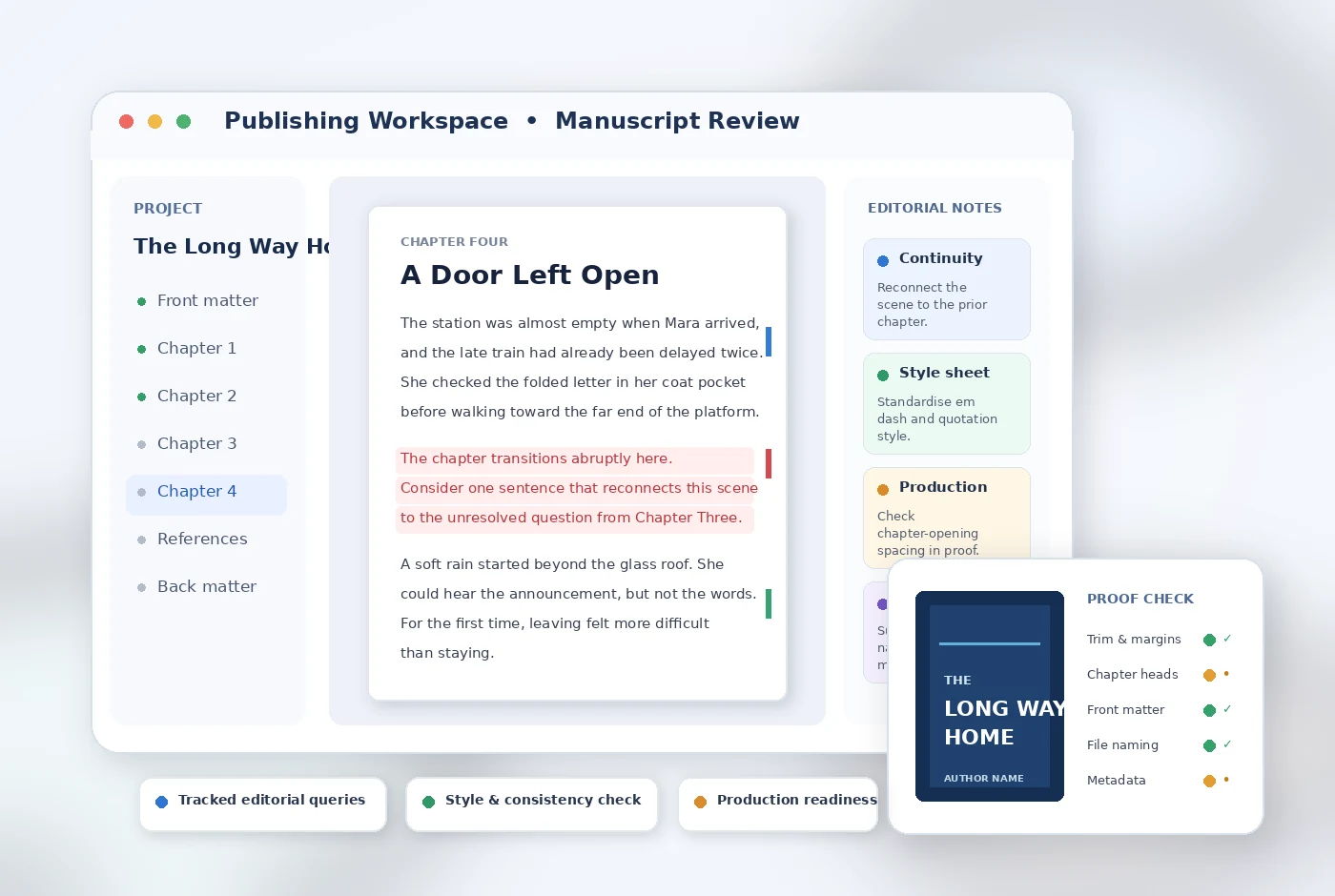
Check structure, file condition, open issues, and next editorial steps.
Book Publishing Support Service for a Clearer Path from Manuscript to Publication
Bring editorial review, publishing checks, author queries, manuscript consistency, proof preparation, and production-readiness tasks into one structured support workflow—without losing sight of your voice, content, or publishing requirements.
- Manuscript-readiness review across chapters, front matter, references, captions, and supporting elements
- Editorial queries and tracked revisions where clarification or author decisions are required
- Style, formatting, proof, and production-readiness checks aligned to the confirmed project scope
- Custom scope and quote after your manuscript and publishing requirements are reviewed
What Problems Book Publishing Support Helps Resolve
A manuscript can be well written and still be difficult to move through a publishing workflow. The support service focuses on the practical editorial and production-readiness issues that can slow review, create repeated author queries, or lead to inconsistent files.
Different files, versions, comments, and instructions can make the next editorial step unclear.
Headings, quotations, numbering, terminology, notes, and references may vary between sections.
Ambiguous wording, missing cross-references, or unclear source details can remain open late in the process.
Title information, contents, acknowledgements, references, appendices, and contributor details may not align.
Labels, callouts, caption text, numbering, or placement instructions can require reconciliation.
A near-final manuscript may still need file, style, proof, or consistency checks before handoff.
Chapter 4: A Door Left Open
The chapter begins with a new location, but the transition from the previous section is not explained not yet connected to the unresolved question in Chapter 3.
The first reference to the house style uses double hyphens an em dash, while later chapters use a different convention.
Figure 4.2 is cited in the manuscript, but its caption file is not present in the supplied materials.
What Book Publishing Support Covers
The final scope is set after manuscript review. These are the core publishing-readiness areas that can be combined into a project-specific workflow rather than treated as unrelated one-off fixes.
Headings, numbering, terminology, punctuation, spelling, and recurring conventions.
Title-page information, contents, acknowledgements, appendices, references, and related elements.
Numbering, callouts, captions, cross-references, and presentation consistency.
Presentation consistency and obvious mismatches within the confirmed scope.
Questions raised where author clarification or a content decision is needed.
Near-final page or file checks for visible consistency and production issues.
Open-item tracking so unresolved tasks are visible before the next handoff.
Clear notes for agreed file, layout, proof, or unresolved publishing items.
Sequence work around manuscript condition, priorities, and the confirmed deadline.
Service Demonstration: Annotated Manuscript Review
The example below is illustrative rather than a client document. It shows how book-publishing support can combine editorial judgment, consistency work, author queries, and production notes in one review.
From Draft Handoff to Publishing-Ready Manuscript
Book publishing support is broader than a single correction pass. The workflow makes open issues visible, resolves what can be resolved safely, and separates author decisions from production checks.
Mixed manuscript state
The manuscript contains a strong narrative, but chapter headings vary, comments are unresolved, a figure callout lacks a caption file, and the front-matter details do not fully match the title page.
Issues classified and resolved
Safe consistency corrections are made, author decisions are converted into explicit queries, supplied publisher guidance is applied, and proof or production notes are separated from editorial changes.
Clearer manuscript handoff
The revised file, clean copy where applicable, query log, style notes, and readiness checklist show what is complete, what still needs author input, and what should be carried into production.
Proofreading vs. Book Publishing Support
Proofreading can be one part of a publishing workflow, but it is not the same as coordinating broader manuscript-readiness, editorial-query, and production-handoff tasks.
| Aspect | Proofreading | Book Publishing Support |
|---|---|---|
| Primary focus | Final-stage spelling, grammar, punctuation, and light presentation corrections. | Publishing-readiness across editorial issues, manuscript consistency, queries, proof checks, and handoff requirements. |
| Depth | Surface-level correction on a largely stable document. | Scope can combine manuscript review, cross-chapter consistency, front/back matter, style, proof, and production checks. |
| Author queries | Usually limited to issues that prevent a safe correction. | Queries can be an explicit part of the workflow when author decisions are required before publishing handoff. |
| Production awareness | May check obvious formatting inconsistencies. | Can include proof-stage and production-readiness notes when these are part of the confirmed scope. |
| Supporting files | Typically the near-final text. | May use publisher instructions, house style, figures, captions, front matter, contributor details, and related production material. |
| Best fit | Stable manuscript needing a careful final language check. | Book project requiring coordinated editorial and publishing-readiness support before or during production. |
Manuscript Areas We Review
The exact project determines which parts are included. A complete publishing-readiness review may need to connect content that is often handled in separate files or at different points in the editorial process.
Our Book Publishing Support Workflow
The workflow is structured so editorial corrections, author decisions, and production-readiness tasks do not get mixed together. Each step can be adjusted to the manuscript stage and confirmed scope.
Share Project Details
Provide manuscript stage, approximate word count, deadline, target format, and relevant instructions.
Scope Review
Review manuscript condition and identify which publishing-support tasks are actually required.
Editorial Plan
Separate editing, author queries, style checks, proof tasks, and production observations into a clear sequence.
Manuscript Review
Perform the confirmed editorial and publishing-readiness checks using supplied guidelines and project instructions.
Query Resolution
Flag questions that require author input and keep unresolved items visible rather than making unsupported assumptions.
Proof & Production Check
Review agreed page, figure, caption, front-matter, file, or layout items at the relevant production stage.
Quality Review
Check that the confirmed scope is complete and that open author or production items are clearly marked.
Delivery & Next Steps
Return the agreed files, notes, and checklist with clear guidance on what is ready and what still needs action.
What You Receive
Deliverables depend on the confirmed project scope. The aim is to leave you with a reviewable set of files and notes that make the next publishing step easier to understand.
Reviewed Manuscript
Tracked revisions where editing is included, with visible changes for author review.
Clean Manuscript
A clean copy can be provided when tracked edits have been resolved within the confirmed workflow.
Editorial Query Notes
Questions and author-action points kept separate from changes that can be made safely.
Style & Consistency Notes
Recurring conventions, terminology, headings, punctuation, and presentation decisions documented where useful.
Publishing-Readiness Checklist
Completed items and unresolved manuscript or production issues summarised for the next step.
Production Handoff Notes
Scope-dependent observations for proof, layout, figures, front matter, files, or other production items.
Quality Assurance Methodology
A publishing-support review works best when it separates meaning, language, style, references, formatting, and final handoff checks instead of treating every issue as the same kind of correction.
Editorial changes do not replace author decisions; unclear points are queried.
Recurring style, terminology, numbering, and presentation issues are reviewed across the manuscript.
Obvious mismatches, missing items, captions, and cross-references are surfaced when in scope.
Layout or proof observations are labelled so they can be handled at the right stage.
Delivery checks against the agreed project scope before the files are returned.
Publishing Projects This Service Can Be Structured Around
Book publishing workflows vary by project. The scope can be discussed for different long-form manuscript situations where coordinated editorial and readiness support is needed.
Confidentiality & Manuscript Handling
Unpublished manuscripts, project instructions, and client information are handled as confidential service information through the designated submission and delivery process.
Turnaround Options
No fixed delivery time is assumed on this page. Timing is confirmed only after the manuscript, word count, complexity, requested publishing tasks, file condition, and deadline are reviewed.
Standard
For planned publishing support with enough time to sequence editorial queries, revisions, and readiness checks carefully.
Confirmed after scope review.Priority
For shorter publishing windows where the manuscript and requested tasks can be prioritised within the available schedule.
Subject to manuscript and capacity review.Express
For the shortest feasible window when scope, manuscript condition, and required checks allow a compressed workflow.
Availability must be confirmed; no duration is promised here.Pricing Clarity
Book publishing projects vary in manuscript length, stage, file complexity, supporting materials, and the combination of editorial or production-readiness tasks required. Pricing is therefore scoped to the actual project rather than shown as a one-size-fits-all package.
The quote is based on the actual publishing-support work required rather than a generic package copied from an unrelated service family.
- Manuscript length and current stage
- Editorial, style, proof, and production tasks requested
- Figures, tables, references, captions, front/back matter, or supporting files
- Deadline, file condition, and publisher or house-style requirements
What helps us scope accurately
Provide enough detail to distinguish language work from publishing-readiness, proof, and production support.
Why Choose ContentXprtz for Book Publishing Support
The value is coordination: editorial issues, author questions, style choices, proof observations, and handoff tasks stay connected to one manuscript rather than becoming scattered across late-stage corrections.
Manuscript-Focused Scope
Work is defined around the manuscript condition and publishing stage rather than a generic fixed bundle.
Clear Author Queries
Issues requiring author input are surfaced explicitly instead of being silently guessed.
Publishing-Readiness View
Editorial, consistency, proof, and production observations are reviewed in context.
Cleaner Handoff
Files, notes, and unresolved items are organised so the next publishing step is easier to understand.
Style Awareness
Supplied publisher or house-style guidance can be used for relevant checks within the confirmed scope.
Cross-Element Consistency
Chapters, front matter, references, captions, figures, and proof observations can be reviewed together.
Scope-Based Timing
Delivery timing is confirmed after the actual work, manuscript condition, and deadline are understood.
Confidential Handling
Unpublished manuscript and client information are treated as confidential service information.
Book Publishing Support FAQs
Practical answers about scope, files, author queries, proofs, publisher style, deliverables, confidentiality, turnaround, and pricing.
What is included in a Book Publishing Support Service?
The confirmed scope can cover manuscript-readiness review, editorial queries, chapter and front-matter consistency, style and formatting checks, references and captions, proof-stage review, production handoff notes, and a publishing-readiness checklist. The exact combination depends on the manuscript and the support requested.
Is this the same as proofreading?
No. Proofreading focuses mainly on final-stage language and presentation corrections. Book publishing support can coordinate a broader set of publishing-readiness tasks such as manuscript organisation, style consistency, front and back matter, production queries, proof checks, and handoff preparation.
Can you work with a manuscript that is still being revised?
Yes, but the most suitable workflow depends on how stable the manuscript is. An early-stage manuscript may need a different sequence from a near-final book that is ready for proof or production checks.
What files should I send for a publishing-support review?
Share the current manuscript and any relevant publisher, editor, house-style, formatting, front-matter, figure, permissions, or production instructions that should guide the review.
Do you support references, tables, figures, and captions?
These elements can be reviewed for consistency and presentation when they are included in the confirmed project scope and the relevant style or publisher instructions are supplied.
Will you change the author’s meaning or voice?
The workflow is designed to improve readiness and presentation while preserving author intent. When a change cannot be made safely without clarification, the issue is raised as an editorial query.
Do I receive tracked changes and a clean manuscript?
Where editing is part of the confirmed scope, the workflow can use tracked changes for review transparency and can also provide a clean file after agreed changes are resolved.
Can you follow a publisher or house style?
Yes, when the applicable publisher or house-style instructions are supplied and the requested checks are within the confirmed scope.
How is turnaround decided?
Turnaround is confirmed after the manuscript, word count, complexity, requested publishing tasks, file condition, and deadline are reviewed. Standard, Priority, and Express handling can be discussed where appropriate; no delivery time is assumed until scope review is complete.
How is pricing decided?
Pricing is provided as a custom quote after the manuscript and requested publishing-support scope are reviewed. Book publishing projects vary in manuscript length, stage, file complexity, supporting materials, and the editorial or production-readiness tasks required.
Is my manuscript handled confidentially?
Manuscript and client information are handled as confidential service information through the designated submission and delivery process.
What happens after I submit an enquiry?
Your manuscript details and publishing requirements are reviewed to identify the appropriate scope, clarify open questions, confirm feasibility and timing, and provide the next-step information needed to proceed.
Request a Book Publishing Support Quote
Tell us where your manuscript is in the publishing process, what files you have, what support you need, and the deadline you are working toward. The details help define an accurate scope rather than forcing the project into an unrelated fixed plan.
Draft, edited manuscript, near-final file, proof stage, or production handoff—plus your exact deadline and time zone.
Describe editing, chapter consistency, front/back matter, references, captions, proofs, production notes, or query support needed.
Include applicable instructions, templates, style sheets, or production specifications if available.
Note whether figures, tables, captions, references, front matter, contributor details, or proof pages are part of the project.
Highlight the issues you most want resolved before the next publishing step.
Request a Publishing-Support Assessment
Share your contact details and project requirements. Manuscript files and publisher instructions can be provided through the designated follow-up process after the enquiry is reviewed.
Ready to Make Your Manuscript Easier to Move Through Publishing?
Share the manuscript stage, scope, deadline, and publishing requirements so the right support workflow can be defined.