Course & Module Content
Unit outlines, module pages, lesson content, concept explanations, summaries, and progression across a learning sequence.

Turn a syllabus, curriculum map, course brief, subject-matter notes, approved source pack, or existing draft into coherent learning materials with purposeful sequencing, accessible explanations, learning objectives, activities, assessments, and review-ready content.
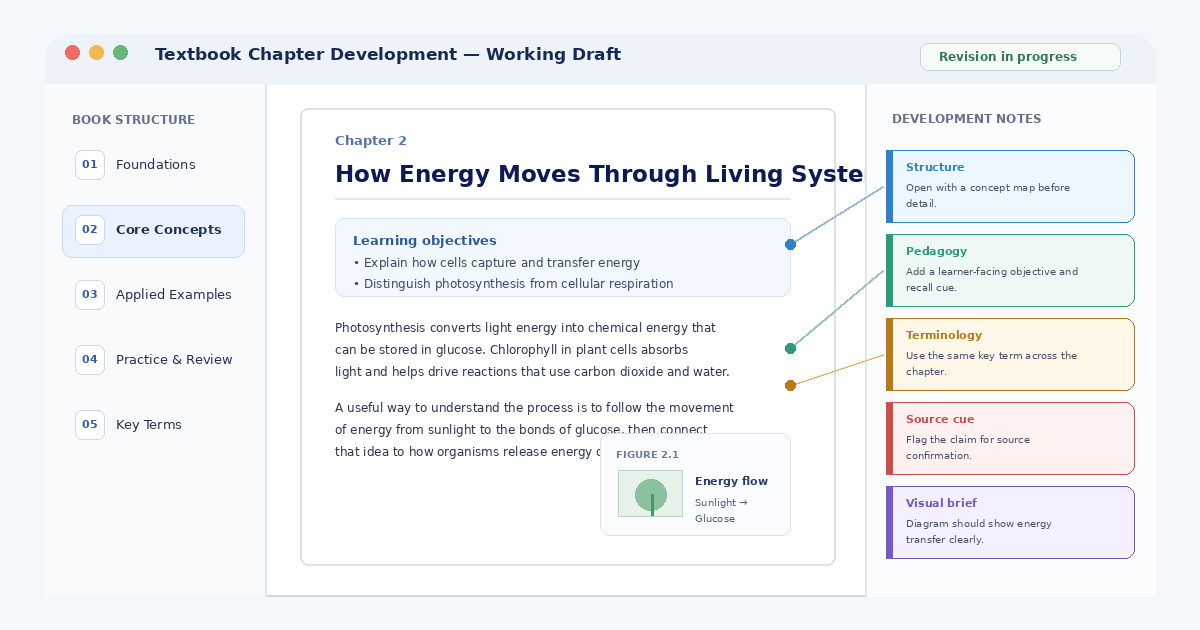
The starting scope is tied to a usable learner-facing deliverable, not a consultation: a compact module, guide, or workbook section written from approved project sources.
Suitable for: A course module, learner guide, study resource, workbook section, or training asset with a defined audience, source pack, and learning purpose.
Extensive original research, specialist SME sourcing, full curriculum design, advanced assessment banks, visual design, and e-learning authoring are quoted separately.
Learning-content support can be shaped around the format, audience, subject, instructional purpose, and source materials defined in your project brief.
Unit outlines, module pages, lesson content, concept explanations, summaries, and progression across a learning sequence.
Guided notes, exercises, worked examples, revision prompts, chapter recaps, practice pages, and learner-support content.
Professional or institutional training modules, facilitator content, learner handouts, procedure explanations, and practice activities.
Knowledge checks, quizzes, reflection prompts, case questions, short activities, and answer guidance where included in scope.
Screen-level copy, microlearning text, narration scripts, scenario prompts, interaction notes, and structured content for later LMS implementation.
Facilitator notes, teaching guidance, answer keys, discussion prompts, delivery cues, and supporting material for the people using the content.
A clear workflow keeps the writing connected to the intended learner, the supplied source material, the learning goals, and your review process.
Clarify the learner profile, subject, format, content volume, learning goals, source pack, guidelines, and required outputs.
Build the content map, lesson or module sequence, headings, instructional flow, and expected learning elements.
Write or substantially develop the content from the confirmed brief and approved source materials.
Check clarity, learner level, sequencing, examples, terminology, source cues, activities, and internal consistency.
Provide the agreed files for client review, with author queries, notes, and revision-ready handoff where included.
The service is designed for projects where subject knowledge must become teachable content rather than simply longer prose.
The writing can be structured for different learning environments without forcing one content format onto every project.
Structured lessons, page-level content, activities, and digital learning sequences.
Independent study material with explanations, examples, checks, and recaps.
Materials that support live sessions, independent work, assignments, and follow-up.
Educational narration, lesson scripts, storyboard notes, and supporting on-screen copy.
Short, scannable content units designed for compact digital learning experiences.
Facilitator notes, handouts, exercises, discussion prompts, and workshop activities.
Learning material writing can be scoped for academic, professional, institutional, publishing, and digital-learning contexts.
Instead of treating every page as an isolated writing task, a learning-content project can use a consistent instructional pattern across modules, reducing avoidable variation and making review easier.
A training team has slides, notes, policy documents, and facilitator knowledge but no consistent learner-facing material. The writing workflow can turn those inputs into a sequenced module with objectives, explanations, examples, practice prompts, and a review-ready facilitator guide.
The exact output depends on the supplied materials, the subject-matter review process, the learner profile, and the agreed scope.
Depending on the confirmed requirement, a learning material project may need different kinds of expertise at different stages.
Helps organize learning goals, content sequence, module structure, learner depth, and instructional patterns.
Develops readable instructional prose from the confirmed brief, approved sources, and subject-matter inputs.
Checks clarity, flow, consistency, terminology, instructional tone, headings, and review-readiness across the material.
Supports knowledge checks, practice activities, reflection prompts, assessment questions, and answer guidance when required.
Creates figure, table, diagram, callout, and illustration briefs so visual support can match the learning sequence.
Clear checkpoints help reviewers assess the material without relying on vague reactions such as “make it more engaging.”
Review vocabulary, assumed prior knowledge, explanation depth, examples, and pacing against the intended audience.
Check whether learning objectives, explanations, activities, and assessment prompts address the same intended outcomes.
Confirm that foundational concepts appear before advanced application and that transitions make the progression visible.
Check terminology, headings, key-term treatment, recap style, formatting, and instructional conventions across modules.
Confirm that approved sources, source cues, author queries, references, and any subject-matter verification points are clear.
Choose a working model based on whether you need a single resource, a course series, institutional content development, or consultation-led planning.
One module, guide, workbook, lesson set, assessment pack, or focused learning-content requirement.
Custom quote after scope reviewDiscuss Resource →Multiple modules or related resources requiring a shared structure, style system, terminology, and review workflow.
Milestone-based planningPlan a Series →Curriculum-linked or department-wide content development with agreed templates, review roles, and repeatable deliverables.
Scope defined collaborativelyDiscuss Partnership →Planning support for content architecture, format decisions, review criteria, templates, and development workflows.
Consultative scopeRequest Consultation →Answers to practical questions about scope, inputs, formats, assessments, source handling, pricing, timelines, revision, and project setup.
The confirmed scope can include learning objectives, content outlines, lesson or module writing, examples, key terms, summaries, activities, assessment questions, instructor notes, source integration, visual briefs, editing, and revision support.
Projects can include course modules, workbooks, training manuals, study guides, lesson content, e-learning scripts, learner handouts, facilitator guides, assessments, and related educational resources when these are included in the confirmed scope.
Yes. A project can begin from a supplied syllabus, curriculum map, outline, lesson plan, source pack, subject-matter notes, existing draft, or a combination of approved materials.
Yes, when included in scope. Learning objectives, knowledge checks, quizzes, reflection prompts, practice activities, and assessment questions can be developed around the confirmed learning goals and learner level.
Yes, when the relevant curriculum, competency framework, training standard, or institutional requirements are supplied. These inputs can guide the sequence, depth, terminology, activities, and assessment approach.
The writing scope can include modular e-learning content, screen-level copy, narration or voice-over scripts, knowledge checks, scenario prompts, interaction notes, and content structured for later LMS or authoring-tool implementation.
Yes. Instructor notes, facilitator guidance, answer keys, activity instructions, discussion prompts, lesson delivery notes, and related support resources can be developed when required by the brief.
Writing should rely on the source materials approved for the project. The required citation style, source notes, reference integration, permissions, and factual review responsibilities should be agreed during scope review.
Pricing is confirmed after scope review. The quote depends on the project scope, content volume, source readiness, subject complexity, learning elements, assessment requirements, visual briefs, formatting, and revision needs.
Turnaround is confirmed after scope review. A realistic schedule is confirmed after the content volume, source readiness, review stages, milestones, and required learning elements have been assessed.
Yes. Existing material can be reorganized, rewritten, expanded, simplified, updated for a different learner level, or adapted into a more structured instructional format when that work is part of the agreed scope.
Send the project brief, learner profile, course or module outline, learning goals, approved source materials, sample content if available, required formats, assessment needs, guidelines, approximate length, and any deadline or milestone requirements.
Share enough detail for the content scope, learning requirements, review process, schedule, and quote to be assessed before work begins.
Clear starting inputs make it easier to recommend the right development approach without inventing requirements that your project does not need.
Who the learners are, what they should understand or be able to do, and the intended depth.
Syllabus, outline, slides, notes, source pack, existing modules, policy documents, or approved references.
Modules, lessons, workbooks, assessments, facilitator guides, e-learning scripts, study guides, or another format.
Objectives, examples, activities, knowledge checks, case prompts, key terms, summaries, figures, tables, or visual briefs.
Curriculum standards, style rules, brand voice, citation system, SME reviewers, stakeholder approvals, or templates.
Approximate content volume, number of modules or resources, priority dates, review stages, and final delivery needs.
Provide the basic project details below so the requirement can be reviewed for fit, scope, schedule feasibility, and quote preparation.
Share your syllabus, source readiness, learner level, module requirements, preferred format, and review goals so the scope can be assessed before writing begins.