
Academic & Educational Content Development

Textbook Writing Service for Clear, Structured, Learner-Focused Content

Develop textbook chapters from a brief, outline, syllabus, author notes, approved source material, or an existing draft. The focus is on logical chapter architecture, teachable explanations, consistent terminology, purposeful learning elements, and a manuscript that is easier for authors, reviewers, and learners to navigate.

  • Chapter planning, sequencing, headings, and content hierarchy
  • Learner-focused explanations, examples, recaps, and key terms
  • Source-aware drafting and reference integration from supplied materials
  • Revision-friendly delivery with clear author queries and development notes
Scope-led workflow Confidential handling Publisher or institutional guidelines used when supplied
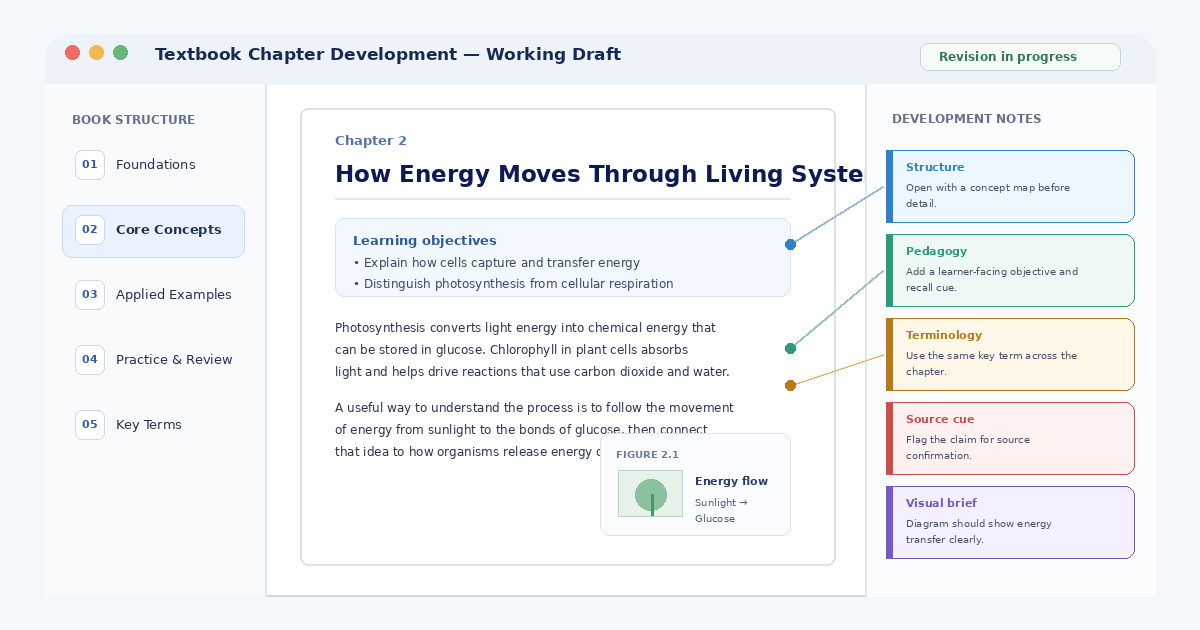
Textbook chapter manuscript with chapter navigation, learning objectives, figure planning, and development notes showing Textbook Writing Service
Chapter ArchitectureSequence, hierarchy, flow
Learner FocusObjectives, explanations, recaps
Source IntegrationReferences from supplied material
Visual PlanningFigure, table, and callout briefs
Consistency ReviewTerms, tone, structure, style
1

What Textbook Writing Service Helps You Solve

Textbook projects need more than fluent sentences. They require a clear teaching sequence, controlled terminology, purposeful examples, consistent chapter design, and content that develops ideas at an appropriate pace.

Common Development Problems

  • ×Strong subject matter but weak chapter flow
  • ×Sections written at inconsistent learner depth
  • ×Unclear learning objectives or chapter purpose
  • ×Examples, figures, and key terms added without structure
  • ×Repetition across chapters or inconsistent terminology
  • ×Source notes that need coherent instructional prose
From source notes to teachable prose

Source note: “Energy is stored in glucose. Plants use light. Chlorophyll absorbs light. Carbon dioxide and water are used.”

Developed textbook passage: Photosynthesis allows plants to capture light energy and store it as chemical energy. Chlorophyll absorbs light, helping drive a sequence of reactions that use carbon dioxide and water to form glucose. This provides a useful foundation for comparing how energy is stored during photosynthesis and released during cellular respiration.

Development focus: organise ideas in a teaching sequence, define the core concept, connect related concepts, and preserve source-backed meaning without adding unsupported claims.
Chapter Structure

Scope, chapter order, headings, section purpose, and progression.

Learning Objectives

Clear learner outcomes aligned with the confirmed chapter purpose.

Explanatory Prose

Readable concept development with controlled depth and logical transitions.

Examples & Applications

Worked examples, scenarios, case prompts, and context where suitable.

Key Terms & Recaps

Definitions, summaries, takeaways, and chapter-end reinforcement.

Figure & Table Briefs

Content briefs for visual elements that support the learning sequence.

References & Sources

Source cues and reference integration based on materials supplied for the project.

Terminology Consistency

Stable naming, voice, notation, and presentation across chapters.

2

Service Demonstration: Annotated Textbook Development

The example below shows the kind of intervention involved in textbook development: not only sentence correction, but also sequencing, teaching cues, terminology control, source flags, and visual planning.

128129130131132133134135

Plants make food from sunlight convert light energy into chemical energy stored in glucose. This process, photosynthesis, occurs mainly in chloroplasts.

Begin by following the movement of energy. Chlorophyll absorbs light, and the captured energy supports reactions that use carbon dioxide and water.

The chapter should tell students help learners distinguish energy storage in photosynthesis from energy release during cellular respiration.

Add a labelled energy-flow diagram here so the transition from sunlight to stored chemical energy is visible before the text introduces the reaction sequence.

Key term: chlorophyll — the light-absorbing pigment central to this introductory explanation.

StructureLead with the organising idea before process detail.
PedagogyState what the learner should distinguish.
TerminologyDefine the key term where it first matters.
Source checkFlag factual additions that need source support.
Visual briefUse a diagram to reduce cognitive load before detail.
3

From Brief to Developed Textbook Chapter

Textbook writing can begin at different stages. The workflow below shows how unstructured material can become a chapter draft and then a cleaner, review-ready section while preserving the confirmed instructional goals.

1) Before development

Author / Publisher Brief

Topic: energy in living systems.

Cover photosynthesis, chlorophyll, glucose, and respiration. Audience: introductory learners. Include a simple figure and two learning objectives. Use approved sources supplied with the project.
Issues to resolve: hierarchy, teaching order, transitions, definitions, visual placement, source cues.
2) Developed draft

Structured Chapter Section

The section opens with a conceptual overview, states the learner objectives, then explains how light energy becomes stored chemical energy. Key terms are introduced at first use, and a figure brief is placed before the reaction detail.
Development checks: clarity, sequence, learner level, terminology, source-backed claims, visual logic.
3) Clean review copy

Consistent Textbook Manuscript

The final review copy presents the approved chapter structure, learning objectives, explanatory text, key terms, recap elements, figure instructions, references or source notes, and author queries in a consistent format.
Delivery format depends on the confirmed project scope and agreed workflow.
4

Textbook Writing vs. Editing vs. Proofreading

These services solve different problems. Textbook writing develops content and instructional structure; editing improves developed content; proofreading is a final-stage correction pass.

AspectProofreadingEditingTextbook Writing Service
Primary focusGrammar, spelling, punctuation, minor consistencyClarity, flow, tone, structure, language refinementContent development, chapter architecture, learner progression, instructional presentation
Starting pointNear-final textDeveloped draftBrief, outline, notes, source pack, existing draft, or mixed materials
Structural depthMinimalSentence to section level depending on scopeChapter and section planning can be part of the confirmed scope
Learning designNot the main purposeMay improve presentationObjectives, explanations, examples, key terms, recaps, and visual briefs can be developed
Source integrationChecks obvious presentation issuesCan review citation consistencyDrafting can use approved source materials and source cues supplied for the project
Best fitFinal correction before delivery or publicationImproving an existing manuscriptBuilding or substantially developing educational content
5

Textbook Sections & Learning Elements

Chapter Title & OverviewScope, purpose, and chapter map
Learning ObjectivesClear outcomes for the chapter
Core ExplanationsConcept development and transitions
Worked ExamplesApplied or contextual learning
Figures & TablesContent briefs and placement cues
Key Terms & GlossaryDefinitions and terminology control
Summary & RecapChapter-end reinforcement
References & Source NotesPresentation based on supplied sources
6

Our Textbook Development Workflow

1Scope the Project

Clarify audience, chapter count, source materials, guidelines, and expected learning elements.

2Build the Chapter Map

Agree the instructional order, headings, section purpose, and content depth.

3Develop the Draft

Write or substantially develop the chapter from the confirmed brief and supplied sources.

4Review Learning Flow

Check clarity, sequence, learner level, examples, terminology, and internal connections.

5Plan Visual Support

Add figure, table, box, callout, or caption briefs where these improve understanding.

6Resolve Queries

Surface author decisions, source gaps, guideline questions, and points needing confirmation.

7Final Consistency Pass

Review terminology, hierarchy, formatting cues, references, and revision completeness.

8Prepare Delivery

Package the agreed manuscript files, notes, and supporting development material.

7) What You May Receive

Final deliverables depend on the confirmed textbook scope.

DOCX
Developed ManuscriptChapter content in an agreed working format
Draft
DOCX
Clean Review CopyConsolidated text after agreed revisions
Clean
MAP
Chapter / Section MapHierarchy and instructional sequence where included
Plan
NOTE
Author QueriesQuestions, source gaps, or decisions requiring confirmation
Notes
REF
Reference / Source NotesWhere source handling is included in the agreed scope
Sources
VIS
Figure & Table BriefsContent instructions where visual development is required
Visual

8) Quality Assurance Methodology

Layer 1 — Scope & Source Alignment
Layer 2 — Structure & Learning Flow
Layer 3 — Chapter-Level Development Review
Layer 4 — Final Consistency & Delivery Check
Author intent and supplied source boundaries are checked against the confirmed brief.
Chapter purpose, teaching order, headings, objectives, and transitions are reviewed together.
Terminology, examples, visual cues, source flags, and presentation are checked for consistency.
Open queries and agreed revisions are reviewed before the final delivery package is prepared.

9) Common Textbook Contexts

Project fit is reviewed against subject complexity, audience, source readiness, and required learning elements.

Life Sciences
Medicine & Health
Engineering
Computer Science
Social Sciences
Business & Economics
Humanities
Interdisciplinary
Secure SubmissionUse the designated project-submission channel for files and instructions.
Restricted AccessProject materials are handled within the assigned service workflow.
Controlled DevelopmentWriting and review take place within the working project environment.
Confidential DeliveryCompleted files are returned through the agreed delivery process.
File RetentionRetention should follow the applicable service and operational requirements.
NDA RequestsAsk about confidentiality documentation if your project requires it.
Your Unpublished Textbook Material Remains Project Content

Share only the materials required for the confirmed scope. Confidentiality, file access, delivery method, and any project-specific NDA requirement can be addressed during project setup.

10) Turnaround Options

StandardBalanced schedule based on confirmed chapter scope and review stages.
PriorityFaster planning may be considered where scope, readiness, and capacity allow.
ExpressFastest feasible delivery is assessed only after the exact textbook requirement is reviewed.

No fixed turnaround is stated for Textbook Writing Service on this page. A realistic schedule is confirmed after scope review.

11) Pricing Clarity

Custom Quote Based on Textbook ScopeNo fixed price is stated for this service on this page.
Chapter count & length
Source readiness
Subject complexity
Learning elements
Figures & tables
References & formatting

A transparent scope discussion should precede the final quote.

12) Why Choose This Service

Structured DevelopmentChapters built around purpose and sequence
Learner FocusExplanations aligned with intended depth
Style ContinuityTerminology and hierarchy checked across sections
Confidential HandlingUnpublished project material treated as confidential content
Revision SupportAuthor queries and agreed revisions built into the workflow
Guideline AlignmentPublisher or institutional instructions used when supplied
13

Textbook Writing Service FAQs

These questions address the practical decisions that usually matter before a textbook-writing scope is confirmed.

What does a textbook writing service include?

The confirmed scope can cover chapter planning, structured drafting, learner-focused explanations, learning objectives, examples, key terms, visual briefs, source integration, references, consistency review, and revision support.

Can you work from an outline, syllabus, or source pack?

Yes. A project can begin from a supplied outline, syllabus, chapter brief, author notes, approved references, or a combination of source materials. The exact starting materials should be agreed during scope review.

Can you develop a chapter from author notes rather than a full draft?

Yes, when concept-to-draft development is part of the confirmed scope. The notes should be supported by a clear brief, intended audience, required chapter depth, and the source material that may be used.

Can existing textbook chapters be rewritten or expanded?

Existing material can be developed, reorganised, expanded, or rewritten when that work is included in scope. The author or publisher should provide the source text, desired learning level, and any constraints that must be preserved.

Can learning objectives, examples, key terms, and chapter summaries be added?

They can be included when required by the project brief. The purpose, number, depth, and placement of learning elements should be agreed so they support the chapter rather than being added mechanically.

Can figure and table content be planned?

Figure, table, callout, and caption briefs can be developed when included in the scope. These briefs can explain what the visual should communicate, where it belongs, and what labels or data need author confirmation.

How are references and source materials handled?

Drafting should rely on the source materials approved for the project. Reference integration, citation style, source notes, and factual verification responsibilities should be clarified during scope review so the workflow is transparent.

Can publisher or institutional guidelines be followed?

Yes, when the applicable instructions are supplied and included in scope. They can inform chapter structure, formatting, terminology, citation style, visual conventions, and other presentation requirements.

Do you provide a fixed textbook-writing price?

This page does not state a fixed price. Textbook projects vary substantially by chapter count, source readiness, subject complexity, learning elements, references, visuals, and revision requirements, so the project is reviewed before a quote is confirmed.

Is turnaround fixed for textbook projects?

No fixed turnaround is stated on this page. Delivery planning depends on scope, chapter length, source readiness, subject complexity, review stages, and required milestones. A realistic schedule is confirmed after scope review.

What should I send for a textbook-writing assessment?

Send the project brief, intended audience, chapter list or outline, sample material if available, source pack, style or publisher instructions, desired learning elements, approximate length, and any deadline or milestone requirements.

How is unpublished textbook content handled?

Share unpublished material through the designated service process and only to the extent required for the confirmed scope. If your project requires an NDA or specific confidentiality documentation, raise that requirement during project setup.

14

Request a Textbook Writing Assessment

Share the intended audience, textbook or chapter scope, source readiness, approximate length, learning elements, publisher or institutional requirements, and any delivery milestones. The project can then be reviewed for fit, scope, and quote preparation.

Project & audience

Textbook type, subject, learner level, chapter count, and intended use.

Starting materials

Outline, syllabus, notes, existing chapters, source pack, or approved references.

Learning elements

Objectives, examples, recaps, key terms, exercises, figures, tables, or callouts.

Timeline & milestones

Share required dates, review stages, and time zone so feasibility can be assessed.

Visual requirements

Figure, table, diagram, caption, or illustration briefs needed for the manuscript.

Guidelines & references

Publisher style, institution requirements, citation system, or approved source rules.

Helpful to include: a chapter outline, intended reader level, one sample chapter or brief, source materials, expected learning elements, approximate word count, required visual support, reference style, and any milestone dates.
Textbook Writing Enquiry

Tell Us About Your Textbook Project

Provide enough detail for the scope to be assessed before pricing or delivery dates are confirmed.

Security check *Loading question…

Please do not include sensitive or unnecessary personal information in the message field. Supporting files and confidentiality requirements can be handled through the agreed project-submission process.

Ready to Develop a Clearer, Better-Structured Textbook Manuscript?

Share your outline, source readiness, intended learner level, chapter requirements, and project goals so the scope can be reviewed.

Scope-led development Custom quote after review Confidential handling Revision-friendly delivery