Master Thesis Writer: Ethical Support for a Stronger, Defensible Thesis
Searching for a master thesis writer usually means you are facing a practical academic problem, not simply looking for someone who can produce more words. You may have a workable research question but a literature review that feels like a list of summaries. Your methodology may be sound but difficult to explain. Supervisor comments may point to weak argument flow, inconsistent citations, unclear English, repetitive discussion, or a conclusion that does not answer the research question sharply enough. At the same time, the boundary between legitimate academic support and inappropriate ghostwriting can be confusing, especially when online services use the same phrases for very different levels of help.
A master's thesis is assessed as evidence of your own research competence. That makes authorship and intellectual responsibility central. Ethical support can still be valuable: a thesis consultant can help you diagnose structure, an academic editor can improve clarity and consistency, a proofreader can catch final errors, and a subject-aware reviewer can ask questions that expose gaps you need to resolve. What ethical support should not do is invent data, fabricate references, make undisclosed research decisions, or create a thesis for you to submit as your own. Your university's rules are the controlling standard, so check them before engaging any external assistance.
This distinction matters for international students, ESL researchers, working professionals, and first-time postgraduate authors who may understand their subject well but struggle to communicate it in the expected academic form. Thesis quality depends on more than grammar. Examiners look for a coherent problem, justified methods, disciplined use of evidence, traceable citations, transparent limitations, and a discussion that shows what the findings mean. A polished sentence cannot compensate for weak reasoning, and a sophisticated-sounding paragraph is unsafe if the source behind it cannot be verified.
This guide explains how to use professional thesis help responsibly, what different kinds of support actually include, how to evaluate a provider, what to prepare before editing begins, and how to protect your authorship throughout the process. Contentxprtz is presented as one option for PhD and thesis support, academic editing services, and proofreading when those services match the problem. The goal is not to replace your scholarship; it is to help you make the scholarship you already own clearer, more consistent, and easier to defend.
Quick Answer: What Is a Master Thesis Writer?
A master thesis writer should be approached as a consultant, editor, reviewer, or writing coach when the work is part of an assessed degree. Ethical assistance can help you understand expectations, organise chapters, improve argument flow, refine academic language, check consistency, strengthen transitions, and prepare a near-final thesis for proofreading.
The safest model is collaborative: you provide the research, ideas, sources, analysis, and draft; the expert provides feedback or edits that you can inspect and accept or reject. You remain able to explain every sentence, table, citation, method, and conclusion. This is consistent with a broader academic principle reflected in the ICMJE guidance on authorship and contribution: writing assistance and language editing do not by themselves establish authorship, while named authors remain accountable for the work.
Before paying for any service, check your university's policy on third-party editing, generative AI, acknowledgements, and academic integrity. If the provider will write assessed content from scratch for you, invent citations or data, or guarantee a grade or approval, treat that as a serious warning sign.
Key Takeaways
- A master thesis writer is safest when used as a transparent consultant or editor, not a hidden substitute author.
- You should retain control of the research question, evidence, methodology, analysis, interpretation, citations, and final submission.
- Developmental editing, copyediting, and proofreading solve different problems and should not be purchased as if they are interchangeable.
- University rules on permitted editing and AI use vary, so institutional policy should be checked before external support begins.
- Good thesis support uses comments, tracked changes, questions, and explanations that you can review and defend.
- Fabricated references, invented data, guaranteed approval, and undisclosed ghostwriting are clear red flags.
- Professional support is most valuable when it targets a defined bottleneck such as structure, academic language, citation consistency, or final quality control.
What This Page Covers
- What the term “master thesis writer” means in an ethical academic context.
- The difference between writing support, substantive editing, copyediting, and proofreading.
- How to decide whether self-editing, supervisor feedback, peer review, or professional support is appropriate.
- A step-by-step workflow for preparing and reviewing a master's thesis.
- Warning signs that a service may cross academic-integrity boundaries.
- Practical examples involving ESL writing, literature reviews, methodology, and final submission.
- A submission-readiness checklist and ten decision-focused FAQs.
Table of Contents
Methodology and Academic Sources
This article is based on common master's thesis writing, academic editing, proofreading, supervision, and submission-readiness workflows. It distinguishes language or structural assistance from authorship because those roles can carry different academic-integrity implications. University rules vary, so readers should treat institutional regulations and supervisor guidance as the final authority for their programme.
The ethical principles discussed here align with established publishing guidance that keeps responsibility with authors and separates legitimate editing from undisclosed authorship. For example, Springer Nature's language-editing guidance describes editing as improving communication while encouraging authors to review changes critically, and its ethics material distinguishes editing from ghostwriting. These publisher sources do not replace university thesis policies, but they illustrate why transparent scope and author control matter.
What “Master Thesis Writer” Means in an Academic Context
The phrase covers several very different services, so the first job is to define the scope. A student asking for a “writer” may actually need a developmental editor to diagnose a weak chapter, a proofreader to remove final errors, a research coach to explain how to plan a literature review, or a formatter to bring references and headings into line with university requirements.
Writing support is not the same as ghostwriting
Legitimate writing support helps you perform the writing task better. A consultant may ask you to state the research problem in one sentence, map each chapter to a research objective, explain why a method was selected, or identify the evidence behind a claim. The resulting intellectual decisions remain yours. Ghostwriting, by contrast, hides the true creator of assessed work. If another person designs the argument, writes substantial thesis content, or invents sources for you to submit under your name, the service may violate academic-integrity rules even if the prose is technically excellent.
Editing should preserve the author's meaning
Language editing can be extensive without becoming authorship when it improves grammar, clarity, style, terminology, and flow while preserving the researcher's underlying ideas. Springer Nature's author-services ethics material explicitly distinguishes language editing from taking control of an author's content. That principle is especially useful for multilingual researchers: the goal is to remove language barriers without replacing intellectual contribution.
Why Master's Students Search for Professional Thesis Help
Most students seek help because several pressures converge at once. A thesis is longer than a normal assignment, so small weaknesses repeat across dozens of pages. A term used inconsistently in Chapter 2 can distort the discussion in Chapter 5. A vague research objective can create an unfocused literature review, an overbroad method, and a conclusion that cannot answer the original question.
Common reasons include limited experience with long-form academic argument, supervisor feedback that is difficult to translate into revisions, English-language challenges, demanding citation styles, large reference lists, table and figure consistency, work or family commitments, and a deadline that leaves little room for repeated self-editing. Some students also need a neutral reader because they have become too familiar with the document to notice gaps.
Professional help is most useful when the problem is named precisely. “Make my thesis better” is too broad. “Check whether every discussion subsection links the findings back to the research questions” is actionable. “Improve grammar” is also broad; “edit for formal academic English while preserving technical terminology and mark any sentence whose meaning is uncertain” gives an editor a safer brief.
Free, Low-Cost, and Professional Master Thesis Support Options
You do not need professional help for every stage. The best support mix depends on the maturity of the draft, the stakes of the submission, and the rules of your programme.
| Support option | Best use | What it can improve | Main limitation |
|---|---|---|---|
| Supervisor feedback | Research direction and programme expectations | Scope, methods, argument, disciplinary fit | Time may be limited; detailed language editing may not be included |
| University writing centre | Writing development and academic conventions | Planning, paragraphing, argument, revision habits | May offer coaching rather than line-by-line editing |
| Peer review | Reader perspective and clarity testing | Confusing passages, missing context, logical jumps | Peers may not know formal editing or citation standards |
| Grammar and reference tools | Routine self-checks | Typos, grammar flags, citation organisation | Can misread technical language or import incorrect metadata |
| Professional academic editor | Structure, clarity, consistency, academic language | Flow, readability, terminology, comments, style | Must stay within university rules and cannot replace your research |
| Proofreader | Near-final quality control | Spelling, punctuation, numbering, formatting consistency | Too late for major argument or chapter restructuring |
A student with a strong draft and enough time may combine supervisor feedback, a writing centre, and careful self-editing. A complex or multilingual thesis may benefit from professional thesis proofreading support or deeper academic editing, provided the scope is transparent and permitted.
When Self-Editing Is Enough and When Expert Editing Helps
Self-editing is usually enough when the thesis is structurally stable, you understand the institutional requirements, the language is already clear, the reference list is manageable, and you have enough time to review the document in several passes. Separate your passes: first argument, then evidence, then paragraph structure, then sentences, then formatting. Trying to fix everything at once makes it easy to miss recurring problems.
Expert editing becomes more useful when supervisor comments identify the same weakness repeatedly, when the thesis crosses disciplines, when English expression is obscuring otherwise sound research, when the literature review contains hundreds of sources, when citation formatting is inconsistent, or when the final document must meet detailed submission specifications. It is also useful when you need an independent reader who can tell you where the logic is not visible to someone outside your project.
Professional editing is not a substitute for supervisor approval or institutional review. It is a communication and quality-control layer. If a thesis is conceptually weak, no amount of polishing can create evidence that is not there.
Ethical Academic Editing and Author Responsibility
The safest rule is simple: support may improve how your work is communicated, but it should not conceal who did the intellectual work. You should be able to defend every major decision in the thesis, including why the research question matters, why a method was selected, how evidence was evaluated, how results were interpreted, and why the conclusion follows.
The ICMJE recommendations on roles and responsibilities emphasise accountability and contribution in scholarly work. Although master's theses are governed by university rules rather than journal authorship standards, the same underlying idea is useful: credit and responsibility should reflect genuine intellectual contribution. If substantial external assistance is permitted but requires acknowledgement, follow that rule.
Responsible editing also means protecting source integrity. References should be authentic and traceable. A citation manager can help with consistency, but imported metadata must still be checked against the original record. Generative AI can assist with low-risk tasks only if your institution permits it; it should never be trusted to supply unverifiable citations or to make research claims you have not validated.
Step-by-Step: How to Work With a Master Thesis Writer or Editor Responsibly
1. Confirm what your university allows
Read the academic-integrity policy, thesis handbook, and any rules on third-party proofreading, editing, statistical consultation, and AI. If wording is unclear, ask your supervisor or graduate school. Do this before sharing the thesis with a provider.
2. Define the problem rather than buying a vague service
Identify whether you need structure feedback, language editing, reference checking, formatting, or final proofreading. A precise scope reduces cost and prevents inappropriate intervention.
3. Prepare the governing documents
Provide the current thesis, programme formatting guide, citation style, relevant supervisor comments, and a short note describing what must not be changed. If technical terminology has preferred spellings, include a glossary.
4. Ask for a transparent editing method
Tracked changes and comments make external assistance reviewable. They allow you to see whether an edit merely improves language or changes meaning. If meaning is uncertain, the editor should query the passage rather than silently inventing an interpretation.
5. Keep research decisions with the student
Editors can identify a gap, but you decide how to address it. They can flag a weak transition, but you should confirm the claim that connects the sections. They can point out that a method is under-explained, but you must supply an accurate explanation based on what you actually did.
6. Review every returned change
Do not accept all edits automatically. Confirm technical accuracy, preserve discipline-specific meaning, verify citations, and reject suggestions that overstate results. A thesis is not ready until you can stand behind the final wording.
7. Perform a final independent quality check
After substantive revisions, recheck chapter numbering, figures, tables, appendices, cross-references, abbreviations, citations, references, and submission files. This final pass should happen after the content has stabilised.
How a Master Thesis Writer Can Help With Each Thesis Chapter
Support should adapt to the function of the chapter rather than applying the same editing intensity everywhere.
Introduction
An editor can check whether the problem, context, gap, aim, research questions, scope, and chapter map are logically connected. They can flag claims that appear before evidence is introduced and identify terminology that changes meaning later in the thesis.
Literature review
The goal is synthesis, not a catalogue of papers. A reviewer can identify paragraphs that merely summarise one source after another, suggest stronger thematic grouping, flag missing transitions, and ask whether each subsection helps justify the research problem. If the literature review is particularly difficult, research support can focus on organisation and source-management workflows while leaving source selection and interpretation with the researcher.
Methodology
Editing can improve clarity around design, sampling, materials, variables, procedures, ethics, and analysis. It should not invent procedures or make undocumented methodological choices. Every sentence must reflect what the research actually did.
Results or findings
An editor can improve labels, sequencing, cross-references, and the clarity of explanatory text. They should never alter data to create a cleaner story. Tables and figures must agree with the text.
Discussion and conclusion
These chapters often need the deepest reasoning review. A consultant can ask whether each claim is supported, whether limitations are acknowledged, whether findings are compared fairly with prior literature, and whether the conclusion answers the research questions without overstating generalisability.
How to Evaluate a Master Thesis Writer Before You Hire
Do not judge a provider only by fluent marketing copy. Ask questions that reveal how the work will actually be performed.
- Scope: Will the service edit my draft, coach me, or create new assessed content?
- Method: Are changes tracked? Are uncertain passages queried rather than rewritten speculatively?
- Subject fit: Can the editor understand the discipline's terminology without changing technical meaning?
- References: Will the provider verify presentation and flag suspicious entries without inventing sources?
- Integrity: Will the provider refuse data fabrication, citation fabrication, and guaranteed-grade claims?
- Privacy: How is unpublished research handled, and can unnecessary sensitive data be removed before sharing?
- Revisions: What is included if you question an edit or need clarification?
- Ownership: Are you expected to review and approve all changes before submission?
For thesis-focused help, the relevant next step should be specific. Contentxprtz's thesis writing and editing service is most appropriate when a student needs structured support around a thesis draft rather than unrelated publication services.
Common Mistakes to Avoid When Using Thesis Writing Support
Buying a complete thesis instead of improving your own work
This creates the largest authorship risk. Even if the text passes a superficial originality check, you may be unable to defend the reasoning, sources, or methods in an examination.
Allowing an editor to change technical meaning silently
A grammatically smoother sentence can still be wrong. Require comments when meaning is uncertain and review all technical edits.
Trusting generated or imported citations without verification
Reference tools and AI systems can produce incomplete or false details. Open the original source and verify author names, title, year, publication, pages, DOI, and the specific claim you are citing.
Leaving proofreading until after file conversion
Formatting can shift during PDF conversion, especially tables, equations, page breaks, captions, and cross-references. Review the exact final submission file, not only the editable document.
Assuming professional editing guarantees approval
No editor can guarantee a grade, supervisor approval, or examination outcome. Results depend on the quality of the research, programme standards, examiner judgement, methodology, evidence, and the student's ability to defend the work.
Practical Examples: Choosing the Right Level of Master Thesis Support
Example 1: The ESL student with strong research but unclear English
A master's student in engineering has completed experiments and understands the results, but the discussion contains long sentences, inconsistent tense, and awkward transitions. The wrong solution is to ask a writer to create a new discussion from the raw data. The better solution is language editing with tracked changes and comments. The student checks every edit against the technical meaning, rewrites any passage that still feels unlike their voice, and keeps responsibility for interpretation. Ethical expert help removes language friction without replacing the research.
Example 2: The literature review that reads like an annotated bibliography
A social-sciences student has collected 120 sources, but each paragraph begins with a different author's name and ends without comparing studies. A thesis consultant does not need to write the chapter. Instead, they can help the student build a thematic evidence matrix, identify recurring concepts and methodological differences, and mark places where synthesis is missing. The student then rewrites the section around themes and research questions, verifying all citations. This is a higher-value use of expertise because it improves the student's method of thinking and organising evidence.
Example 3: The final thesis with inconsistent references and formatting
A business master's student has an approved argument and only one week before submission. The thesis contains inconsistent heading levels, duplicated bibliography entries, incorrect table numbering, and mixed APA punctuation. Deep developmental editing is no longer the priority. A final proofread and formatting check is more appropriate. The editor flags anomalies, but the student confirms the source records and the university's exact formatting rules before generating the final PDF.
Example 4: The methodology chapter that cannot be defended
A student asks a service to “fix the methodology” after a supervisor says the sampling strategy is unclear. An unethical provider might invent a rationale. A responsible consultant asks what the student actually did, what inclusion criteria were used, and what limitations follow from that design. If the method itself needs changing, that decision should be made with the supervisor and, where applicable, ethics approval—not by an editor. The editor can then help communicate the approved method accurately.
Master Thesis Editing and Submission-Readiness Checklist
Use this checklist after the main research decisions are complete and again after final editing.
Research and argument
- The research problem, aim, and questions are explicit and consistent.
- Each chapter has a clear purpose linked to the research questions.
- Claims are supported by evidence rather than confident wording alone.
- Limitations are stated honestly and match the study design.
Literature and citations
- Sources are authentic, traceable, and actually read.
- The literature review synthesises themes, disagreements, methods, and gaps.
- In-text citations match the reference list.
- The required citation style is applied consistently.
Language and presentation
- Technical terms, abbreviations, spelling conventions, and tense are consistent.
- Paragraphs have clear topic sentences and logical transitions.
- Tables and figures are numbered, captioned, cited in text, and readable.
- Headings, page numbers, appendices, and cross-references are correct.
Integrity and final approval
- External editing complies with university rules.
- Any required acknowledgement or disclosure has been added.
- You have reviewed every substantive edit and can defend the final wording.
- The final PDF has been checked after conversion.
How Contentxprtz Can Help With a Master's Thesis
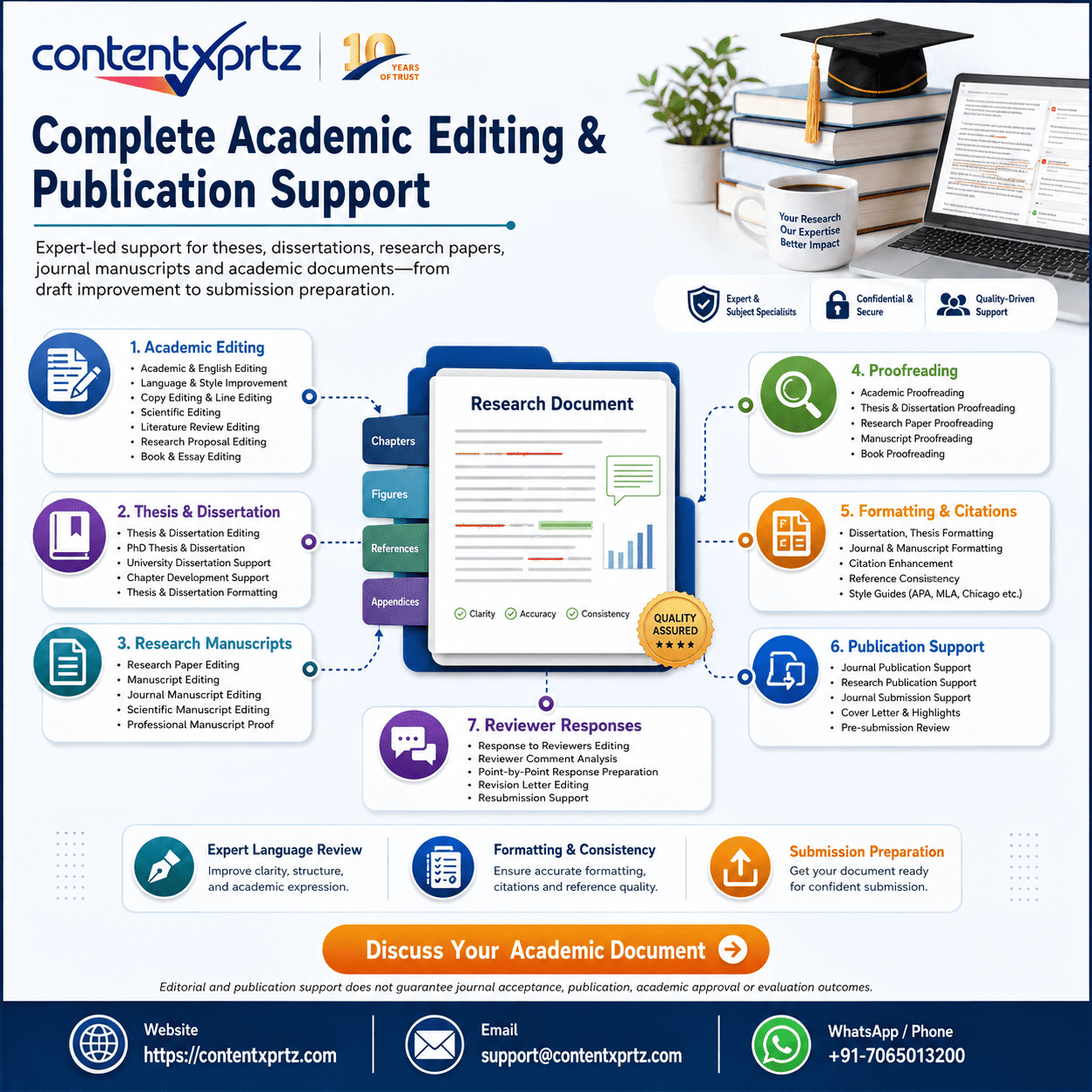
Contentxprtz can support students who already own the research and need clearer academic communication, stronger document organisation, more consistent language, or final quality control. Depending on the draft, relevant support may include thesis editing, professional editing, dissertation proofreading, reference consistency checks, and research-support feedback.
The most useful engagement begins with a defined scope. A near-final thesis may need proofreading only. A draft with repeated structural comments may need developmental editing. A multilingual thesis may need careful sentence-level language editing that protects technical meaning. None of these services can guarantee a grade, supervisor approval, or degree outcome, and none should replace the student's responsibility for research design, data, analysis, citations, and final submission.
If you are unsure what level of help fits the draft, use the thesis-focused CTA rather than ordering unrelated services: review thesis writing and editing support.
Summary: Master Thesis Writer
A master thesis writer is most useful when the role is defined ethically as consulting, editing, reviewing, coaching, or proofreading that strengthens a student's own work. The student should remain the intellectual owner of the thesis: defining the research problem, conducting or accurately reporting the research, selecting and verifying evidence, interpreting findings, and approving the final submission.
Use free and institutional resources first when they solve the problem. Supervisor feedback, writing centres, peers, citation managers, and structured self-editing are often enough. Professional support becomes more valuable when the document is long, multilingual, structurally inconsistent, technically complex, citation-heavy, or close to a high-stakes submission. The safest provider is transparent about scope, uses reviewable edits, refuses fabrication and guarantees, and respects university policy.
Frequently Asked Questions
What does a master thesis writer actually do?
A master thesis writer, used ethically, is better understood as a thesis writing consultant, academic editor, or subject-aware reviewer who helps the student improve a thesis the student owns intellectually. Appropriate support can include clarifying a research question, commenting on chapter structure, identifying gaps in argument flow, explaining academic conventions, editing language, checking consistency, and pointing out citation or formatting problems. The student should still make the research decisions, conduct or accurately report the research, interpret the evidence, write or substantially develop the thesis text, verify every source, and approve the final submission. The phrase can also be used online for services that offer to produce an entire thesis on a student's behalf. That arrangement may conflict with university rules on authorship, contract cheating, or permitted editing. Before using any service, check your institution's policy and ask for a transparent scope of work. Ethical support should strengthen your own scholarship rather than conceal who created it.
Is it ethical to hire a master thesis writer?
It can be ethical to hire professional thesis support when the service is limited to activities your university permits, such as language editing, proofreading, formatting, feedback, research coaching, or explaining academic writing conventions. It becomes risky when another person invents your research, writes substantial assessed content for you to submit as your own, fabricates references or data, or makes intellectual decisions that the degree candidate is expected to make. Policies differ between universities, departments, and programmes, so the safest step is to read the relevant thesis, academic integrity, and editing rules before work begins. Ask the provider to define exactly what they will and will not do, use tracked changes or comments where possible, and keep a record of the assistance received. The student remains responsible for every claim, citation, table, interpretation, and final submission. Ethical assistance should be visible, reviewable, and designed to improve the student's own work rather than replace it.
What is the difference between thesis writing, thesis editing, and proofreading?
Thesis writing develops ideas and text; thesis editing improves how existing ideas are organised and communicated; proofreading checks the near-final document for surface errors. In practice, the boundaries matter. Developmental or substantive editing may comment on chapter order, argument logic, repetition, transitions, and whether each section serves the research question. Copyediting focuses more closely on sentence clarity, grammar, academic tone, terminology, consistency, and style. Proofreading normally happens after major revisions and checks spelling, punctuation, numbering, cross-references, headings, tables, figures, and reference presentation. A responsible provider should tell you which level you are buying rather than using 'writing' as a vague label. For a master's thesis, this distinction protects authorship: advice and editing can improve communication, while wholesale ghostwriting can cross institutional integrity rules. Choose the lightest level of support that solves the actual problem.
Can a master thesis writer help with the literature review?
Yes, an ethical thesis consultant can help you improve a literature review without taking over the intellectual work. Useful support includes helping you define search concepts, organise an evidence matrix, distinguish summary from synthesis, group studies by theme or method, identify unsupported transitions, and check whether claims are linked to traceable sources. The consultant can also flag places where older or irrelevant evidence dominates and suggest questions you should investigate. What they should not do is fabricate sources, cite papers that were never read, invent findings, or write an entire assessed literature review for submission as if it were solely your work. You should verify every reference against the original source and follow your university's rules on permitted assistance. If language or structure is the main difficulty, academic editing can make your synthesis easier to follow while preserving your interpretation of the literature.
Can professional thesis support help with methodology and data analysis?
Professional support can help you communicate and review methodology, but the degree candidate must remain responsible for the research design, data, analysis choices, and conclusions unless the programme explicitly permits a different arrangement. A subject-aware reviewer may ask whether the research question aligns with the chosen method, whether inclusion criteria are described, whether variables or participants are defined consistently, whether limitations are acknowledged, and whether the analysis is explained clearly enough to reproduce or assess. Statistical or methodological consulting may also be permitted in some programmes if it is disclosed appropriately. The danger is outsourcing decisions you are expected to defend in a viva or examination. Never accept invented data, manipulated results, or references you cannot verify. Ask your supervisor what kinds of technical consultation are allowed, document the help received, and ensure you can explain every methodological choice in your own words.
How do I choose a trustworthy master thesis writer or editor?
Choose a provider by evaluating transparency, scope, subject fit, privacy, revision process, and ethics rather than promises of grades or guaranteed approval. Ask what level of editing is offered, whether changes are tracked, who makes substantive research decisions, how references are handled, what happens when a claim cannot be verified, and whether the service will respect your university's policy. A credible provider should be willing to say no to fabrication, ghost authorship, invented citations, or deceptive guarantees. Review a sample workflow if available and make sure the editor can work with your citation style, discipline, chapter structure, and deadline. Protect unpublished data and personally identifiable information by sharing only what is necessary and by checking confidentiality terms. Finally, choose someone whose feedback you can understand and evaluate. Good support leaves you more capable of defending the thesis; it should not create a document you no longer recognise as your own.
What should I send before professional master thesis editing begins?
Prepare the latest thesis file, your university or department guidelines, required citation style, supervisor comments that are relevant to the edit, and a short description of the support you want. If your institution limits third-party editing, include that policy so the editor can stay within scope. It also helps to identify the submission stage: early structural review, chapter-level revision, language editing, formatting, or final proofreading. For technical theses, provide a glossary or preferred terminology if consistency matters. Do not send unnecessary sensitive participant data or confidential material. If tables, figures, appendices, or references are included, specify whether they should be checked for numbering and cross-references. A clear brief prevents both under-editing and inappropriate over-editing. After receiving the edited file, review every change, resolve comments, recheck references, and make sure the final thesis still reflects your own reasoning and voice.
How much does a master thesis writer cost?
There is no universal price because ethical thesis support can mean very different things. Cost may depend on word count, subject complexity, level of editing, condition of the draft, citation or formatting requirements, turnaround time, and whether the work is a single chapter or a complete thesis review. Proofreading is usually lighter than developmental editing because it addresses a more stable near-final document, while deep structural feedback takes more expert time. Rather than comparing only a per-word figure, compare scope: what will be changed, what will only be commented on, whether references and tables are included, how many review rounds are provided, and whether the editor has relevant subject familiarity. Avoid services that combine unusually low prices with promises to write an entire thesis, guarantee approval, or supply unverifiable references. The most economical option is often to identify the real bottleneck first and purchase only the level of support you need.
Can AI replace a master thesis writer or human thesis editor?
AI tools can assist with limited tasks such as brainstorming search terms, checking readability, generating questions for self-review, or suggesting alternative wording, but they should not be treated as an unquestioned thesis author or source of facts. AI output can contain fabricated citations, inaccurate summaries, hidden assumptions, or wording that changes the meaning of your research. University policies on generative AI also vary and may require disclosure or prohibit particular uses in assessed work. A human academic editor adds contextual judgement about argument flow, disciplinary conventions, ambiguity, tone, and whether an edit preserves the author's intended meaning. If you use AI, verify every factual statement and reference against authentic sources, retain control of the reasoning, and follow institutional rules. Human review is especially valuable when the thesis contains specialised terminology, complex methodology, sensitive interpretation, or high-stakes final submission requirements.
When should I get master thesis editing or proofreading?
Seek editing when the research and core argument exist but the draft still has structural, clarity, flow, language, or consistency problems. Developmental feedback is most useful before the document is fully frozen, because major chapter changes can still be made without wasting a final proofread. Copyediting is appropriate after the main argument and evidence are stable. Proofreading should usually be the last quality-control pass after supervisor revisions, formatting, tables, figures, and references are close to final. If your deadline is near, prioritise the highest-risk issues rather than asking an editor to redesign the entire thesis at the last moment. Students who write in an additional language may also benefit from earlier language feedback so repeated patterns can be corrected across chapters. Whatever the timing, leave enough space to review every change yourself and confirm compliance with your programme's submission rules.
Conclusion: Choose Thesis Help That Makes Your Own Work Stronger
The real problem behind a search for a master thesis writer is usually not a lack of words. It is the challenge of turning months of research into a coherent, accurate, readable, and defensible academic document. The right support addresses the exact bottleneck without taking ownership away from the student.
Self-service support may be enough when the argument is stable and you have time to revise systematically. Expert-assisted editing or proofreading may be safer when language, structure, references, formatting, or document scale makes errors difficult to detect. In either case, academic integrity remains non-negotiable: verify sources, preserve accurate methods and data, follow university rules, and review every external contribution before submission.
Contentxprtz helps researchers improve clarity, structure, consistency, ethics, and thesis readiness while keeping the author's ideas and responsibility at the centre. “At Contentxprtz, we don’t just edit; we help ideas reach their fullest potential.”