What Is a PhD? Meaning, Requirements, Process and Career Value
What is a PhD? A PhD, short for Doctor of Philosophy, is an advanced doctoral research degree built around sustained, original investigation of a focused question or problem. A PhD student does far more than attend higher-level classes: the student learns how to work as an independent researcher, evaluate existing scholarship, design a rigorous study, analyse evidence, defend decisions, and communicate a contribution that meets the standards of a university and academic discipline.
For a prospective doctoral candidate, the phrase can sound deceptively simple. The reality varies across countries, disciplines, and universities. Some programmes begin with coursework, rotations, or qualifying examinations; others move quickly into supervised research. Some candidates write a monograph-style thesis, while others submit a thesis built around published papers. Laboratory scientists may spend years generating experimental data, while historians may work in archives, social scientists may conduct fieldwork or interviews, and theorists may develop proofs, models, or conceptual arguments.
The degree also carries practical questions: Do you need a master’s first? How many years does a PhD take? Is a PhD the same as a doctorate? What is the difference between a thesis and a dissertation? Do PhD students get paid? Is the degree worth the time and opportunity cost? These questions matter because doctoral study is not simply a qualification to collect. It is a multi-year research commitment that requires intellectual fit, supervision, funding, resilience, and a realistic view of the career paths that may follow.
This guide explains the degree in plain academic language and then moves into the parts applicants and current scholars actually need: entry routes, programme structure, supervision, research milestones, thesis and viva expectations, common mistakes, ethical writing responsibilities, and decisions about self-service versus professional PhD thesis support. Contentxprtz is included only where editing, proofreading, or structured academic communication can help a researcher present their own work more clearly and responsibly.
Quick Answer: What Is a PhD?
A PhD is a doctoral research degree that trains a student to become an independent researcher in a specific field. The candidate normally works under academic supervision, studies the existing literature, defines a research problem, chooses appropriate methods, produces and analyses evidence, and writes a thesis or dissertation that demonstrates a significant research contribution.
The exact path differs by university and country. In the United States, PhD programmes often combine graduate coursework, examinations, teaching, and later dissertation research. In the United Kingdom and some other systems, students may begin focused research earlier. The UK Quality Assurance Agency describes doctoral graduates as demonstrating an original contribution to knowledge or the original application of existing knowledge, while EducationUSA explains that US doctoral degrees typically involve comprehensive assessment and original research leading to a dissertation.
A PhD can prepare people for academic research and teaching, but it can also lead to specialist careers in industry, government, policy, data, consulting, laboratories, research organizations, publishing, and other sectors that value advanced analytical expertise.
Key Takeaways
- PhD means Doctor of Philosophy; the title applies across many disciplines, not only philosophy.
- The defining feature of a PhD is sustained, supervised research that makes an original contribution.
- Entry requirements vary: some programmes accept strong bachelor’s graduates, while others prefer or require a master’s degree.
- Duration varies by country, programme structure, funding, research design, and whether study is full-time or part-time.
- A thesis or dissertation is normally examined by experts and may be followed by an oral defence or viva.
- A PhD is useful beyond universities, but its career value depends on the field and the role you want.
- Editing and research support should improve clarity and presentation without replacing the researcher’s ideas, evidence, analysis, or authorship.
What This Page Covers
- The meaning of PhD, doctorate, DPhil, thesis, dissertation, and viva
- Typical entry requirements and whether a master’s degree is necessary
- How doctoral programmes move from admission to final examination
- How PhD study differs from bachelor’s and master’s study
- Costs, funding, workload, and realistic time commitments
- Practical examples of common doctoral decisions and mistakes
- When independent work is enough and when ethical academic editing may help
Table of Contents
Methodology and Academic Sources
This guide uses official university and education-sector descriptions to explain the broad characteristics of doctoral study while avoiding the mistake of treating one national model as universal. The UK Quality Assurance Agency doctoral degree characteristics statement describes the doctorate as a qualification involving original contribution to knowledge or the original application of knowledge. EducationUSA’s graduate study guidance explains that US doctoral degrees include original research leading to a dissertation and may include comprehensive examinations.
To illustrate programme variation, the University of Oxford’s research degree guidance notes that its DPhil is its name for a PhD and usually centres on a major thesis and viva, while Princeton Graduate School’s PhD advising guidance shows the importance of a faculty dissertation adviser and a defined research topic in the research stage. Readers should still verify the exact regulations, funding conditions, milestones, and editing rules of the university they are considering.
What Does PhD Mean in an Academic Context?
PhD stands for Doctor of Philosophy. The word “philosophy” is historical; it does not restrict the degree to the discipline of philosophy. A chemist, historian, computer scientist, linguist, engineer, economist, psychologist, or management researcher can all earn a PhD if their university offers a doctoral programme in that field.
A PhD is one type of doctorate. “Doctorate” is the broader category, while “PhD” is a particular research doctorate. Other doctoral qualifications may be professional or practice-focused, such as the Doctor of Education (EdD), Doctor of Business Administration (DBA), or discipline-specific professional doctorates. Their research expectations, taught elements, and intended career applications can differ.
PhD and DPhil: are they different?
Usually, the difference is naming rather than level. Oxford uses the term DPhil for its Doctor of Philosophy and explicitly describes it as its name for a PhD. Applicants should still compare programme regulations rather than assume that two doctorates with similar titles have identical structures.
What makes a PhD “doctoral”?
The central standard is not simply the length of the document or the number of courses completed. Doctoral work is expected to demonstrate advanced command of a field, rigorous research practice, and a defensible contribution that goes beyond merely summarising what is already known. The contribution might be a new empirical finding, method, interpretation, model, dataset, theory, application, synthesis, or evidence-based challenge to an established assumption.
What Are the Typical Requirements to Start a PhD?
PhD entry requirements vary widely, but universities usually look for evidence that an applicant can succeed in advanced research. A high grade alone is rarely the whole story. Departments also consider research preparation, fit with supervisors, subject knowledge, methods experience, writing ability, references, and the feasibility of the proposed direction.
| Requirement | What it helps the university assess |
|---|---|
| Previous degree(s) | Academic preparation and subject depth; may be bachelor’s, master’s, or both depending on the programme. |
| Academic transcripts | Performance in relevant courses and evidence of sustained academic ability. |
| Research proposal or statement | Clarity of research interests, feasibility, awareness of literature, and fit with the department. |
| Writing sample | Ability to construct an argument, use evidence, and communicate academically. |
| References | Independent assessment of research potential, reliability, and academic readiness. |
| CV or résumé | Research, work, teaching, publication, technical, or field experience. |
| Language evidence | Ability to study and write in the programme’s language where required. |
| Interview or supervisor discussion | Research fit, communication, motivation, and understanding of the proposed project. |
Do you need a master’s before a PhD?
No universal rule applies. Many US programmes admit students after a bachelor’s degree and incorporate master’s-level training into the PhD. Some UK and international programmes accept strong bachelor’s graduates, while others prefer or require a master’s degree. Integrated doctoral routes may combine taught and research stages. Always check the programme itself.
Does your previous degree have to match your PhD exactly?
Not always. Interdisciplinary doctoral research is common, but the applicant still needs enough foundational knowledge and methods preparation to undertake the proposed work. A candidate moving from engineering into health data science, for example, may be well prepared computationally but need additional training in clinical research methods or ethics. A convincing application explains both the transferable strengths and the gaps that will be addressed.
How Does a PhD Work from Admission to Graduation?
A PhD is best understood as a sequence of research decisions and milestones rather than one long writing task. The details differ across systems, but the following stages are common.
1. Define a research direction and supervision fit
Before or shortly after admission, the project must become specific enough to be researchable. Strong doctoral questions are important, bounded, feasible, and connected to a real gap or unresolved problem. Supervisors help the student refine the scope without owning the project for them.
2. Complete required training or coursework
Some programmes require courses in theory, methods, statistics, languages, teaching, or professional development. Others require less formal coursework but still expect research training and milestone reviews. A student should know which elements are mandatory and how progression is assessed.
3. Conduct the literature review
The literature review maps what is known, how it has been studied, where scholars disagree, and why the proposed research is necessary. It should not become an endless collection exercise. The purpose is to position the study and justify the research question, concepts, and methods.
4. Finalise the research design and approvals
Empirical projects may need ethics approval, data-access permissions, laboratory protocols, fieldwork plans, archival access, participant recruitment, preregistration, or data-management procedures. Weak planning here can delay the entire degree.
5. Generate, collect, or analyse evidence
This is the core research stage. Depending on the discipline, it can involve experiments, simulations, interviews, surveys, archival analysis, textual interpretation, field observation, software development, mathematical proof, secondary datasets, or combinations of methods.
6. Review progress and refine the project
Doctoral projects evolve. Universities often require annual reviews, confirmation or upgrade milestones, committee meetings, or candidacy examinations. These checkpoints are not only bureaucratic; they help determine whether the project is sufficiently focused, rigorous, and feasible.
7. Write and revise the thesis or dissertation
Writing should begin before the final year. Methods notes, literature matrices, analytic memos, results drafts, and chapter outlines reduce the risk of trying to reconstruct years of reasoning at the end. Researchers who need language or structural help can use ethical academic editing services, provided the university permits external editing and the intellectual work remains the candidate’s own.
8. Submit and complete the final examination
Many systems use an oral examination, commonly called a viva voce or dissertation defence, in addition to the written thesis. Examiners test the candidate’s understanding of the project, methods, findings, limitations, and contribution. Outcomes may include immediate approval, minor corrections, major revisions, resubmission, or other categories defined by the institution.
How Is a PhD Different from a Master’s Degree or Professional Doctorate?
A master’s degree usually develops advanced subject knowledge and may include a research dissertation, but it is generally shorter and more structured. A PhD demands a deeper level of independent research and an original contribution. The candidate is not only learning what a field already knows; they are expected to produce defensible new knowledge, interpretation, or application.
| Feature | Master’s | PhD | Professional doctorate |
|---|---|---|---|
| Primary emphasis | Advanced learning, professional or research preparation | Original research and independent scholarship | Advanced practice plus applied research |
| Research project | May be optional or substantial | Central requirement | Usually central but often practice-oriented |
| Typical structure | Mostly taught or mixed | Research-led; coursework varies | Often combines taught modules and research |
| Outcome | Specialist knowledge and skills | Doctoral-level contribution to knowledge | Doctoral-level contribution to professional practice or applied knowledge |
These are general patterns, not universal definitions. Programme documentation is the final authority.
How Long Does a PhD Take, and What Does It Cost?
The most accurate answer is: long enough to complete the programme’s required training, research, thesis, and examination within its formal registration rules. Full-time UK research doctorates are often designed for roughly three to four years, while US doctorates frequently take longer because they may include a substantial pre-dissertation phase. Part-time study can take significantly longer.
Funding matters as much as tuition
Applicants should calculate the complete cost of doctoral study: tuition or programme fees, living costs, health insurance where applicable, research travel, fieldwork, equipment, software, conferences, visa costs, and the income they may forego by studying full-time. A funded offer may include tuition, a stipend, teaching work, research-assistant pay, or a combination. Conditions differ, so check what is guaranteed, for how long, and what performance or work obligations apply.
Do PhD students get paid?
Some do, some receive scholarships or stipends, some are employed on research projects, and others self-fund. Payment models vary by country and institution. Never assume that “PhD student” automatically means salaried employee or fully funded scholar. Read the funding letter carefully and compare the funding period with the expected programme duration.
When Is Self-Service Support Enough, and When Can Expert Editing Help?
Most doctoral work should remain firmly under the researcher’s control. Supervisors, librarians, writing centres, peer groups, statistical consulting services, and university training can solve many problems without external commercial help. Self-service support is usually enough when the candidate understands the argument, methods, and evidence and mainly needs routine checks, reference-manager cleanup, or feedback from people already within the academic environment.
Expert editing becomes more useful when the intellectual content is sound but the writing is difficult to follow, terminology is inconsistent, grammar obscures meaning, the thesis has grown structurally uneven, or institutional formatting is complex. A researcher working in English as an additional language may particularly benefit from scholarly proofreading after the substantive research is complete.
The safest boundary is straightforward: editing may improve expression, organization, consistency, and presentation, but it should not invent arguments, fabricate references, create data, perform undisclosed analysis, or replace the candidate’s authorship.
Ethical Academic Editing and Author Responsibility During a PhD
A doctoral thesis is examined as the candidate’s scholarly work. That makes transparency and authorship responsibility essential. The student remains responsible for the research question, methods, data, analysis, interpretations, citations, and final submitted text, even when other people provide feedback.
University editing policies differ. Some institutions permit language editing but restrict substantive rewriting; others require disclosure of particular forms of assistance. Before paying for external help, check the graduate school handbook, thesis regulations, departmental guidance, and supervisor advice. If AI tools are used, follow the institution’s current policy and verify outputs carefully rather than treating generated text or citations as authoritative.
A credible ethical editing service should preserve the author’s meaning, avoid invented citations or claims, and make the scope of support clear. For a thesis, good editing often focuses on readability, transitions, consistency, sentence-level accuracy, referencing format, and presentation after the scholar has completed the underlying thinking.
Common Mistakes Prospective and Current PhD Students Should Avoid
Choosing the title instead of the research problem
“I want a PhD” is not yet a research reason. Start with the field, questions, problems, methods, and career implications. A doctorate is more sustainable when curiosity and project fit come before status.
Applying without supervisor or department fit
A strong university may still be a poor choice if no one can supervise the project effectively. Read faculty research profiles, recent publications, laboratory or group priorities, and doctoral outcomes.
Making the proposal too broad
Ambitious doctoral projects often fail because the scope is impossible. A precise question completed rigorously is stronger than a huge question answered superficially.
Ignoring funding details
Compare stipend, tuition coverage, fees, duration, teaching duties, health costs, and location expenses. A prestigious offer with inadequate funding can create avoidable pressure.
Waiting too long to write
Writing is part of thinking. Draft literature notes, methods rationales, results summaries, analytic memos, and chapter plans as the project develops.
Treating editing as ghostwriting
A thesis must remain the scholar’s own intellectual work. External support should clarify and polish, not conceal authorship or manufacture scholarship.
Practical Examples: What PhD Decisions Look Like in Real Life
Example 1: The bachelor’s graduate unsure about a master’s
Riya has a strong computer science degree and two years of research-assistant experience. She assumes every PhD requires a master’s, so she plans to spend two years on another degree before applying. The better approach is to check the entry rules of her target programmes. Some US PhDs may admit her directly and provide coursework within the doctorate, while certain European programmes may prefer a master’s. Ethical guidance helps her compare programme structures rather than pushing a single route.
Example 2: The doctoral scholar with a thesis that reads like separate papers
Daniel has completed his studies and analyses, but each thesis chapter was written at a different stage and the terminology has drifted. His mistake would be to assume that correcting grammar alone will solve coherence. He first needs to clarify the overall argument, chapter relationships, and contribution statement. After that, professional thesis editing support can help standardize language, transitions, formatting, and consistency without changing his research claims.
Example 3: The professional considering a PhD for career advancement
Meera works in public policy and enjoys evidence synthesis, but she does not intend to become a professor. She assumes a PhD is unnecessary outside academia. Instead of rejecting the idea automatically, she reviews senior roles in research institutes, government, think tanks, and consulting. She discovers that some roles value doctoral research expertise while others value applied experience more. Her decision becomes a career-fit analysis rather than a prestige decision.
Example 4: The ESL researcher using grammar software for final submission
Jin’s thesis is methodologically strong, but automated grammar suggestions occasionally change technical meaning. The error is accepting every correction because the tool labels it “clearer.” He reviews changes against disciplinary terminology and supervisor guidance, then uses human proofreading for high-risk passages. The goal is not to make the thesis sound generic; it is to make Jin’s own argument precise and readable.
PhD Readiness and Publication-Quality Writing Checklist
- Research motivation: Can you explain the problem you want to investigate, not only the degree you want?
- Programme fit: Does the department have supervisors, methods expertise, facilities, data access, or archives relevant to your project?
- Entry route: Have you checked whether a master’s is required, preferred, or unnecessary?
- Funding: Do you understand tuition, stipend, employment status, funding duration, and living costs?
- Research feasibility: Can the project be completed with the available time, participants, equipment, data, permissions, and skills?
- Supervision: Do you understand how often you will meet, who else may advise you, and how progress is reviewed?
- Writing plan: Will you draft and organize material throughout the degree rather than only at the end?
- Ethics: Have you checked research ethics, data management, authorship, AI-use, and external editing rules?
- Career value: Is the PhD required, preferred, or simply optional for the work you want to do?
- Support: Do you know when to use supervisors, librarians, writing centres, peers, methods advisers, and ethical editing services?
How Contentxprtz Can Help PhD Scholars
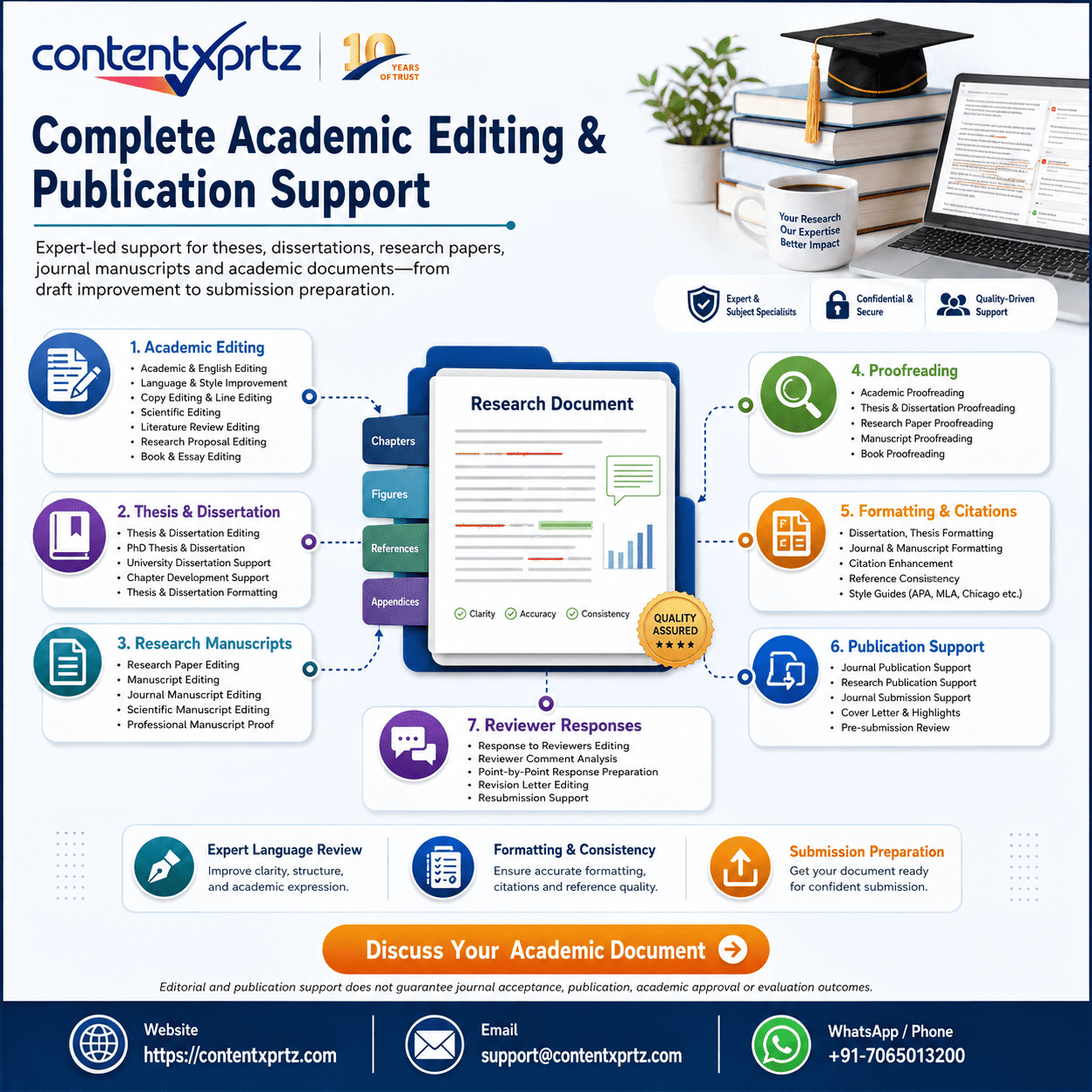
Contentxprtz supports doctoral researchers who already own the research and need help communicating it clearly. Relevant services can include thesis editing, dissertation support, and academic editing focused on language, structure, coherence, style, and presentation.
The role of an editor is not to become the researcher. Good support protects the scholar’s meaning, keeps claims traceable to evidence, respects university policies, and leaves final decisions with the author. This is especially valuable during final submission, when a researcher is too familiar with the document to notice inconsistent terminology, awkward transitions, formatting drift, or sentences that are technically correct but difficult to interpret.
Summary: What Is a PhD?
A PhD is a research doctorate designed to develop advanced expertise and independent scholarly capability. Its central requirement is a substantial piece of original research, normally documented in a thesis or dissertation and assessed by academic experts. The programme may also include coursework, examinations, teaching, professional training, progress reviews, and an oral defence.
The degree is not identical across countries, so prospective candidates should verify entry requirements, supervision, duration, funding, thesis format, and assessment rules for each programme. A PhD can support academic and non-academic careers, but it is most valuable when it aligns with a genuine research interest and a realistic career goal.
For current scholars, strong research is only part of doctoral success. Clear writing, accurate citation, coherent structure, and ethical presentation help examiners understand the contribution. Self-service tools and university resources may be sufficient for many tasks; expert editing becomes useful when language or structure prevents strong research from being communicated effectively.
Frequently Asked Questions About PhDs
What is a PhD in simple terms?
A PhD, or Doctor of Philosophy, is an advanced doctoral research degree in which a student develops deep expertise in a focused field and completes a substantial piece of original research. Despite the word “philosophy,” PhDs are awarded across sciences, engineering, humanities, social sciences, business, education, and many other disciplines. The exact structure varies by country and university. Some programmes include substantial coursework and examinations before the dissertation stage, while others begin with supervised research much earlier. In most cases, the candidate works with one or more academic supervisors, studies existing scholarship, designs a research project, collects or analyses evidence, writes a thesis or dissertation, and completes a final examination such as a viva or dissertation defence. A PhD is therefore not simply “more classes after a master’s.” Its defining feature is sustained independent research and a contribution to knowledge or understanding. The degree also develops transferable skills in critical thinking, project management, academic writing, data or textual analysis, communication, and problem solving.
What does PhD stand for, and why is it called Doctor of Philosophy?
PhD stands for Doctor of Philosophy, from the Latin expression philosophiae doctor. The name is historical and does not mean that every PhD student studies philosophy as an academic subject. In this context, “philosophy” reflects the older idea of the pursuit of knowledge. Universities now award PhDs in fields ranging from physics and computer science to literature, sociology, economics, nursing, and management. Some universities use a different abbreviation for an equivalent research doctorate. Oxford, for example, calls its PhD a DPhil; the qualification is still a Doctor of Philosophy. Other doctorates may use titles such as EdD, DBA, EngD, or professional doctorate, and their structure or purpose may differ. When comparing programmes, focus less on the abbreviation and more on the university’s stated learning outcomes, research expectations, supervision model, assessment process, entry requirements, and recognition in your discipline.
Do you need a master’s degree before starting a PhD?
Not always. Whether a master’s degree is required depends on the country, university, department, and field. In the United States, many students enter PhD programmes after a bachelor’s degree and complete graduate coursework, examinations, and research training within the doctoral programme. In the United Kingdom and some other systems, applicants may enter a PhD directly with a strong undergraduate degree, while other programmes prefer or require a relevant master’s degree, especially when advanced methods training is important. Some doctoral routes are structured as integrated or 1+3 programmes that combine a master’s year with doctoral research. The right approach is to check the official admissions page for the exact programme rather than assume a universal rule. A master’s can strengthen preparation by providing subject depth, research methods experience, and a substantial dissertation, but it is not automatically mandatory everywhere.
How long does a PhD usually take?
A PhD commonly takes several years, but there is no single global duration. Many full-time research doctorates in the UK are designed around roughly three to four years, while US PhD programmes often take longer because they may include substantial coursework, examinations, teaching, and a later dissertation stage. Part-time study can extend the timeline considerably. Fieldwork, laboratory experiments, access to archives, recruitment of research participants, ethics approval, funding conditions, publication plans, leave periods, and the complexity of the thesis can all affect completion time. The most reliable estimate is the normal and maximum registration period published by the specific university. Applicants should also distinguish funded duration from total permitted registration: a scholarship may fund a certain number of years even if the university allows more time for completion. Planning should therefore include research scope, supervision, milestones, finances, and realistic writing time rather than relying on a single average number.
What is the difference between a PhD thesis and a dissertation?
The terms thesis and dissertation are used differently across countries and institutions. In many UK, European, Indian, and Commonwealth contexts, the major research document submitted for a doctorate is commonly called a PhD thesis. In the United States, “dissertation” is widely used for the doctoral research document, while “thesis” is often used for a master’s research project. However, terminology is not universal, so students should follow their own university’s regulations. Regardless of the label, the doctoral document normally explains the research question, scholarly context, methodology, evidence or analysis, findings, interpretation, limitations, and contribution. It must meet disciplinary and institutional standards for originality, rigor, structure, citation, and presentation. Editing can improve clarity and consistency, but the research, argument, analysis, and conclusions must remain the candidate’s own work unless institutional rules explicitly permit a particular kind of collaborative contribution.
Is a PhD only for people who want to become professors?
No. Academic careers are one possible path, but a PhD can also lead to research, technical, analytical, policy, consulting, data, innovation, government, nonprofit, publishing, and specialist roles outside universities. The value of a doctorate depends on the field and the role. In some careers, a PhD is essential or strongly preferred because the work requires advanced research expertise. In others, equivalent professional experience may be more valuable. Prospective students should therefore avoid treating the degree as a generic status credential. Instead, examine the jobs you realistically want, talk to people in those roles, study labour-market requirements, and compare the opportunity cost of several years of doctoral study with alternative routes. A strong PhD experience can develop research independence, complex problem solving, communication, project management, and resilience, but the degree should fit a clear intellectual or professional objective.
How difficult is a PhD compared with a master’s degree?
A PhD is usually more demanding in a different way, not simply because every task is academically harder. A master’s programme often has a clearer timetable, taught modules, defined assignments, and shorter research projects. A PhD requires the student to operate with much greater independence, tolerate uncertainty, define and refine a research problem, manage a multi-year project, respond to criticism, and produce work that meets doctoral standards. Progress can be non-linear: experiments fail, archives are incomplete, participants are difficult to recruit, methods need to change, or chapters require multiple revisions. Strong supervision, realistic scope, research training, peer support, and disciplined project management matter as much as raw intelligence. The challenge also varies by field and individual circumstances. Students should understand the programme’s support system, milestones, funding, workload, and expectations before enrolling.
Can you use the title Doctor after completing a PhD?
In many countries and professional contexts, a person who has been formally awarded a PhD may use the title “Dr.” before their name. Conventions differ by country, institution, profession, and style guide, and the title should not be used in a way that creates confusion about medical qualifications or regulated professional status. Some academics prefer to use their post-nominal letters, such as PhD, rather than the prefix. The important point is that the doctoral title follows the official award of the degree, not simply enrolment or submission of a thesis. Candidates should wait until the university has formally confirmed completion according to its rules. In biographies, publications, or professional profiles, it is also good practice to state the person’s field or role clearly when context matters.
What are the typical PhD entry requirements?
Typical PhD entry requirements include a strong prior academic record, evidence of research potential, fit with the proposed field, and the ability to work at an advanced level. Depending on the programme, applicants may need a bachelor’s or master’s degree, academic transcripts, a research proposal or statement of purpose, writing samples, references, a CV, English-language evidence, and sometimes standardized tests or interviews. Research-intensive programmes may also expect applicants to identify potential supervisors or demonstrate that their interests align with an existing research group. Requirements vary significantly, so generic advice should never replace the official programme page. A strong application usually shows a feasible research direction, awareness of relevant literature, appropriate methods preparation, and a convincing reason for pursuing doctoral work in that department. It is better to present a focused, realistic project than an overly broad idea that cannot be completed within the available time and resources.
When can professional editing or PhD support be useful?
Professional support can be useful when a doctoral researcher needs help improving the clarity, structure, language, consistency, or presentation of work while remaining responsible for the research and ideas. Ethical academic editing may help an ESL scholar express complex arguments more clearly, identify ambiguous sentences, improve chapter flow, standardize terminology, check formatting, or align references with a required style. It can also help a candidate prepare a thesis for submission after the substantive research and analysis are complete. The boundary is important: an editor should not invent data, fabricate references, write a thesis in place of the candidate, conceal authorship, or make disciplinary decisions that belong to the researcher and supervisor. Students should check their university’s policy on permitted editing before using external assistance. Contentxprtz offers thesis and academic editing support designed to improve communication and presentation while preserving author responsibility and institutional requirements.
Conclusion: Deciding Whether a PhD Is the Right Next Step
Understanding what a PhD is should make the decision more concrete. It is not simply the “highest degree” or a longer version of a master’s. It is a structured period of advanced research in which you become responsible for defining a problem, producing evidence or analysis, defending your choices, and communicating a contribution that experts can examine.
If your goal can be reached through professional experience, a master’s degree, specialist certification, or shorter research training, a PhD may not be necessary. If your intended career depends on deep research expertise, or you have a question you are prepared to investigate for several years, doctoral study can be a strong fit. The right choice depends on programme quality, supervision, funding, research feasibility, and career alignment.
During the degree, university resources and self-service tools can handle many needs. When the research is complete but the thesis requires clearer structure, stronger academic language, or consistent presentation, Contentxprtz can provide ethical editing support through its research and academic editing service. The scholar remains responsible for the ideas, data, analysis, citations, and final submission.
At Contentxprtz, we don’t just edit; we help ideas reach their fullest potential.