Is PhD Harder Than MBBS? A Practical Comparison for Students
Is PhD harder than MBBS? There is no universal winner because the two qualifications are difficult in fundamentally different ways. MBBS is usually harder in terms of dense prescribed learning, frequent examinations, clinical responsibility, long practical schedules, and the need to apply knowledge safely around patients. A PhD is often harder in terms of uncertainty, self-direction, original research, long periods without a clear answer, repeated revision, and the pressure to produce a defensible contribution to knowledge.
For a student choosing between medicine and doctoral research, the useful question is not “Which degree is objectively tougher?” but “Which kind of difficulty matches my strengths, motivation, and career goal?” Someone who thrives on structured study, rapid recall, teamwork, clinical decision-making, and continuous practical training may find the MBBS pathway demanding but meaningful. Someone who enjoys independent investigation, deep reading, writing, methodological problem-solving, and working for months on questions with uncertain outcomes may find a PhD challenging in a different, more open-ended way.
The comparison also depends on country, discipline, institution, supervisor, medical school, research design, funding, personal circumstances, and what happens after graduation. In India, for example, the University Grants Commission states that a PhD normally has a minimum duration of three years, including coursework, while medical education is governed by the National Medical Commission through undergraduate medical education and internship requirements. Those formal structures help explain why the day-to-day experience differs, but they do not turn difficulty into a simple numerical score.
This guide compares PhD and MBBS across workload, duration, assessment, research pressure, practical responsibility, writing, uncertainty, finances, and career development. It is written for students and early-career researchers who want a realistic decision framework rather than a prestige contest. Where academic writing becomes a bottleneck, ethical PhD thesis help or academic editing services can support clarity and presentation without replacing the scholar’s research, analysis, or authorship.
Quick Answer: Is PhD Harder Than MBBS?
A PhD is not simply harder than MBBS, and MBBS is not simply harder than a PhD. MBBS tends to impose a more structured and clinically intensive workload: students must master a large syllabus, pass repeated assessments, develop practical competence, attend clinical postings, and learn to work responsibly in healthcare settings. The pressure can be immediate because errors in clinical learning have real-world implications and professional standards are strict.
A PhD tends to create a different type of pressure. The scholar must formulate or refine a research question, master a specialised literature, design and conduct research, solve unexpected methodological problems, interpret ambiguous results, write a long thesis, respond to supervisory criticism, and defend the originality and quality of the work. Progress is less predictable, and there may be no model answer.
If you are deciding between them, compare the kind of challenge rather than the label. MBBS rewards disciplined study, clinical stamina, communication, practical judgement, and consistency. A PhD rewards intellectual independence, persistence, tolerance for uncertainty, analytical depth, research design, and sustained academic writing.
Key Takeaways
- MBBS and PhD are difficult for different reasons; direct ranking is usually misleading.
- MBBS is generally more structured, exam-heavy, clinically intensive, and schedule-driven.
- A PhD is generally more self-directed, uncertain, research-intensive, and writing-heavy.
- Medical students face practical and professional responsibility; PhD scholars face originality and research-validity pressure.
- Personality and motivation strongly affect which route feels harder.
- Duration alone does not determine difficulty because the learning model and assessment system differ.
- The best choice is the pathway that aligns with the work you want to do after graduation.
What This Page Covers
- Why “harder” means different things in medicine and doctoral research
- A side-by-side comparison of workload, exams, research, writing, and uncertainty
- How duration and assessment differ between the two routes
- Which skills make MBBS or PhD more manageable
- Common misconceptions students should avoid
- Practical examples of learners who may prefer one pathway over the other
- A decision checklist for choosing based on career fit rather than prestige
Table of Contents
Methodology and Academic Sources
This comparison uses official higher-education and medical-education frameworks where relevant and distinguishes formal programme requirements from personal experience. For Indian doctoral study, the University Grants Commission PhD regulations provide the regulatory baseline. For undergraduate medicine, the National Medical Commission rules and regulations provide the current official framework for MBBS education and internship-related standards.
Because “difficulty” is subjective, this article does not treat one degree as universally superior or more demanding. Instead, it compares the type of work, degree of structure, responsibility, assessment, independence, and uncertainty. Students should also check the current rules of their university, medical college, research institution, and professional regulator because programme details can change.
What Does “Harder” Actually Mean in PhD vs MBBS?
Difficulty has several dimensions, and PhD and MBBS score differently across them. A programme can be difficult because of the amount of material, the number of hours, the emotional load, the level of responsibility, the uncertainty of outcomes, the competitiveness of admission, or the standard of independent thinking expected at the end.
MBBS usually has a defined curriculum and a comparatively clear progression. Students know which subjects, competencies, practical skills, examinations, clinical postings, and internship responsibilities they must complete. The content load is large, and the pace can be relentless, but the destination is visible.
A PhD is less predictable. The scholar may begin with a proposal that changes after a literature review, pilot study, failed experiment, unavailable dataset, reviewer-style criticism, or a new finding in the field. Progress can involve long periods of reading, coding, fieldwork, laboratory work, data cleaning, analysis, rewriting, and waiting. A successful PhD requires not merely learning existing knowledge but producing and defending a contribution that is sufficiently original and rigorous for the discipline.
Five useful dimensions of difficulty
- Volume: How much prescribed knowledge or work must be completed?
- Intensity: How demanding is the weekly schedule?
- Responsibility: What are the consequences of mistakes?
- Uncertainty: How clear is the path from effort to completion?
- Independence: How much must the learner decide without a fixed answer key?
Using these dimensions produces a fairer comparison than asking which title sounds more prestigious.
PhD vs MBBS Difficulty: Side-by-Side Comparison
MBBS is generally more structured and clinically intensive, while a PhD is generally more independent and uncertain. The table below summarises the contrast without assuming that every university or medical school works identically.
| Dimension | MBBS | PhD |
|---|---|---|
| Learning model | Prescribed curriculum, classes, labs, clinical postings, supervised practice | Research-led, highly specialised, progressively independent |
| Knowledge demand | Very broad biomedical and clinical knowledge | Very deep knowledge in a narrow research area |
| Assessment | Frequent written, practical, clinical, and competency-based assessment | Coursework where applicable, progress review, research outputs, thesis, viva/defence |
| Uncertainty | Moderate; syllabus and competencies are comparatively defined | High; results, methods, timelines, and research direction can change |
| Practical responsibility | High during clinical training and internship under supervision | High for research integrity, data quality, methods, and claims |
| Writing demand | Important, but usually not the dominant requirement during the degree | Central: proposal, reviews, chapters, papers, revisions, thesis |
| Daily structure | Usually tightly scheduled | Often self-managed, varying by lab, field, project, and supervisor |
| Main psychological challenge | Workload, exams, clinical pressure, fatigue, responsibility | Ambiguity, isolation, slow progress, criticism, repeated revision |
| Completion challenge | Meet defined academic and clinical requirements | Produce a defensible original contribution and complete an accepted thesis |
The comparison shows why students can have opposite experiences. A person who dislikes uncertainty may find a PhD especially stressful even if they are academically strong. A person who struggles with rapid recall, practical examination, and highly structured schedules may find MBBS more difficult.
Where MBBS Can Feel Harder Than a PhD
MBBS can feel harder because the workload is broad, continuous, practical, and closely tied to professional competence. Medical students do not study only one narrow specialty. They build knowledge across anatomy, physiology, pathology, pharmacology, microbiology, medicine, surgery, paediatrics, obstetrics and gynaecology, community medicine, and other areas while learning clinical reasoning and communication.
1. The syllabus is broad and cumulative
Medical knowledge builds layer by layer. A weakness in foundational science can make later clinical reasoning more difficult. Students must retain large amounts of information while learning when and how to apply it. This combination of breadth and application can be exhausting even for students with strong memory.
2. Clinical learning adds real-world pressure
Clinical education involves people, not only textbooks. Students learn history-taking, examination, communication, documentation, teamwork, and professional conduct under supervision. The seriousness of healthcare makes accuracy and ethical behaviour important from early training onward.
3. Assessment is frequent and varied
Medical students may face theory examinations, practical examinations, clinical assessments, viva voce, internal assessment, skill demonstrations, and competency requirements. Different assessment formats demand different preparation strategies.
4. Time is heavily structured
Classes, laboratory sessions, postings, ward-based learning, study, and internship duties can leave limited control over the timetable. Even when the pathway is clear, the weekly intensity can be high.
5. Professional identity develops early
Students are preparing for a regulated profession with ethical and clinical obligations. The pressure to become dependable, communicate sensitively, and make safe decisions can make the degree emotionally demanding in a way that is different from most research programmes.
Where a PhD Can Feel Harder Than MBBS
A PhD can feel harder because there is often no fixed syllabus, no guaranteed result, and no simple relationship between time spent and progress made. The scholar must learn to work productively when the answer is unknown.
1. You must create knowledge, not only learn it
A doctoral researcher is expected to identify a worthwhile question, understand the literature, select or develop an appropriate method, collect or generate evidence, analyse it, and explain what the work contributes. The challenge is not merely knowing what other researchers have said. It is showing what your own study adds.
2. Research can fail without anyone being at fault
An experiment may not work. Recruitment may be slower than expected. A dataset may be incomplete. A field site may become inaccessible. Statistical assumptions may fail. A theoretical idea may not survive contact with the evidence. A negative or ambiguous result can still be valuable, but the scholar must decide what it means and how to proceed.
3. Progress depends on self-management
In many PhD programmes, nobody gives the researcher a daily checklist. Long-term planning, meeting preparation, reading, analysis, writing, version control, data management, and milestone tracking become part of the job. Freedom can be intellectually rewarding, but it can also expose weaknesses in time management.
4. Academic writing is a core research skill
A thesis must explain the problem, justify the methods, position the research within existing scholarship, present results accurately, discuss limitations, and make defensible conclusions. Researchers writing in a second language may have strong ideas but still need substantial revision for clarity and consistency. Ethical dissertation proofreading support can help with language-level issues, while substantive decisions must remain with the researcher and supervisor.
5. Feedback can require major rethinking
Supervisory comments, committee reviews, peer review, or a viva may reveal that a chapter needs restructuring, a claim is too strong, a method requires further justification, or a discussion does not adequately engage with the literature. Rewriting is not a side task in doctoral work; it is often how the argument becomes rigorous.
Researchers preparing publications alongside a thesis may also use manuscript editing and publication support for presentation, formatting, or response organisation, while retaining responsibility for the research and all scientific claims.
Duration, Exams, and Assessment: Which Route Is More Demanding?
MBBS usually concentrates difficulty into a highly structured professional curriculum, while a PhD spreads difficulty across a longer and more variable research process. Duration should therefore be read together with assessment style.
For Indian PhD programmes covered by the UGC regulations, the formal minimum duration is three years including coursework, with the regulatory framework also setting a normal maximum duration. In practice, completion time can vary according to research design, institutional rules, fieldwork, data collection, publications, supervisory processes, and personal circumstances. Students should confirm the current rules for their own institution rather than assuming that every doctorate follows the same timeline.
For MBBS, the National Medical Commission governs undergraduate medical education and internship standards. The pathway is structured around specified competencies and supervised clinical training. Because medical education regulations can be amended, applicants should use the current NMC documents and their college’s official academic schedule rather than relying on an old year-by-year chart from a coaching website.
Assessment pressure is different
MBBS students often know when major examinations are coming and what broad curriculum they cover. This creates intense peaks of preparation. PhD scholars may have fewer conventional examinations but face continual evaluation of research quality. A thesis chapter can be revised many times, a paper can receive major reviewer comments, and a viva can test whether the candidate truly understands the choices, limitations, and contribution of the project.
In other words, MBBS assessment is usually more frequent and standardised; PhD assessment is usually less frequent but more open-ended and individually focused.
Which Personality and Skill Set Makes Each Degree Easier?
The route that fits your working style can feel more manageable even when it is objectively demanding. Interest does not remove hard work, but it changes how sustainable that work feels.
You may be better suited to MBBS if you enjoy:
- Learning a large body of established scientific and clinical knowledge
- Working to a structured timetable and clear competency framework
- Interacting with patients and multidisciplinary teams
- Making decisions under time pressure with supervision
- Practical skills, observation, communication, and applied reasoning
- Continuous assessment and visible milestones
You may be better suited to a PhD if you enjoy:
- Investigating a narrow question in great depth
- Reading critically and identifying gaps or contradictions
- Designing methods and solving unfamiliar research problems
- Working independently for long periods
- Writing, revising, analysing, and defending an argument
- Accepting uncertainty and changing direction when evidence requires it
A student can possess both sets of strengths. Clinician-scientists, medical researchers, and doctors who later complete PhDs show that the pathways can intersect. The comparison is about primary training demands, not fixed personality types.
Common Mistakes When Comparing PhD and MBBS
The biggest mistake is treating difficulty as a prestige ranking. Both routes require serious commitment, but they prepare people for different kinds of work.
Mistake 1: Comparing only the number of years
A longer programme is not automatically harder. A shorter programme with intense clinical schedules can be exceptionally demanding, while a longer research programme can be difficult because progress is uncertain and highly independent.
Mistake 2: Assuming a PhD is “just writing a thesis”
The thesis is the written record of a much larger research process. Before the final document exists, the scholar may spend years on literature review, ethics approval, data collection, experiments, coding, analysis, failed approaches, conference feedback, manuscripts, and revision.
Mistake 3: Assuming MBBS is “just memorisation”
Memory matters in medicine, but clinical competence also requires reasoning, communication, observation, practical skill, professionalism, and the ability to integrate information under pressure.
Mistake 4: Choosing based on social status
A degree is a poor fit if the day-to-day work does not suit you. Choose medicine because you genuinely want the responsibilities of healthcare. Choose a PhD because you genuinely want to conduct sustained research in a field.
Mistake 5: Ignoring the post-degree career
The correct comparison includes what happens after graduation. A medical graduate may continue into postgraduate training, practice, research, public health, or other medical careers. A PhD graduate may move into academia, industry R&D, policy, consulting, data-intensive roles, teaching, or research management. The destination should influence the choice.
Practical Examples: Who Might Find Which Route Harder?
Realistic examples make the difference clearer because the same workload can affect two students very differently.
Example 1: The strong memoriser who dislikes ambiguity
Arjun studies efficiently from a syllabus, performs well in timed exams, and likes clear performance targets. He becomes frustrated when a task has no obvious endpoint. He may still find MBBS exhausting, but the structured curriculum could suit him better than a PhD project where a research question evolves for months.
Example 2: The deep thinker who dislikes packed schedules
Nisha enjoys reading one topic for days, comparing theories, and writing analytical arguments. She needs time to think and dislikes back-to-back practical sessions. A PhD may align better with her style, although she would still need strong self-discipline and tolerance for criticism.
Example 3: The medical student who loves research
Rahul enjoys clinical training but is most excited by unanswered questions in neuroscience. For him, the decision may not be PhD versus MBBS forever. He may pursue medicine and later research training, or choose a research-focused route where biomedical questions remain central.
Example 4: The PhD scholar struggling with the thesis rather than the research
Mei has completed a strong dataset but finds it difficult to turn analyses into coherent chapters in academic English. Her challenge is communication, not intellectual ownership. She can work with her supervisor and, where institutionally permitted, use ethical professional academic editing to improve clarity, grammar, structure, and consistency without outsourcing research decisions or authorship.
Decision Checklist: Should You Choose PhD or MBBS?
Choose by career fit, daily work preferences, and the type of pressure you can sustain. Use this checklist before treating either route as “harder.”
- Do I want to work directly with patients and healthcare teams?
- Do I enjoy biology and clinical application enough for years of intensive study?
- Am I comfortable with structured schedules, practical assessments, and professional responsibility?
- Do I want to investigate one specialised question deeply for several years?
- Can I continue working when results are slow, negative, or ambiguous?
- Do I enjoy reading research papers critically and writing long analytical documents?
- Am I willing to revise my ideas repeatedly in response to evidence and feedback?
- Have I checked the actual admission, duration, funding, and progression rules for the institutions I am considering?
- Have I spoken to current MBBS students, doctors, PhD scholars, and researchers about day-to-day reality?
- Am I choosing the route for its work, not merely its title or social perception?
If several answers remain unclear, gather first-hand information before committing. University open days, department seminars, research internships, hospital volunteering where permitted, mentorship conversations, and shadowing opportunities can give a more accurate picture than online comparisons.
How Contentxprtz Can Help PhD Scholars Without Replacing Their Work
Professional support is most useful when it improves communication while preserving the researcher’s intellectual ownership. A PhD candidate may know the subject deeply but still need help making a chapter coherent, reducing language errors, aligning references, improving transitions, or preparing a manuscript for submission.
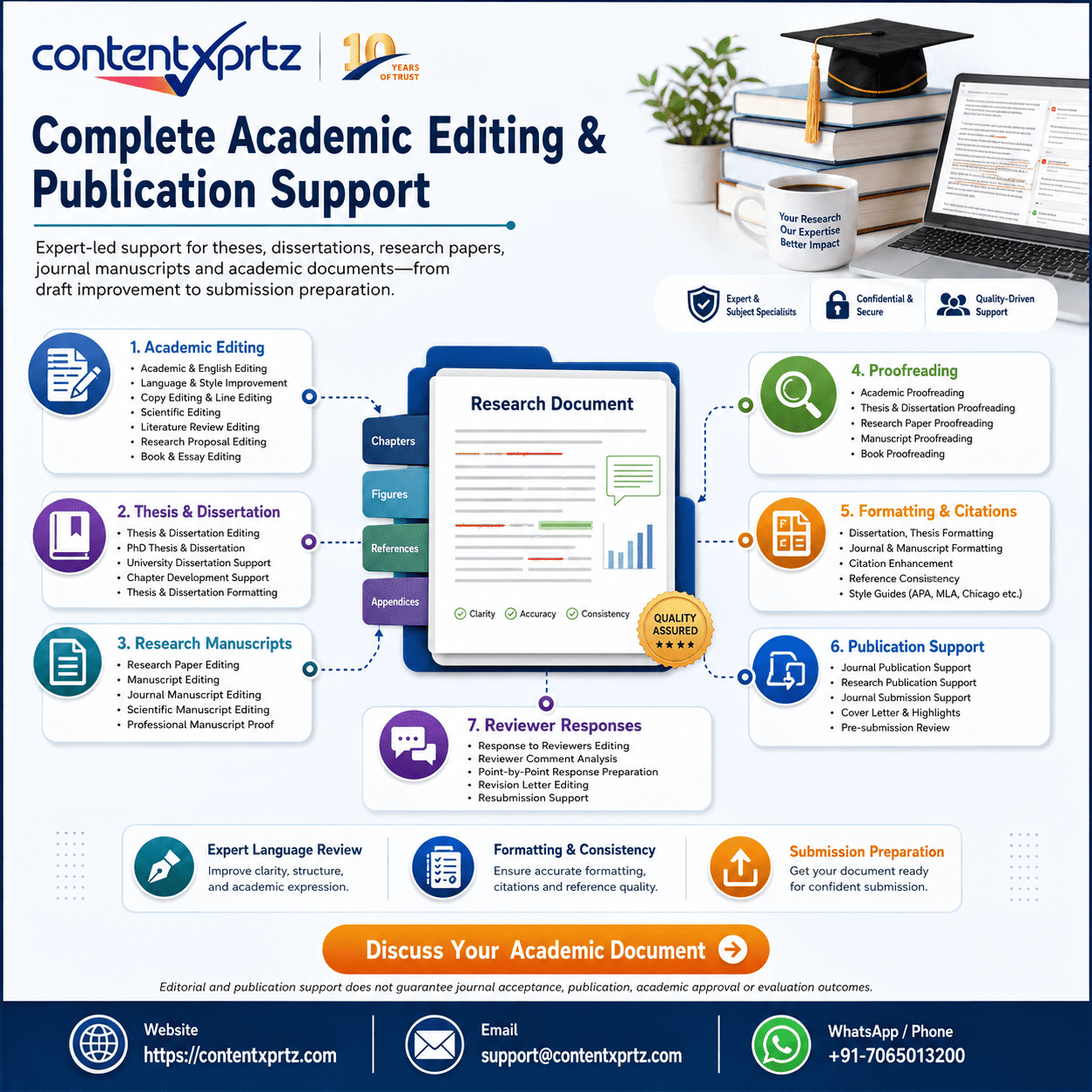
Contentxprtz supports researchers through ethical editing, proofreading, thesis and dissertation support, and publication-readiness services. The researcher remains responsible for the research question, data, methods, analysis, interpretations, citations, conclusions, and final submission. Students should always follow their university’s rules on permitted assistance and disclosure.
For publication ethics, researchers can consult the Committee on Publication Ethics guidance. For broader scholarly writing and publishing expectations, resources from established publishers such as Springer Nature author resources can also help authors understand manuscript preparation and submission practices.
Summary: Is PhD Harder Than MBBS?
Neither qualification is universally harder. MBBS is usually harder when the challenge is measured by breadth of prescribed knowledge, frequent assessments, clinical workload, practical competence, and professional responsibility. A PhD is usually harder when difficulty is measured by independence, uncertainty, originality, research setbacks, sustained specialised thinking, and the demand to produce a defensible thesis.
The better question is which form of difficulty suits your goals. If you want a career centred on patient care and can sustain structured medical training, MBBS may be the right challenge. If you want to create new knowledge and can tolerate uncertainty, long research cycles, and extensive academic writing, a PhD may be the right challenge.
Do not choose either route merely because someone says it is harder, more respected, or more intelligent. Choose the work you are willing to practise repeatedly for years.
Frequently Asked Questions
Is PhD harder than MBBS?
There is no universal answer. MBBS is typically more structured, syllabus-heavy, clinically intensive, and assessment-driven. Students must learn a very broad body of biomedical and clinical knowledge, demonstrate practical competencies, complete clinical postings, and develop professional judgement. A PhD is difficult in a different way: the researcher must work on an original problem, tolerate uncertainty, solve methodological issues, analyse evidence, write extensively, respond to criticism, and defend the quality and contribution of the research. The route that feels harder often depends on the learner. Someone who prefers defined objectives and frequent external structure may cope better with MBBS than with the ambiguity of doctoral research. Someone who prefers deep independent work but struggles with fast-paced clinical schedules may experience the opposite. It is more useful to compare workload, uncertainty, responsibility, writing, and career fit than to rank the degrees as if they test the same abilities.
Which is more stressful, MBBS or PhD?
Both can be stressful, but the sources of stress differ. MBBS stress often comes from a packed timetable, large syllabus, examinations, practical assessments, clinical exposure, sleep disruption during demanding periods, and the responsibility associated with healthcare training. PhD stress often comes from uncertain progress, research failures, supervisory relationships, funding or time pressure, isolation, publication expectations, repeated revision, and the need to make independent decisions without a fixed answer. Individual circumstances matter greatly. A supportive supervisor can transform a PhD experience, just as a healthy teaching environment can make medical training more manageable. Students should therefore examine the actual institution, mentorship, workload, financial situation, and support system rather than relying only on the degree title.
Does a PhD require more intelligence than MBBS?
No credible comparison can reduce either route to a single measure of intelligence. MBBS requires strong learning capacity, clinical reasoning, observation, communication, practical skill, judgement, and consistency under pressure. A PhD requires analytical depth, research design, critical reading, creativity, persistence, writing, and the ability to solve open-ended problems. These abilities overlap but are not identical. Success also depends on motivation, preparation, mentorship, emotional resilience, time management, and access to resources. A person can be excellent at clinical reasoning and dislike long-form research, while another can be an outstanding researcher and have little interest in patient care. Choosing between MBBS and PhD should therefore be based on aptitude and career goals rather than an assumption that one proves greater intelligence.
Is a PhD more difficult because it takes longer?
Not necessarily. Duration is only one aspect of difficulty. A PhD can take several years because research includes coursework where required, literature review, proposal development, ethics processes, data collection, experiments or fieldwork, analysis, writing, revision, and examination. Some stages may depend on external factors that the scholar cannot fully control. MBBS follows a more structured professional curriculum and can be intensely demanding even though its pathway is defined differently. A shorter period with heavy clinical schedules and frequent assessment can be harder for some students than a longer period of independent research. When comparing programmes, look at weekly workload, assessment frequency, uncertainty, responsibility, financial sustainability, and the career stage that follows—not only total years.
Is MBBS harder because students have to memorise more?
MBBS does involve a large amount of factual learning, but describing it as memorisation alone is inaccurate. Medical students must connect foundational science to symptoms, examination findings, investigations, treatment principles, communication, ethics, and patient safety. They also develop practical and clinical skills that cannot be learned through recall alone. The volume of information can make MBBS feel especially hard for students who struggle with rapid retrieval and cumulative study. A PhD usually involves less breadth of prescribed factual content but much deeper engagement with a narrow field. Doctoral researchers must critique evidence, understand methods, locate gaps, and create an original argument. In short, MBBS may demand more breadth and rapid recall, while a PhD may demand more depth and independent analysis.
Is PhD research harder than medical examinations?
They are hard in different ways. Medical examinations usually have a defined curriculum, scheduled assessment dates, and established standards for knowledge and clinical competence. Preparation can be intense, but students generally know what is being assessed. PhD research is open-ended. A researcher may spend months developing a method, only to discover that the data do not support the original plan. There may be no answer key and no guarantee that a particular approach will produce publishable or thesis-worthy results. Medical examinations can create intense short-term pressure; doctoral research can create prolonged uncertainty. Which feels harder depends on whether the person handles timed assessment or ambiguous long-term problem-solving more comfortably.
Can an MBBS graduate do a PhD later?
Yes, medical graduates can pursue research careers and, subject to programme eligibility, may later enrol in PhD programmes in biomedical, clinical, public health, basic science, health policy, epidemiology, medical education, or related fields. The exact eligibility requirements differ by university, discipline, and country, so applicants should check the official admission regulations of the institution they are considering. Some doctors choose postgraduate clinical specialisation first; others move into research earlier. A medical background can provide valuable subject knowledge and clinically relevant research questions, while doctoral training develops deeper expertise in research design and independent investigation. The combination can be especially useful for clinician-scientists, but it involves a substantial time commitment and should be planned around the career role the individual wants.
Which has more writing, MBBS or PhD?
A PhD generally requires much more sustained academic writing. Doctoral scholars may write a proposal, literature review, ethics documents, progress reports, conference abstracts, journal manuscripts, thesis chapters, responses to reviewers, and a final dissertation or thesis. The writing must accurately represent methods, evidence, limitations, and contribution. MBBS students also write extensively in examinations, case records, assignments, and clinical documentation, but long-form scholarly argument is usually less central to the undergraduate medical degree than it is to doctoral completion. Researchers who struggle with grammar or structure can use institutionally permitted editing or proofreading support, but the intellectual content, analysis, citations, and conclusions must remain their own.
Which degree gives a clearer career path, MBBS or PhD?
MBBS generally begins with a clearer professional identity because it is a medical qualification linked to regulated healthcare training, although graduates may still choose among clinical practice, postgraduate specialisation, public health, research, administration, or other directions. PhD careers can be more varied and less linear. Graduates may enter academia, industry research, data science, policy, consulting, scientific communication, government, teaching, or specialist roles depending on the discipline. A clearer path is not automatically an easier path. Medical careers can require further competitive training, while research careers can involve temporary contracts, grant competition, or relocation. Before choosing either degree, examine the likely post-degree roles in your specific field and country.
How should I decide between PhD and MBBS?
Start with the work you want to do, not with which qualification sounds harder. Choose MBBS if you are genuinely motivated by medicine, patient care, clinical responsibility, and a structured professional training pathway. Choose a PhD if you are strongly motivated by research, specialised inquiry, independent problem-solving, and producing new knowledge. Then test your assumptions. Speak with current medical students, doctors, PhD scholars, and researchers. Read official programme regulations. Review admission requirements, duration, costs, funding, work patterns, and likely career outcomes. If possible, gain exposure through research projects, internships, volunteering, laboratory experience, or academic mentorship. The best decision is the one based on sustained interest and realistic understanding of daily work, not on prestige or online comparisons.
Conclusion: Choose the Challenge That Fits the Career You Want
PhD and MBBS demand different forms of excellence. MBBS asks students to master a broad medical curriculum, develop clinical competence, work within rigorous professional standards, and perform consistently in structured training. A PhD asks researchers to become specialists in uncertainty: to question, design, investigate, interpret, write, revise, and defend original work.
If your main obstacle as a PhD scholar is communicating strong research clearly, Contentxprtz can support ethical editing and research-paper preparation through its research paper editing service. The goal is not to replace your scholarship but to help your own ideas, evidence, and argument read as clearly as possible.
At Contentxprtz, we don’t just edit; we help ideas reach their fullest potential.