Step of Research Process: From a Clear Question to a Defensible Conclusion
The step of research process is not a single fixed recipe; it is a sequence of connected decisions that moves a researcher from a broad problem to a question, then to evidence, analysis, interpretation, and responsible communication. In most academic projects, the practical flow is: define the problem, review existing literature, formulate a research question or hypothesis, choose an appropriate design and methods, address ethics and feasibility, collect and manage data, analyse the evidence, interpret findings in relation to the question, write the report, and revise it for clarity, accuracy, citation integrity, and submission requirements.
That sequence matters because research quality is cumulative. A weak question can produce an unfocused literature review; an unfocused review can lead to a poorly justified method; weak data management can undermine otherwise sound analysis; and a strong study can still be difficult to evaluate if the final paper does not explain its decisions transparently. Students often think the research process begins when they start collecting data. In reality, much of the intellectual work happens earlier, when the researcher defines exactly what is being investigated, what prior scholarship already shows, what gap remains, and what evidence could answer the question credibly.
For PhD scholars and first-time researchers, the process is also iterative rather than perfectly linear. A literature search may reveal that the original question is too broad. A pilot test may expose a measurement problem. Early analysis may show that a variable needs clearer operational definition. Revising an earlier decision is not automatically a failure; it can be a sign of responsible research, provided changes are documented and do not compromise ethical approval, data integrity, or transparency.
This guide explains each stage as an academic decision, not merely a checklist item. It also shows how research methodology, literature review, data collection, data analysis, academic writing support, and ethical editing fit together. Where professional assistance is useful, it should strengthen clarity, structure, and presentation without replacing the researcher's responsibility for the question, data, reasoning, citations, and conclusions.
Quick Answer: What Is the Step of Research Process?
The research process is a structured cycle for turning a problem or curiosity into a defensible academic conclusion. A practical sequence is to identify the research problem, narrow it into a researchable question, review relevant literature, select a suitable methodology and design, plan ethics and sampling, collect data, manage and analyse the data, interpret the results, write the study, and revise the final document.
The exact order can differ by discipline. A historian may begin with archival feasibility; an experimental scientist may emphasise protocol design and controls; a qualitative researcher may refine questions during fieldwork; a systematic reviewer follows a more protocol-driven evidence-synthesis workflow. The key principle is alignment: the question, method, data, analysis, and conclusion should fit one another.
Before moving from one stage to the next, ask a simple quality-control question: Does this decision help me answer the research question in an ethical, transparent, and reproducible or auditable way? If the answer is unclear, revisit the earlier stage rather than trying to repair the problem only at the writing stage.
Key Takeaways
- A research project starts with a clearly bounded problem and question, not with random data collection.
- The literature review identifies what is already known, how the topic has been studied, and where a justified gap remains.
- Research design and methods must match the question; there is no universally “best” method.
- Ethics, feasibility, sampling, measurement, and data-management decisions should be planned before full data collection.
- Analysis should follow the design and the nature of the data, while interpretation should distinguish evidence from speculation.
- Academic writing is part of the research process because readers need enough clarity to evaluate what was done and why.
- The process is often iterative: responsible researchers refine questions, searches, instruments, and explanations when evidence requires it.
What This Page Covers
- The main research process steps from topic selection to final submission.
- How to turn a broad topic into a focused research question or hypothesis.
- How literature review, methodology, sampling, data collection, and analysis connect.
- Where ethics, research integrity, authorship, and data management enter the workflow.
- Common mistakes that make a study harder to defend.
- Three realistic examples for a PhD scholar, a first-time researcher, and an ESL academic author.
- When self-service work is enough and when ethical academic editing or research support may help.
Table of Contents
Methodology and Academic Sources
This guide synthesises common research-planning, responsible-conduct, literature-review, data-management, analysis, authorship, and academic-writing practices. The exact workflow varies by discipline, institution, study design, and publication venue. Researchers should therefore use this guide as a planning framework and then check their supervisor's requirements, institutional ethics procedures, funder rules, and target journal or publisher instructions.
For broader methodological and integrity context, useful authoritative resources include the APA Handbook of Research Methods in Psychology, the U.S. Office of Research Integrity's Introduction to the Responsible Conduct of Research, the Office of Research Integrity's guidance on research data acquisition and management, the ICMJE Recommendations for scholarly conduct and reporting in medical journals, and university library research guides such as the USC guide to organising social-sciences research papers.
What the Research Process Means in Academic Context
The research process is the logic that connects a research problem to a justified claim. It is more than a series of administrative tasks. Each step should reduce uncertainty: first about what question is worth asking, then about what evidence would count, how that evidence should be obtained, how it should be analysed, and what conclusions the evidence can legitimately support.
A useful way to think about the process is as three linked layers. The conceptual layer includes the topic, problem, theory, research question, and literature. The empirical layer includes design, sampling, measurement, data collection, and analysis. The communication layer includes interpretation, limitations, references, reporting, editing, and dissemination. Problems in one layer often propagate into the next, which is why early planning is so valuable.
Research question, hypothesis, and objective are not interchangeable
A research question asks what the study seeks to understand or explain. A hypothesis states a testable expectation, usually in quantitative or experimental work. Research objectives translate the question into specific tasks, such as comparing groups, estimating an association, describing a phenomenon, or exploring participants' experiences. Some qualitative studies do not require formal hypotheses, while many experimental studies do.
Research methodology is the rationale, not just the tool
Methodology explains why a particular approach is appropriate for the question and the assumptions behind it. Methods are the concrete procedures—interviews, surveys, experiments, archival analysis, statistical models, coding frameworks, laboratory protocols, or other techniques. A well-written methodology section should make those choices understandable and defensible.
Step of Research Process: A Practical Step-by-Step Workflow
1. Identify and delimit the research problem
Begin with a problem that is meaningful enough to investigate and narrow enough to study. “Mental health among students” is a topic, not yet a research problem. A stronger problem statement specifies the population, setting, phenomenon, uncertainty, and why the uncertainty matters. At this point, do a preliminary scan of literature and available data so you do not design a project around a question that has already been answered adequately or cannot be studied with your resources.
2. Convert the problem into a researchable question
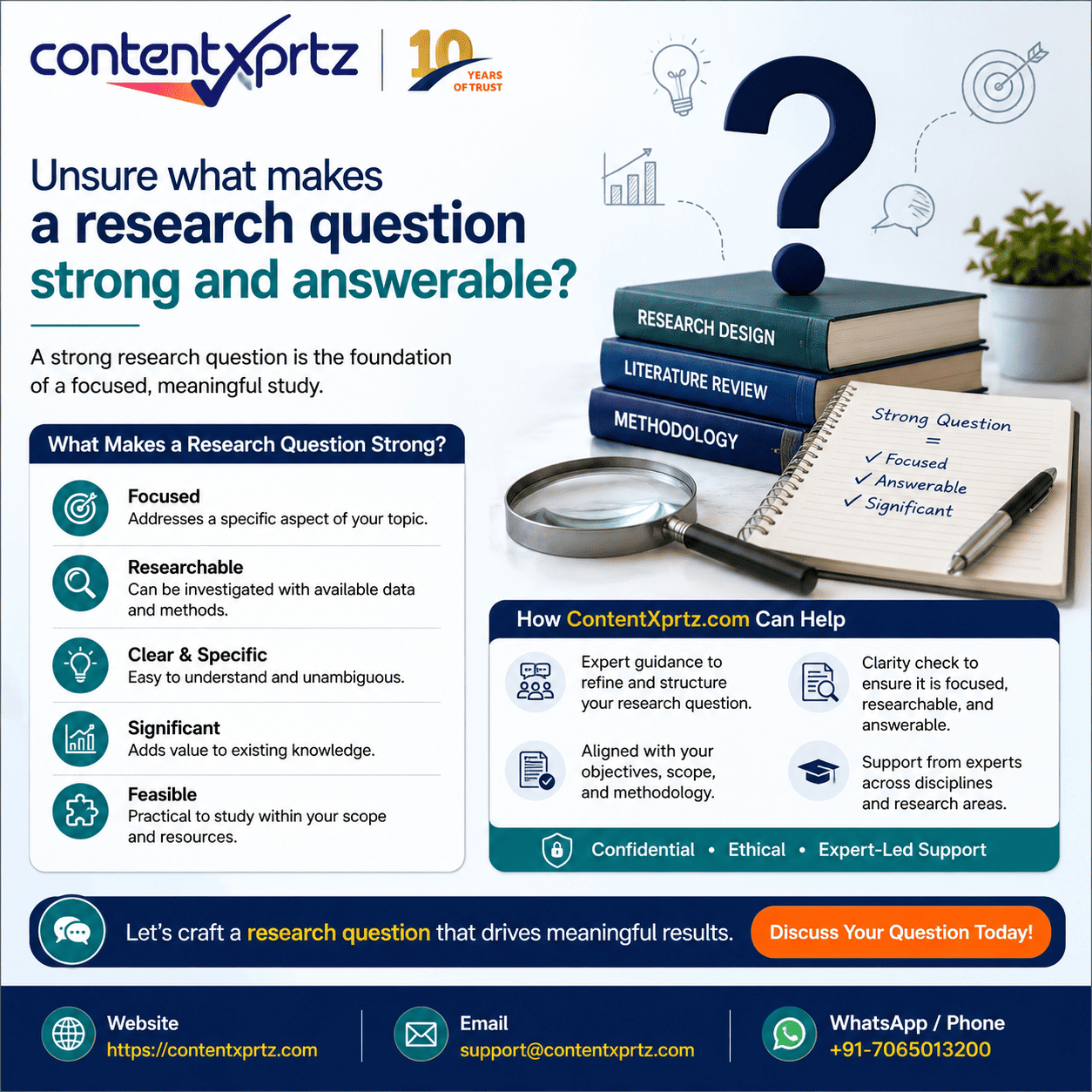
A strong research question is clear, focused, answerable with evidence, ethically investigable, and appropriate to the discipline. It should guide what literature you search, what data you need, and how you will analyse them. In some fields, frameworks such as PICO, SPIDER, FINER, or concept-population-context structures can help, but no framework should be applied mechanically if it does not fit the research problem.
3. Review the literature systematically enough for the purpose
The literature review should map concepts, theories, methods, findings, disagreements, and gaps. For a standard thesis chapter, that may involve transparent database searching, citation chaining, and thematic synthesis. For a systematic review, the search and screening process must be much more protocol-driven. Keep a search record: databases, dates, search strings, filters, inclusion logic, and key papers. This makes the review easier to update and reduces the risk of selectively citing only studies that support an initial opinion.
4. Develop the conceptual framework, objectives, and hypotheses where appropriate
Once you understand the literature, state what the study will do. Define the main concepts and expected relationships. If the project uses a theoretical framework, show how the theory informs variables, themes, observations, or interpretation. This stage is where vague ideas become operational decisions.
5. Choose the research design and methodology
Select a design that can answer the question. Descriptive studies characterise a phenomenon; correlational designs examine relationships; experiments test causal effects under controlled conditions; qualitative designs investigate meaning, experience, process, or context; mixed-methods studies deliberately integrate quantitative and qualitative evidence. The design should also be feasible within the available time, access, expertise, budget, equipment, and sample.
6. Plan sampling, measurement, and instruments
Define who or what will provide the evidence. Specify inclusion and exclusion criteria, recruitment or selection procedures, sample-size rationale where relevant, and how key concepts will be measured or observed. Use validated instruments when suitable, but check whether they are valid for your population, language, and context. For qualitative work, describe how participants or documents will be selected and how sampling will support the study's analytic purpose.
7. Address ethics, permissions, and risk before data collection
Research involving human participants, identifiable information, sensitive topics, animals, protected archives, clinical data, or other regulated materials may require formal approval. Plan informed consent, privacy, confidentiality, data security, conflicts of interest, and participant risk. Do not treat ethics approval as paperwork that can be added after the study begins. The protocol should reflect the actual methods you intend to use.
8. Pilot the procedure when appropriate
A pilot can reveal unclear survey questions, unrealistic interview length, technical failures, recruitment barriers, missing response options, or coding ambiguities. Piloting is especially useful when using a new instrument, procedure, language adaptation, data pipeline, or multi-step protocol. Record what changed and why.
9. Collect and manage data consistently
Follow the approved protocol and document deviations. Use naming conventions, version control, codebooks, field notes, laboratory records, audit trails, or data dictionaries appropriate to the field. Store raw data separately from cleaned or transformed data where possible. Backups, access controls, anonymisation or pseudonymisation, and retention procedures should be decided early rather than after files accumulate.
10. Clean, code, and analyse the evidence
Analysis begins with checking the quality and structure of the data. In quantitative work, this may include missing-data review, variable coding, assumptions, descriptive statistics, model selection, uncertainty estimates, and sensitivity checks. In qualitative work, it may include transcription, coding, memoing, category development, reflexive analysis, triangulation, or other method-specific procedures. The analysis should answer the research question rather than merely use every technique available.
11. Interpret results in relation to the question and prior research
Interpretation asks what the findings mean, not just whether a statistical test is significant or a theme appears frequently. Compare results with the literature, explain plausible mechanisms carefully, acknowledge alternative explanations, and distinguish what the data show from what you infer. Avoid causal language when the design cannot support causal claims.
12. Write, revise, and report transparently
Write the paper so another informed reader can understand the problem, reproduce or audit the logic of the methods, evaluate the evidence, and see how the conclusions follow. Revise for structure, coherence, tables, figures, citations, and discipline-specific reporting standards. Academic editing services can help improve clarity and organisation after the intellectual content is in place, while the author remains responsible for the research choices, facts, data, citations, and final claims.
How to Keep the Research Question, Method, and Evidence Aligned
Alignment means every major research decision serves the same central question. The table below shows a simple way to test that alignment before data collection begins.
| Research decision | Question to ask | Warning sign | Corrective action |
|---|---|---|---|
| Problem and question | Is the question specific, researchable, and meaningful? | It is only a broad topic or contains several unrelated questions. | Narrow the population, context, concepts, relationship, or outcome. |
| Literature review | Does the search explain what is known and justify the gap? | The review is a list of summaries with no synthesis. | Group evidence by themes, methods, findings, and unresolved issues. |
| Design | Can this design produce evidence that answers the question? | A causal question uses only a weak descriptive design without justification. | Revise the question or choose a design capable of supporting the intended claim. |
| Sampling and measurement | Do the participants, sources, or measures represent the concepts being studied? | Convenience determines the sample without discussing bias or fit. | State the sampling logic, limitations, and validity considerations. |
| Analysis | Does the analytic method match the data and design? | The researcher chooses techniques because they look advanced. | Start from the question, outcome type, assumptions, and design structure. |
| Conclusion | Does each claim stay within what the evidence supports? | The conclusion is broader or more causal than the results justify. | Calibrate the language and state limitations explicitly. |
This alignment check is especially useful before proposal approval, ethics submission, a pilot study, or a major thesis review. It can save substantial time because correcting a mismatch before data collection is usually easier than trying to explain it after the fact.
When Self-Service Research Is Enough and When Expert Support May Help
Many parts of the research process should remain directly under the researcher's control: choosing the problem, making substantive methodological decisions, collecting or supervising data, interpreting results, and taking responsibility for the final claims. Self-service is often sufficient when the researcher understands the field, has a clear method, receives effective supervisor feedback, and mainly needs time to execute the plan carefully.
Expert support can be useful when the difficulty is procedural or communicative rather than a request to outsource authorship. A researcher may need help organising a literature matrix, improving the logic of a methodology explanation, checking reference consistency, clarifying tables, or editing language for an international journal. Ethical support should preserve the author's ideas and should not fabricate data, invent references, write unsupported findings, or conceal inappropriate third-party contribution.
Contentxprtz offers research support and editing support for researchers who already own and understand their work but need a clearer structure, a more coherent scholarly narrative, or careful language and citation review.
Ethical Research, Data Integrity, and Author Responsibility
Ethics is not a separate final step; it shapes the entire workflow. Researchers are responsible for obtaining required approvals, protecting participants, managing conflicts, recording procedures accurately, preserving data integrity, citing sources honestly, and reporting limitations. The U.S. Office of Research Integrity places planning, data management, collaboration, authorship, publication, and peer review within responsible research conduct, while the ICMJE emphasises that authorship carries accountability for published work.
For students and PhD scholars, institutional rules may also govern permitted editing, AI assistance, data storage, thesis confidentiality, and acknowledgements. If language editing or academic support is used, follow the university or journal's disclosure expectations. AI-generated text, summaries, references, or coding suggestions should be independently verified; researchers should never assume a generated citation or factual claim is authentic simply because it appears plausible.
A practical rule is to preserve an audit trail for consequential decisions: protocol versions, search strategies, consent materials, data dictionaries, analysis scripts, codebooks, decision memos, and manuscript revisions. The exact documentation will differ by discipline, but the principle of traceability strengthens both research integrity and later writing.
Common Mistakes to Avoid in the Research Process
- Starting with a method instead of a question. Wanting to “run a survey” or “use machine learning” is not yet a research rationale.
- Treating the literature review as a bibliography. A useful review synthesises patterns, disagreements, methods, and gaps.
- Changing the research question after seeing results without documenting the change. Exploratory findings can be valuable, but they should not be presented as if they were always confirmatory.
- Ignoring feasibility. A theoretically elegant project can fail if participants, data, equipment, permissions, or time are unavailable.
- Using an instrument without checking validity or context. A scale may not function equivalently across populations, languages, or settings.
- Collecting more data than the protocol can manage responsibly. Data volume is not a substitute for relevance, quality, or security.
- Choosing analysis after seeing which result becomes significant. Analytical flexibility should be handled transparently, particularly in confirmatory research.
- Overstating conclusions. Association does not automatically establish causation, and a narrow sample may not justify broad generalisation.
- Leaving citation and reference checks until the final night. Reference integrity is easier when sources are recorded accurately during the literature-review stage.
- Using editing support to replace author responsibility. Professional editing should clarify expression, not create data or unsupported arguments.
Practical Examples: How the Research Process Works in Real Academic Projects
Example 1: A PhD scholar studying remote-work burnout
Situation: A doctoral researcher begins with “burnout in remote workers,” reads dozens of papers, and plans a large online survey. The problem is that the topic remains too broad: industry, work arrangement, country, measurement period, and explanatory variables are unclear.
Common mistake: Designing the questionnaire before defining the research question creates a long instrument with variables that do not support one coherent analysis.
Correct approach: The scholar narrows the question to a defined population and specifies whether the goal is description, association, prediction, or explanation. The literature review identifies validated burnout measures and plausible workplace predictors. The methodology then follows from that question, including sampling logic, ethics, measurement, analysis, and limitations.
How ethical expert guidance can help: A research consultant or supervisor can challenge the alignment of question, variables, and design, while an editor can later improve the proposal's clarity. The scholar remains responsible for the research decisions and data.
Example 2: A first-time researcher preparing a journal article
Situation: An early-career researcher has a useful dataset from an institutional project and wants to turn it into a paper. The initial draft begins with the results because the numbers are already available.
Common mistake: Retrofitting a vague question to available data can produce a manuscript with weak theoretical motivation and post-hoc claims.
Correct approach: The researcher first defines a question that the existing data can legitimately answer, checks what consent and permissions allow, conducts a focused literature review, documents the analytic plan, and distinguishes exploratory analyses from pre-specified ones. The discussion then compares the findings with prior literature and states the limitations of using an existing dataset.
How ethical expert guidance can help: Manuscript assessment may help identify structural gaps, but it should not transform exploratory work into a misleading confirmatory narrative.
Example 3: An ESL researcher writing a mixed-methods thesis
Situation: A multilingual researcher has completed interviews and a quantitative survey but struggles to explain how the two strands relate.
Common mistake: Reporting quantitative and qualitative findings in separate chapters without a clear integration strategy makes the thesis feel like two disconnected studies.
Correct approach: The researcher returns to the mixed-methods rationale, identifies where integration was intended, and shows whether one strand explains, expands, contrasts with, or triangulates the other. The conclusion reflects the integrated evidence rather than merely repeating two sets of results.
How ethical expert guidance can help: Ethical academic editing can improve transitions, terminology, and chapter coherence while preserving the researcher's analytical decisions and intended meaning.
Research Process and Publication-Readiness Checklist
Question and literature
- The research problem is clearly bounded and important enough to study.
- The research question is specific, answerable, and aligned with the intended evidence.
- The literature search is documented well enough to explain how key sources were found.
- The literature review synthesises rather than merely summarises papers one by one.
- The gap is justified by evidence, not by saying only that “few studies exist.”
Design, ethics, and data
- The research design fits the question and planned claims.
- Sampling, measurement, instruments, and procedures are justified.
- Required ethics approvals and permissions are in place before data collection.
- Data management, file naming, access, backup, confidentiality, and retention are planned.
- Pilot testing has been considered where the procedure or instrument is new.
Analysis and interpretation
- The analysis method fits the design and data type.
- Assumptions, coding decisions, exclusions, and transformations are documented.
- Results are separated from speculation and interpreted in relation to prior evidence.
- Limitations are specific and linked to what they mean for the conclusions.
Writing and submission
- The manuscript explains enough methodology for an informed reader to evaluate the work.
- Tables, figures, citations, and references are accurate and consistent.
- Claims remain within the scope of the evidence.
- Author and contributor roles are handled transparently.
- The final document follows institutional or journal formatting and reporting requirements.
How Contentxprtz Can Help During the Final Research and Writing Stages
Research quality depends first on the study itself, but clear academic communication determines whether readers can evaluate that quality. Once your question, data, and analysis are genuinely yours, Contentxprtz can help improve the presentation of a thesis, dissertation, research paper, proposal, or manuscript through structure review, language editing, proofreading, citation consistency checks, and publication-readiness support.
Researchers who need help organising a complex thesis can explore PhD thesis support. Authors preparing a paper for submission may benefit from publication support where the service fits the journal-readiness problem. The goal should be to make the research easier to understand and evaluate—not to replace the author's intellectual contribution or promise an academic outcome.
Summary: Step of Research Process
The step of research process is best understood as an aligned cycle: define a meaningful problem, convert it into a researchable question, review the literature, choose a suitable methodology, plan sampling and ethics, collect and manage evidence, analyse it with appropriate methods, interpret it cautiously, and report the work transparently. Each stage should make the next stage more defensible.
For small coursework projects, this cycle may be compact. For a PhD thesis, funded study, clinical project, or journal article, each stage can involve protocols, approvals, teams, software, documentation, and multiple rounds of review. The principle remains the same: strong research is not created by one sophisticated statistical technique or one polished final draft. It comes from consistent alignment between the question, evidence, reasoning, and communication.
Frequently Asked Questions
What is the step of research process in simple terms?
The step of research process is the sequence used to move from a problem or question to a supported conclusion. In simple terms, you identify what you want to know, study what other researchers have already found, narrow the topic into a researchable question, choose a method that can answer that question, collect relevant evidence, analyse it, interpret what it means, and communicate the result in a paper, thesis, report, or presentation. Ethics, data management, and citation integrity run through the whole process rather than appearing only at the end. The steps are connected, so an early weakness can affect everything that follows. For example, if the question is vague, the literature review may become unfocused and the data collection may include information that is interesting but not useful. The process is also iterative: researchers may refine a question after reading the literature or adjust a procedure after a pilot study. The important point is to document legitimate changes and keep the question, method, analysis, and conclusion aligned.
What are the main steps in a research process?
A practical list of the main steps is: identify the research problem; formulate a focused research question or hypothesis; review relevant literature; define concepts, objectives, and any theoretical framework; choose the research design and methodology; plan sampling and measurement; obtain necessary ethics approval and permissions; pilot the procedure where useful; collect and manage data; clean, code, and analyse the evidence; interpret the results; write the study; revise for clarity, accuracy, references, and reporting requirements; and disseminate or submit the work. Different disciplines may combine or reorder some stages. For example, qualitative research can refine questions during fieldwork, archival research may begin with source availability, and systematic reviews use formal search, screening, and synthesis protocols. The list should therefore be treated as a planning framework rather than a rigid formula. What matters most is that each stage is justified and that the final claims do not exceed what the design and evidence can support.
Which step comes first: literature review or research question?
Usually, the researcher begins with a preliminary problem or question and then uses early literature searching to refine it. A full literature review becomes more efficient once the question is reasonably focused, but the relationship is iterative rather than strictly one-way. If you attempt a comprehensive review before you know what you are asking, the search can become too broad. If you finalise the question without checking the literature, you may discover later that it has already been answered, uses outdated concepts, or is not feasible. A sensible workflow is to start with a provisional question, conduct an orientation search, identify key concepts and gaps, revise the question, and then build a more systematic search around the refined version. For a thesis proposal, document that development because it demonstrates how the research problem emerged from the field rather than from intuition alone. For systematic reviews or registered protocols, question formulation and search planning are more formal and should follow the relevant reporting or protocol guidance.
How do I know whether my research question is strong enough?
A strong research question is clear, focused, researchable, significant enough to justify the study, feasible with available resources, and ethically investigable. It should identify the core phenomenon, relationship, comparison, population, setting, or context as needed, without becoming so narrow that the study loses value. Test the question by asking what evidence would answer it. If you cannot describe the data, sources, participants, observations, or documents required, the question may still be too vague. Also ask whether the intended design can support the type of claim in the wording. A question about causation generally requires stronger design logic than a question about description or association. Finally, compare the question with the literature: does it address a genuine uncertainty, replication need, contextual gap, theoretical issue, or methodological problem? A supervisor or research-methods adviser can help challenge the framing, but the final question should remain intellectually owned by the researcher and be consistent with institutional requirements.
Why is the literature review an important step in research?
The literature review shows what is already known and helps prevent the new study from being designed in isolation. It can reveal established theories, definitions, measures, datasets, common methods, contradictory findings, under-studied populations, and unresolved debates. That information helps the researcher sharpen the question, justify the gap, select methods, anticipate limitations, and interpret later results. A strong review is not a sequence of article summaries. It synthesises evidence by comparing themes, methods, strengths, weaknesses, and findings across sources. It also creates the intellectual context for the study: readers should be able to see why the research question follows logically from prior scholarship. The depth and reproducibility of the search should match the project. A class paper may use a focused scholarly search, while a systematic review requires a much more transparent and comprehensive process. In every case, keep accurate citation records and verify sources from the original publication rather than relying only on second-hand summaries or AI-generated references.
How do research design and research methodology differ?
Research design is the overall structure of the study, while methodology is the reasoning that explains why a particular approach and set of methods are appropriate. A design might be a randomised experiment, cross-sectional survey, longitudinal cohort, case study, ethnography, grounded-theory study, archival analysis, or mixed-methods project. Methods are the concrete techniques used within that design, such as interviews, questionnaires, laboratory measurements, document coding, statistical modelling, or thematic analysis. Methodology connects those choices to the research question, assumptions, and standards of the discipline. The distinction matters in academic writing because simply listing tools does not justify a study. A reader needs to understand why the selected design can answer the question, how sampling and measurement fit the design, what biases or limitations are expected, and why the analysis is appropriate. When writing a methodology chapter, organise it around this logic instead of presenting software names or procedures without explaining their purpose.
At what stage should ethics approval be obtained?
Ethics approval should be obtained before starting research activities that require it, according to the rules of the researcher's institution, jurisdiction, funder, and discipline. For human-participant studies, this normally means the research question, protocol, recruitment, consent process, instruments, privacy protections, data management, and risk considerations should be developed enough for review before participants are enrolled or identifiable data are collected. Some projects using existing anonymised data, public records, routine service information, or certain educational activities may be exempt or follow a different review route, but researchers should not make that determination casually when institutional review is available. Significant changes to an approved protocol may also require an amendment. Ethics planning should therefore begin during research design, not after the methods are finalised. Students should consult their supervisor and institutional ethics office early because review time can affect the project schedule. Publication and authorship ethics also continue after data collection through accurate reporting, contributor recognition, conflict disclosure, and responsible handling of data and citations.
What should happen before data analysis begins?
Before formal analysis, confirm that the dataset or qualitative material is complete enough for the planned method and that the analysis plan still matches the research question and design. For quantitative work, common preparatory steps include checking variable definitions, coding, missing values, duplicates, impossible values, outliers, data transformations, measurement reliability, and assumptions relevant to the intended models. Keep a record of exclusions and cleaning decisions, and preserve raw data separately from edited versions when possible. For qualitative work, preparation may include transcription checks, anonymisation, a coding framework, reflexive notes, case organisation, and decisions about how themes or categories will be developed. If changes to the analysis are made after examining the data, distinguish exploratory decisions from pre-specified tests rather than presenting all analyses as if planned in advance. Good preparation reduces errors and makes the final methodology and results sections easier to write because the researcher has an audit trail of what was done and why.
Can the research process steps change during a PhD or dissertation?
Yes. Research is often iterative, and responsible changes can improve a PhD or dissertation when new evidence, feasibility issues, pilot results, access constraints, or methodological insights emerge. A literature review may show that a question is too broad. Recruitment may reveal that the planned sample is unrealistic. A pilot interview may expose ambiguous wording. Qualitative analysis may suggest that additional sampling is needed. What matters is how the change is handled. Discuss major changes with the supervisor, check whether ethics approval or protocol amendments are required, preserve version history, and explain material deviations transparently in the thesis or related publications. Avoid rewriting the research history to make every decision appear pre-planned. Exploratory development is legitimate when reported honestly. Because doctoral research is assessed partly on methodological judgment, demonstrating why a change was necessary can be more credible than pretending the original plan was perfect. The final study should still show coherent alignment among the revised question, evidence, analysis, and conclusion.
When should I use professional academic editing during the research process?
Professional academic editing is most useful after the researcher's intellectual decisions and substantive content are sufficiently developed to be evaluated and communicated clearly. For a proposal, editing can help clarify the problem statement, literature synthesis, objectives, and methodology explanation before review. For a thesis or manuscript, it can improve structure, transitions, grammar, terminology, consistency, tables, references, and adherence to a journal or university style. Editing should not invent data, create unsupported findings, fabricate references, or replace the author's analysis and interpretation. Students should check university policies on permitted third-party editing, and journal authors should follow any relevant disclosure rules. If the difficulty is earlier—such as an unfocused question, an incoherent design, or unclear analysis logic—research-methods guidance from a supervisor or qualified adviser may be needed before copyediting. Contentxprtz can provide ethical academic editing and research-support services when the goal is to strengthen clarity and publication readiness while preserving the researcher's authorship and responsibility.
Conclusion: Build the Research Process Around Alignment, Not a Checklist
The most useful way to understand the research process is not as a set of boxes to tick, but as a chain of justified decisions. The research question should lead to the literature you examine; the literature should help justify the design; the design should determine what evidence you collect; the analysis should match that evidence; and the conclusion should remain within what the design and results can support.
Self-service research is often enough when the question, method, and writing are under control and effective supervisory guidance is available. Expert-assisted support becomes useful when the challenge is to organise a complex research narrative, improve methodological explanation, polish academic English, check reference consistency, or prepare a manuscript for submission. The safest form of support strengthens clarity and transparency while leaving the author fully responsible for the research, data, claims, citations, and final submission.
If your study is complete but the thesis or manuscript is difficult to present clearly, explore Contentxprtz academic editing for ethical support focused on structure, language, coherence, and publication readiness.
At Contentxprtz, we don’t just edit; we help ideas reach their fullest potential.