Research Process Step: 12 Stages from Question to Final Report
Understanding each research process step helps students, PhD scholars, academic researchers, and professional authors turn a broad idea into work that can be explained, checked, and defended. The research process is not simply “choose a topic, collect data, and write the paper.” It is a chain of linked decisions: defining a problem, asking a focused question, learning what previous research shows, selecting a methodology, considering ethics, collecting or identifying evidence, analysing it, interpreting the result, and communicating the work with accurate citations and appropriate limitations.
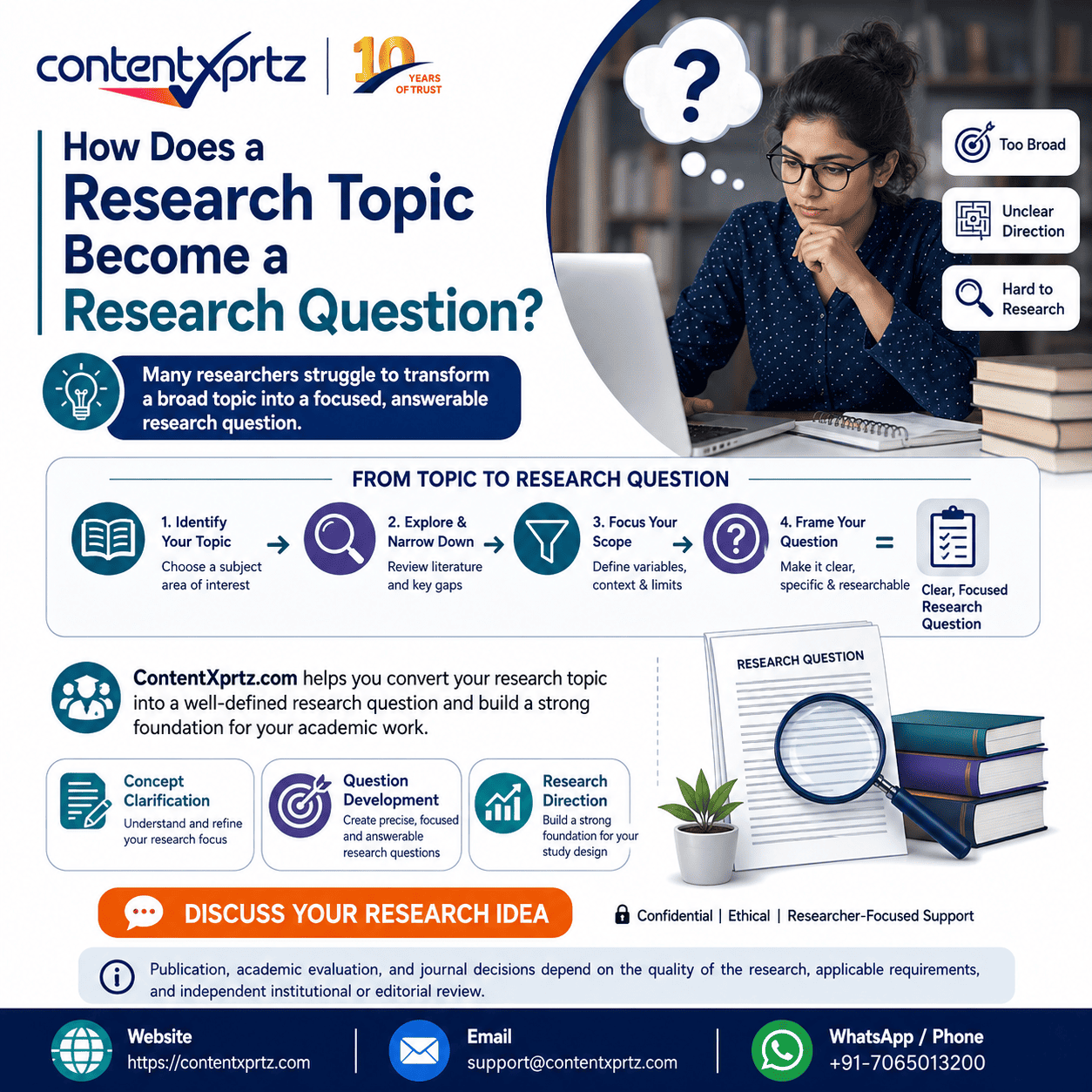
The difficulty is that these stages depend on one another. A vague question can produce an unfocused literature review. A weak literature review can lead to a method that repeats an old study without understanding its limitations. An inappropriate measure can produce data that cannot answer the question. Poor data organisation can damage reproducibility. And even a well-designed study can be misunderstood if the final thesis, dissertation, manuscript, or report does not clearly connect the question, methods, results, and conclusions.
Researchers also work under real constraints. PhD deadlines, supervisor expectations, journal standards, language barriers, limited database access, recruitment problems, changing datasets, citation requirements, and publication pressure can all affect how a project develops. That is why the most useful model is not a rigid staircase but a disciplined cycle. You move forward, review what you have learned, revise where necessary, and document important changes. The aim is not perfection at every stage; it is a transparent process in which each decision is justified by the question, the evidence, accepted methods, and relevant ethical rules.
This guide presents a practical 12-step workflow that works across many academic contexts while recognising that disciplines differ. It explains where literature review, research design, sampling, data collection, analysis, academic writing, and research integrity fit together. It also shows when self-directed work is usually enough and when a supervisor, librarian, statistician, methodologist, or ethical research support service may help. Contentxprtz is included only where academic editing or research-writing support can improve clarity and structure without replacing the author’s responsibility for the research itself.
Quick Answer: What Is the Research Process Step by Step?
The research process is a structured sequence for turning a problem or question into credible, documented knowledge. A practical sequence is: define the problem; formulate the question; review literature; set objectives or hypotheses; choose the design; plan ethics, sampling, and data management; collect evidence; organise and clean it; analyse it; interpret findings; write and revise; then submit, share, or preserve the work.
These stages are connected rather than mechanically linear. A literature review may reshape the question, a pilot may change the instrument, and early analysis may reveal a need for an additional check. The key is to make changes for defensible reasons and document them clearly.
The safest rule is to let the research question determine the method, let the evidence determine the conclusion, and let transparent records show how you moved from one to the other.
Key Takeaways
- Start with a specific research problem before choosing tools, methods, or data.
- Use the literature review to refine the question, identify methods, and understand what is already known.
- Choose methodology because it fits the question, not because it is familiar or convenient.
- Plan ethics, permissions, sampling, and data management before full data collection.
- Keep raw evidence, decisions, analysis, and interpretations traceable.
- Report results honestly, including uncertainty, limitations, and findings that do not support the hypothesis.
- Academic editing can improve communication, but authors remain responsible for research choices, data, citations, and conclusions.
What This Page Covers
- The 12 core stages of a research process
- How to move from a topic to a focused research question
- Where literature review, methodology, sampling, ethics, and data management fit
- How data collection, analysis, interpretation, and writing connect
- Common process mistakes that weaken theses and research papers
- Three practical cases for PhD, journal, and ESL research contexts
- A final research-process checklist and 10 detailed FAQs
Table of Contents
Methodology and Academic Sources
This guide synthesises established research-practice principles rather than presenting one universal method. The U.S. Office of Research Integrity (ORI) guidance on responsible conduct of research notes that accepted practices vary by discipline while shared values such as honesty, accuracy, efficiency, and objectivity remain important. ORI’s data-collection guidance also stresses that reliable data depend on methods appropriate to the research problem.
For broader ethical context, UNESCO’s Guide for Ethical Research and Recommendation on Open Science emphasise quality, integrity, responsibility, accountability, and transparent scientific practice. Researchers should still follow the exact requirements of their university, ethics board, funder, professional association, discipline, and target journal.
Contentxprtz can assist with ethical academic editing services, methodology-section clarity, literature-review organisation, proofreading, and manuscript presentation. These services support communication; they do not replace research supervision, institutional approval, discipline-specific methodological judgment, or author responsibility.
What “Research Process Step” Means in Academic Work
A research process step is a purposeful stage that produces an output needed by the next stage. Defining the problem produces a problem statement. Reviewing literature produces a map of existing evidence and gaps. Selecting methodology produces a design and procedure. Data collection produces an evidence set. Analysis produces patterns, estimates, themes, comparisons, or model outputs. Interpretation turns those outputs into claims that answer the research question.
This output-based view is useful because it prevents activity from being mistaken for progress. Reading 100 papers is not automatically a literature review; the review must help define the field, evaluate evidence, and justify the question. Running statistical software is not automatically analysis; the tests must match the design, variables, assumptions, and question. Writing many pages is not automatically a strong thesis; the chapters must form a coherent argument supported by traceable evidence.
Research quality therefore depends less on the number of steps than on the alignment between them. The question, evidence, method, analysis, and conclusion should fit one another. If one link is weak, the rest of the project may need revision.
The 12 Research Process Steps Explained
The following sequence is broad enough for many academic projects and flexible enough to adapt to disciplinary needs. Treat every step as a decision point with a concrete output.
1. Define the research problem
Begin with the problem, not the method. Describe what is unknown, inconsistent, poorly explained, practically important, or theoretically unresolved. A good problem statement identifies the context, the affected population or body of knowledge, and why further investigation is justified. Avoid claiming a ‘gap’ merely because you have not found papers yet. Search enough literature to distinguish a real unresolved issue from an unfamiliar topic. The output of this step should be a concise problem statement that another reader can understand without seeing the rest of the proposal.
2. Convert the problem into a focused research question
Turn the broad problem into a question that can be answered with obtainable evidence. Define key concepts, population or unit of analysis, context, timeframe where relevant, and the type of answer needed. Questions such as ‘What is the effect?’, ‘How common is it?’, ‘How do participants experience it?’, ‘Why does this process occur?’, and ‘How does one case compare with another?’ imply different designs. If the question contains too many outcomes, populations, or mechanisms, narrow it before building the method.
3. Review and map the literature
Search relevant databases, library catalogues, repositories, citation networks, and authoritative sources. Build a concept list with synonyms and disciplinary terms. Screen sources for relevance and quality, then organise them by themes, methods, populations, findings, and limitations. The purpose is to understand the evidence landscape, not to collect quotations. A strong review helps refine the question, select definitions, identify suitable measures or analytic frameworks, and explain how the study adds value. Researchers preparing a thesis may use PhD thesis support for structural editing after they have selected and interpreted the literature themselves.
4. Set objectives, hypotheses, or propositions
State what the study intends to accomplish. Quantitative studies may specify testable hypotheses; qualitative studies may use research objectives or sensitising questions; exploratory projects may avoid premature hypotheses. The statements should align with the problem and the available design. This step creates a clear target for the methodology and later analysis. If you cannot explain how each objective will be answered by a source of evidence, the objective is probably too vague or the design is incomplete.
5. Choose the research design and methodology
Select the overall strategy that best answers the question: experimental, observational, survey, qualitative interview, ethnography, case study, archival research, computational analysis, design science, systematic review, mixed methods, or another justified approach. Then specify units, variables or concepts, instruments, procedures, comparison groups, and analytic framework. Feasibility matters, but convenience alone is not a methodological rationale. Explain why the chosen design can produce evidence capable of supporting the intended claims.
6. Plan ethics, permissions, sampling, and data management
Before full data collection, identify approvals, consent requirements, privacy risks, inclusion and exclusion criteria, recruitment methods, sampling logic, power or saturation considerations where relevant, and data-handling procedures. Decide how raw files will be stored, protected, named, backed up, versioned, and retained. For collaborative projects, clarify roles, access, and ownership. The strongest time to prevent an ethics or data-management problem is before the first participant is recruited or the first production dataset is created.
7. Pilot the procedure or test the workflow
A pilot checks whether the planned process works in practice. Test survey wording, interview length, recruitment assumptions, equipment, code, database queries, extraction forms, coding schemes, or experimental procedures. The goal is not to prove the hypothesis early; it is to find design defects. Record what changed after the pilot and whether changes affect comparability or approval requirements. In some studies, pilot data can be included in the final analysis; in others it should remain separate. Decide this in accordance with the protocol and discipline.
8. Collect or identify the evidence
Follow the approved procedure consistently and document deviations. Evidence may be measurements, survey responses, interview recordings, field notes, documents, archival sources, images, code repositories, published studies, or secondary datasets. Quality control should occur during collection rather than only after it. Check missing fields, equipment calibration, response patterns, transcription accuracy, source provenance, and secure transfer procedures as appropriate. Protect raw evidence from accidental overwriting and preserve enough metadata to understand where it came from.
9. Organise, clean, code, and prepare the data
Raw evidence rarely arrives ready for analysis. Quantitative data may need validation, recoding, missing-data checks, units harmonisation, outlier review, and derived variables. Qualitative material may need transcription, anonymisation, coding preparation, and memoing. Literature-review data may need deduplication, screening records, extraction fields, and study-quality assessment. Create a data dictionary or codebook and keep raw data separate from processed files so transformations are traceable. Never silently delete observations or change coding simply because results look inconvenient.
10. Analyse the evidence using appropriate methods
Analysis should follow the question and design. Statistical tests require attention to assumptions, uncertainty, effect size, model specification, and the difference between association and causation. Qualitative analysis requires transparent coding, theme development, reflexivity, and evidence for interpretations. Computational work should preserve scripts, parameters, and environment details where feasible. Evidence synthesis requires explicit inclusion logic and a suitable method of combining results. Distinguish planned analyses from exploratory analyses so readers understand what was decided before and after seeing the data.
11. Interpret findings in context
Interpretation asks what the results mean, what they do not mean, and how they compare with previous evidence. Return to the original research question and objectives. Explain agreements, contradictions, plausible mechanisms, alternative explanations, uncertainties, and limitations. Avoid treating statistical significance as practical importance or assuming a qualitative theme represents every participant. Do not overstate causality, generalisability, or novelty. A credible discussion acknowledges where the evidence is strongest and where further work is needed.
12. Write, revise, verify, and communicate the research
Build the final thesis, dissertation, manuscript, report, poster, or presentation so the logic of the project is visible. The introduction should lead to the question; the methods should explain what was done; the results should report evidence without hiding inconvenient findings; and the discussion should interpret rather than repeat results. Verify every citation against the original source, check tables and figures, and ensure abstract, conclusions, and claims match the evidence. Professional academic editing can improve clarity and consistency, but the author should approve all changes and remain responsible for the final submission.
Research Process Steps, Questions, and Outputs
This table turns the workflow into a practical planning tool. If a row has no clear answer, the project may not be ready to move forward.
| Research stage | Key question | Expected output | Common risk |
|---|---|---|---|
| Problem definition | What exactly needs to be understood? | Problem statement | Topic is too broad or gap is unsupported |
| Research question | What answer can evidence realistically provide? | Focused question/objectives | Question and method do not align |
| Literature review | What is already known and how was it studied? | Evidence map and rationale | Source-by-source summary without synthesis |
| Design and ethics | What method can answer the question responsibly? | Protocol, sampling, permissions | Collecting data before approvals or planning |
| Data/evidence collection | How will evidence be obtained consistently? | Traceable raw evidence | Missing metadata or inconsistent procedures |
| Preparation and analysis | How will evidence be transformed and tested? | Processed data, codes, models, themes | Undocumented exclusions or inappropriate tests |
| Interpretation | What do the results support? | Defensible claims and limitations | Overclaiming causality or generalisability |
| Writing and communication | Can readers trace claims back to methods and evidence? | Thesis, paper, report, archive | Abstract or conclusion exceeds the evidence |
The table is deliberately method-neutral. The specific content of each output depends on the discipline, project type, institutional policy, and publication destination.
Why the Research Process Is Iterative, Not Perfectly Linear
Good research can move backward as well as forward. Iteration is necessary when new information exposes a weakness in an earlier decision. The important distinction is between transparent methodological learning and undisclosed post-hoc manipulation.
For example, a scoping literature search may show that the population in the original question has already been studied extensively, but an under-researched subgroup remains important. The question can be narrowed before data collection. A pilot interview may reveal that participants interpret a key term differently, requiring clearer wording. A statistical diagnostic may show that a planned model violates assumptions, requiring an alternative analysis. Each change should be documented and, where required, reviewed against ethics approval, preregistration, supervisor expectations, or a formal protocol.
Use a decision log with the date, the original plan, the issue discovered, the change made, the reason, and any consequences for interpretation. This simple habit can prevent confusion months later when writing the methods chapter or responding to peer review.
When Self-Service Research Is Enough and When Expert Support Can Help
Self-directed research is often enough when the question is limited, the methodology is familiar, the project is low-risk, and the researcher has access to appropriate supervision and resources. Course assignments, small exploratory projects, and routine literature updates may not need external support beyond university libraries and supervisors.
Specialist help becomes more useful when the project involves unfamiliar statistics, complex qualitative methods, systematic evidence synthesis, sensitive participants, large datasets, interdisciplinary terminology, or high-stakes thesis or journal submission. A librarian can strengthen search strategy. A statistician or methodologist can advise on design and analysis. An ethics office can clarify institutional requirements. A subject expert can challenge interpretation.
Editing is a different role. Ethical editors can improve the written presentation once the researcher has made the substantive choices. Researchers who need academic proofreading or language polishing should preserve the meaning, evidence, and authorship of the original work and check whether their university requires editing disclosure.
Ethical Research, Integrity, and Author Responsibility
Research integrity applies to every research process step. ORI describes responsible conduct through values including honesty, accuracy, efficiency, and objectivity. In practical terms, this means reporting what was actually done, preserving accurate records, protecting participants and data, representing contributions fairly, and letting evidence constrain the conclusion.
Ethical issues are broader than plagiarism. They include informed consent, privacy, confidentiality, conflicts of interest, data ownership, authorship, image manipulation, selective reporting, undisclosed protocol changes, fabricated references, and inappropriate use of confidential material. AI-assisted tools add another layer: researchers should verify generated text and references, protect sensitive inputs, and follow institutional or publisher rules for permitted use and disclosure.
Academic editing should improve communication rather than replace intellectual contribution. The author remains responsible for the research question, methods, data, citations, claims, and final submission. If assistance becomes substantial enough to affect authorship, acknowledgements, or disclosure, follow the applicable policy rather than assuming one rule fits every institution or journal.
Common Research Process Mistakes to Avoid
- Choosing a method before clarifying the question. A familiar survey or software package is not automatically the right design.
- Calling any missing paper a research gap. A gap must be demonstrated and academically meaningful.
- Treating the literature review as a list of summaries. Compare, evaluate, and synthesise evidence.
- Collecting data before ethics, permissions, or data plans are ready. Some problems cannot be repaired after collection.
- Changing inclusion rules after seeing favourable results. Document legitimate changes and distinguish exploratory analysis.
- Overcleaning data. Do not remove inconvenient observations without a defensible rule.
- Confusing association with causation. Match claims to what the design can support.
- Hiding null or contradictory findings. Credible research reports uncertainty and limitations.
- Citing sources that were not checked. Verify authors, titles, dates, DOIs, quotations, and context.
- Writing the abstract and conclusion more strongly than the evidence allows. The shortest sections often contain the biggest overclaims.
Practical Examples of the Research Process in Real Academic Work
Example 1: A PhD scholar with a thesis topic that is too broad
Situation: A doctoral scholar starts with “AI in higher education” and immediately collects dozens of papers.
Common mistake: The scholar confuses a topic with a research problem and cannot decide what evidence is relevant.
Correct approach: The literature is mapped by learning outcome, user group, AI application, geography, and study design. The scholar then narrows the problem to a specific decision context, defines a population, and formulates one primary question plus supporting objectives. Only then is the methodology chosen.
How ethical expert guidance can help: A supervisor or subject specialist can challenge the scope, while thesis editing support can later improve the coherence between problem statement, objectives, literature review, and methodology without inventing the research question.
Example 2: A first-time journal author whose results contradict the hypothesis
Situation: A researcher expected a positive relationship but the planned analysis shows little evidence of one.
Common mistake: The researcher runs many alternative tests and considers reporting only the model that looks favourable.
Correct approach: The researcher checks data quality, assumptions, protocol deviations, measurement reliability, and the planned analysis. Exploratory follow-up analyses are clearly labelled as exploratory. The paper reports the original result and discusses plausible explanations and limitations.
How ethical expert guidance can help: A statistician can advise on model appropriateness, and manuscript editing can help present the distinction between confirmatory and exploratory analysis clearly. Neither role should manufacture significance or hide results.
Example 3: An ESL researcher with a strong study but an unclear manuscript
Situation: The methods and results are sound, but reviewers struggle to see how the objectives connect to the discussion.
Common mistake: The author focuses only on grammar and keeps the same weak structure.
Correct approach: The manuscript is mapped from question to method to result to interpretation. Repetitive background is cut, methods are clarified, result headings mirror objectives, and the discussion is reorganised around findings rather than around the order of cited papers.
How ethical expert guidance can help: manuscript assessment can identify structural gaps, followed by language editing that preserves technical meaning and author ownership.
Research Process Checklist Before You Finalise a Study
Question and literature
- The research problem is specific and supported by evidence.
- The primary research question is answerable with available resources.
- The literature review synthesises themes, methods, disagreements, and limitations.
- Key definitions and theoretical assumptions are explicit.
Design and ethics
- The methodology is justified by the research question.
- Sampling or source-selection logic is documented.
- Required ethics approval, consent, permissions, or data agreements are in place.
- Data management, privacy, file naming, access, backup, and retention are planned.
- A pilot or workflow test has been considered.
Evidence and analysis
- Raw evidence is preserved separately from processed files.
- Cleaning, exclusions, transformations, and coding rules are traceable.
- Analysis methods match the design and stated objectives.
- Exploratory analyses are distinguished from planned analyses.
- Results that do not support expectations are still reported appropriately.
Writing and reporting
- Claims do not exceed what the design and evidence can support.
- Limitations and uncertainty are explained.
- Every citation is authentic, traceable, and checked against the original source.
- Tables, figures, abstract, and conclusion agree with the main text.
- The author has reviewed all editorial or AI-assisted changes and accepts responsibility for the final work.
How Contentxprtz Can Help at the Writing and Revision Stage
Research support is most valuable when it improves clarity without taking ownership away from the researcher. Contentxprtz can help organise literature-review arguments, improve the readability of methodology descriptions, strengthen transitions between objectives and results, correct grammar, standardise terminology, and check citation-format consistency. For manuscripts close to submission, professional academic editing for researchers can also help make dense technical writing easier for editors, reviewers, and readers to follow.
The boundary is important. Editors should not invent data, fabricate citations, choose a research design on the author’s behalf, or conceal substantive contributions. Students should follow university policies on permitted editing, and journal authors should follow applicable disclosure and authorship rules.
Summary: Research Process Step by Step
A dependable research process begins with a well-defined problem and a focused question, then uses literature to understand the evidence landscape and select an appropriate design. Ethics, sampling, permissions, and data management should be planned before full collection. Evidence must be collected consistently, prepared transparently, analysed with methods suited to the question, and interpreted without exceeding what the design can support.
The process is iterative, so responsible researchers may refine earlier decisions when new evidence reveals a weakness. The safeguard is documentation: record what changed, why it changed, and how the change affects the interpretation. Finish by writing a clear account of the project, verifying citations, reporting limitations, and ensuring that the abstract and conclusion match the evidence.
Frequently Asked Questions About Research Process Steps
What is a research process step?
A research process step is one defined stage in the structured work of moving from a research problem to a defensible conclusion. Typical stages include defining the problem, reviewing literature, formulating research questions or hypotheses, choosing a design, addressing ethics, selecting a sample or evidence base, collecting data, analysing data, interpreting findings, writing the report, checking references, and sharing or preserving outputs. The exact sequence varies by discipline: a historian may work iteratively with archives, while an experimental scientist may formalise variables and protocols before data collection. The important point is not to treat the steps as a rigid checklist. Researchers often move backward and forward when new evidence changes the question or when a pilot study exposes a design problem. A good process keeps decisions traceable. Record why the question was narrowed, how sources were selected, how data were handled, and what limitations remain. This makes the final work easier to explain, audit, revise, and defend.
What are the main steps in the research process?
A practical research process usually begins with a clear problem and ends with communication and record keeping. The core sequence is: identify the problem; convert it into a focused question; review relevant literature; define objectives or hypotheses; select an appropriate methodology; plan ethics, permissions, data management, and sampling; collect evidence; clean and organise the data or source set; analyse it using methods suited to the question; interpret results against prior research; write and revise the thesis, paper, report, or dissertation; verify citations and supporting material; and prepare the work for submission, presentation, archiving, or publication. Different disciplines combine or rename these stages. Qualitative researchers may refine questions during fieldwork, design researchers may prototype and iterate, and systematic reviewers use explicit search, screening, appraisal, and synthesis stages. The best process is the one that is methodologically justified, transparent, ethical, and appropriate to the research question.
Do research process steps always happen in a fixed order?
No. Research is structured, but it is rarely perfectly linear. A literature review may reveal that the original question is too broad. Pilot data may show that a survey item is ambiguous. Early coding may expose a concept that requires additional sampling or a revised analytic framework. These changes do not automatically indicate poor research; they can indicate responsible learning when they are documented and methodologically justified. What matters is distinguishing legitimate iteration from changing methods simply to obtain a preferred result. Keep a research log that records major decisions, dates, protocol changes, reasons, and consequences. If a study has a preregistered protocol, funded plan, ethics approval, or trial registration, check whether amendments must be documented or approved before proceeding. In a thesis or paper, explain important deviations from the original plan so readers can understand how the final design developed.
Which research process step should come before data collection?
Before data collection, the researcher should have a sufficiently clear question, a literature-informed rationale, an appropriate design, defined variables or concepts, a sampling or source-selection plan, data-collection procedures, and any required ethics or institutional approvals. Data management should also be planned early: decide what will be recorded, where files will be stored, how versions will be named, who can access sensitive material, how identifiers will be protected, and how long records must be retained. Collecting data first and deciding the question later creates serious risks of bias, wasted effort, unusable measurements, and unsupported conclusions. In exploratory work, some flexibility is normal, but the purpose and boundaries of exploration should still be clear. Pilot testing is especially useful before full collection because it can reveal unclear questions, technical failures, unrealistic recruitment assumptions, or coding problems while they are still inexpensive to fix.
How does the literature review fit into the research process?
The literature review connects the research problem to what is already known. It helps define terminology, identify theories and methods, locate disagreements, understand common measures, reveal limitations in previous work, and show whether the proposed question is genuinely useful. It is not simply a collection of summaries. A strong review compares studies, evaluates evidence quality, separates established findings from uncertainty, and explains how the new research responds to a specific gap or need. The review can occur at more than one point. Researchers often conduct an initial scoping review while shaping the question, a deeper review while designing the method, and an updated search before final writing so recent work is not missed. For formal evidence syntheses, search and screening methods may themselves be part of the methodology and require reproducible documentation.
How do I choose the correct research methodology?
Choose methodology by starting with the question, not with a favourite tool. If the aim is to estimate frequency or test an association, quantitative designs may be appropriate. If the aim is to understand experience, meaning, process, or context, qualitative approaches may fit better. Mixed-methods research is useful when numerical patterns and contextual explanation are both necessary. Experimental, observational, case-study, archival, computational, survey, ethnographic, design-science, and evidence-synthesis methods each answer different kinds of questions and carry different assumptions. Consider validity, feasibility, ethics, sample access, measurement quality, analytic expertise, time, and the norms of the discipline. Then explain why the selected design can produce evidence capable of answering the question. Professional academic support can help improve the clarity of a methodology chapter, but the researcher and supervisor remain responsible for design choices and disciplinary compliance.
What is the role of research ethics in the research process?
Research ethics is not a final formality; it shapes the project from planning through dissemination. Researchers should consider risks to participants or communities, informed consent, privacy, confidentiality, data security, conflicts of interest, fair recruitment, authorship, intellectual property, responsible data handling, and accurate reporting. Requirements vary by country, institution, discipline, sponsor, and study type. Human-participant or animal research may require formal review before data collection, and secondary data can also have restrictions. Ethical practice includes honest methods and reporting: do not fabricate or falsify data, hide inconvenient results, misrepresent contributions, or cite sources you have not checked. The Office of Research Integrity emphasises honesty, accuracy, efficiency, and objectivity as shared values, while UNESCO’s open-science principles also stress quality, integrity, responsibility, and accountability. Researchers should follow the specific policies that govern their own project.
What should I do if my results do not support my hypothesis?
Report the result accurately and investigate reasonable methodological explanations without forcing the data to fit the original hypothesis. A non-supporting or null result can still be informative when the design is sound and the analysis is appropriate. Check data quality, assumptions, statistical power where relevant, coding decisions, protocol deviations, measurement reliability, and whether the hypothesis was stated before or after seeing the data. Distinguish confirmatory analyses from exploratory follow-up work. Avoid selectively reporting only favourable outcomes, repeatedly testing alternatives until significance appears, or rewriting the original hypothesis as though it had always predicted the observed result. In the discussion, explain what the findings do and do not show, compare them with previous studies, and state limitations. Good research is judged by the credibility of the process and interpretation, not by whether every prediction succeeds.
How can I keep my research process organised and reproducible?
Use a project structure that preserves decisions as well as files. Maintain a research log, version-controlled drafts where possible, a reference manager, consistent file names, a data dictionary or codebook, dated search records, and a clear separation between raw data and processed data. Record software versions, analytic scripts, inclusion decisions, protocol amendments, and the origin of external datasets. Back up important files in approved locations and protect confidential material appropriately. For literature work, record databases, search strings, dates, filters, and screening criteria. For qualitative work, preserve coding definitions and analytic memos. For quantitative work, retain analysis code and a description of transformations. Reproducibility requirements differ across fields, and some data cannot be openly shared because of privacy, consent, security, or ownership limits. The goal is to make the work traceable enough that another qualified person can understand how the evidence became the reported result.
When can academic editing help during the research process?
Academic editing is most useful after the researcher has made the core intellectual and methodological decisions and needs help communicating them clearly. An editor can improve structure, grammar, transitions, terminology consistency, table and figure presentation, citation consistency, and the alignment between research questions, methods, results, and discussion. Editing can also flag unclear claims, missing definitions, unsupported transitions, or places where the method is described too vaguely for a reader to follow. It should not invent data, fabricate references, choose conclusions without the author, conceal inappropriate assistance, or rewrite a thesis in a way that violates university policy. Students should check institutional rules on permitted editing, and journal authors should follow publisher guidance on acknowledgements and disclosure. Contentxprtz provides ethical academic editing support while leaving research ownership, evidence, decisions, and final approval with the author.
Conclusion: Build a Traceable Research Process, Not Just a Finished Document
The most important outcome of a research process is not simply a thesis, dissertation, journal article, or report. It is a defensible chain of reasoning that shows how the problem became a question, how evidence was selected or collected, how analysis was performed, and why the conclusions are justified.
Self-service work is often enough for straightforward projects when the researcher has appropriate supervision and methodological confidence. Expert support becomes more useful when the design is complex, the analysis is unfamiliar, the evidence base is difficult to search, or the final manuscript needs substantial structural or language refinement. Use specialists for their actual expertise, keep roles transparent, and retain author responsibility throughout.
Contentxprtz supports ethical academic communication by improving clarity, structure, consistency, and publication readiness while preserving the researcher’s own ideas, methods, evidence, and decisions. “At Contentxprtz, we don’t just edit; we help ideas reach their fullest potential.”