What Plagiarism Is: A Practical Academic Integrity Guide
What plagiarism is becomes urgent the moment a student, PhD scholar, researcher, or professional must use other people’s work while still showing an original contribution. Academic writing depends on sources: we quote definitions, paraphrase theories, compare findings, reuse methods, interpret data, and build on earlier scholarship. The difficulty is not using sources. The difficulty is making the boundary between borrowed material and your own work unmistakably clear.
Plagiarism is often described as copying, but that description is too narrow. It can involve words, ideas, data, images, tables, code, structures, translations, methods, or unpublished material. It can be intentional, such as presenting purchased work as your own, or unintentional, such as forgetting a citation after moving text between drafts. It can also occur when a citation is present but the wording remains too close to the source and quotation marks are missing. For researchers writing in an additional language, the pressure to sound academic can make patchwriting especially tempting, even when the intention is simply to communicate clearly.
The practical challenge is that plagiarism is not measured by one universal percentage. A similarity report finds matching text; it does not determine authorship, intent, or academic context. A thesis chapter can contain legitimate overlap in references or standard methods language, while a low-similarity paper can still appropriate an original idea without credit. Universities, publishers, and journals apply their own policies, so responsible writers need both a sound writing process and an understanding of the rules that govern the particular submission.
This guide explains definitions, types, paraphrasing, citation, self-plagiarism, similarity reports, AI-assisted writing, prevention steps, and ethical editing. It is designed to help readers act before a problem reaches an examiner or editor. Where deeper review is useful, Contentxprtz offers contextual plagiarism and AI integrity support and academic editing that preserve author responsibility rather than replacing it.
Quick Answer: What Plagiarism Is
Plagiarism is the use of another person’s words, ideas, data, images, structure, methods, or other intellectual contribution without appropriate acknowledgement, in a way that makes the material appear to be your own. In research settings, the U.S. Office of Research Integrity definition focuses on appropriating another person’s ideas, processes, results, or words without giving appropriate credit.
To avoid plagiarism, distinguish quotations, paraphrases, summaries, common knowledge, and your own analysis. Cite ideas as well as exact words. When wording is copied, use quotation marks or block formatting according to the required style. When paraphrasing, change the expression and structure because you understand the source—not because you are trying to defeat a text-matching tool.
A similarity score is evidence to review, not a verdict. The correct next step is to inspect each meaningful match, verify attribution, and check the policy of the university, course, journal, or publisher that will evaluate the work.
Key Takeaways
- Plagiarism can involve words, ideas, data, visuals, code, methods, structure, or translations.
- A citation does not make copied wording acceptable unless quotation rules are also followed.
- Paraphrasing requires a new expression of the source’s meaning plus a citation.
- Similarity and plagiarism are related but not identical; percentages require human interpretation.
- Self-plagiarism concerns undisclosed reuse of your own assessed or published material.
- Reliable prevention begins with source notes, drafting discipline, and citation checks.
- Authors remain responsible for originality, evidence, citations, and final submission even when editing or AI tools are used.
What This Page Covers
- A direct definition of plagiarism in academic and research contexts
- Common forms, including direct copying, patchwriting, idea plagiarism, and text recycling
- The difference between plagiarism, poor citation, copyright, and similarity scores
- A practical process for quoting, paraphrasing, summarising, and citing sources
- How to review similarity reports without chasing an arbitrary percentage
- Examples involving a thesis, journal manuscript, and ESL academic writing
- When self-review is sufficient and when ethical expert support may help
Table of Contents
Methodology and Academic Sources
This article synthesises established academic-writing and publication-ethics principles. It draws on the Office of Research Integrity, the Committee on Publication Ethics discussion of plagiarism, Purdue OWL guidance on avoiding plagiarism, the ICMJE recommendations on overlapping publications, and the UNESCO Recommendation on Open Science.
Policies vary by institution, discipline, manuscript type, assessment method, and journal. Readers should therefore use this guide as an educational framework and verify the exact requirements of their university, supervisor, funder, target journal, or publisher. Contentxprtz can assist with ethical editing, citation consistency, and plagiarism-risk reduction, but authors remain responsible for their research, claims, source selection, and final submission.
What Plagiarism Means in an Academic Context
Plagiarism means obscuring the true origin of intellectual material. The ethical question is whether the reader can see what came from a source, what came from collaborators, what came from earlier work, and what the current author contributed.
Academic work is cumulative. A literature review does not become original by avoiding citations; it becomes credible by accurately representing existing scholarship and adding a clear synthesis, critique, method, or application. Attribution is therefore not a weakness. It shows where the argument stands in relation to the scholarly record.
Common forms of plagiarism
- Direct plagiarism: copying exact wording without quotation and attribution.
- Patchwriting or mosaic plagiarism: combining source phrases with minor substitutions or rearrangements.
- Paraphrase plagiarism: restating an idea without credit or staying too close to the source’s expression.
- Idea plagiarism: using another person’s original concept, interpretation, method, or argument without acknowledgement.
- Data or results plagiarism: presenting another person’s findings, calculations, images, or datasets as your own.
- Translation plagiarism: translating material from another language without citing the original source.
- Source-based plagiarism: citing a source you did not consult, misrepresenting a secondary citation, or fabricating a reference.
- Self-plagiarism or undisclosed reuse: reusing earlier assessed or published material without appropriate disclosure.
Not every repeated phrase has the same significance. Standard terminology, common methodological expressions, and unavoidable technical wording may overlap across papers. Context, extent, attribution, and the expectations of the relevant community matter. However, writers should not rely on this nuance as permission to copy. Clear notes and transparent citation remain the safest approach.
Why Students, PhD Scholars, and Researchers Encounter Plagiarism Problems
Plagiarism problems often emerge from workflow failures, language pressure, and unclear rules rather than from one dramatic act of copying. Understanding the cause helps the writer choose the right correction.
Students learning academic conventions
New academic writers may understand that sources need citation but not realise that copied wording also needs quotation marks. They may treat a bibliography as sufficient even when in-text attribution is missing, or they may assume that material found online is free to reuse without acknowledgement.
PhD scholars managing large source collections
A thesis can involve hundreds of articles, multiple chapter drafts, conference papers, and notes accumulated over several years. Source boundaries can disappear when quotations are pasted into working documents, references are stored separately, or a chapter is rewritten repeatedly without a traceable citation system.
ESL researchers seeking academic fluency
Writers working in an additional language may preserve source sentence patterns because the wording sounds authoritative or technically precise. This can create patchwriting even when the underlying interpretation is genuine. Language development and ethical editing should therefore focus on understanding and re-expression, not synonym substitution.
Journal authors reusing prior material
Researchers may need to describe the same method in a thesis, conference paper, preprint, and journal article. Some reuse may be acceptable, but duplicate submission, undisclosed overlap, or repeated publication of the same findings can mislead editors and readers. Transparent citation and disclosure are essential.
Professionals using digital and AI tools
Reference generators, summarisation systems, translation tools, and generative AI can speed up drafting, but they can also create false citations, obscure source origins, reproduce familiar phrasing, or encourage reliance on text the user has not verified. Tool output must be treated as material to check, not as proof of originality.
Self-Checking, Institutional Support, and Professional Options
Different forms of support solve different problems. The table below separates discovery, diagnosis, instruction, and editing so writers can choose help without outsourcing authorship.
| Option | Best use | Strength | Limitation |
|---|---|---|---|
| Personal source log | Tracking quotations, paraphrases, pages, and ideas | Prevents source confusion during drafting | Requires consistent use from the beginning |
| Citation guide or library tutorial | Learning style and attribution rules | Usually free and aligned with institutional practice | May not diagnose a complex draft |
| Supervisor, instructor, or librarian | Clarifying assignment, thesis, and source-use expectations | Context-specific academic guidance | Availability and review depth vary |
| Similarity report | Finding matching text for manual review | Highlights potential overlap efficiently | Cannot determine plagiarism by percentage alone |
| Reference manager | Organising sources and formatting citations | Improves consistency and traceability | Imported metadata may contain errors |
| Ethical academic editing | Improving language, citation consistency, and source integration | Provides document-level review and explanation | Must not replace the author’s ideas or assessed work |
Self-service tools are usually enough when the writer understands the sources, can explain the argument, and needs a routine citation check. Expert review becomes more useful when the document is long, the overlap is complex, the writer is unsure about paraphrasing, or submission rules carry high academic or publication consequences.
When Self-Service Is Enough and When Expert Review Is Safer
Self-service is enough when the problem is identifiable and the author has time to correct it responsibly. For example, a student who finds two missing citations and a quotation-formatting error can usually fix them by checking the style guide and original sources.
Expert review is safer when a thesis chapter contains widespread patchwriting, a journal manuscript overlaps with earlier publications, an ESL researcher cannot tell whether technical paraphrases are independent enough, or an AI-assisted draft contains uncertain references. In these situations, the reviewer should explain risks and preserve the author’s intellectual control.
- Use self-review for isolated citation, quotation, and reference-list corrections.
- Ask an instructor or supervisor when course rules, prior-work reuse, or permitted assistance is unclear.
- Use a librarian for source discovery, citation systems, and database guidance.
- Use ethical editing for document-wide clarity, attribution, consistency, and language support.
- Never use a service that promises guaranteed plagiarism removal, hidden authorship, fabricated references, or evasion of academic review.
How to Avoid Plagiarism: A Step-by-Step Source-Use Workflow
The most reliable prevention method is to build attribution into the research process. The following workflow reduces the chance that source material will lose its identity during drafting and revision.
1. Read the applicable policy before drafting
Check the assignment instructions, university academic-integrity policy, thesis handbook, journal author guidelines, and disclosure rules. Clarify whether prior coursework, preprints, editing, translation, collaborative writing, or AI assistance must be disclosed.
2. Create a source record immediately
Record the author, title, year, publication, DOI or stable link, and relevant page or section. Do not postpone this step. A citation cannot be reconstructed reliably from a vague note such as “article about motivation.”
3. Label the kind of note
Mark notes as direct quotation, paraphrase, summary, data, method, figure, or your own reflection. Use quotation marks in the notes themselves so copied wording cannot later be mistaken for your prose.
4. Separate reading from drafting
After understanding the source, close or minimise it and write the point in relation to your argument. This reduces the tendency to imitate sentence structure. Reopen the source to verify accuracy and add the citation.
5. Decide whether to quote, paraphrase, or summarise
Quote when exact wording is important, disputed, authoritative, or unusually precise. Paraphrase when the specific idea matters but the original wording does not. Summarise when only the broad contribution or pattern is relevant.
6. Cite at the point of use
Place the citation where the borrowed idea appears. A citation at the end of a long paragraph may not show which sentences it supports. When multiple sources contribute to one paragraph, signal each relationship clearly.
7. Add your analytical contribution
Explain why the source matters, how it relates to other evidence, what limitation it has, or how it supports or challenges your argument. A literature review should synthesise sources rather than stack paraphrases.
8. Verify figures, tables, code, and translated material
Attribution rules apply beyond prose. Check licences and permission requirements for visual material. Cite adapted figures, translated passages, datasets, instruments, software, and code according to disciplinary practice.
9. Audit the manuscript before similarity checking
Search for quotation marks, placeholder citations, comments such as “source?”, and paragraphs drafted from one reference. Confirm that every in-text citation has a reference entry and that every reference entry is actually cited.
10. Interpret the similarity report manually
Review meaningful matches, not just the total percentage. Correct missing attribution, overly close paraphrasing, and undisclosed prior work. Do not distort accurate technical language merely to reduce the score.
Quoting, Paraphrasing, Summarising, and Citing Correctly
Each source-use method has a different purpose, but all require the writer to preserve meaning and make attribution clear.
Direct quotation
Use the source’s exact words only when the wording itself matters. Reproduce the text accurately, use quotation marks or block formatting, add the in-text citation, and include a page number or other locator when the citation style requires it. Avoid filling a paper with quotations that substitute for analysis.
Paraphrase
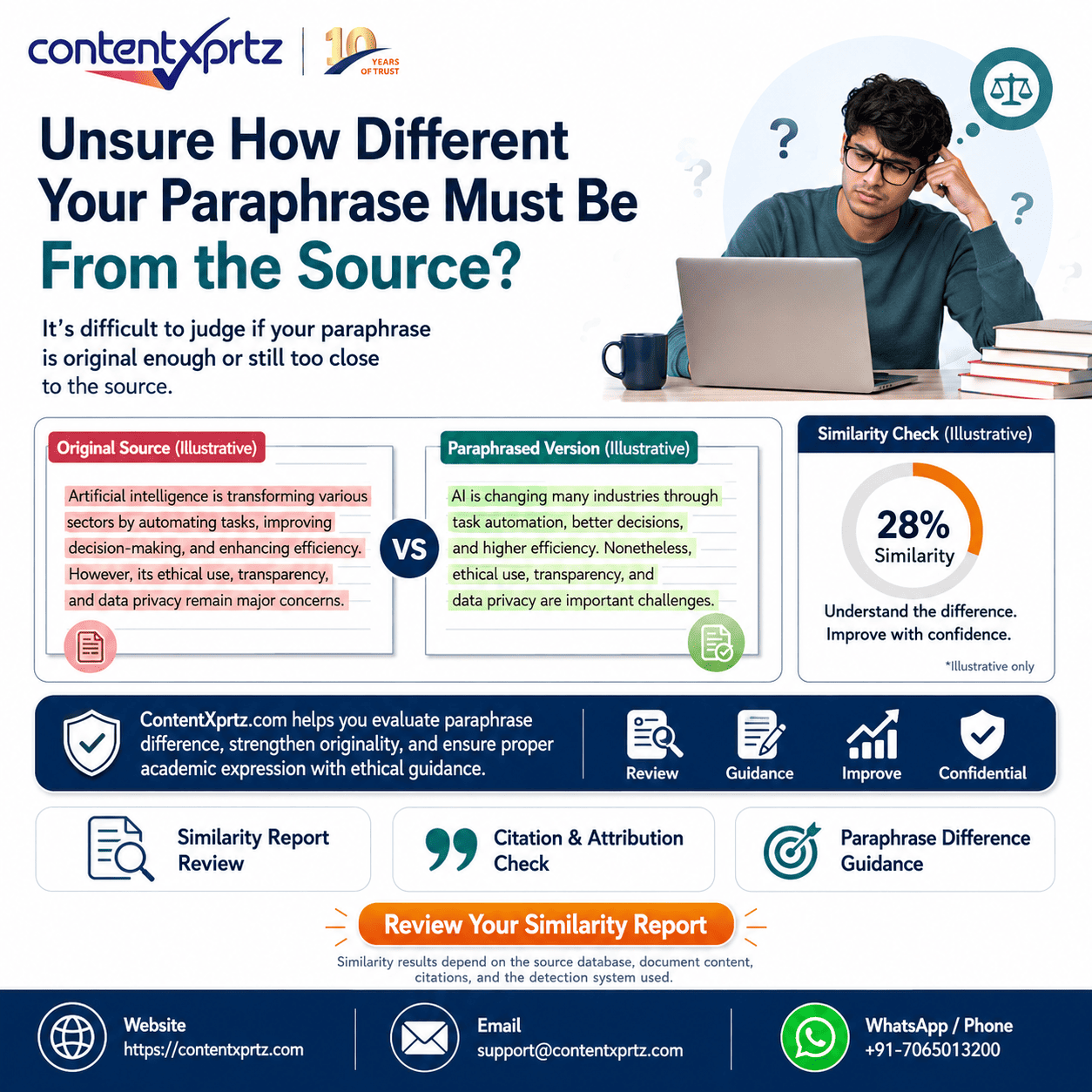
Explain the source’s specific point in a genuinely new sentence structure and vocabulary. Keep technical terms that cannot be replaced without distortion, but do not preserve the source’s sequence of clauses. Add a citation because the idea is borrowed. Purdue OWL’s paraphrasing guidance is a useful teaching resource for this distinction.
Summary
Condense the main contribution of a longer source or group of sources. A summary should be selective and proportionate to your purpose. Cite the source or sources, and avoid implying that a broad conclusion came from one article when it reflects a larger evidence base.
Synthesis
Combine sources around a question, pattern, disagreement, or method. Synthesis is not simply placing several citations after a sentence. It explains relationships: where studies converge, why they differ, what evidence is stronger, and what gap remains.
Secondary citation
Whenever possible, read and cite the original work. If the original is unavailable and the citation style permits secondary citation, make it clear that you encountered the idea through another source. Never list the original source as though you consulted it directly.
| Method | Use it when | Required action | Common risk |
|---|---|---|---|
| Quotation | Exact wording has analytical value | Copy accurately, mark as quotation, cite and locate | Quoting without analysis or missing quotation marks |
| Paraphrase | A specific idea matters more than wording | Rewrite from understanding and cite | Synonym substitution or copied sentence structure |
| Summary | A broad contribution or pattern is relevant | Condense fairly and cite | Oversimplifying or attributing too broadly |
| Synthesis | Several sources must be compared | Explain relationships and cite each contribution | Creating a citation list without analysis |
| Adaptation | A figure, table, model, or instrument is modified | Credit the source and check permission or licence | Treating modification as original ownership |
How Similarity Reports and Plagiarism-Checking Tools Should Be Used
Text-matching tools are useful for locating overlap, but they should support editorial judgement rather than replace it. The report shows where a document resembles material in the system’s database. It may not include every source, and it cannot know why the match exists.
Review the location, not only the percentage
A long uncited match in the discussion section is more important than many small matches in a reference list. Examine the context, source, length, and attribution of each substantial match. A document-wide percentage can hide these differences.
Distinguish legitimate and problematic overlap
Legitimate overlap may include quoted passages, titles, references, standard terminology, ethics statements, or required methods language. Problematic overlap may include copied analysis, missing quotation marks, patchwriting, duplicated results, or undisclosed reuse from a previous submission.
Do not chase a universal threshold
Universities and journals configure reports differently. Some exclude quotations, bibliographies, or small matches; others review all overlap. No single percentage proves that a paper is safe. The document must be assessed according to the applicable policy and the nature of the matches.
Avoid manipulation
Changing random words, inserting hidden characters, translating text back and forth, deleting legitimate citations, or using “humanising” software to reduce similarity undermines the purpose of academic review. The correct remedy is transparent source use and genuine rewriting from understanding.
Ethical Academic Editing, AI Use, and Author Responsibility
Ethical support improves communication without transferring authorship. Editors, proofreaders, supervisors, and tools may identify problems, explain conventions, and improve clarity, but the author must retain responsibility for the ideas, evidence, argument, data, and final decisions.
For students, permitted help may depend on whether the work is formative, assessed, or part of a thesis examination. For journal authors, disclosure requirements may depend on publisher policy and the extent of assistance. Check instructions before substantial rewriting, translation, or AI use.
Appropriate editing support
- Flagging passages that are too close to a source
- Checking quotation marks, in-text citations, and reference consistency
- Improving grammar, flow, transitions, and academic tone
- Explaining why a paraphrase is insufficiently independent
- Identifying unsupported claims or unclear source boundaries
- Checking that figures, tables, and adapted material are credited
Inappropriate assistance
- Writing assessed content that the author is required to create independently
- Inventing references, data, quotations, or results
- Concealing ghost authorship or unapproved collaboration
- Manipulating text solely to evade similarity detection
- Promising guaranteed originality, acceptance, grades, or institutional approval
AI tools require the same caution. They may generate fluent but inaccurate content, invent citations, reproduce familiar phrases, or obscure the writer’s contribution. Authors should verify outputs, protect confidential material, retain records where required, and follow current institutional or publisher rules. The ICMJE recommendations illustrate why authors must check current guidance rather than assume one rule applies everywhere.
Common Plagiarism Mistakes to Avoid
Most preventable problems begin before the final draft. The following mistakes are common because they appear efficient in the moment but create uncertainty later.
- Pasting source text into a draft without quotation markers. Months later, the wording can look like your own notes.
- Citing only at the end of a long paragraph. The reader cannot tell which sentences the source supports.
- Changing a few words and calling it a paraphrase. Sentence structure and distinctive phrasing may still be copied.
- Assuming online material is free to reuse. Public accessibility does not remove attribution or permission requirements.
- Citing a source you did not read. Secondary citations can distort context and create inaccurate references.
- Reusing a previous paper without permission. Ownership of the words does not automatically make reuse acceptable in a new assessment.
- Treating a low similarity score as proof of originality. Idea plagiarism and fabricated citations may not produce matches.
- Removing references to lower similarity. Accurate citation is part of the solution, not the problem.
- Using a paraphrasing tool without checking meaning. Automated rewriting can introduce errors while leaving the source structure intact.
- Waiting until submission day. Complex source problems need time to revisit originals and rebuild paragraphs.
Practical Examples: Plagiarism Risks in Real Academic Work
Example 1: A PhD scholar preparing a literature-review chapter
Situation: A doctoral researcher has collected articles for three years and copied useful passages into a chapter-development file. During final drafting, some quotation marks and page numbers are missing.
Common mistake: The scholar rewrites the passages by changing several words and keeps the citations, assuming the result is a paraphrase.
Correct approach: Return to each original source, identify the exact claim being used, write the point from understanding, and compare the new version with the original. Use direct quotation where wording is essential and add precise citations. Rebuild paragraphs around synthesis rather than one-source paraphrases.
How ethical guidance helps: A thesis editor can flag patchwriting patterns, improve transitions, and check citation consistency, while the scholar verifies sources and retains responsibility for the analysis. Relevant thesis support should remain educational and policy-compliant.
Example 2: A first-time journal author reusing a conference paper
Situation: A researcher expands a conference paper into a journal manuscript using the same dataset, methods, and several paragraphs of background text.
Common mistake: The author assumes that self-authored text can be reused freely and does not mention the conference version in the cover letter or manuscript.
Correct approach: Check the journal’s prior-publication policy, cite the conference paper where appropriate, explain how the new manuscript adds substantial value, disclose related material, and obtain permissions if the conference publisher controls the text or figures. The ICMJE and COPE materials show why transparency about overlap matters.
How ethical guidance helps: A publication specialist can review disclosure language, cross-references, and manuscript differentiation without deciding novelty or guaranteeing editorial acceptance. Contentxprtz publication support can help authors prepare transparent submission materials.
Example 3: An ESL researcher using paraphrasing and AI tools
Situation: An ESL author understands the research but uses a paraphrasing tool and generative AI to make the English sound more formal. The output includes polished sentences and several references.
Common mistake: The author assumes the output is original and copies it into the manuscript without checking the sources or the institution’s AI policy.
Correct approach: Verify every reference, compare key sentences with source material, rewrite unsupported or overly generic claims, and disclose AI assistance if required. Preserve a record of the author’s original reasoning and ensure the final wording accurately represents the research.
How ethical guidance helps: Human editing can improve language while protecting meaning and source traceability. Contentxprtz AI and human editing support should be used only within the rules governing the manuscript.
Academic Integrity and Plagiarism-Prevention Checklist
Source capture
- I recorded complete source details and relevant page or section numbers.
- I clearly marked direct quotations in my notes.
- I can distinguish source summaries from my own reflections.
Drafting
- I wrote paragraphs around my research question rather than around one source at a time.
- I cited borrowed ideas at the point where they appear.
- I used quotation marks or block formatting for exact wording.
- My paraphrases use new sentence structures and preserve the source’s meaning.
- I added analysis that explains why each source matters.
Non-text material
- I credited tables, figures, images, instruments, datasets, code, and translations.
- I checked licence and permission requirements where necessary.
- I disclosed related papers, preprints, or prior assessed work when required.
Final verification
- Every in-text citation has a matching reference entry, and every reference is authentic.
- I reviewed significant similarity matches manually rather than relying on the total score.
- I checked the current university, course, journal, and AI-use policies.
- I can explain and defend the final wording, evidence, and argument as my own work.
How Contentxprtz Can Help With Plagiarism-Risk Reduction
Contentxprtz supports authors who understand their subject but need help making source use, language, and attribution clearer. The aim is not to disguise borrowed material or produce assessed work on the author’s behalf. The aim is to identify risk, explain the problem, and improve the manuscript within ethical academic boundaries.
Depending on the document and institutional rules, relevant support may include reviewing paraphrases, flagging unattributed overlap, checking citation placement, improving quotation integration, aligning references with the required style, editing ESL academic language, and reviewing consistency across a thesis or manuscript. Authors who need wider document development can also use research support or proofreading services when those services match the actual problem.
Contentxprtz does not guarantee a particular similarity percentage, journal decision, grade, or university outcome. Originality depends on authentic authorship, correct source use, accurate citations, and compliance with the relevant policy.
Summary: What Plagiarism Is
Plagiarism is misleading use of another person’s intellectual contribution without appropriate acknowledgement. It can involve exact words, ideas, data, structure, methods, visuals, translations, code, or earlier work. It may be intentional or accidental, but responsible writers prevent it through traceable notes, genuine paraphrasing, accurate quotation, clear citation, transparent disclosure, and careful final review.
Similarity tools can reveal matching text, but they cannot replace academic judgement. A percentage must be interpreted in context, and a low score does not prove originality. Writers should focus on intellectual ownership and reader traceability rather than on software targets.
Self-service support is often enough for routine citation and quotation corrections. Expert-assisted academic editing becomes useful when a thesis, dissertation, or manuscript contains extensive patchwriting, unclear source boundaries, complex prior-work overlap, ESL language challenges, or uncertain AI-generated material. In every case, the author remains responsible for the final work.
Frequently Asked Questions
What plagiarism is in simple academic terms?
Plagiarism is presenting another person’s words, ideas, data, structure, images, methods, or other intellectual contribution as though it were your own, without appropriate acknowledgement. In academic work, the problem is not limited to copying full sentences. It can also occur when a writer closely follows a source’s reasoning, translates material without credit, reuses a table or figure without permission where required, or paraphrases so lightly that the source remains recognisable while the citation is missing. The central issue is misleading the reader about authorship or contribution. A useful working test is to ask whether a reasonable reader could identify which parts came from you and which came from a source. If that boundary is unclear, attribution needs improvement. Citation alone may not be enough when wording is copied; quotation marks or block-quote formatting may also be required. Standards vary by institution, discipline, assignment, and journal, so writers should check the applicable policy. The safest practice is to keep careful source notes, write from understanding rather than from the source sentence, cite ideas as well as words, and verify every quotation, paraphrase, figure, and reference before submission.
Is plagiarism always intentional?
No. Plagiarism can be deliberate, careless, or caused by incomplete understanding of academic conventions. Deliberate cases may include purchasing an assignment, copying text without attribution, inventing a false citation, or presenting a colleague’s analysis as one’s own. Unintentional cases often arise when a writer loses track of notes, omits a citation during revision, paraphrases by changing only a few words, misunderstands what counts as common knowledge, or imports inaccurate references from a digital tool. Intention can affect how an institution evaluates a case, but the submitted work may still contain plagiarism even when the writer did not plan to deceive. That is why prevention should focus on process rather than on last-minute detection. Separate direct quotations from paraphrase notes, record page numbers while reading, place citations during drafting, and use a consistent reference manager or source log. Before submission, compare key passages with the originals and check that borrowed ideas are attributed. Students should also review the course or university policy because procedures and consequences differ. Seeking clarification before submission is usually safer than assuming that an uncited passage will be treated as an innocent mistake.
What is the difference between plagiarism and a similarity score?
A similarity score reports text overlap detected between a document and material in a comparison database; it does not, by itself, decide whether plagiarism has occurred. A properly quoted definition, a reference list, a standard methods phrase, a title, or a correctly cited passage can increase similarity without being unethical. Conversely, an idea can be plagiarised even when the wording has been changed enough to avoid text matching. The percentage therefore needs human interpretation. Review where the matches occur, how long they are, whether quotation marks are used, whether the correct source is cited, and whether the borrowed wording is necessary. Also check whether the tool has matched your own previously submitted work, a preprint, a repository version, or boilerplate language. There is no universal “safe” percentage that applies to every university, journal, or discipline. A low score is not proof of originality, and a high score is not automatic proof of misconduct. Treat the report as a diagnostic aid. Correct the underlying writing and citation issues rather than trying to manipulate the number by changing random words, removing legitimate references, or using artificial text-spinning techniques.
Can paraphrasing still be plagiarism?
Yes. A paraphrase can be plagiarism when it reproduces a source’s idea, sequence, distinctive phrasing, or analytical structure without clear attribution. Replacing a few words with synonyms, changing active voice to passive voice, or rearranging clauses does not create independent writing. Effective paraphrasing begins with comprehension: read the source, close it, explain the relevant idea in your own conceptual framework, and then compare your version with the original. The result should use your sentence structure and vocabulary while preserving the source’s meaning accurately. A citation is still required because the underlying idea came from another author. When a phrase is distinctive or cannot be rewritten without loss of precision, quote it directly and provide the required page or locator information under the applicable style. Writers should also avoid “patchwriting,” in which fragments from the source are stitched together with minor edits. Patchwriting may occur during language learning, but it still needs revision before submission. The goal is not to hide textual similarity; it is to show genuine understanding, distinguish your contribution, and allow the reader to trace the source.
What is self-plagiarism or text recycling?
Self-plagiarism is a broad label often used when authors reuse their own previously submitted or published material without sufficient disclosure, citation, or permission. More precise terms include text recycling, duplicate submission, redundant publication, and reuse of previously assessed work. The ethical concern is that readers, instructors, editors, or reviewers may be misled into believing the material is new. Reusing a paper for another course without permission can violate academic rules even though the writer owns the words. In publishing, submitting the same manuscript to two journals, republishing substantially overlapping results without transparent cross-reference, or dividing one study into minimally different papers may create serious concerns. Some limited reuse may be acceptable, especially for standard methods language, protocol descriptions, translations, or authorised secondary publication, but the rules vary. Authors should cite earlier work, disclose related manuscripts, obtain permissions when necessary, and follow the target journal’s guidance. Students should ask the instructor before reusing prior coursework. The key principle is transparency: disclose the relationship between the new document and the earlier material so the evaluator can judge whether the reuse is appropriate.
Do common knowledge facts need a citation?
Common knowledge usually does not require citation, but deciding what counts as common knowledge depends on the audience, discipline, and context. A fact may be common knowledge when it is widely known, easily verified in many independent sources, and not associated with a particular researcher’s original interpretation. For example, a broadly known historical date may not need citation in a general essay. By contrast, a specialised statistic, a disputed claim, a recent finding, a theory, a unique definition, or an interpretation developed by a particular scholar should be cited. Course-specific knowledge can also be tricky: something familiar to experts in a field may be new to students and still benefit from a source. When several sources use the same basic fact, you should still cite a reliable source if the fact is central, precise, surprising, or likely to be challenged. Do not use “common knowledge” as a reason to omit attribution for a source’s distinctive wording or analysis. When uncertain, cite. A well-chosen citation improves traceability and usually creates less risk than an unsupported claim, provided the citation genuinely supports the statement.
How can I avoid plagiarism in a thesis or research paper?
Avoiding plagiarism in a thesis or research paper requires a traceable research and drafting workflow. Start by recording complete source details and page numbers as soon as you read. In your notes, visibly separate direct quotations, paraphrases, summaries, your own reflections, and data extracted from a source. Draft sections from an outline and your understanding rather than copying sentences into the manuscript and rewriting them later. Add citations while drafting, not at the end. For each paragraph, identify which claims are yours, which are supported by evidence, and which come from another author’s theory or method. Use quotation marks for exact wording and paraphrase only after you understand the source. Check tables, figures, images, instruments, code, translations, and appendices because attribution requirements extend beyond prose. Before submission, run a manual source audit and, where permitted, review a similarity report as one diagnostic tool. Finally, verify the university’s thesis policy, the required citation style, and any disclosure rules for editing or AI assistance. Ethical academic editing can improve clarity and citation consistency, but the researcher remains responsible for ideas, evidence, analysis, references, and the final document.
Can AI-generated text create plagiarism or academic integrity problems?
Yes. AI-generated text can create plagiarism and broader academic integrity problems even when the output does not exactly match a published source. A system may reproduce familiar phrasing, generate unsupported claims, invent references, blur the boundary between the user’s contribution and machine-generated material, or produce text that violates an institution’s authorship rules. Whether AI use is permitted depends on the assignment, university, funder, publisher, journal, and type of assistance. Writers should not assume that an AI tool’s output is original, accurate, confidential, or properly cited. Verify every factual statement and reference against authentic sources, keep a record of how the tool was used, and disclose assistance when required. Do not ask a system to conceal copying, fabricate citations, or rewrite material solely to evade detection. Use AI, where allowed, for bounded support such as brainstorming questions, testing clarity, or identifying areas that need revision, while retaining human responsibility for the argument and evidence. For journal manuscripts, check the current author instructions and relevant publication-ethics guidance because policies continue to evolve.
What should I do if my similarity report is high?
First, do not panic and do not edit only to lower the percentage. Open the report and classify the matches. Some may be legitimate references, titles, standard terminology, properly quoted text, or required methods language. Others may reveal missing quotation marks, incomplete citations, patchwriting, overreliance on one source, duplicated material from your own earlier work, or copied tables and captions. Prioritise long or repeated matches and passages that carry substantive ideas. Return to the original source, decide whether the passage should be quoted, paraphrased, summarised, or removed, and cite it correctly. Rewrite from understanding rather than substituting synonyms. Check whether exclusions for references, quotations, or small matches are appropriate under the institution’s settings, but do not use exclusions to hide real problems. If the report matches a preprint, repository copy, or your previously submitted draft, document that context and ask the supervisor or editor how it should be handled. Because institutions interpret reports differently, seek guidance before submission when the matches are complex. A revised manuscript should be clearer about intellectual ownership, not merely lower in numerical similarity.
When can professional editing help without compromising authorship?
Professional editing can help when the service improves language, organisation, citation consistency, and clarity while preserving the author’s ideas, evidence, analysis, and decisions. Appropriate support may include identifying passages that are too close to a source, flagging missing citations, checking quotation formatting, reviewing reference consistency, improving transitions, and explaining why a paraphrase remains dependent on the original wording. An ethical editor should not invent data, create unsupported arguments, fabricate references, write assessed work that the student is expected to produce independently, or promise to “remove plagiarism” automatically. The author should review every change, verify every citation, and remain able to explain the final text. University and journal policies may require disclosure of substantial editing, translation, or AI-assisted work, so check those rules before commissioning support. Contentxprtz can provide plagiarism-risk reduction guidance, academic editing, and proofreading that focus on clarity and attribution, but the responsibility for originality, source use, research claims, and final submission remains with the author. The safest engagement is transparent, educational, and limited to assistance that the relevant institution or publisher permits.
Conclusion: Build Original Work Through Transparent Source Use
Understanding what plagiarism is gives academic writers a practical way to protect both originality and credibility. The central task is not to avoid sources; it is to use them honestly. Quotations should be marked, paraphrases should reflect real understanding, ideas should be credited, prior work should be disclosed, and every reference should be authentic and traceable.
Free guidance, library resources, citation manuals, and careful self-review are often sufficient for straightforward documents. When a thesis or manuscript has complex overlap, inconsistent citations, patchwriting, language barriers, or uncertain AI-assisted text, ethical expert review can provide a safer, more educational path. Contentxprtz helps improve clarity, structure, attribution, and publication readiness while preserving the author’s ideas and responsibility.
Academic integrity matters because readers must be able to trust who contributed what. A well-attributed document does more than avoid misconduct; it shows how the author has read, evaluated, and added to the scholarly conversation.
Need a Careful Plagiarism-Risk Review?
Get ethical guidance on paraphrasing, citation consistency, source integration, and academic clarity without replacing your authorship.
“At Contentxprtz, we don’t just edit; we help ideas reach their fullest potential.”